Unit Test (Solutions): Triangles

Time: 1 hour
M.M. 30
Attempt all questions.
Question numbers 1 to 5 carry 1 mark each.
Question numbers 6 to 8 carry 2 marks each.
Question numbers 9 to 10 carry 3 marks each.
Question number 11 carries 4 marks.
Question numbers 12 & 13 carry 5 marks each.
Q1. What does CPCT stand for in the context of congruent triangles? (1 Mark)
(a) Corresponding Parts of Congruent Triangles
(b) Congruent Parts of Corresponding Triangles
(c) Common Parts of Congruent Triangles
(d) Corresponding Points of Congruent Triangles
Ans: (a)
Sol: CPCT stands for "Corresponding Parts of Congruent Triangles." It means that if two triangles are congruent, then their corresponding sides and angles are equal in measure
Q2. If two triangles have all three angles equal, are they congruent? (1 Mark)
(a) Always congruent
(b) Never congruent
(c) Congruent if one side is equal
(d) Not necessarily congruent
Ans: (d)
Sol: Equal angles mean the triangles are similar (same shape), but not necessarily congruent (same shape and size). Triangles may differ in size even if all angles are equal.
Q3. In a triangle, if two sides are equal, what can be said about the angles opposite to them? (1 Mark)
(a) They are unequal
(b) They are equal
(c) They are supplementary
(d) They are complementary
Ans: (b)
Sol: In an isosceles triangle, the sides opposite to equal sides are also equal in measure.
So, if two sides of a triangle are equal, the angles opposite those sides will also be equal.
This is a property of isosceles triangles.
Q4. Which congruence rule applies if two sides and the included angle of one triangle are equal to two sides and the included angle of another triangle? (1 Mark)
(a) SSS
(b) SAS
(c) ASA
(d) RHS
Ans: (b)
Sol: SAS (Side-Angle-Side) congruence rule applies when two sides and the angle included between them are equal in two triangles.
Q5. In a right-angled triangle, if the hypotenuse and one side are equal to the hypotenuse and one side of another triangle, which congruence rule applies? (1 Mark)
(a) SSS
(b) SAS
(c) ASA
(d) RHS
Ans: (d)
Sol: RHS (Right angle-Hypotenuse-Side) congruence rule is used when the hypotenuse and one side of two right-angled triangles are equal.
Q6. In triangle ABC, if AB = AC and angle B = 50°, what is the measure of angle C? (2 Marks)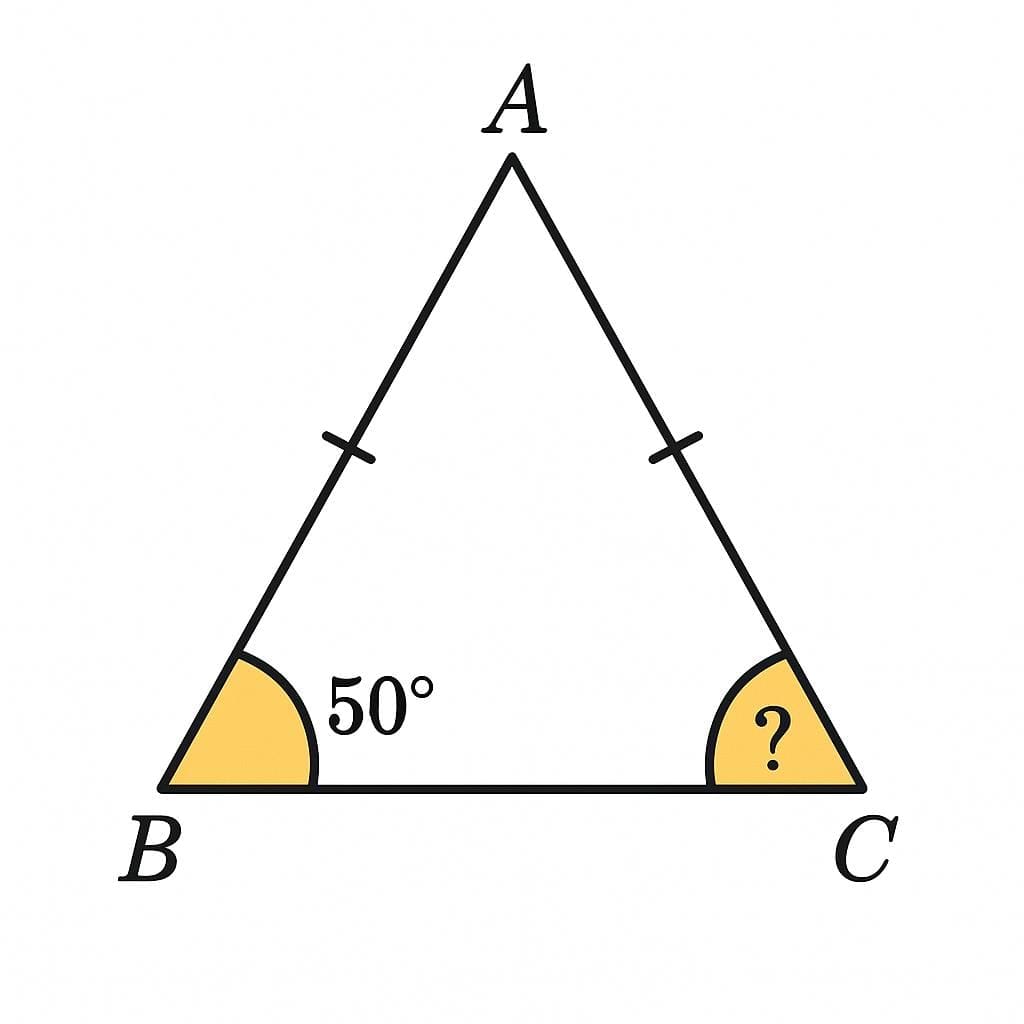
Ans: Since AB = AC, triangle ABC is isosceles.
Therefore, ∠B = ∠C = 50°.
Q7. In triangle ABC, if AD is the perpendicular bisector of BC, prove that AB = AC. (2 Marks)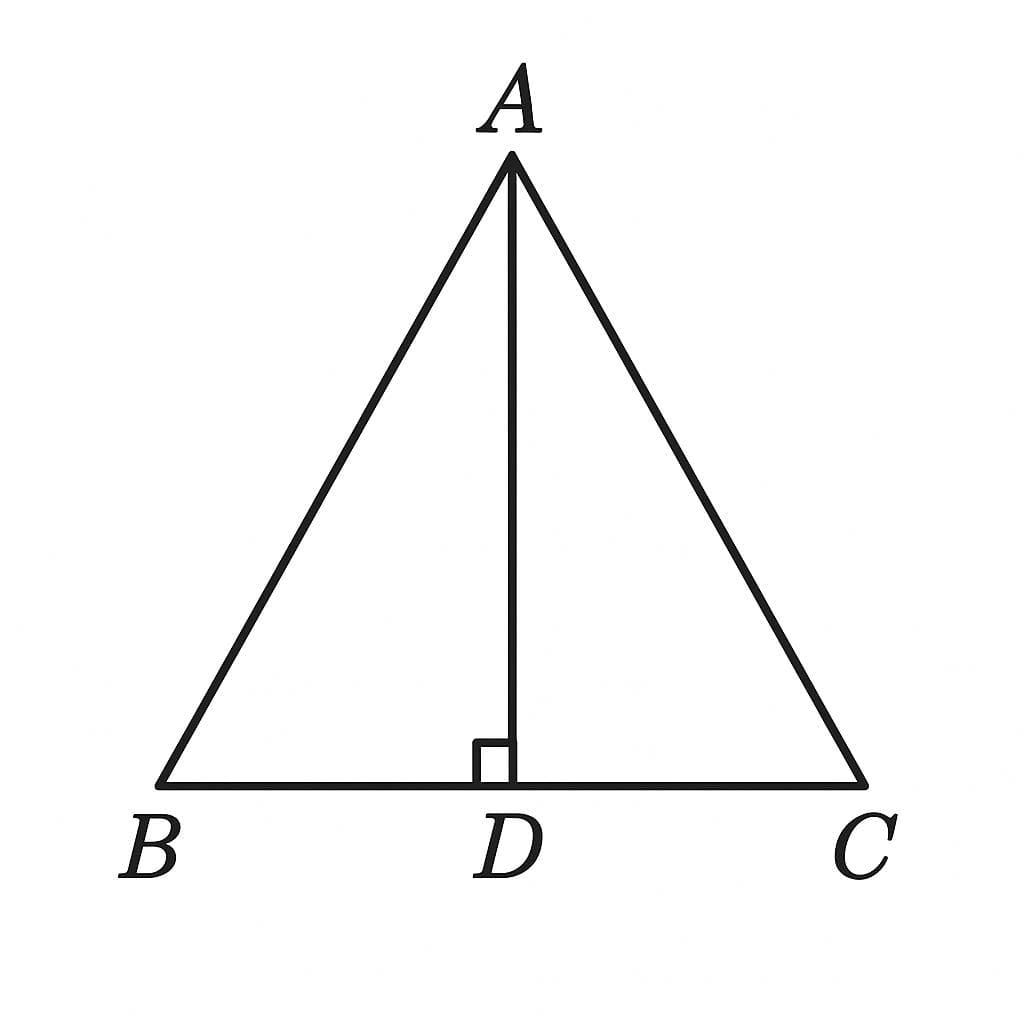
Ans: In triangles ABD and ACD:
- AD = AD (common)
- Angle ADB = angle ADC = 90° (AD is perpendicular to BC)
- BD = DC (AD is the bisector of BC)
By RHS congruence rule, triangle ABD ≅ triangle ACD.
Thus, AB = AC (CPCT).
Q8. If AD = BC and ∠ BAD = ∠ ABC, then ∠ ACB is equal to (2 Marks)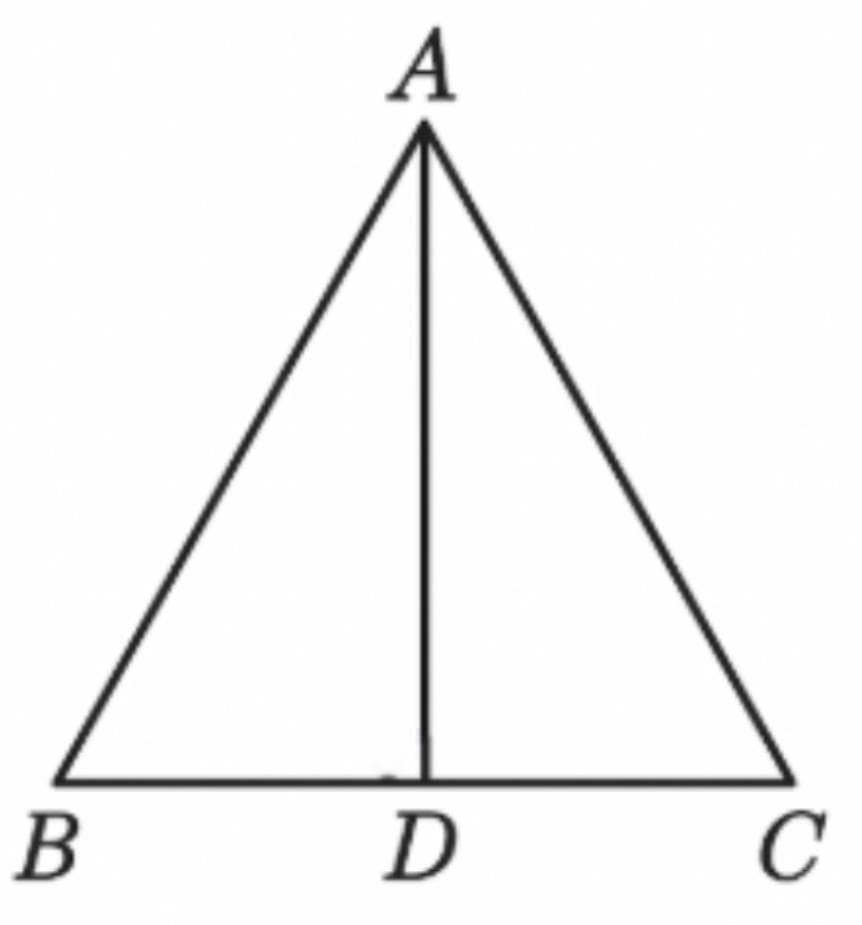
Ans: In △ABC and △ABD,
AD =BC (given)
∠ BAD = ∠ ABC (Given)
AB = AB (Common side)
∴ △ABC ≅ △ABD
By CPCT theorem, ∠ACB=∠ADB ( By SAS Congruency )
Q9. In △ABC, AB=AC. Points E and F are the midpoints of AB and AC respectively. Prove that BF = CE. (3 Marks)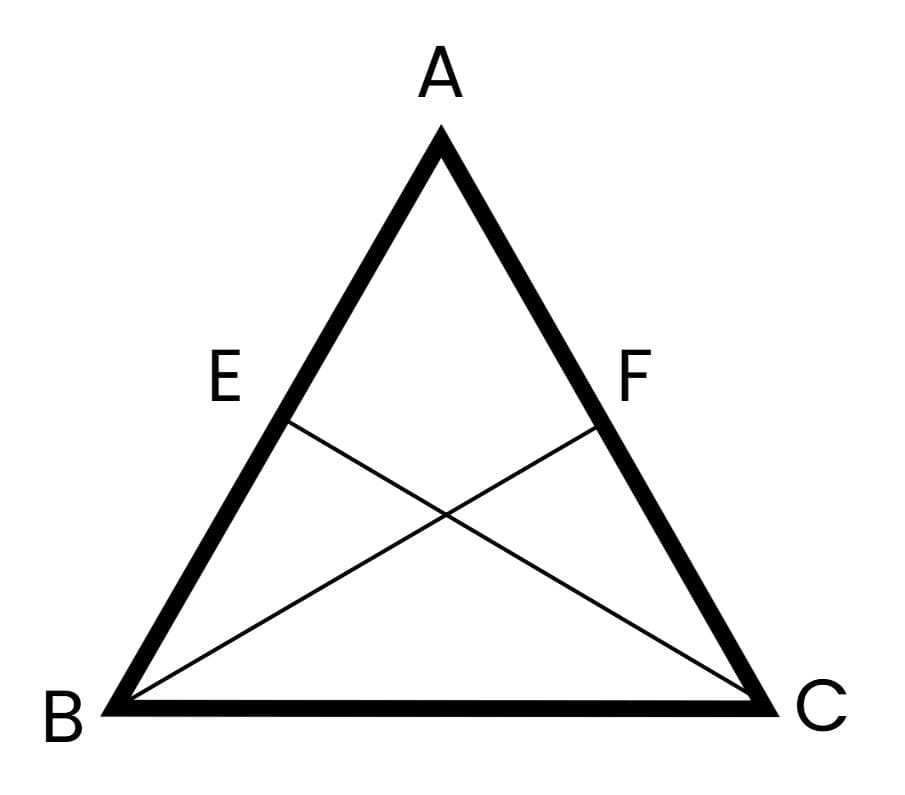
Ans: Given:
AB = AC
E and F are midpoints.
⇒ AE = AF = (1/2)ABIn △ABF and △ACE:
- AB = AC (Given)
- ∠A = ∠A (Common angle)
- AF = AE (From midpoint property)
By SAS Congruence Rule: △ABF ≅ △ACE
Therefore, BF = CE (By CPCT)
Q10. Show that in a right-angled triangle, the hypotenuse is the longest side. (3 Marks)
Ans: We suppose that ABC be a right-angled triangle, ∠ B =90°.
To prove: Hypotenuse AC is the longest side.
Proof:
∠A + ∠B + ∠C = ∠A + 90° + ∠C = [∠B = 90° ]
∠A + ∠C = 180° - 90°
And ∠B = 90°
∠B > ∠C and ∠B > ∠A
Since the greater angle has a side longer as opposed to it.
AC > AB and AC > BC
Therefore, ∠B being the greatest angle, has the longest opposite side AC, i.e. hypotenuse.
Q11. John recently read a Mathematics experiment. He was keen to perform it on its own. He chose a long building whose height he want to know, he placed a mirror at ground. He is standing at some distance to the building as well as mirror. John height is 5 m and the distance of John from mirror is 12 m and distance of building from mirror is also 12 m and its height 5 m.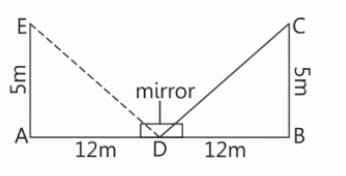
On the basis of the above information, solve the following questions.
(a) Write two congruent triangles formed in the given figure.
(b) Find the distance between top of building and mirror.
(c) Find the area of △AED.
(d) In the given figures, find the measure of ∠B′A′C′.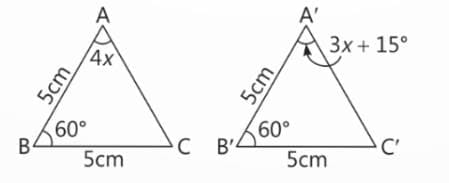
Ans:
(a) In ΔAED and ΔBCD,
AD = BD = 12 m
AE = BC = 5 m
and ∠A = ∠B = 90°
∴ ΔAED ≅ ΔBCD [By SAS rule]
(b) In right angled ΔEAD, use Pythagoras theorem,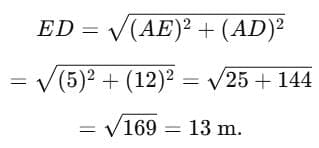
Hence, the distance between top of building and mirror is 13 m.
(c) 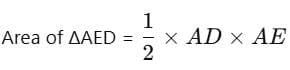
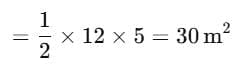
(d) In ΔABC and ΔA′B′C′,
AB = A′B′ = 5 cm [Given]
∠B = ∠B′ = 60° [Given]
and BC = B′C′ = 5 cm
∴ ΔABC ≅ ΔA′B′C′ [By SAS congruence]
By CPCT,
∠BAC = ∠B′A′C′
4x = 3x + 15°
⇒ x = 15°
∴ ∠B′A′C′ = 3x + 15°
= 3 × 15° + 15°
= 45° + 15° = 60° [∴ x = 15°]
Q12. AD and BC are equal perpendiculars to a line segment AB. Show that CD bisects AB. (5 Marks)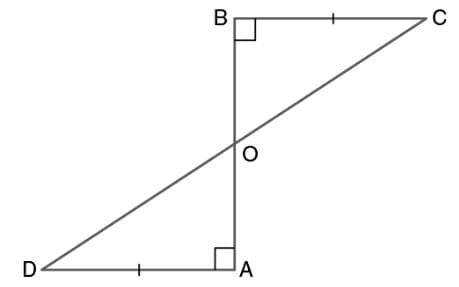
Ans: Given, AD and BC are two equal perpendiculars to AB.
To Prove: CD is the bisector of AB
Proof:
Triangles ΔAOD and ΔBOC are similar by AAS congruency
Since:
(i) ∠A = ∠B (perpendicular angles)
(ii) AD = BC (given)
(iii) ∠ADO = ∠BOC (vertically opposite angles)
∴ ΔAOD ≅ ΔBOC.
So, AO = OB ( by CPCT).
Thus, CD bisects AB (Hence proved).
Q13. AB is a line segment, and P is its midpoint. D and E are points on the same side of AB such that ∠BAD = ∠ABE and ∠EPA = ∠DPB. Show that (5 Marks)
(i) ΔDAP ≅ ΔEBP
(ii) AD = BE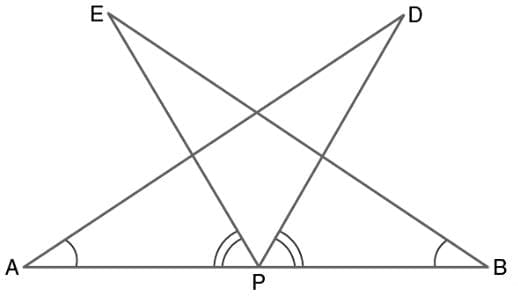
Ans: Given, P is the mid-point of line segment AB.
Also, ∠BAD = ∠ABE and ∠EPA = ∠DPB
(i) Given, ∠EPA = ∠DPB
Now, add ∠DPE on both sides,
∠EPA + ∠DPE = ∠DPB + ∠DPE
This implies that angles DPA and EPB are equal
i.e. ∠DPA = ∠EPB
Now, consider the triangles DAP and EBP.
∠DPA = ∠EPB
AP = BP (Since P is the mid-point of the line segment AB)
∠BAD = ∠ABE (given)
So, by ASA congruency criterion,
ΔDAP ≅ ΔEBP.
(ii) By the rule of CPCT,
AD = BE
FAQs on Unit Test (Solutions): Triangles
| 1. What are the different types of triangles based on their sides and angles? |  |
| 2. How can the area of a triangle be calculated? | |
| 3. What is the significance of the Pythagorean theorem in triangles? | |
| 4. What properties do similar triangles share? | |
| 5. How do you determine if two triangles are congruent? | |





