CBSE Class 8 > Class 8 Notes > English Poorvi - New NCERT > NCERT Solutions: Spectacular Wonders
NCERT Solutions: Spectacular Wonders


Let us do these activities before we read (Page 137)
I. Look at the pictures given below and sort them into natural and man-made wonders.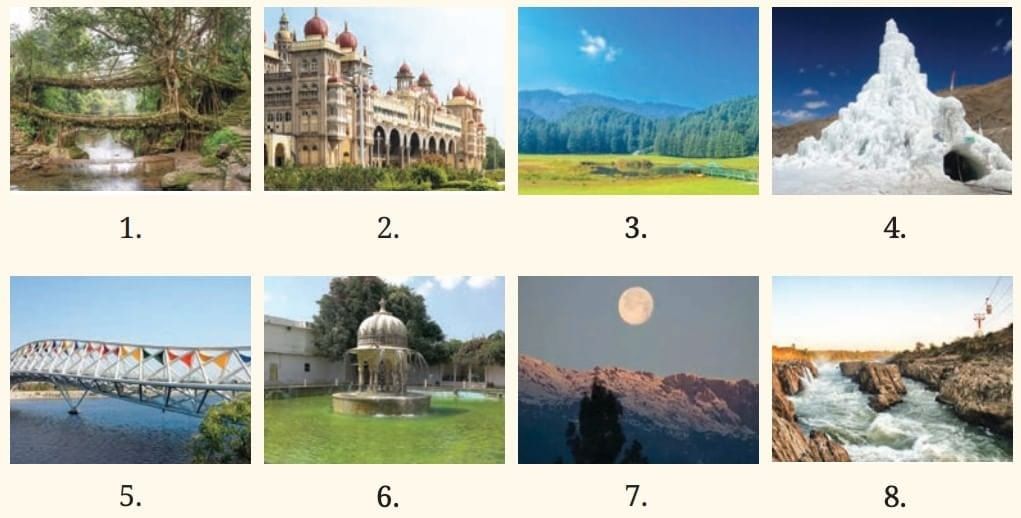
Ans: Natural Wonders
3. Dzukou Valley
4.Ice Glacier
7. Moon over the Himalayas
8. Marble Rocks with Cable Car (the marble rocks are natural; the cable car is man-made, but the site is best known for its natural beauty)
Man-made Wonders
1. Living Root Bridge
2. Mysore Palace
5. Bogibeel Bridge
6. Fountain Garden
II. Which of these wonders-man-made or natural-are more appealing and why? Share your answers with your classmates and teacher.
Ans: Natural wonders tend to be more appealing because they form without direct human intervention and often show large-scale processes of the Earth. They offer a sense of tranquillity and timeless beauty. For example, the Living Root Bridge and the Himalayas are impressive both for their appearance and for the long time over which they developed, which makes visiting them feel peaceful and refreshing.
III. Work in pairs. Write down two wonders of nature that have amazed you. Discuss what makes them impressive.
Ans: 1. The Grand Canyon (USA) - A vast valley carved by the Colorado River. Its enormous size, layered rock colours and exposed strata show how slow natural forces shape the Earth over millions of years.
2. Aurora Borealis (Northern Lights) - Colourful lights seen in polar skies, often green, pink or purple. Their shifting patterns and intensity make them look magical and rare.
What makes them impressive:
Both are entirely natural, cannot be reproduced by humans, and remind us of the scale and wonder of the natural world.
IV. Work in groups of four. Complete the web chart given below with words that you associate with the phrase, 'Nature's Power'. Share your answers with your classmates and teacher.
Ans: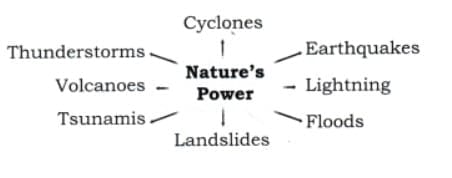
Let us discuss (Page 142)
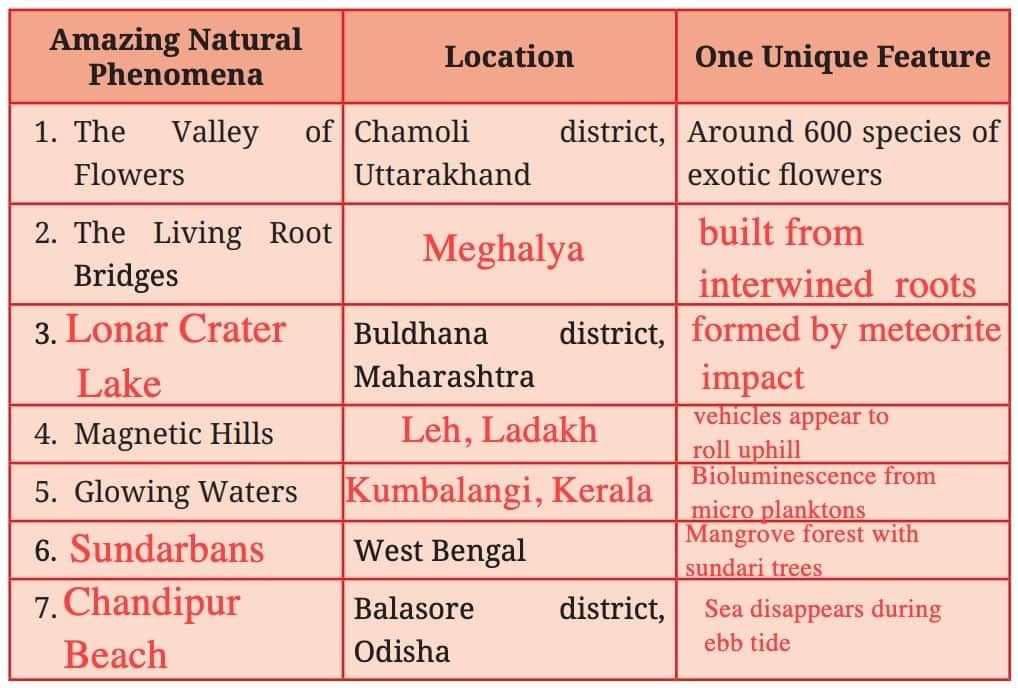
I. Complete the information in the table given below. One example has been done for you. Share your answers with your classmates and teacher.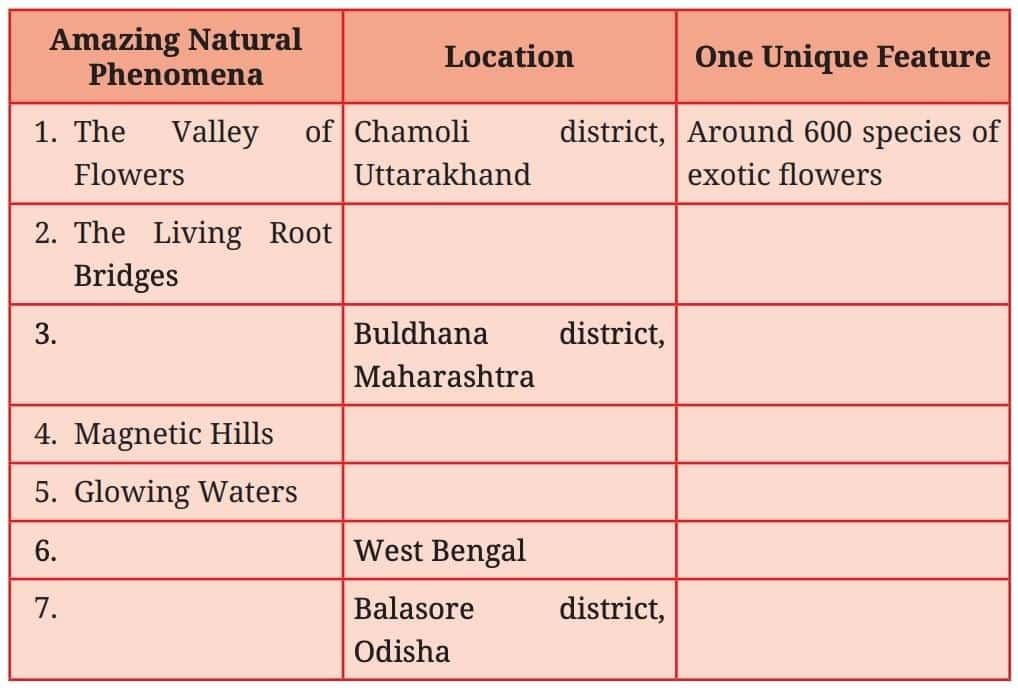
Ans:
Let us think and reflect (Page 142)
I. Read the given extracts and answer the questions that follow.
1. India is home to some of the most mystifying natural phenomena that surprise and spark our imagination.
(i) Replace the underlined phrase with one from the extract.
India is the birthplace of several rare species of flora and fauna that thrive in its diverse ecosystems.
Ans: home to
(ii) What does the phrase 'nature's unusual side' suggest about the phenomena described?
Ans: It suggests rare and surprising natural events or features that are different from everyday sights and that provoke curiosity and wonder.
(iii) Complete the similarity by choosing the correct option. spark: imagination: : ______________ : ______________.
A. inspiration; creativity
B. wonder; amazement
C. effort; reward
D. knowledge; books
Ans: (B)
Explanation: 'Spark' is used to mean 'cause a sudden feeling' as with imagination; similarly, 'wonder' causes 'amazement'. Both pairs show a trigger and the emotional response it produces, so option B is correct.
(iv) Identify whether the following statement is true or false. Some natural phenomena can surprise people.
Ans: True
Explanation: Certain natural events are uncommon or dramatic enough to astonish observers; they are not part of everyday experience and therefore can surprise people.
2. Have you seen things disappearing in front of your eyes? Well, such things happen at times, when we keep things in some place, and just forget where we have kept them. But what if there's a sea that disappears? This happens in Odisha. It is a beach in the Balasore district where one can witness the sea disappearing mysteriously-the Chandipur Beach, which is known for its unique feature of playing hide-and-seek with its visitors.
(i) Complete the following sentence with a suitable reason. The writer's most likely purpose in introducing the information about the Chandipur Beach phenomenon with a question is to____________________. (engage the reader's curiosity and create a sense of suspense/draw the reader to learn more about the unusual phenomenon/set the tone for the surprising nature of the content that follows)
Ans: engage the reader's curiosity and create a sense of suspense
(ii) Select the option that is correct for both Assertion (A) and Reason (R).
(A): Chandipur Beach in Odisha is known for its unique feature of the sea disappearing.
(R)The tides retreat drastically, exposing the Chandipur beach.
A. Both (A) and (R) are true, and (R) is the correct explanation of (A).
B. Both (A) and (R) are true, but (R) is not the correct explanation of (A).
C. (A) is true, but (R) is false.
D. (A) is false, but (R) is true
Ans: (A)
Explanation:
(i) Assertion: Chandipur Beach is famous for the sea appearing to disappear.
(ii) Reason: Strong tides at the location retreat far from the shore, exposing the seabed.
(iii) Justification: The drastic retreat of tides directly explains why the sea seems to disappear, so the reason correctly explains the assertion.
(iii) What does the term 'unique' suggest about the beach in Balasore?
A.very popular
B. one of its kind
C.ancient place
D.far from the city
Ans: (B)
Explanation: 'Unique' means one of its kind or uncommon; in this context, it indicates that the beach has a rare feature not found commonly elsewhere.
(iv) What does the writer want to convey with the use of the phrase 'playing hide-and-seek with its visitors'?
Ans: The phrase suggests that the sea alternately appears and disappears because of the pushing and pulling of tides, creating a surprising and playful effect for visitors who see the water vanish and return.
II. Answer the following questions.
1. How are the living root bridges a boon for the local people of Meghalaya?
Ans: The Living Root Bridges provide safe, durable crossings over rivers and streams, especially during heavy rains. They are grown from tree roots, require little maintenance, and last for many years. These bridges reflect local knowledge of nature and offer a sustainable solution that helps villagers move, trade and attend school even in difficult weather.
2. Why is the Lonar Crater Lake considered a remarkable and rare site?
Ans: Lonar Crater Lake is rare because it is a crater formed by a meteorite striking basaltic rock, a combination that is uncommon in India. It has a nearly perfect circular rim, saline water, and distinctive geology. It is also one of the largest such craters, which makes it an important and unusual geological feature.
3. What might be the writer's purpose of highlighting the awe-inspiring natural wonders of India?
Ans: The writer wishes to inspire appreciation for India's natural diversity, to arouse curiosity and respect for these places, and to encourage readers to learn about and protect such unique environments.
4. The writer uses descriptive language and introductory questions for some of the natural phenomena. What impact does it have on the readers?
Ans: Using vivid descriptions and questions grabs readers' attention, creates curiosity, and helps them picture the wonders clearly. This makes the information more engaging and memorable.
5. Which of these unusual phenomena did you find the most interesting and why?
Ans: I found the Glowing Waters of Kerala most interesting because tiny organisms make the water shine in blue-green light at night. The sight is beautiful and surprising, combining natural beauty with an unusual natural process which feels magical.
Let us learn (Page 144)
I. Fill in the blanks with the correct expressions from the text given in the box below.
- I have read many stories _____________________.
Ans: to name a few - Do you know when this little town _____________________?
Ans: came into existence - His hard work has helped him _____________________.
Ans: to no end - There are no simple solutions to the _____________________of traffic jams.
Ans: age-old problem - He opened the ancient wooden box and stared at the treasure_____________________.
Ans: in disbelief - The garden is _____________________ in springwith lots of beautiful flowers in bloom.
Ans: in full glory
II. Select the correct synonyms from the box given below that match the list of words in 1-5. You may refer to a thesaurus.
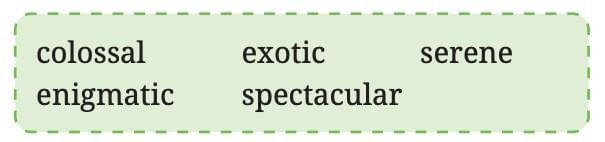
- mysterious, puzzling, baffling
- mighty, gigantic, huge.
- breath-taking, stunning, awe-inspiring.
- peaceful, calm, tranquil
- unusual, peculiar, foreign
Ans:
- mysterious, puzzling, baffling → enigmatic
- mighty, gigantic, huge → colossal
- breath-taking, stunning, awe-inspiring → spectacular
- peaceful, calm, tranquil → serene
- unusual, peculiar, foreign → exotic
III. The expressions 'hide-and-seek' and 'flora and fauna' are used in the text. These are called binomials-a pair of fixed words joined by 'and' or 'or'. The binomials are mostly synonyms, antonyms, rhyming words, same-sound words (alliterations), etc. Match the binomials in Column 1 with their meanings in Column 2. You may refer to a dictionary.
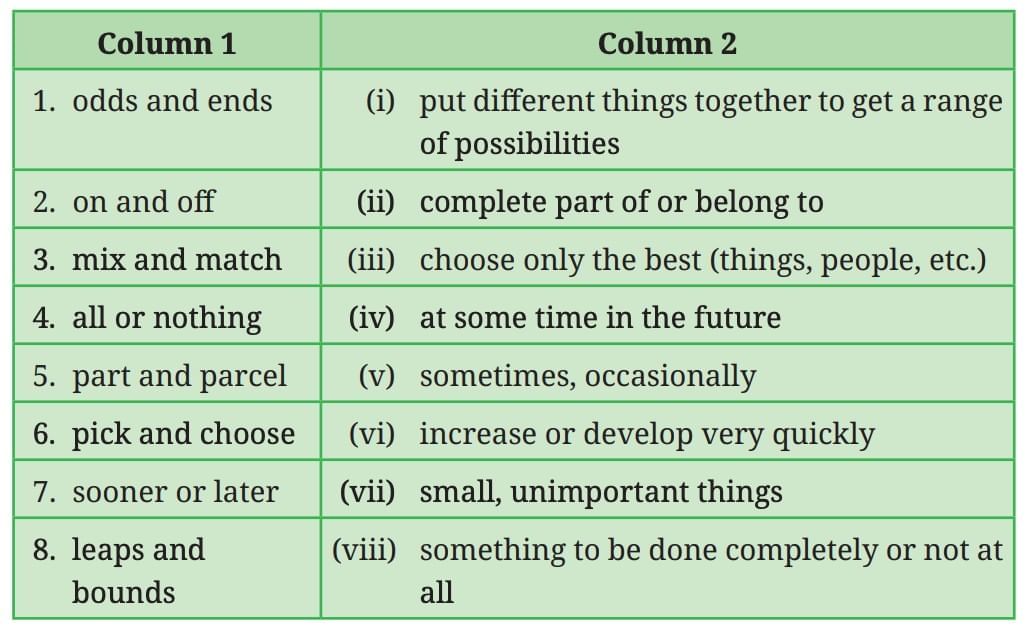
Ans: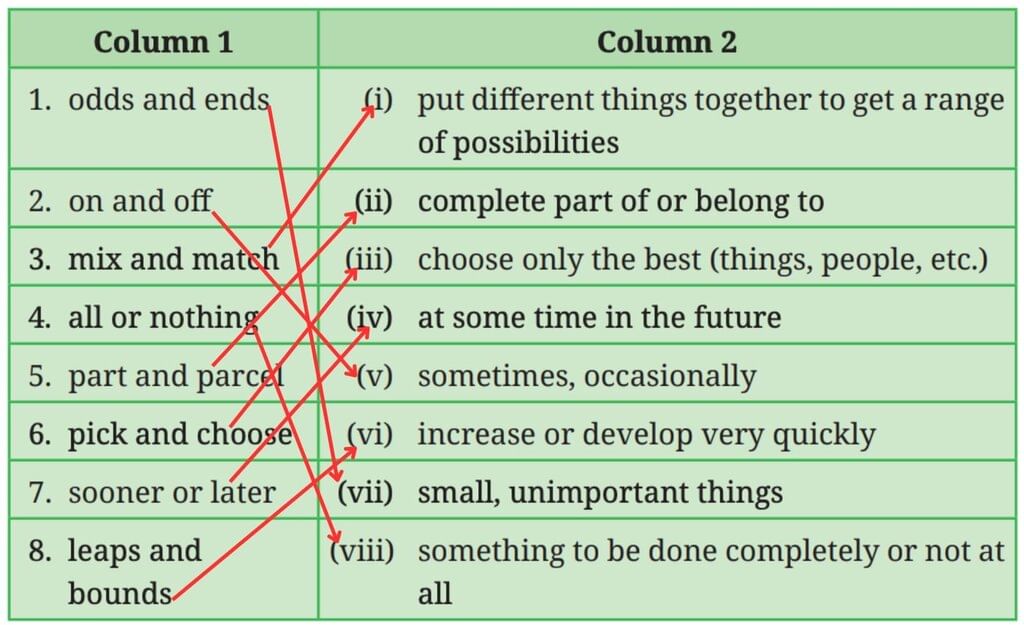
Sentences:
1. I cleaned my room and found odds and ends like old pens and buttons.
2. She visits the park on and off when she has free time.
3. I like to mix and match my clothes to create new outfits.
4. This project is all or nothing; we must finish it completely.
5. Helping others is part and parcel of being a good friend.
6. At the store, I can pick and choose the best apples.
7. Sooner or later, I'll visit the Valley of Flowers.
8. Her drawing skills improved by leaps and bounds this year.
IV. Study the highlighted words in the following sentences from the text.
- The living root bridges are one of Meghalaya's most beautiful...
- ...creating a striking visual contrast against the surrounding rugged terrain.
In the given sentences, the highlighted words 'living', 'striking', and 'rugged' are examples of verbs used as adjectives. Such verbs are called participles.
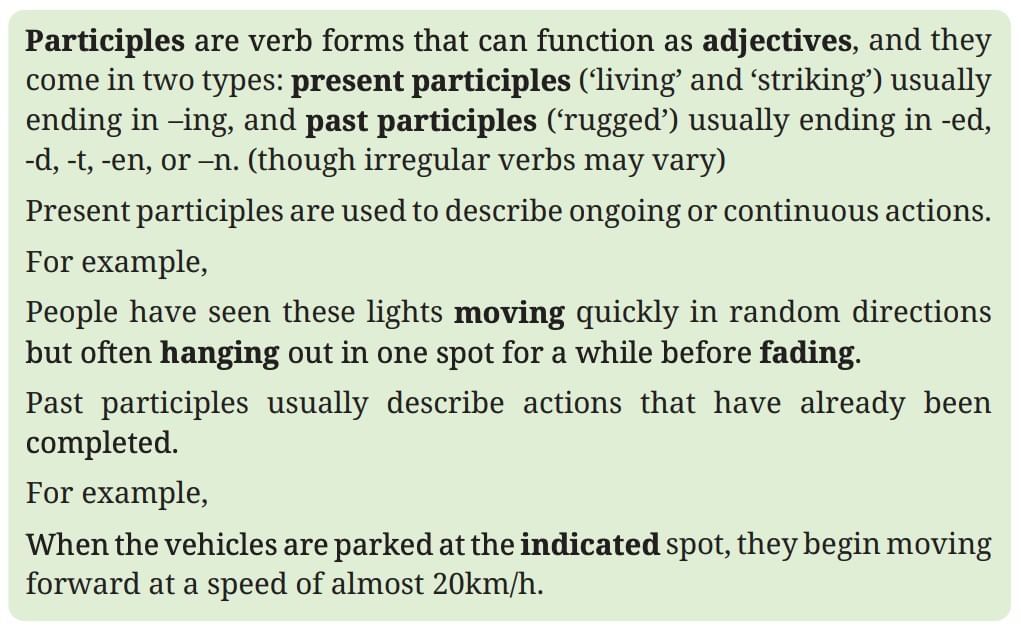
Now, fill in the blanks using the present participle or past participle form of the verbs in the box given below.

1. The _______________ marble monument looks even more spectacular inthe moonlight.
Ans: glowing
2. The _______________ view of the Himalayas from Darjeeling attracts visitors from all over the world.
Ans: amazing
3. The Sun Temple in Konark features intricately _______________ stone wheels and walls.
Ans: carved
4. _______________ at a height of 182 m, the Statue of Unity is dedicated toSardar Vallabhbhai Patel.
Ans: Standing
5. The _______________ islands of the Andaman and Nicobar offer some of the cleanest beaches in India.
Ans: scattered
V. Study the highlighted word in the following sentence from the text
Crossing the many waterways without bridges was difficult for people in the past, during monsoons. In the given sentence, the highlighted word 'crossing', is one example of a verb used as a noun. Such a verb is called a gerund.
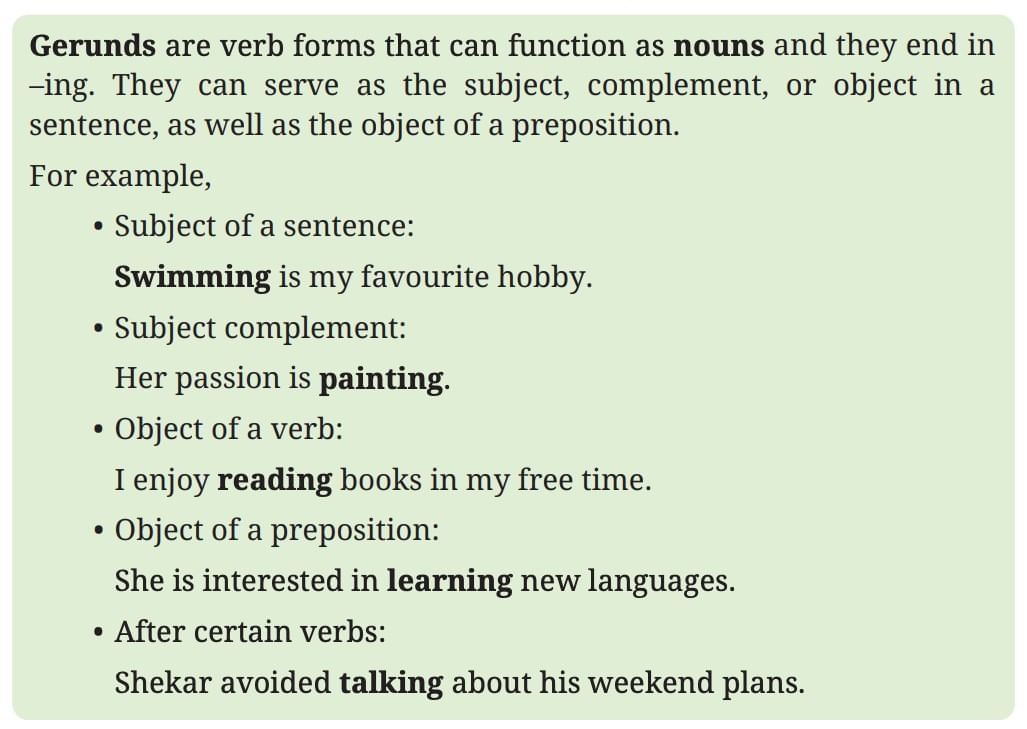
Underline the gerunds and participles in the following sentences. Write 'G' for gerunds and 'P' for participles in the space provided. One example has been done for you.
1. Dancing is a great way to express emotions. G
2. Travelling can broaden your perspective.
3. The falling leaves signalled the arrival of autumn.
4. She enjoys cooking new recipes for her family.
5. Reading helps improve your vocabulary.
6. He watched the shimmering stars in the night sky.
7. Forgetting the keys inside, Kanchan locked the door.
Ans:
1. Dancing is a great way to express emotions. G
2. Travelling can broaden your perspective. G
3. The falling leaves signalled the arrival of autumn. P
4. She enjoys cooking new recipes for her family. G
5. Reading helps improve your vocabulary. G
6. He watched the shimmering stars in the night sky. P
7. Forgetting the keys inside, Kanchan locked the door. P
VI. Combine the following pairs of sentences using participles or gerunds. You may use the clues given in brackets. One example has been done for you.
1. Nitesh entered the room. He saw his friend sitting in the corner. (participle)
Ans: Entering the room, Nitesh saw his friend sitting in the corner.
2. Smitha walked carelessly. She slipped on the doormat. (participle)
Ans: Walking carelessly, Smitha slipped on the doormat.
3. Sleep for eight hours. It is good for health. (gerund)
Ans: Sleeping for eight hours is good for health.
4. Ranjith felt happy about the result. He called his parents. (participle)
Ans: Feeling happy about the result, Ranjith called his parents.
5. Father encouraged Meena. Meena joined the course. (gerund)
Ans: Father encouraged Meena in joining the course.
Let us listen (Page 148)
I. You will listen to a brother and sister discuss a natural phenomenon. As you listen, mark the four true statements from 1-6 given below.

1. The brother was taken aback to see the posted pictures.
2. The brother admitted to not knowing about his sister's favourite picture.
3. The sister stated that the rainbow mountain was like any other mountain.
4. The brother was aware of the reason for the formation of colours on the mountain.
5. The brother was surprised to learn about the mountain being covered with snow till recently.
6. The sister understood nature's role in the beauty of the mountain.
Ans: True statements: 2, 4, 6
Let us speak (Page 149)
I. Work in groups of four. Make a presentation on a place of interest in and around your region that people like to visit. You may use the following guidelines to make your presentation.
Guidelines:
1. Slides 1-2: Choose any popular place of interest in your region.
2. Slides 3-4: Mention where it is located and how to get there.
3. Slides 5-6: Describe the attractions of the place, why it is popular and explain its historical importance, if any.
4. Slides 7-8: List out weather conditions, local food, customs, and language.
5. Slides 9-10: Suggest the best time of the year to visit and why you recommend this place.
Ans:
Slide 1-2: Place - Qutub Minar, Delhi.
Slide 3-4: Location - In Mehrauli, Delhi; reachable by metro (Qutub Minar station) or bus.
Slide 5-6: Attractions - Tallest brick minaret, built in 1192 by Qutb-ud-din Aibak, with intricate carvings; historically important as a symbol of the Delhi Sultanate.
Slide 7-8: Details - Pleasant weather in winter; local food like parathas; Hindi and English spoken; respect monument rules.
Slide 9-10: Best Time - October to March for cool weather; recommended for its historical beauty and architecture.
Let us write (Page 149)
I. You just read vivid descriptions of the natural wonders of our country. Write a descriptive essay for your school magazine describing anything from nature that attracted your attention. It may be an object, a place, or an event experienced by you. Remember to give a title to your essay. Use proper format and content organisation-begin with a title, including an introduction (one paragraph), body (two to three paragraphs), and conclusion (one paragraph).Ans:
A Sparkling Night at Kumbalangi
Last summer, I visited Kumbalangi village in Kerala, and its glowing waters left me spellbound. As night fell, the backwaters twinkled like a sky full of stars, a magical sight I'll never forget.
The village was quiet, with lush green trees rustling in the breeze. At dusk, we took a boat ride, and soon, the water began to glow with tiny blue-green sparkles. These were micro-plankton, tiny organisms creating bioluminescence. Each ripple in the water sent sparkles dancing, like fireflies on the surface. The air smelled fresh, and the sound of gentle waves was soothing. I dipped my hand in, and the water glowed around my fingers, making me feel as if I were part of a gentle light show.
The villagers explained that this natural phenomenon happens when certain micro-organisms are active on warm, calm nights. I also savoured their spicy fish curry and learnt about local fishing traditions. The glowing waters showed how small living things can produce a remarkable sight that draws people to learn and protect such places.
This experience taught me to value simple, natural wonders and to respect the environment that makes such sights possible.
Let us explore (Page 150)
I. Man-made Wonders
1. Kallanai Dam (The Grand Anaicut) in Tamil Nadu is one of the world's oldest dams and is still in use. The Kallanai Dam represents a significant achievement in ancient Indian hydraulic engineering. It was built by the Chola King Karikala around 150 CE.
2. Another spectacular legacy of ancient wisdom that we have is the world's fist residential university at Nalanda in Bihar. Nalanda was established much before any European university, providing higher education to thousands of students. It was declared as a UNESCO heritage site in 1980. You may visit the site given below to know more about this. https://nalandauniv.edu.in/about-nalanda/history-and-revival/
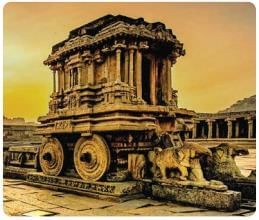
3. Hampi, a town in Karnataka, is also a UNESCO World Heritage Site. The Vittala Temple in Hampi was built in the 15th century. This temple has 56 special pillars known as the SaReGaMa pillars. When these pillars are tapped, they produce musical notes that can be heard clearly.
4. Some of the man-made wonders of modern India include the Bandra-Worli Sea Link in Mumbai; Statue of Unity in Gujarat; Bhupen Hazarika Setu (The Dhola-Sadiya Bridge) in Assam; and many more.
Ans: Do it yourself
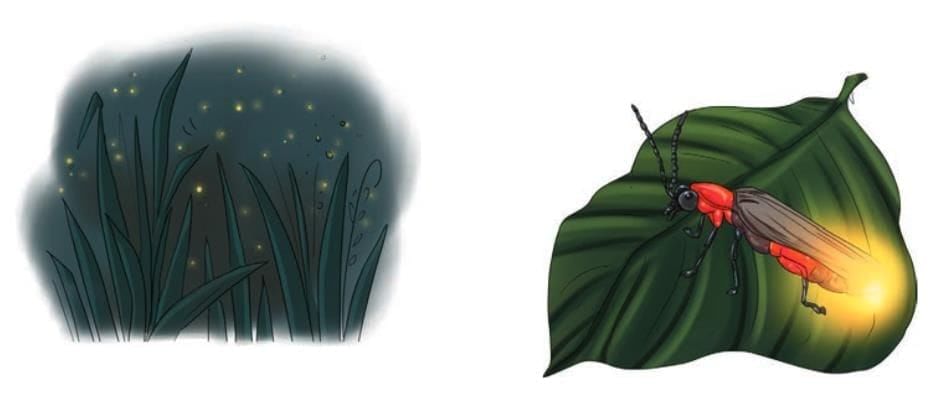
II. Some micro-planktons in the sea are bioluminescent. Have you seen any other life form that has this quality? Identify the insect given below and find out what it is called in your language. Look out for it when you visit a field or a place with a wetland.
Ans:
- Insect Shown: Firefly
- Bioluminescence: Fireflies produce light from their abdomen due to a chemical reaction, similar to the micro-planktons.
- Common Names in Indian Languages:
- Hindi: Jugnu
- Malayalam: Minnaminungu
- Tamil: Minnal Poochi
- Bengali: Jonaki Poka
- Telugu: Deepa Purugu
- Marathi: Jugas
The document NCERT Solutions: Spectacular Wonders is a part of the Class 8 Course English Poorvi Class 8 - New NCERT.
All you need of Class 8 at this link: Class 8
FAQs on NCERT Solutions: Spectacular Wonders
| 1. What are the seven wonders of the world and why are they called spectacular? |  |
Ans. The seven wonders of the world are extraordinary architectural and natural marvels including the Great Pyramid of Giza, the Colossus of Rhodes, and the Hanging Gardens of Babylon. They're termed "spectacular" because they showcase exceptional engineering, artistic brilliance, and cultural significance from ancient civilisations. These monuments represent humanity's capacity to create awe-inspiring structures that have survived or influenced civilisation for centuries.
| 2. How do the historical wonders differ from natural wonders in terms of their creation and preservation? | |
Ans. Historical wonders are human-made monuments built through deliberate craftsmanship and architectural expertise, while natural wonders form through geological processes over millennia. Human-made structures like the Taj Mahal require intentional preservation efforts and restoration, whereas natural formations like waterfalls or mountains sustain themselves through environmental cycles. Both categories inspire wonder but demand different conservation approaches for their longevity.
| 3. What makes the Taj Mahal considered one of the most spectacular structures for NCERT Class 8 English study? | |
Ans. The Taj Mahal exemplifies spectacular architecture through its perfect symmetry, intricate marble inlay work, and profound historical narrative of love and devotion. Built by Emperor Shah Jahan as a mausoleum for his wife Mumtaz Mahal, it represents the pinnacle of Mughal architectural design. Its timeless beauty and cultural significance make it an ideal subject for understanding how structures become iconic symbols of civilisation.
| 4. Why do students often confuse the definitions of monument and wonder in their Class 8 CBSE English curriculum? | |
Ans. Students frequently conflate these terms because all wonders are monuments, but not all monuments qualify as wonders. A wonder must demonstrate exceptional scale, artistic merit, historical importance, and universal recognition, whereas a monument simply commemorates an event or person. Understanding this distinction helps students analyse texts more precisely and appreciate why certain structures achieve "spectacular" status beyond mere historical relevance.
| 5. What role does descriptive language play in portraying wonders as spectacular in NCERT English texts? | |
Ans. Descriptive language elevates wonders by employing vivid imagery, sensory details, and emotive vocabulary that transport readers to these magnificent locations. Words like "breathtaking," "magnificent," and "awe-inspiring" create emotional connections and emphasise the grandeur of these structures. Mastering such language techniques helps students enhance their own writing and comprehend how authors communicate the spectacular nature of global marvels effectively.
About this Document

7.7K Views

4.85/5 Rating

Apr 21, 2026 Last updated
Related Exams
Document Description: NCERT Solutions: Spectacular Wonders for Class 8 2026 is part of English Poorvi Class 8 - New NCERT preparation. The notes and questions for NCERT Solutions: Spectacular Wonders have been prepared according to the Class 8 exam syllabus. Information about NCERT Solutions: Spectacular Wonders covers topics like and NCERT Solutions: Spectacular Wonders Example, for Class 8 2026 Exam. Find important definitions, questions, notes, meanings, examples, exercises and tests below for NCERT Solutions: Spectacular Wonders.
Introduction of NCERT Solutions: Spectacular Wonders in English is available as part of our English Poorvi Class 8 - New NCERT for Class 8 & NCERT Solutions: Spectacular Wonders in Hindi for English Poorvi Class 8 - New NCERT course. Download more important topics related with notes, lectures and mock test series for Class 8 Exam by signing up for free. Class 8: NCERT Solutions: Spectacular Wonders
Description
NCERT Solutions: Spectacular Wonders of English Poorvi Class 8 provides all the questions of NCERT textbook with detailed solutions. Download free PDF from EduRev.
Information about NCERT Solutions: Spectacular Wonders
In this doc you can find the meaning of NCERT Solutions: Spectacular Wonders defined & explained in the simplest way possible. Besides explaining types of NCERT Solutions: Spectacular Wonders theory, EduRev gives you an ample number of questions to practice NCERT Solutions: Spectacular Wonders tests, examples and also practice Class 8 tests



Related Searches
Sample Paper, Exam, pdf , study material, ppt, MCQs, Free, mock tests for examination, NCERT Solutions: Spectacular Wonders, NCERT Solutions: Spectacular Wonders, Summary, NCERT Solutions: Spectacular Wonders, Previous Year Questions with Solutions, shortcuts and tricks, Viva Questions, Semester Notes, Objective type Questions, practice quizzes, past year papers, Extra Questions, Important questions, video lectures;