NCERT Solutions: The Cherry Tree


Let us do these activities before we read (Page 155)
I. Work in pairs and answer the questions that follow. Share your answers with your classmates and teacher.
1. Have you ever used a seed or a sapling to grow a plant?
Ans: Yes. I planted a mango seed in a pot last year and watched it sprout into a small sapling over a few weeks.
2. What kind of care did the plant need? Who helped you with it?
Ans: It needed regular watering, sufficient sunlight, good potting soil and occasional fertiliser. My mother helped me water it regularly and taught me how to keep the soil moist but not waterlogged.
3. How did you feel when you saw the plant grow?
Ans: I felt happy and proud when it sprouted tiny leaves. Watching gradual growth gave me a sense of responsibility and joy.
II. What kind of trees do people plant in their homes? Why is it important to plant trees?
Ans: People commonly plant trees like neem, mango, guava, lemon or tulsi at home for shade, fruits, fragrance and beauty. Planting trees is important because they produce oxygen, help clean the air, provide shade and habitats for birds and insects, and reduce soil erosion.
III. Name some fruit trees that grow in your region. What type of conditions help these fruit trees grow?
Ans: In my region, mango, guava and lemon trees grow well. They need warm weather, plenty of sunlight, well-drained soil and regular watering during the growing season to flourish.
Let us discuss (Page 159)
I. Arrange the events in order of occurrence in the narrative. Two have been done for you. Share your answers with your classmates and the teacher.
1. Rakesh discovered that the small, well-rooted twig had grown into a cherry tree.
2. Rakesh was sent to live with his grandfather in Mussoorie.
3. Rakesh pressed the cherry seed into the soft soil with his thumb. (5)
4. The cherry tree grew quickly after the rains arrived early.
5. Rakesh bought a bunch of cherries and ate most of them.
6. A goat entered the garden and ate all the leaves of the young cherry tree.
7. Rakesh's parents grew maize, rice, and barley in a village. (1)
8. Rakesh sprinkled water on the cherry tree and surrounded it with pebbles.
9. Grandfather told Rakesh that cherry trees were tough.
10. Rakesh kept rolling the last cherry seed in his mouth.
Ans: The correct order of the events is:
7 → 2 → 5 → 10 → 3 → 1 → 8 → 4 → 6 → 9
Let us discuss (Page 164)
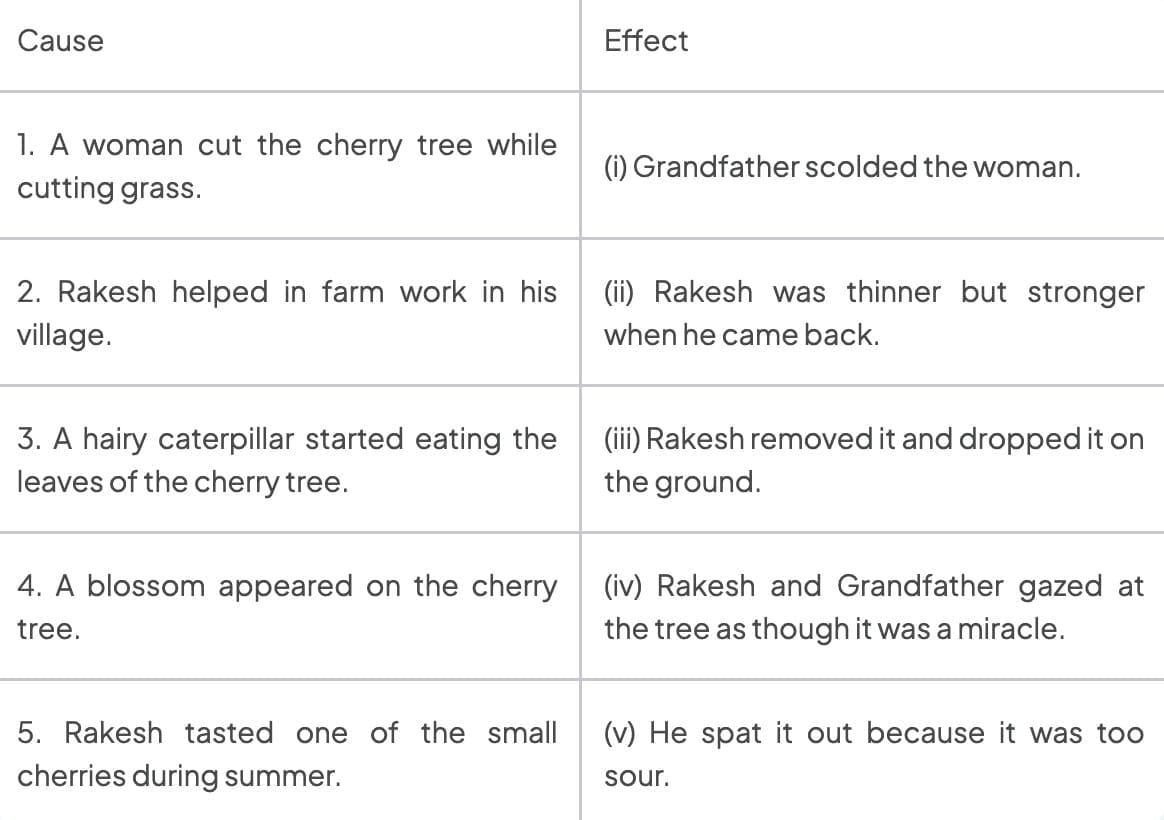
I. Complete the table given below based on your understanding of Part II of the narrative. One example has been done for you. Share your answers with your classmates and teacher.
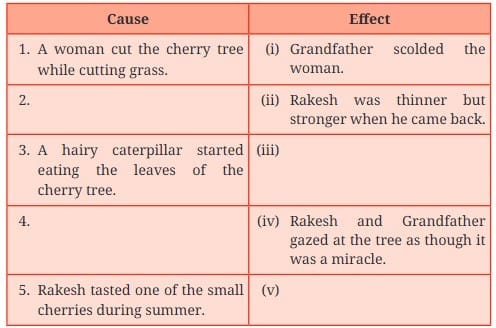
Ans:
Let us think and reflect (Page 164)
I. Read the given extracts and answer the questions that follow.
1. "Have a cherry, Grandfather," he said, as soon as he saw his grandfather in the garden. Grandfather took one cherry, and Rakesh promptly ate the other two. He kept the last seed in his mouth for some time, rolling it round and round on his tongue until all the tang had gone. Then he placed the seed on the palm of his hand and studied it. "Are cherry seeds lucky?" asked Rakesh. "Of course." "Then I'll keep it." "Nothing is lucky if you put it away. If you want luck, you must put it to some use."
(i) Substitute the underlined phrase with a correct word from the extract. The Kho-kho captain changed her strategy quickly and without delay when a new player came in from the opposing team.
Ans: promptly
(ii) What does Rakesh's action of rolling the cherry seed in his mouth most likely suggest about his mood at that moment?
A. He is feeling impatient and restless.
B. He is enjoying the taste and the moment.
C. He is bored and has nothing better to do.
D. He is thoughtful and feels playful.
Ans: (b)
Explanation: Rakesh rolls the seed 'round and round' until the tang is gone, which shows he savoured the taste and the moment. This behaviour indicates enjoyment rather than impatience or deep boredom.
(iii) Complete the following sentence suitably with reference to Rakesh and his grandfather. Rakesh's decision to plant the seed shows that ______________. (he respects and values his grandfather's advice/he has a close bond with his grandfather and a willingness to learn from him)
Ans: he respects and values his grandfather's advice
(iv) How does the grandfather's advice reflect his view about luck and effort?
Ans: Grandfather's advice shows that luck alone is not useful unless it is acted upon. He believes that one must use opportunities and put in effort to make luck meaningful.
2. Winter came early. The cherry tree bent low with the weight of snow. Field mice sought shelter in the roof of the cottage. The road from the valley was blocked, and for several days there was no newspaper, and this made Grandfather quite grumpy. His stories began to have unhappy endings. In February, it was Rakesh's birthday. He was nine, and the tree was four, but almost as tall as Rakesh.
(i) Complete the following sentence suitably. The phrase 'field-mice sought shelter in the roof of the cottage suggests that _____________.
Ans: The weather was extremely cold and harsh, forcing small animals to seek shelter close to human habitations.
(ii) What can be inferred about the cherry tree's toughness from the line, 'The cherry tree bent low with the weight of snow'?
A. The weight of the tree was more than the snow.
B. The tree could withstand harsh weather.
C. The tree was growing close to the ground.
D. The snow gave support to the tree.
Ans: (b)
Explanation: The tree bending under heavy snow but remaining alive suggests it endured severe weather. Bending under weight shows resilience rather than damage beyond recovery.
(iii) How did the early winter affect Grandfather's mood and storytelling?
Ans: The early winter made Grandfather grumpy; his mood grew sombre and his stories began to have unhappy endings, reflecting his discomfort and worry.
(iv) Complete the sentence by choosing the correct option. The comparison of Rakesh's age to the cherry tree's age symbolises _______________. (the tree's growth paralleling Rakesh's own development/the tree standing as a dear one on Rakesh's birthday)
Ans: The tree's growth parallels Rakesh's own development.
II. Answer the following questions.
1. Why did Rakesh's parents send him to Mussoorie?
Ans: Rakesh's parents lived in a small village in the lower Himalayan slopes where there were no schools. They were keen that Rakesh should receive a proper education. Since his grandfather lived in Mussoorie, a place with schools, they decided to send him there. They wanted him to have better opportunities to study and grow. So, Rakesh began living with his grandfather to attend school.
2. Why did Rakesh let the praying mantis remain on the branch of the cherry tree?
Ans: Rakesh let the praying-mantis remain on the branch of the cherry tree because he saw it as a harmless and perhaps even welcome visitor. It was the first insect he noticed on the tree after it had started growing well. He didn't feel the need to remove it since it wasn't causing any damage. His gentle attitude showed his growing care and respect for the tree and its ecosystem. He understood the tree was now a small part of nature.
3. How is life in the Himalayan foothills described in the story?
Ans: Life in the Himalayan foothills is described as beautiful but challenging for plant life. The soil was mostly stony, and the dry, cold winds made it difficult for fruit trees to grow. However, forests of oak and deodar thrived in the more sheltered areas. The environment changed with the seasons-spring brought migrating birds, monsoons brought rain and greenery, and winters brought snow and silence. Despite its challenges, the setting added natural beauty and rhythm to the story.
4. What might Rakesh mean when he says, "Is this what it feels like to be God?" at the end of the story?
Ans: When Rakesh says, "Is this what it feels to be God?' he is reflecting on the joy and wonder of having nurtured something from a tiny seed to a fully grown tree. By planting and caring for the cherry tree, he experienced the process of creation and growth. Watching the tree flourish gave him a sense of accomplishment and peace. The feeling of having given life and beauty to the world made him feel powerful in a quiet, divine way. It was a moment of deep emotional connection with nature.
5. How does the writer describe the relationship between Rakesh and his grandfather?
Ans: The writer describes Rakesh and his grandfather's relationship as warm, affectionate, and full of mutual respect. Grandfather is wise and caring, guiding Rakesh gently with advice and stories. They share quiet evenings around the fire and joyful moments in the garden. Grandfather teaches Rakesh about responsibility and nature through small acts like planting a seed. Their bond deepens as they care for the cherry tree together. It is a relationship built on love, learning, and companionship.
6. What can you infer about the connection between humans and nature based on the story?
Ans: The story shows that the connection between humans and nature is emotional, nurturing, and deeply meaningful. By planting a seed, Rakesh unknowingly begins a journey of care and responsibility. Nature responds to his effort by growing, blooming, and offering peace and beauty. This bond teaches patience, resilience, and respect. It also shows that humans can find joy and a sense of purpose in nurturing life. Nature and humans thrive when they support each other.
7. Imagine Rakesh reflects on his wonderful experience of watching a seed being transformed into a full-grown cherry tree. Write how he must have felt.
Ans: Rakesh must have felt incredibly proud and joyful watching the seed he planted grow into a tall, blossoming cherry tree. He would have remembered how small and insignificant the seed looked at first and how he had nearly forgotten about it. But over time, through seasons of rain, snow, and sunshine, the seed became something beautiful. The tree was not only a plant but a living reminder of his patience, care, and love. He probably felt humbled by nature's magic and amazed at how such a simple act could bring so much meaning. Lying under its shade, he must have felt peaceful and deeply connected to the tree. It was a quiet joy that came from having helped something grow.
Let us learn (Page 166)
I. Each word list has one word that does not match the other words. Identify the odd word. One example has been done for you.
1. chop, trim, slice, mince ('chop', 'slice' and 'mince' are words used for cutting with a knife; whereas 'trim' is to cut a part with a pair of scissors)
Ans: trim (uses scissors, others use a knife)
2. plodded, galloped, scrambled, trudged
Ans: galloped (shows fast movement; others show slow or steady movement)
3. tender, delicate, soft, smooth
Ans: smooth (describes texture; others describe fragility or sensitivity)
4. stared, peered, pecked, gazed
Ans: pecked (a physical action by a bird; others are ways of looking)
5. growing, blossoming, progressing, planting
Ans: planting (an initial action; others describe ongoing or developing states)
II. Choose the most suitable taste words given in the box below and write against the food items that follow.

1. tamarind
Ans: sour
2. jaggery
Ans: sweet
3. neem leaves
Ans: bitter
4. paneer (cottage cheese)
Ans: bland (tasteless)
5. lemon
Ans: tangy
6. pickle
Ans: spicy
7. a dish of vegetables
Ans: salty
Now, use any five taste words and make sentences of your own.
1. The lemonade was too sour to drink without sugar.
2. I love the sweet flavour of fresh mangoes.
3. Neem juice is very bitter, but it's good for health.
4. The curry was too spicy for the children to enjoy.
5. This soup is quite bland; it needs more seasoning.
III. Choose the correct antonyms for the textual words given below from the box. There are two extra words that you will not need.
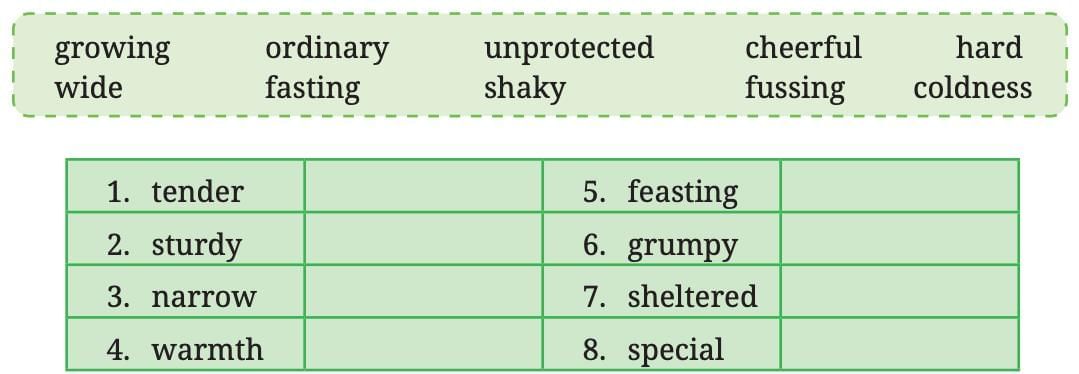
Ans:
- tender: hard
- sturdy: shaky
- narrow: wide
- warmth: coldness
- feasting: fasting
- grumpy: cheerful
- sheltered: unprotected
- special: ordinary
IV. Read the following lines from the text and underline all the verbs and identify the form of tense.
1. Rakesh was on his way home from school when he bought the cherries.
Ans: Rakesh was on his way home from school when he bought the cherries. Simple Past Tense
2. Rakesh was looking for Grandfather without finding him in any of his favourite places around the house.
Ans: Rakesh was looking for Grandfather without finding him in any of his favourite places around the house. Past Progressive Tense
3. Rakesh and Grandfather gazed at the tree as though it had performed a miracle.
Ans: Rakesh and Grandfather gazed at the tree as though it had performed a miracle. Simple Past Tense, Past Perfect Tense
The forms of tenses in the given statements are Simple Past Tense(1 and 3), Past Progressive Tense (2), and Past Perfect Tense (3).
Now, fill in the blanks with the correct form of Simple Past, Past Progressive, or Past Perfect Tenses of the verbs given in brackets. One example has been done for you.
(i) I was sitting (sit) with my grandparents in the garden, sharing the wonderful memories from my childhood. As we (ii) ______________ (talk),I (iii) ______________ (realise) how much wisdom they (iv) ______________ (impart) to me over the years. WhileI (v) ______________ (listen) to their stories for hours together, I (vi) ______________ (remember) the times we(vii) ______________ (spend) together planting flowers and learning about life. By the time I left, the sun(viii) ______________ (set), and I (ix) ______________(feel) a deep sense of gratitude for the bond we(x) ______________ (nurture) through love, care, and countless memories.
Ans: (i) I was sitting (sit) with my grandparents in the garden, sharing the wonderful memories from my childhood. As we (ii) were talking (talk), I (iii) realised (realise) how much wisdom they (iv) had imparted (impart) to me over the years. While I (v) was listening (listen) to their stories for hours together, I (vi) remembered (remember) the times we (vii) had spent (spend) together planting flowers and learning about life. By the time I left, the sun (viii) had set (set), and I (ix) felt (feel) a deep sense of gratitude for the bond we (x) had nurtured (nurture) through love, care, and countless memories.
V. Study the punctuation marks in the following sentences from the text.
- "Hey, not there," said Grandfather, "I've sown mustard in that bed. Plant it in that shady corner, where it won't be disturbed."
- When Grandfather saw what had happened, he went after the woman and scolded her, but the damage could not be repaired.
- She did not try to avoid the tree: one sweep, and the cherry tree was cut in two.
every sunday roshni would visit her grandparents house on their farm come sit grandpa would say patting the bench on their porch roshni loved these moments where the world slowed down and storiesflowed like magic grandma would bring tea her eyes twinkling with joy im excited to hear about your younger days the adventures the lessonsand the memories roshni said eagerly grandpa smiled softly his wrinkled hands resting on the cane ah the olddays... when everything was simple and happiness was all we had roshni could feel the warmth of those memories he sat in silence boundnot by words but by a timeless bond
Ans: Every Sunday, Roshni would visit her grandparents' house on their farm. "Come, sit," Grandpa would say, patting the bench on their porch. Roshni loved these moments where the world slowed down and stories flowed like magic. Grandma would bring tea, her eyes twinkling with joy. "I'm excited to hear about your younger days-the adventures, the lessons, and the memories," Roshni said eagerly. Grandpa smiled softly, his wrinkled hands resting on the cane. "Ah, the old days... when everything was simple, and happiness was all we had," he said. Roshni could feel the warmth of those memories. They sat in silence, bound not by words but by a timeless bond.
Let us listen (Page 170)
I. You will listen to a conversation between a son and his mother. As you listen, select four true statements from 1-7 given below.
2. The son was surprised to know about the Appiko Movement.
3. The son agreed that the Chipko Movement was about people uniting to make an impact.
4. The mother expressed a desire to share more details about Saalumarada Thimakka.
5. The mother was curious to hear about Saalumarada Thimakka.
6. The mother and son were in disagreement about the work of JadavPayeng.
7. The son found the information on Jadav Payeng wonderful.
Ans: Four True statements:
2. → 3. → 5. → 7.
Let us speak (Page 170)
A syllable is a single, unbroken vowel sound in a word. Some words have only one syllable. Some have two, and some more than two. For example, the word 'tree' has one syllable. The word 'cherry' has two syllables-che-rry. (Here the hyphen is used to mark the gap between the two syllables.)
A syllable can also be called a 'beat' because you can clap out the 'beats' in the word.
I. Work in pairs. Read aloud the following words from the text. Write the number of syllables in each word. Check your answers with your classmates and teacher.
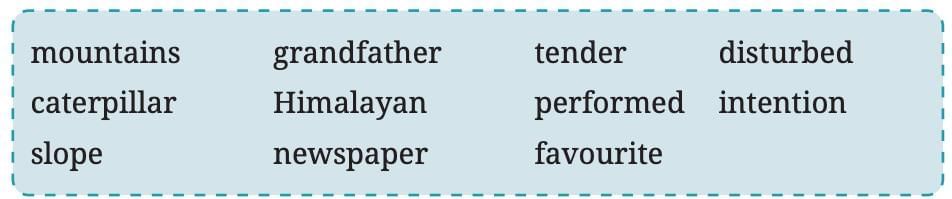
Now, read the words aloud again with the beats. Check if the number of syllables matches the number of beats.
Ans:
1. mountains - 2 syllables
2. grandfather - 3 syllables
3. tender - 2 syllables
4. disturbed - 2 syllables
5. caterpillar - 4 syllables
6. Himalayan - 4 syllables
7. performed - 2 syllables
8. intention - 3 syllables
9. slope - 1 syllable
10. newspaper - 3 syllables
11. favourite - 3 syllables
II. Speak about Van Mahotsav Diwas and its significance. Before you speak in the class or assembly, prepare yourself on the following points:
- When is it celebrated?
- Who celebrates it?
- Why is it celebrated?
- How is it celebrated?
- What is the message it conveys?
- Van Mahotsav Diwas is celebrated in the first week of July every year.
- People across India, including students, farmers, and government officials, celebrate it.
- It promotes tree planting to save the environment and increase greenery.
- People plant trees, hold awareness campaigns, and organise events in schools and communities.
- It teaches us to protect trees and nature to ensure a healthy planet for the future.
Let us write (Page 171)
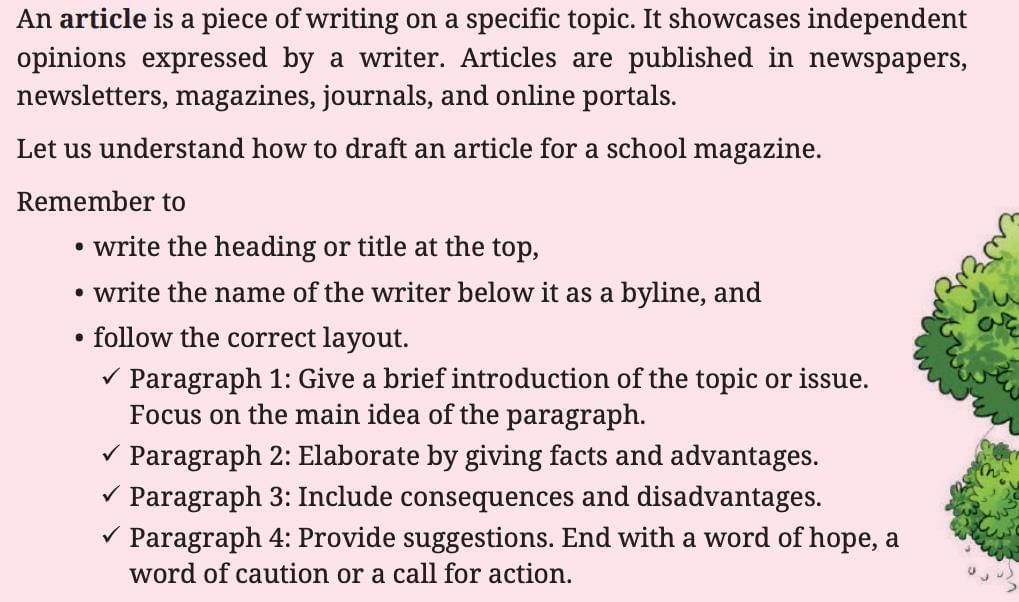
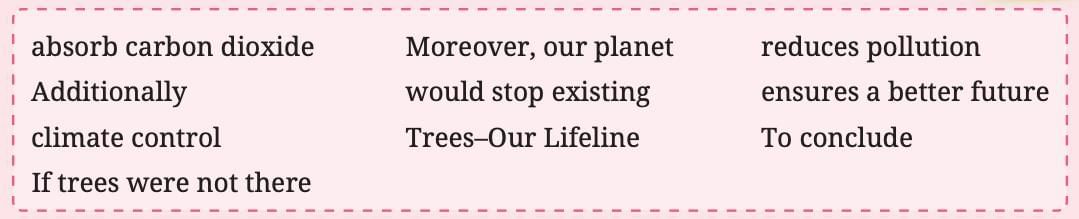
Ans:
(i) Trees-Our Lifeline - by [Your Name] and Class
Trees are essential for life on Earth. Without them, life as we know (ii) would stop existing. This is the reason why trees are our lifeline. Trees provide us with food, shelter, and even medicine. Trees (iii) absorb carbon dioxide and release oxygen, helping us breathe. This process also (iv) reduces pollution and keeps the environment clean. (v) Additionally, trees give us fruits, nuts, and other foods. Trees also help in (vi) climate control and the prevention of soil erosion. (vii) If trees were not there, the air would be polluted, and we would struggle to breathe. (viii) Moreover, our planet would be barren, lacking food, shelter, and life-giving greenery. (ix) To conclude, trees are true friends. Protecting and planting trees (x) ensures a better future for everyone on Earth. Therefore, we must act now to protect and plant more trees, preserving Earth's green lifeline for future generations.
Let us explore (Page 172)
I. Did you know that the banyan tree is the National Tree of India?
Our country has age-old banyan trees. Some of them are:
1. The Great Banyan, located in Shibpur, Howrah, near Kolkata.
2. Dodda Aalada Mara, located in Kethohalli village, near Bengaluru.
3. Thimmamma Marrimanu, in Anantapur District in Andhra Pradesh. It was recorded as the largest tree specimen in the world in the Guinness Book of World Records in 1989.
II. Kailash Sankhala, 'The Tiger Man of India', was an Indian biologist and conservationist. He carried out a census of the tigers in India in 1971. Later, because of his studies, he was appointed the first director of Project Tiger-an initiative to prevent the extinction of the Indian Tiger. He was awarded the Padma Shri in 1992.
Now, find more information about such Indian environmentalists and share it with your classmates.
Ans: Sundarlal Bahuguna
Sundarlal Bahuguna was a prominent Indian environmentalist known for leading the Chipko Movement in the 1970s. In this movement, villagers hugged trees to stop them from being cut down by commercial loggers. He worked tirelessly to protect Himalayan forests and raised awareness about the importance of sustainable development. His efforts helped influence forest conservation policies in India. He believed that nature and humans should coexist in harmony. He was awarded the Padma Vibhushan in 2009 for his environmental work.
FAQs on NCERT Solutions: The Cherry Tree
| 1. Who is the main character in The Cherry Tree and what does he do? |  |
| 2. Why does the boy lie about breaking the cherry tree, and what happens after? | |
| 3. What is the main message or moral lesson of The Cherry Tree NCERT chapter? | |
| 4. How does the setting of the garden affect the story's meaning in The Cherry Tree? | |
| 5. What are the important character traits shown by the father in The Cherry Tree story? | |