NCERT Solutions: A Story of Numbers


Page 48
Questions (Implied from Reema's Curiosity):
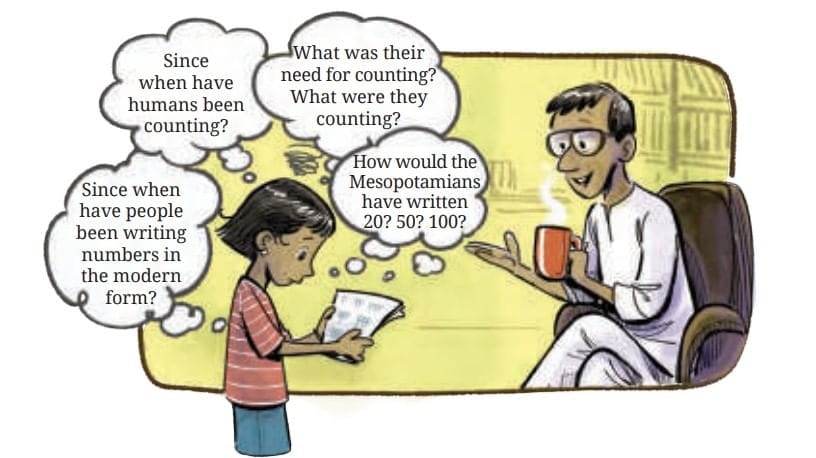
Q1: Since when have humans been counting?
Ans: Humans have been counting since at least the Stone Age (around 10,000 years ago). Early people used simple tallies and marks to keep track of quantities of food, livestock and trade goods, and to note cycles such as lunar phases and seasons. Archaeological finds such as tally sticks and marked bones provide concrete evidence of this early counting activity.
Q2: What was their need for counting?
Ans: The need for counting arose to manage and plan everyday life: to record and share food, to keep track of animals in herds, to measure goods during trade, to note offerings in rituals and to predict and record time-related events such as new moons and seasons. Counting helped people make decisions about sharing, storing and exchanging resources.
Q3: What were they counting?
Ans: They counted food items, animals in herds, trade goods, ritual offerings and days for simple calendars. These counts were practical and connected to immediate needs such as storing grain, dividing spoils, or planning hunts and harvests.
Q4: Since when have people been writing numbers in the modern form?
Ans: The modern digit forms (Hindu numerals 0-9) were developed in India over many centuries. Early forms appear in ancient Indian manuscripts and inscriptions; the use of zero as a placeholder and digit became well established by the first millennium CE. Mathematicians such as Aryabhata (c. 499 CE) used and formalised these methods. Over time these symbols spread to other regions and became the basis of the numerals used across the world today.
Q5: How would the Mesopotamians have written 20, 50, 100?
Ans: The Mesopotamian (Babylonian) system used a base-60 positional system built from two basic signs: one for 1 (

) and one for 10 (

). Numbers were formed by combining these symbols and placing them in positions that represented powers of 60. Using the simplified notation referenced in Section 3.4:
- 20: 20 = 10 + 10 =

- 50: 50 = 10 + 10 + 10 + 10 + 10 =

Now try this on your own.
- 100 = ?
Page 54
Figure it Out
Q1. Suppose you are using the number system that uses sticks to represent numbers, as in Method 1. Without using either the number names or the numerals of the Hindu number system, give a method for adding, subtracting, multiplying and dividing two numbers or two collections of sticks.
Ans:
Method 1: Addition (Putting Together)
► Collect sticks representing the first quantity.
► Collect another set of sticks representing the second quantity.
► Combine both sets into a single group.
► The total number of sticks in the combined group represents the sum.
To verify the result, you can recount the combined group or group sticks into known bundles (for example bundles of five) to make counting easier.
Example:
Group A: |||| (4 sticks)
Group B: ||| (3 sticks)
Total: ||||||| (7 sticks)
Method 2: Subtraction (Taking Away)
► Start with the group of sticks representing the larger collection.
► Remove or take away the number of sticks that represent the smaller quantity.
► The remaining sticks show the result of subtraction.
A clear way is to mark the removed sticks or place them aside so the remaining count is obvious.
Example:
Start with: ||||||| (7 sticks)
Take away: ||| (3 sticks)
Left: |||| (4 sticks)
Method 3: Multiplication (Repeated Addition)
► Make several groups of sticks, each containing the same number.
► Count all the sticks across all groups together.
► The total represents the product.
Alternatively, create identical bundles and then count how many bundles there are, multiplying bundle size by number of bundles.
Example:
Multiply 3 groups of ||| (3 sticks each):
Group 1: |||
Group 2: |||
Group 3: |||
Total: ||||||||| (9 sticks)
Method 4: Division (Equal Sharing or Grouping)
► Take the total number of sticks.
► Split them into equal groups.
Either:
• Count how many sticks are in each group (equal sharing), or
• Count how many such groups can be made (repeated subtraction).
An organised way is to make one group after another until you have no sticks left; the number of full groups gives the quotient and any leftover sticks give the remainder.
Example (Equal Sharing):
Total: |||||| (6 sticks), divide into 2 groups → ||| and ||| (3 sticks each)
Example (Grouping):
How many groups of || (2 sticks) can be made from |||||| (6 sticks)?
Answer: 3 groups.
Q2. One way of extending the number system in Method 2 is by using strings with more than one letter-for example, we could use 'aa' for 27. How can you extend this system to represent all the numbers? There are many ways of doing it!
Ans: Extending a letter-based number system like Method 2 ('a' to 'z' representing 1 to 26):
To represent numbers beyond 26, use combinations of letters in an ordered way, similar to how words are formed. For example:
- 'a' = 1, 'b' = 2, ..., 'z' = 26
- 'aa' = 27, 'ab' = 28, 'ac' = 29, and so on.
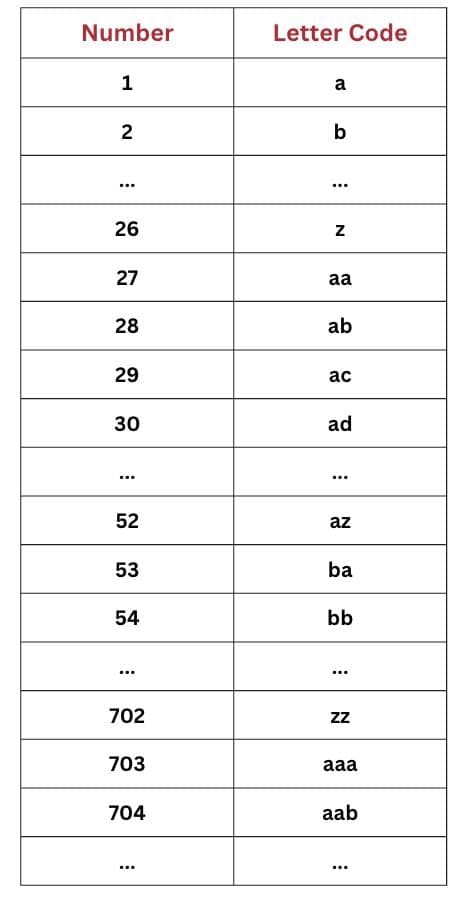
This functions like a base-26 positional system: the rightmost letter represents 26⁰, the next 26¹, etc. By increasing the length of the string (two letters, three letters), you can represent every natural number. Choose a clear ordering rule (for example, lexicographic) so each number has a unique representation.
Q3. Try making your own number system.
Ans: My Own Number System: The "ABC Number System"
• In this number system, I use the letters A, B, C, D and E instead of the usual digits.
• Each letter stands for a number: A = 0, B = 1, C = 2, D = 3 and E = 4.
This system therefore works as a base-5 place-value system. The rightmost letter is the 1s place, the next is 5s, then 25s, and so on. This place-value idea makes it possible to write any natural number using just five symbols.
• I also follow place value: the rightmost letter is worth 1, the next 5, then 25, etc.
For example, the code BD means B = 1 in the 5s place and D = 3 in the 1s place. So BD = (1 × 5) + 3 = 8. Using place value keeps representations compact and makes arithmetic rules straightforward.
• I can count and perform arithmetic using only these letters, which helps understand how different bases and symbols can represent the same numbers as our familiar digits.
Page 58
Q: What could be the difficulties with using a number system that counts only in groups of a single particular size? How would you represent a number like 1345 in a system that counts only by 5s?
Ans:
The difficulties with using a number system that counts only in groups of a single particular size include:
(i) Numbers that are not exact multiples of the group size require a separate way to show remainders, which complicates notation and communication.
(ii) Large numbers may need many repeated marks or groups, making the notation long and inconvenient.
(iii) Performing arithmetic, especially division and multiplication, becomes harder because operations must handle whole groups and remainders explicitly.
For example, 1345 ÷ 5 = 269 remainder 0, because 1345 = 5 × 269. In a system that only counts in 5s you would represent this as 269 groups of 5 (and zero leftover). If a remainder existed, it would need an extra symbol or notation to show the leftover items.
Page 59
Figure it Out
Q1. Represent the following numbers in the Roman system.
(i) 1222
(ii) 2999
(iii) 302
(iv) 715
Ans:
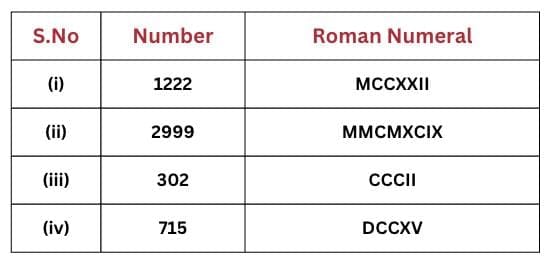
Explanation:
(i) 1222
Break it down:
1000 + 200 + 20 + 2 = M + CC + XX + II
Answer: MCCXXII
(ii) 2999
Break it down:
2000 + 900 + 90 + 9 = MM + CM + XC + IX
Answer: MMCMXCIX
(iii) 302
Break it down:
300 + 2 = CCC + II
Answer: CCCII
(iv) 715
Break it down:
700 + 10 + 5 = DCC + X + V
Answer: DCCXV
Q: Try adding the following numbers without converting them to Hindu numerals:
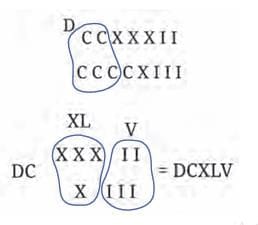
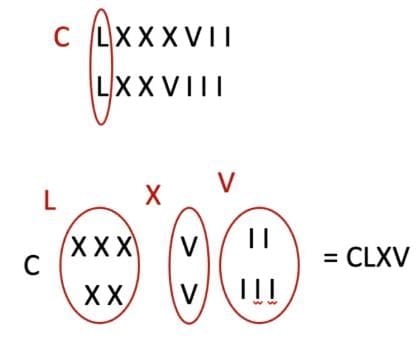
(a) CCXXXII + CCCCXIII
To add Roman numerals directly, group like symbols and simplify using Roman landmark values. Count the total number of I, X and C symbols, then convert groups of five identical lower symbols into the next higher symbol (for example, five Xs → L). After regrouping and simplifying you obtain the final Roman numeral representation.
Do it yourself now:
(b) LXXXVII + LXXVIII
Ans:
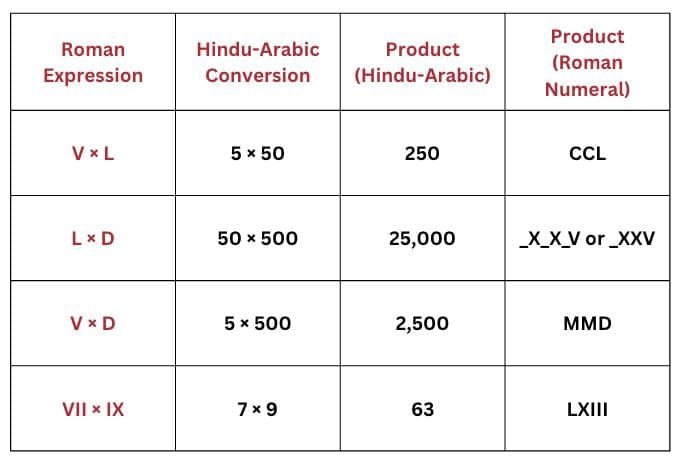
Q: How will you multiply two numbers given in Roman numerals, without converting them to Hindu numerals? Try to find the product of the following pairs of landmark numbers: V × L, L × D, V × D, VII × IX.
Ans: You cannot multiply directly in Roman numerals without a systematic positional method. A reliable procedure is:
- Convert Roman numerals to Hindu-Arabic (decimal) form.
- Multiply using standard arithmetic or an abacus.
- Convert the decimal result back into Roman numerals (using overbars for very large numbers if required).
This method is simple and avoids ambiguity. For instance, V × L = 5 × 50 = 250, whose Roman form is CCL. When results exceed 3,999, Roman notation uses overlines (or other conventions) to indicate thousands.
Note:
_X = 10,000, so _XX = 20,000, and _XXV = 25,000
Roman numerals above 3,999 use overlines to indicate multiplication by 1,000
Page 60-70
Figure it out
Q1. A group of indigenous people in a Pacific island use different sequences of number names to count different objects. Why do you think they do this?
Ans: Different counting sequences reflect cultural practices and the practical needs of everyday life. A community may have specialised words or counting patterns for coconuts, fish, people or time because each category has its own importance and method of handling. Distinct sequences can make counting faster, help grouping (for example pairs or bundles), and reduce ambiguity in trade or ritual contexts.
For example, they might use one set of words for living things and another for inanimate objects, or count paired items (such as eyes or shoes) as single units. These conventions arise to make counting more natural for the tasks they perform.
Q2. Consider the extension of the Gumulgal number system beyond 6 in the same way of counting by 2s. Come up with ways of performing the different arithmetic operations (+, -, ×, ÷)for numbers occurring in this system, without using Hindu numerals. Use this to evaluate the following:
(i) (ukasar-ukasar-ukasar-ukasar-urapon) + (ukasar-ukasarukasar-urapon)
(ii) (ukasar-ukasar-ukasar-ukasar-urapon) - (ukasar-ukasarukasar)
(iii) (ukasar-ukasar-ukasar-ukasar-urapon) × (ukasar-ukasar)
(iv) (ukasar-ukasar-ukasar-ukasar-ukasar-ukasar-ukasar-ukasar) ÷ (ukasar-ukasar)
Ans: First, define base terms:
- urapon = 1
- ukasar = 2
So:
- ukasar-urapon = 3
- ukasar-ukasar = 4
- ukasar-ukasar-urapon = 5
- ukasar-ukasar-ukasar = 6
- ukasar-ukasar-ukasar-urapon = 7
- ukasar-ukasar-ukasar-ukasar = 8
- ukasar-ukasar-ukasar-ukasar-urapon = 9
- etc.
(i) (ukasar-ukasar-ukasar-ukasar-urapon) + (ukasar-ukasar-ukasar-urapon)
- First term: 4 ukasar + 1 urapon = 9
- Second term: 3 ukasar + 1 urapon = 7
Add using parts:
- 4 + 3 = 7 ukasar
- 1 + 1 = 2 urapon = 1 ukasar (since 2×1 = 1 unit of ukasar in their scheme)
Total: 7 ukasar + 1 ukasar = 8 ukasar
Answer: 8 ukasar or ukasar-ukasar-ukasar-ukasar-ukasar-ukasar-ukasar-ukasar
(ii) (ukasar-ukasar-ukasar-ukasar-urapon) - (ukasar-ukasar-ukasar)
- First term = 9
- Second term = 6
Subtract by cancelling matching parts:
- Remove 3 ukasar from 4 ukasar → 1 ukasar remains
- 1 urapon stays
Answer: ukasar + urapon = ukasar-urapon
(iii) (ukasar-ukasar-ukasar-ukasar-urapon) × (ukasar-ukasar)
- First term = 4 ukasar + 1 urapon = 9
- Second term = 2 ukasar = 4 (in decimal equivalent)
Use repeated addition:
- 9 × 4 = 36
- 36 = 18 ukasar
Answer: 18 ukasar
To express it fully in the Gumulgal form, write 18 repetitions of "ukasar" or use a grouped notation if available.
(iv) (ukasar × 8) ÷ (ukasar-ukasar)
- Numerator: 8 × ukasar = 8 × 2 = 16
- Denominator: ukasar-ukasar = 4
Divide:
- 16 ÷ 4 = 4 → 4 = ukasar-ukasar
Answer: ukasar-ukasar
Q3: Identify the features of the Hindu number system that make it efficient when compared to the Roman number system.
Ans: The Hindu number system is more efficient than the Roman system because:
(i) Large numbers are written compactly; long values do not require many repeated symbols.
(ii) It uses place value, so the position of a digit (units, tens, hundreds) determines its value; this is absent in Roman numerals.
(iii) It incorporates zero, both as a number and as a placeholder, which is essential for place value and compact notation.
(iv) It uses only ten digits (0-9) to write any number, whereas Roman numerals need many different symbols and become long for large numbers.
(v) Standard arithmetic rules (addition, subtraction, multiplication, division) work directly and efficiently in the place-value system, making calculations simpler than with Roman numerals.
Q4: Using the ideas discussed in this section, try refining the number system you might have made earlier.
Ans: Do it Yourself!
Hint: Tips to refine your number system
Add symbols for higher values to reduce repetition
Introduce place value (just like Hindu numerals) so position gives value
Define clear rules for operations (+, -, ×, ÷) to make calculations consistent
Create shortcuts or grouping patterns (for example grouping by 5s or 10s) to speed up counting and arithmetic
Page 62
Q1: Represent the following numbers in the Egyptian system: 10458, 1023, 2660, 784, 1111, 70707.
1. 10,458
Let's break it down:
- 1 × 10,000
- 4 × 100
- 5 × 10
- 8 × 1
Representation:

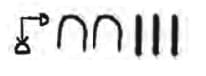
2. 1023
Let's break it down:
- 1 × 1,000
- 0 × 100
- 2 × 10
- 3 × 1
Representation:
3. 2660
Let's break it down:
- 2 × 1,000
- 6 × 100
- 6 × 10
- 0 × 1
Representation:

4. 784
Let's break it down:
- 7 × 100
- 8 × 10
- 4 × 1
Representation:

5. 1111
Let's break it down:
- 1 × 1,000
- 1 × 100
- 1 × 10
- 1 × 1
Representation:

6. 70707
Let's break it down:
- 7 × 10,000
- 0 × 1,000
- 7 × 100
- 0 × 10
- 7 × 1
Representation:

Q2: What numbers do these numerals stand for?
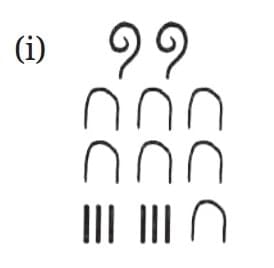
Ans: = (100 + 100) + (10 + 10 + 10 + 10 + 10 + 10 + 10 + 10 + 10 + 10) + (1 + 1 + 1) + (1 + 1 + 1) = 200 + 70 + 6 = 276.
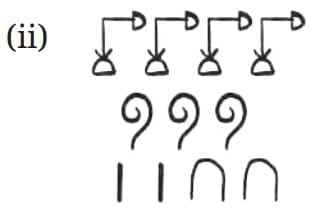
Ans: = (1000 + 1000 + 1000 + 1000) + (100 + 100 + 100) + (10 + 10) + (1 + 1) = 4000 + 300 + 20 + 2 = 4322.
Q: Express the number 143 in this new system.
Ans: Start grouping with the largest landmark smaller than 143, which is 53 = 125. Then 143 = 125 + 5 + 5 + 5 + 1 + 1 + 1. Using the standard symbols this becomes:

So 143 in the new base-5 system is shown as

Page 63
Figure it Out
Q1. Write the following numbers in the above base-5 system using the symbols in Table 2: 15, 50, 137, 293, 651.
Ans: Representing in base-5 system
1. 15
- 25 is too big.
- Largest power usable is 51 = 5, which fits three times (5 × 3 = 15).
- 15 = 5 + 5 + 5 = 3 × 5.
- Base-5 symbols:

2. 50
- Largest power 52 = 25 fits twice (25 × 2 = 50).
- 50 = 2 × 25, nothing left over.
- Base-5 symbols:

3. 137
- Largest power 53 = 125 fits once. 137 - 125 = 12.
- 51 = 5 fits twice in 12. 12 - 10 = 2.
- 50 = 1 fits twice more. So 137 = 125 + 5 + 5 + 1 + 1.
- Base-5 symbols:

4. 293
- 54 = 625 is too big.
- 53 = 125 fits twice → 250. Remaining 43.
- 52 = 25 fits once → remaining 18.
- 51 = 5 fits three times → remaining 3.
- 50 = 1 fits three times → remaining 0.
- Thus 293 = 125 + 125 + 25 + 5 + 5 + 5 + 1 + 1 + 1.
- Base-5 symbols:

5. 651
- 54 = 625 fits once. 651 - 625 = 26.
- 52 = 25 fits once. 26 - 25 = 1.
- 50 = 1 fits once. So 651 = 625 + 25 + 1.
- Base-5 symbols:

Q2. Is there a number that cannot be represented in our base-5 system above? Why or why not?
Ans: In the specific symbol set given, zero (0) cannot be represented because no symbol for zero was defined. Every positive integer can be represented using place value and the five symbols, but a separate symbol or convention is required to indicate the number zero or an empty place.
Q3. Compute the landmark numbers of a base-7 system. In general, what are the landmark numbers of a base-n system? The landmark numbers of a base-n number system are the powers of n starting from n0 = 1, n, n2, n3, ...
Ans: Landmark numbers of base-7:
- 7⁰ = 1
- 7¹ = 7
- 7² = 49
- 7³ = 343
- 7⁴ = 2401
In general, the landmark numbers of a base-n system are the powers of n: 1, n, n², n³, n⁴, ... - that is, n0, n1, n2, and so on.
Page 65
Figure it Out
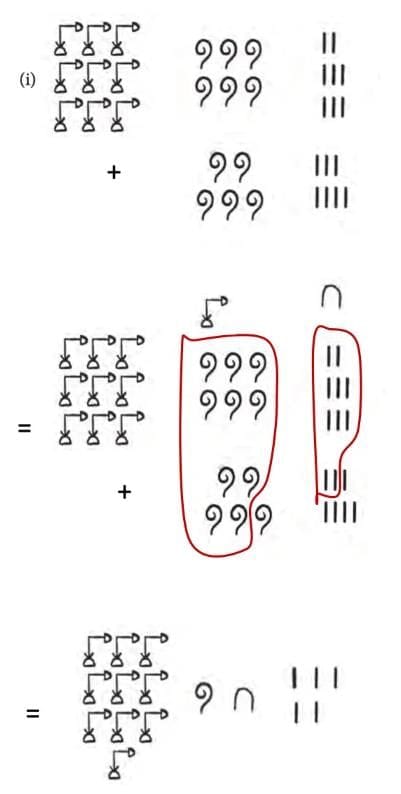
Q1. Add the following Egyptian numerals:
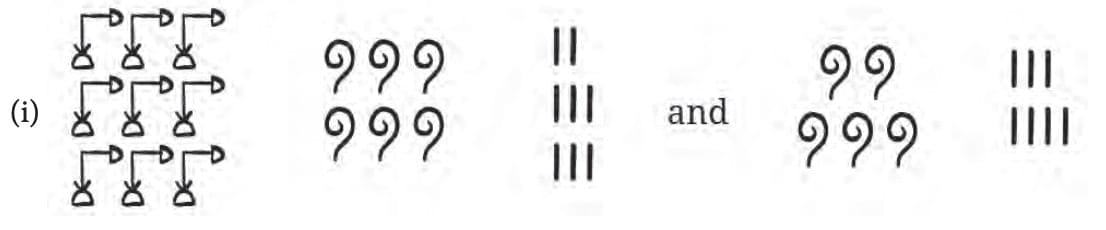
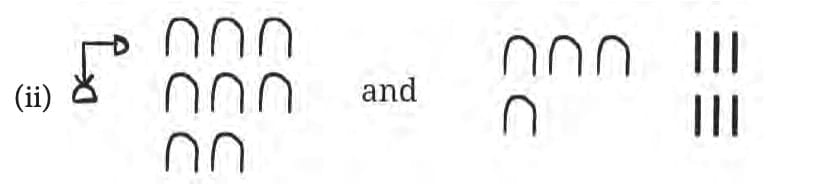
Ans:
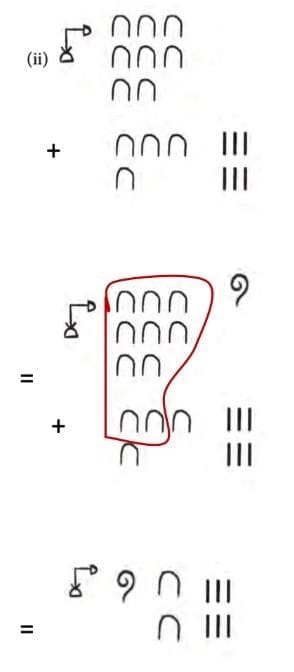
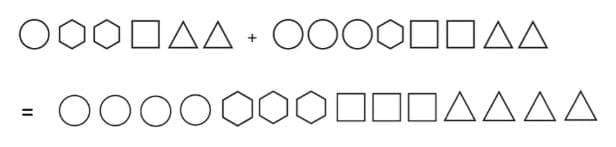
Q2. Add the following numerals that are in the base-5 system that we created:

Remember that in this system, 5 times a landmark number gives the next one!
Ans:
Page 66
Q: How to multiply two numbers in Egyptian numerals?
Let us first consider the product of two landmark numbers.
1. What is any landmark number multiplied by (that is 10)? Find the following products-

(i) 10 × 10 = 100
100 =

(ii) 100 × 10= 1,000
1,000 =

(iii) 1,000 × 10 = 10,000
10,000 =

(iv) 10,000 × 10 = 100,000
100,000 =

Each landmark number is a power of 10 and so multiplying it with 10 increases the power by 1, which gives the next landmark number.
2. What is any landmark number multiplied by (102)? Find the following products-

(i) 10 × 100 = 1,000
1,000 =

(ii) 100 × 100 = 10,000
10,000 =

(iii) 1,000 × 100 = 100,000
100,000 =

(iv) 10,000 × 100 = 1,000,000
1,000,000 =

Each landmark number represents a power of 10, so multiplying by 102 increases the power by 2, giving the landmark two steps higher.
Page 67
Q: Find the following products-

Here are the computations for each part:
(i) 10 × 100,000 = 1,000,000
1,000,000 =

(ii) 100 × 1,000 = 100,000
100,000 =

(iii) 1,000 × 1,000 = 1,000,000
1,000,000 =

(iv) 10,000 × 1,000,000 = 10,000,000,000 = 1010 =

Thus, the product of any two landmark numbers is another landmark number.
Q: Does this property hold true in the base-5 system that we created? Does this hold for any number system with a base?
Ans: Yes. This property holds in the base-5 system. Yes, this holds for any number system with a base.
In any place-value system, each landmark number is a power of the base:
- In base-10 → 10, 100, 1,000 are powers of 10
- In base-5 → 5, 25, 125 are powers of 5
When you multiply a landmark by the base, it moves to the next bigger landmark. This is true for any base-n system.
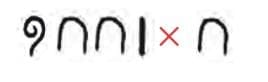
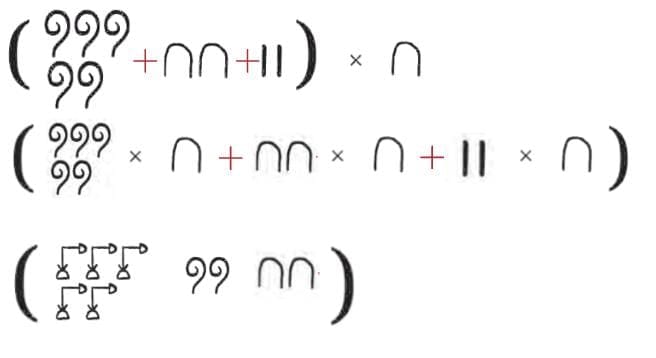
Q: What can we conclude about the product of a number and (10), in the Egyptian system?
(i)

Ans:
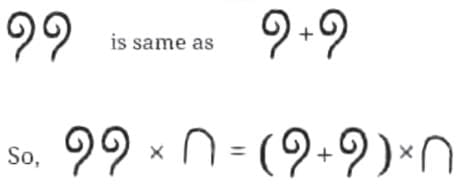
As these are numbers, the distributive law holds. So,
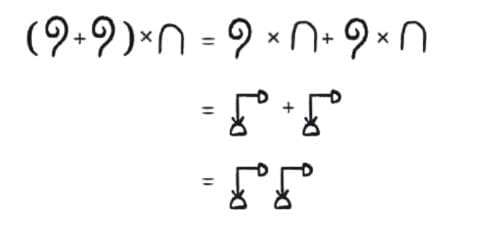
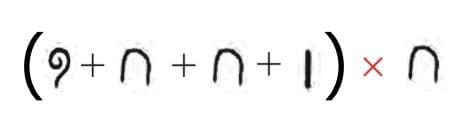
(ii)
Ans: We can expand

as

Applying the distributive property
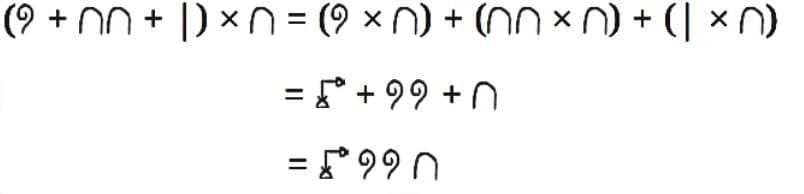
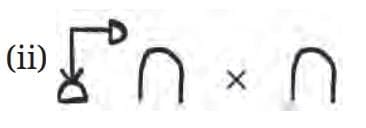
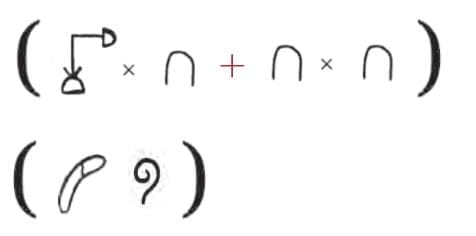
Now find the following products-
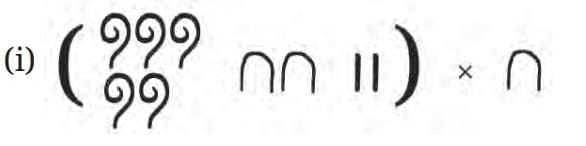
Ans: Applying the distributive property
Page 69-70
Figure it Out
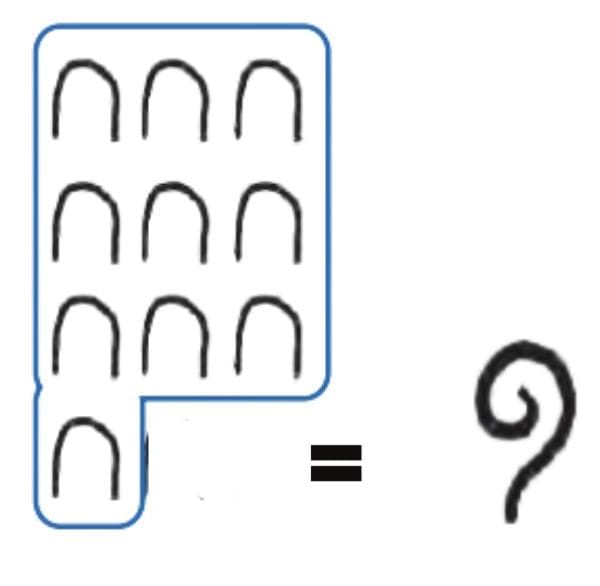
Q1. Can there be a number whose representation in Egyptian numerals has one of the symbols occurring 10 or more times? Why not?
Ans: No. Egyptian numerals use an additive system with separate symbols for 1, 10, 100, 1,000, etc. Each symbol is repeated at most nine times. When ten of a lower symbol would be needed, it is replaced by a single symbol of the next higher value (for example ten 10s are written as one 100). This keeps representations compact and avoids long repetitions.
Example:
- Nine arches (10s) = 90
- Ten arches (10s) would be written as one spiral (100), not 10 arches.
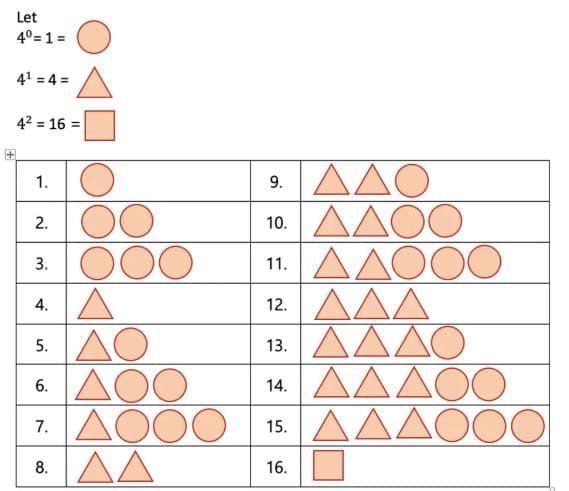
Q2. Create your own number system of base 4, and represent numbers from 1 to 16.
Ans:
Q3. Give a simple rule to multiply a given number by 5 in the base-5 system that we created.
Ans: The simple rule to multiply a number by 5 in the base-5 system is:
Rule: Add a zero symbol (A) at the end of the number.
In base-5, multiplying any number by 5 shifts all digits one place to the left and places a zero in the units place - exactly like appending a zero in base-10 when multiplying by 10.
Example:
Take BC (which represents 1×5 + 2 = 7 in decimal). Multiply by 5 by appending A → BCA. BCA in base-5 equals 7 × 5 = 35 in decimal.
Page 73
Figure it Out
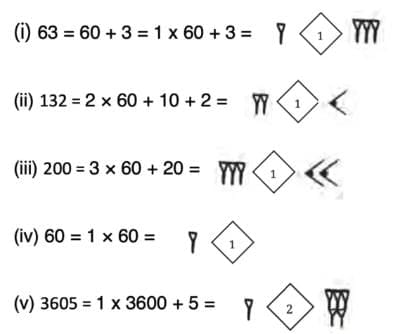
Q1. Represent the following numbers in the Mesopotamian system using-
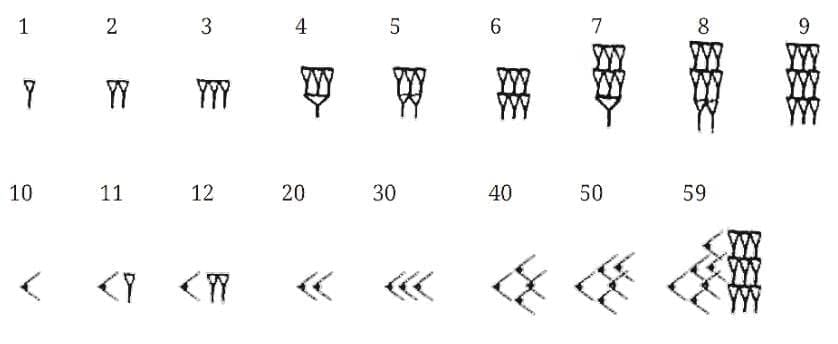
(i) 63
(ii) 132
(iii) 200
(iv) 60
(v) 3605
Ans:
Page 76
Q: Represent the following numbers using the Mayan system:
(i) 77
(ii) 100
(iii) 361
(iv) 721
Ans: Try it Yourself!
Page 80
Figure it Out
Q1. Why do you think the Chinese alternated between the Zong and Heng symbols? If only the Zong symbols were to be used, how would 41 be represented? Could this numeral be interpreted in any other way if there is no significant space between two successive positions?
Ans: Using Zong and Heng symbols:
The Chinese number system used Zong (vertical) and Heng (horizontal) symbols to make place value clear.
They alternated symbol direction at successive places (units, tens, hundreds) so the reader could distinguish positions even when spacing was small.
This alternation reduced the chance of misreading digits and clarified which symbols belonged to which place. In this system: 41 = 4 tens and 1 unit.
Using only Zong symbols, 41 would look like a group for '4' followed by one for '1' - shown as: IIII I. Without alternating direction or clear spacing, such writing could be misread; for example, IIIII might be mistaken for five units instead of '4 tens and 1 unit'. Direction and spacing therefore help preserve place value.
Q2. Form a base-2 place value system using 'ukasar' and 'urapon' as the digits. Compare this system with that of the Gumulgal's.
Ans: To form a base-2 place-value system using 'ukasar' and 'urapon', assign:
• 'ukasar' = 0
• 'urapon' = 1
This mirrors the binary system. Each position from right to left represents powers of 2: 2⁰ = 1, 2¹ = 2, 2² = 4, and so on. Numbers are formed by sequences of these two words. The Gumulgal system, by contrast, names particular numbers directly in their language and extends by combining words rather than relying on positional powers of 2; thus the binary system is compact for calculations while the Gumulgal naming is natural for counting tasks in daily life.
You can show examples of binary representations using 'ukasar' and 'urapon' in the same way as binary digits are written:
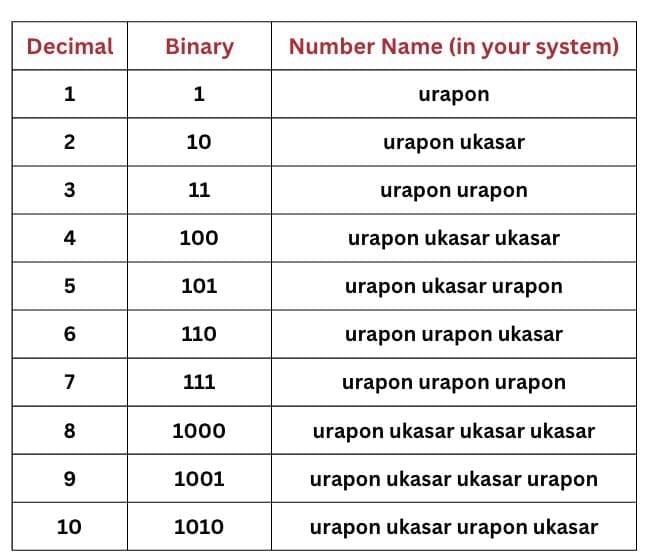
A group of indigenous people in Australia called the Gumulgal had the following words for their numbers.
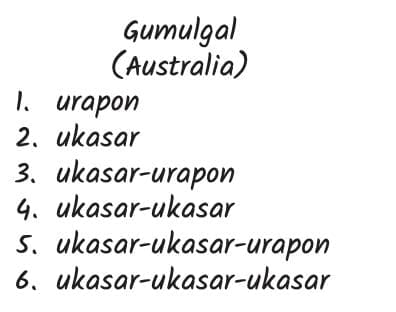
In the Gumulgal System, every number can be named in words; in the binary scheme, names are typically given only for certain patterns, while the positional form handles all numbers compactly.
Q3. Where in your daily lives, and in which professions, do the Hindu numerals, and 0, play an important role? How might our lives have been different if our number system and 0 hadn't been invented or conceived of?
Ans: Hindu numerals and the digit 0 are used everywhere: telling time, handling money, billing, measurements, pricing, phone numbers and arithmetic in school. Professions such as banking, accounting, engineering, science, medicine, computer science and commerce rely on this system. Without zero and a positional system, writing large numbers, performing calculations and developing modern technology would have been far more cumbersome. Many advances in science, engineering and computing depend on this compact and powerful notation.
If zero and the positional system had not been invented, record keeping, trade and technology would be slower and more error-prone; numerical methods and digital computing, which use place value and zero extensively, would be much harder to develop.
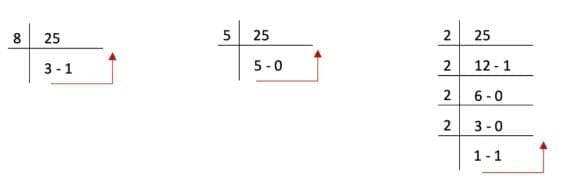
Q4. The ancient Indians likely used base 10 for the Hindu number system because humans have 10 fingers, and so we can use our fingers to count. But what if we had only 8 fingers? How would we be writing numbers then? What would the Hindu numerals look like if we were using base 8 instead? Base 5? Try writing the base-10 Hindu numeral 25 as base-8 and base-5 Hindu numerals, respectively. Can you write it in base-2?
Ans: If humans had 8 fingers, a natural choice would be base-8 (octal). The digit symbols would then represent 0-7 only. For base-8 the numerals are 0,1,2,3,4,5,6,7. For base-5 they would be 0,1,2,3,4.
Converting 25 (decimal):
- 25 in base-8 is 31 (because 3×8 + 1 = 25).
- 25 in base-5 is 50 (because 5×5 + 0 = 25).
- 25 in base-2 (binary) is 11001 (16 + 8 + 0 + 0 + 1 = 25).
FAQs on NCERT Solutions: A Story of Numbers
| 1. What are rational and irrational numbers in NCERT Class 8 Maths? |  |
| 2. How do I simplify square roots and cube roots for my Class 8 exams? | |
| 3. Why do we need to learn about exponents and powers in Class 8 Maths? | |
| 4. What's the difference between terminating and non-terminating decimals in CBSE? | |
| 5. How can I use number line representations to understand real numbers better? | |