NCERT Solutions: Pressure, Winds, Storms, and Cyclones

Probe and ponder (Page 79)
Q1: Why are winds stronger on some days than on others?
Ans: Winds are stronger on some days because the difference in air pressure between two regions is larger. Air moves from a region of high pressure to low pressure, and a greater difference in pressure causes stronger winds.
Q2: Why are water tanks usually placed at a height?
Ans: Water tanks are placed at a height so that water can flow down easily with pressure due to gravity, ensuring a steady supply to all parts of a building or area without needing extra pumping.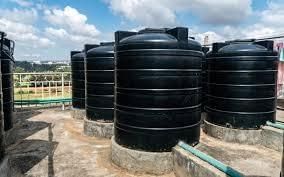 Water TanksQ3: Can air pressure really crush us?
Ans: No, air pressure cannot crush us because the pressure inside our bodies is equal to the air pressure outside. The atmosphere presses on us with great force, but our body fluids and gases push outward with the same amount of pressure, keeping everything balanced. That's why we don't feel the weight of the air or get crushed by it under normal conditions on Earth.
Ans: Storms and cyclones are formed when warm, moist air from the sea rises and cools, causing strong winds and heavy rain. The spinning of the Earth makes these winds rotate, forming a cyclone. If the Earth stopped rotating, there would be no spinning effect, so cyclones would not form, though normal storms could still happen.
Q5: Share your questions ________________
Ans: Possible questions you might ask after exploring these ideas:
- Why don't we feel atmospheric pressure even though it is so high?
- How do buildings and bridges withstand strong winds during storms?
- Do animals sense changes in air pressure before storms?
- What scientific instruments are used to measure wind speed and pressure?
- How do disaster warning systems work for cyclones?
InText (Page 83 - 88)
Q1: Do liquids also exert pressure? (Page 83)
Ans: Yes, liquids also exert pressure. The pressure from a liquid acts in all directions and increases with depth - the deeper you go, the greater the pressure.
Q2: What will happen to the bulge of the balloon if we increase the height of the water column? (Page 84)
Ans: If we increase the height of the water column, the bulge of the balloon will become bigger because the pressure of the water increases with height, pushing more strongly on the balloon.
Q3: Does the difference in air pressure have anything to do with the formation of winds? (Page 88)
Ans: Air moves from a high-pressure region to a low-pressure region. Moving air is called wind. Thus, it is the difference in air pressure that results in the formation of wind.
Keep the curiosity alive (Page 94)
Q1: Choose the correct statement.
(i) Look at Fig. 6.21 carefully. Vessel R is filled with water. When pouring of water is stopped, the level of water will be ____________________. 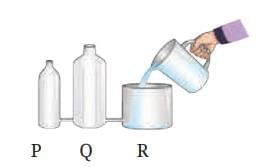 (a) the highest in vessel P
(b) the highest in vessel Q
(c) the highest in vessel R
(d) equal in all three vessels
Ans: (d) equal in all three vessels
The level of water in connected vessels (communicating vessels) will be the same regardless of shape, as liquid pressure depends on the height of the column, not the vessel's shape or width
(ii) A rubber sucker (M) is pressed on a flat smooth surface and an identical sucker (N) is pressed on a rough surface:
(a) Both M and N will stick to their surfaces.
(b) Both M and N will not stick to their surfaces.
(c) M will stick but N will not stick.
(d) M will not stick but N will stick.
Ans: (c) M will stick but N will not stick
The rubber sucker sticks due to atmospheric pressure creating a vacuum on a smooth surface. On a rough surface, air leaks in, preventing the vacuum and thus the sticking.
(iii) A water tank is placed on the roof of a building at a height 'H'. To get water with more pressure on the ground floor, one has to
(a) increase the height 'H' at which the tank is placed.
(b) decrease the height 'H' at which the tank is placed.
(c) replace the tank with another tank of the same height that can hold more water.
(d) replace the tank with another tank of the same height that can hold less water.
Ans: (a) increase the height 'H' at which the tank is placed
Liquid pressure increases with the height of the water column. Raising the tank increases the pressure, resulting in a stronger stream of water.
(iv) Two vessels, A and B contain water up to the same level as shown in Fig. 6.22. PA and PB is the pressure at the bottom of the vessels. FA and FB is the force exerted by the water at the bottom of the vessels A and B. 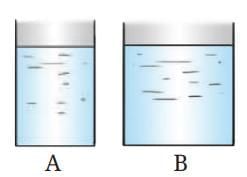 (a) PA = PB, FA = FB
(b) PA = PB, FA < FB
(c) PA < PB, FA = FB
(d) PA > PB, FA > FB
Ans: (b) PA = PB, FA < FB
Pressure at the bottom depends on the height of the water, which is the same in both vessels, so PA = PB. Force equals pressure times area; since vessel A is narrower (smaller area), FA < FB.
Q2: State whether the following statements are True [T] or False [F].
(i) Air flows from a region of higher pressure to a region of lower pressure. [ ]
(ii) Liquids exert pressure only at the bottom of a container. [ ]
(iii) Weather is stormy at the eye of a cyclone. [ ]
(iv) During a thunderstorm, it is safer to be in a car. [ ]
Ans: (i) True [T] - Air flows from a region of higher pressure to a region of lower pressure.
(ii) False [F] - Liquids exert pressure on the bottom, sides, and in all directions within a container.
(iii) False [F] - The eye of a cyclone is calm, with no stormy weather.
(iv) True [T] - During a thunderstorm, it is safer to be in a car, as it acts as a protective enclosure (like a Faraday cage) against lightning.
Q3: Fig. 6.23 a shows a boy lying horizontally, and Fig. 6.23b shows the boy standing vertically on a loose sand bed. In which case does the boy sink more in sand? Give reasons.
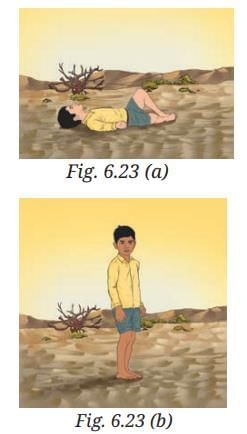
Ans: The boy in Figure (b) will sink more. The weight of the boy is the same, but in Fig. (a), the force (of the weight) is acting on a large area. The pressure in this case is less. In Fig. (b), the same force (of the weight) is acting on a small area. The pressure, therefore, is more. The boy will sink more into the sand in this case.
Q4: An elephant stands on four feet. If the area covered by one foot is 0.25 m2 , calculate the pressure exerted by the elephant on the ground if its weight is 20000 N.
Ans: Force (the weight) of the elephant acting on the ground = 20000 N
Area on the ground covered by the four feet of the elephant = 4 × 0.25 m2 = 1 m2
Pressure exerted by the elephant on the ground = Force / Area
= 20000 N / 1 m2 = 20000 Pa
Q5: There are two boats, A and B. Boat A has a base area of 7 m2 , and 5 persons are seated in it. Boat B has a base area of 3.5 m2 , and 3 persons are seating in it. If each person has a weight of 700 N, find out which boat will experience more pressure on its base and by how much?
Ans: Force of the weight of 5 persons acting on the base of boat A = 5 × 700 N = 3500 N
Base area of boat A = 7 m2
Pressure exerted on the base of boat A = Force / Area
= 3500 N / 7 m2
= 500 Pa
Force of the weight of 3 persons acting on the base of boat B = 3 × 700 N = 2100 N
Base area of boat B = 3.5 m2
Pressure exerted on the base of boat B = Force / Area
= 2100 N / 3.5 m2
= 600 Pa
Therefore, boat B will experience more pressure on its base by 100 Pa.
Q6: Would lightning occur if air and clouds were good conductors of electricity? Give reasons for your answer.
Ans: In case the air and the clouds were good conductors of electricity, the charges could not accumulate in the clouds (because they would flow into the air), there would be no charge buildup, which is necessary for lightning to occur. Therefore, if air and clouds were good conductors of electricity, lightning would not occur.
Q7: What will happen to the two identical balloons A and B as shown in Fig. 6.24 when water is filled into the bottle up to a certain height. Will both the balloons bulge? If yes, will they bulge equally? Explain your answer. 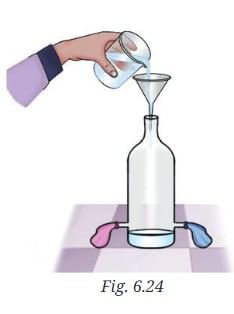 Ans: When water is filled into the bottle up to a certain height (sufficiently above the level of the entry points of water from the bottle) both the balloons will bulge. The entry points of water from the bottle to the balloons are at the same height. The balloons, being elastic, exert some force on the water. Assuming that the balloons are equally elastic, both balloons will bulge equally.
Q8: Explain how a storm becomes a cyclone.
Ans: A cyclone is a large, swirling storm system with strong winds and heavy rain. Not all storms become cyclones. Here's how it happens:
- Warm Ocean Water: Cyclones form over warm ocean waters (usually above 27°C). The heat from the water warms the air above it.
- Air Rises: Warm, moist air above the ocean rises upward, creating an area of low pressure below.
- More Air Rushes In: Surrounding air rushes into the low-pressure area to replace the rising air. As this air moves, it also picks up heat and moisture from the ocean.
- Rotation Begins:Due to the Earth's rotation (Coriolis effect), the air doesn't move straight in but starts to rotate, forming a spiral. In the Northern Hemisphere, it rotates counterclockwise, and in the Southern Hemisphere, clockwise.
- Formation of Cyclone: The rising warm air and spinning motion create a vortex. As more warm air rises, the system strengthens, forming a cyclone with a calm center called the eye and strong winds around it (the eye wall).
Q9: Fig. 6.25 shows trees along the sea coast in a summer afternoon. Identify which side is land- A or B. Explain your answer.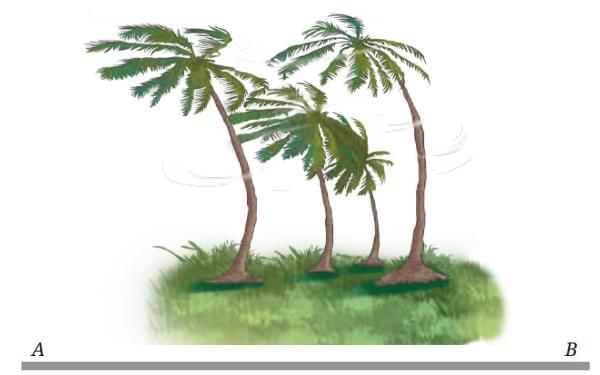 Ans: During the daytime on a summer afternoon, there is a sea breeze that blows from sea to land. This happens because the land gets heated faster and the air above land rises resulting in low-pressure region over land. Cooler air over sea moves from high- pressure region towards the land. The bending of trees due to wind, as shown in the figure, suggests that wind is blowing in the direction from B to A. This suggests 'A' side is land.
Q10: Describe an activity to show that air flows from a region of high pressure to a region of low pressure.
Ans: Activity to show that air flows from a region of high pressure to a region of low pressure.
Materials required: Two similar balloons made of thin rubber, a drinking straw, and some thread.
Procedure:
- Insert one end of the straw into one balloon and secure it with the thread.
- Inflate the second balloon and insert the free end of the straw into the neck of the inflated balloon, and secure it with the thread. (Ensure that the air from the inflated balloon does not leak.)
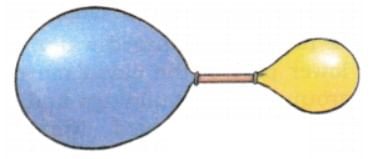
Observations: Some air moves from the inflated balloon to the uninflated balloon, and the sizes of both balloons change. After some time, both the balloons attain almost the same size, and the flow of air stops.
Conclusion: The inflated balloon has higher pressure inside it, and the uninflated balloon has low pressure inside. When the two balloons are connected through a straw, air moves from the high-pressure area (inside the inflated balloon) to the low-pressure area (inside the uninflated balloon).
Q11: What is a thunderstorm? Explain the process of its formation.
Ans: A Thunderstorm is a storm that produces thunder, lightning, heavy rain, and strong winds. It usually occurs during hot weather when the atmosphere becomes unstable.
A thunderstorm forms through the following steps:
- Warm air rises: The Sun heats the ground, and the warm air above it rises.
- Cloud formation: As the air rises, it cools, and water vapor forms cumulus clouds.
- Cloud grows: If the rising continues, the cloud grows into a tall cumulonimbus cloud.
- Lightning and thunder: Inside the cloud, water and ice particles collide, creating electric charges. These charges produce lightning, and the sudden heating of air causes thunder.
- Rain and wind: Water droplets fall as rain, often with strong winds.
Q12. Explain the process that causes lightning.
Ans: During a thunderstorm, warm air rises to high altitudes, where the low temperatures convert water droplets into ice particles. Strong upward and downward winds cause these ice particles and water droplets to rub against each other, generating electric charges.
- The ice particles become positively charged and move to the upper part of the cloud.
- The water droplets become negatively charged and stay in the lower part of the cloud.
The negative charges at the bottom of the cloud induce positive charges on the ground, trees, and buildings. Normally, air acts as an insulator, preventing the charges from meeting. But when the charge difference becomes very large, the insulating property of air breaks down, causing a sudden flow of charges known as lightning.
Lightning can occur within a cloud, between clouds, or between a cloud and the ground. The lightning heats the air rapidly, causing it to expand suddenly, producing a loud sound called thunder.
Q13: Explain why holes are made in banners and hoardings.
Ans: Holes are made in banners and hoardings so that wind can pass through them easily. This reduces the pressure of strong winds and prevents the banner from being blown away.
Discover, design, and debate (Page 97)
Q1: Hold a strip of paper, 18 cm long and 2 cm wide, between your thumb and forefinger so that it hangs freely. Predict what you will observe if you blow over the paper. Perform the activity now. Note down your observations and interpret your results.
Ans: Prediction: The paper strip may move upward when air is blown over it.
Observation: When air is blown over the paper, the paper strip rises upward.
Interpretation: Blowing air creates a low-pressure region above the paper. The higher air pressure below pushes the paper upward.
Q2: List three major cyclones which have occured in India in the last 20 years. List two major destruction caused by each of the cyclones. What measures were taken by the local government and communities to reduce the loss of life and destruction of property? Mention two suggestions you would like to propose to the local government.
Ans: Three Major Cyclones in India in the Last 20 Years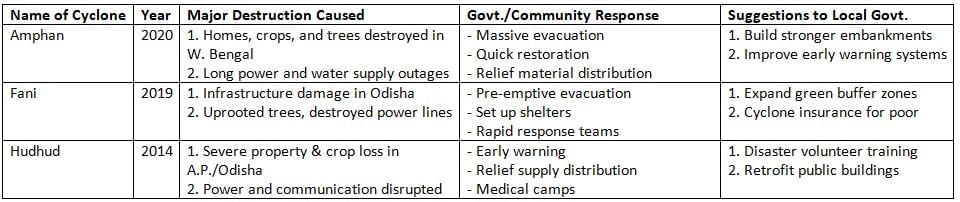 For all major cyclones, the Indian government has developed:
- The National Cyclone Risk Mitigation Project (NCRMP) to build cyclone shelters, strengthen infrastructure, and promote early warning dissemination.
- Community-based disaster management, where local volunteers are trained to assist in evacuations and first response.
Two suggestions for local governments:
- Invest in nature-based coastal defenses - restore and expand mangroves and climate-resilient embankments along the Sundarbans and other vulnerable coasts to reduce storm surge impact.
- Harden critical infrastructure & shelters - upgrade power/telecom lines (underground where feasible), strengthen cyclone shelters with WASH & medical capacity, and ensure resilient local microgrids for faster recovery.
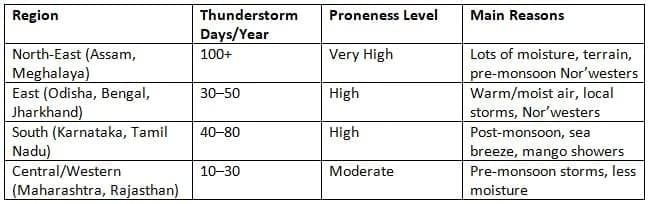
Q3: Collect data on the strength of thunderstorms for various regions of India. Compare your findings and identify which regions are more prone to thunderstorms. Can you give reasons for your findings?
Ans:
Regional Data:
- North-East India: Highest thunderstorm frequency, with some locations experiencing over 100 thunderstorm days per year (especially Assam, Meghalaya, Sub-Himalayan West Bengal).
- East India (Odisha, West Bengal, Jharkhand, Chhattisgarh, Bihar): 30-50 thunderstorm days/year; high intensity.
- Southern Peninsula (including Karnataka, Tamil Nadu): 60-80 thunderstorm days/year in some parts, with Bengaluru region averaging ~41 thunderstorm days and ~157 lightning events annually.
- Central/Western India: Lesser frequency but still significant, particularly during pre-monsoon.
Reasons for Regional Variation:
- North-East and eastern India: Thunderstorms, locally called "Nor'westers" (Kalboishakhi), are frequent in the pre-monsoon months due to high moisture, temperature, and terrain effects.
- Southern India: The convergence of Southwest and Northeast monsoon winds, abundant moisture, and heat creates ideal conditions for frequent and intense thunderstorms, especially post-monsoon.
- Coastal and foothill regions: Interaction between land and sea, rapid heating, and orographic uplift strengthen thunderstorm activity.
Thunderstorm Strength in Various Regions of India:
FAQs on NCERT Solutions: Pressure, Winds, Storms, and Cyclones
| 1. What is the difference between pressure and wind in the atmosphere? |  |
| 2. How do storms and cyclones form from pressure systems? | |
| 3. Why do winds always blow from high pressure to low pressure areas? | |
| 4. What are the main differences between storms and cyclones in Class 8 science? | |
| 5. How does atmospheric pressure affect weather patterns and climate conditions? | |





