UPSC Exam > UPSC Notes > Indian Polity CSE > Infographic: Citizenship
Infographic: Citizenship

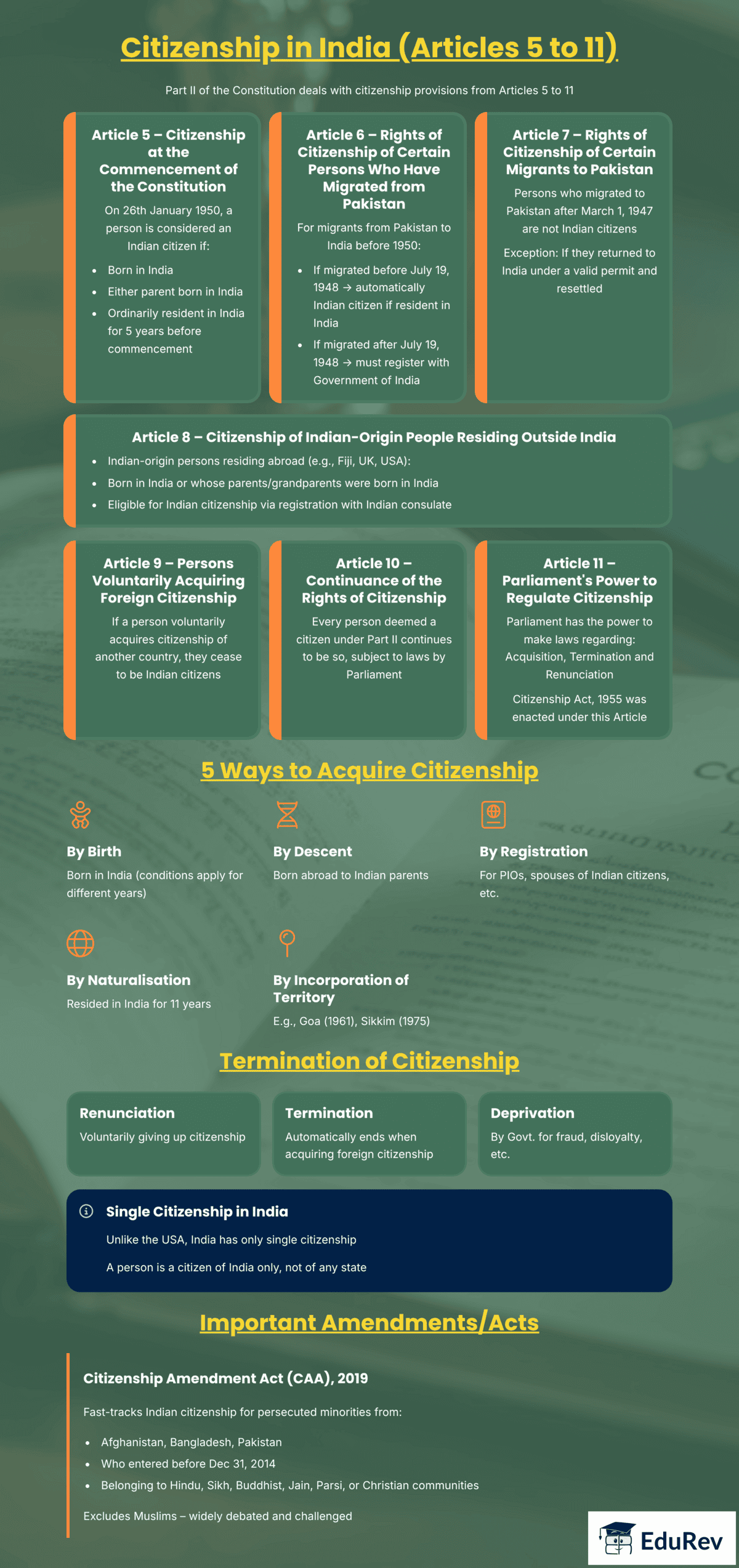
The document Infographic: Citizenship is a part of the UPSC Course Indian Polity for UPSC CSE.
All you need of UPSC at this link: UPSC
FAQs on Infographic: Citizenship
| 1. What is the significance of citizenship in the context of the UPSC exam? |  |
Ans. Citizenship is a fundamental concept in political science and public administration, making it crucial for UPSC aspirants. It represents the legal status of an individual as a member of a state, entailing rights and responsibilities. Understanding citizenship helps candidates grasp the principles of governance, constitutional rights, and social contracts, which are vital for various subjects, including Indian Polity and Governance.
| 2. What are the different types of citizenship recognized in India? | |
Ans. India recognizes several types of citizenship, primarily based on the Citizenship Act of 1955. The main types include: 1. Citizenship by birth: Individuals born in India before a certain date are citizens by birth. 2. Citizenship by descent: Individuals born to Indian parents outside India may acquire citizenship. 3. Citizenship by registration: People of Indian origin residing in other countries can register for Indian citizenship. 4. Citizenship by naturalization: Foreign nationals can acquire Indian citizenship under specific conditions set by the government.
| 3. How does the concept of citizenship relate to individual rights and duties in India? | |
Ans. Citizenship in India is closely linked to individual rights and duties, as enshrined in the Constitution. Citizens have fundamental rights, such as the right to equality, freedom of speech, and protection against discrimination. Alongside these rights, citizens also have duties, including respecting the Constitution, promoting harmony, and upholding the sovereignty of India. This relationship is essential for the functioning of democracy and social cohesion.
| 4. What role does the UPSC play in relation to citizenship and public administration? | |
Ans. The UPSC (Union Public Service Commission) plays a pivotal role in shaping the civil services of India, which are responsible for implementing government policies and upholding the rights of citizens. Through examinations, the UPSC ensures that candidates possess the requisite knowledge of citizenship laws and public administration principles, enabling them to serve effectively in various capacities within the government.
| 5. How can understanding citizenship enhance a candidate's performance in the UPSC exam? | |
Ans. A deep understanding of citizenship helps candidates articulate their knowledge on various exam topics related to governance, law, and human rights. It enables them to analyze issues critically, participate in discussions, and answer questions related to the Constitution and public policy effectively. This knowledge not only boosts their confidence but also equips them with the analytical skills necessary for interviews and group discussions, which are critical components of the UPSC selection process.
About this Document

4.86/5 Rating

Apr 18, 2026 Last updated
Related Exams
Document Description: Infographic: Citizenship for UPSC 2026 is part of Indian Polity for UPSC CSE preparation. The notes and questions for Infographic: Citizenship have been prepared according to the UPSC exam syllabus. Information about Infographic: Citizenship covers topics like and Infographic: Citizenship Example, for UPSC 2026 Exam. Find important definitions, questions, notes, meanings, examples, exercises and tests below for Infographic: Citizenship.
Introduction of Infographic: Citizenship in English is available as part of our Indian Polity for UPSC CSE for UPSC & Infographic: Citizenship in Hindi for Indian Polity for UPSC CSE course. Download more important topics related with notes, lectures and mock test series for UPSC Exam by signing up for free. UPSC: Infographic: Citizenship
Description
Infographic: Citizenship of Indian Polity provides you one-page visual summary of the chapter covering all the important topics. Download the PDF from EduRev.
Information about Infographic: Citizenship
In this doc you can find the meaning of Infographic: Citizenship defined & explained in the simplest way possible. Besides explaining types of Infographic: Citizenship theory, EduRev gives you an ample number of questions to practice Infographic: Citizenship tests, examples and also practice UPSC tests



Related Searches
mock tests for examination, Previous Year Questions with Solutions, Extra Questions, video lectures, Free, Infographic: Citizenship, Objective type Questions, pdf , Infographic: Citizenship, Semester Notes, Exam, Viva Questions, study material, Sample Paper, MCQs, ppt, Summary, Important questions, past year papers, shortcuts and tricks, Infographic: Citizenship, practice quizzes;