UPSC Exam > UPSC Notes > Indian Polity CSE > Infographic: Fundamental Rights
Infographic: Fundamental Rights

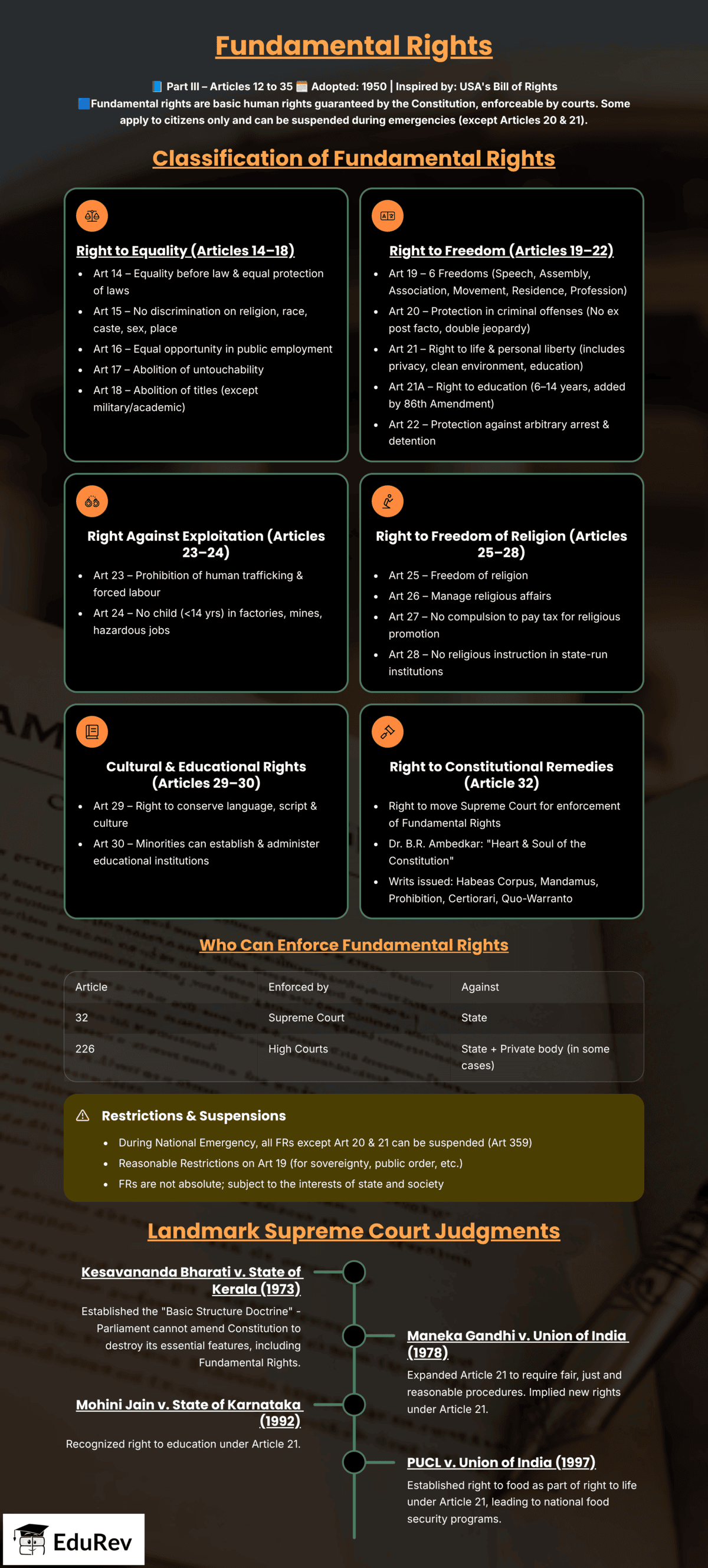
The document Infographic: Fundamental Rights is a part of the UPSC Course Indian Polity for UPSC CSE.
All you need of UPSC at this link: UPSC
FAQs on Infographic: Fundamental Rights
| 1. What are the Fundamental Rights guaranteed by the Constitution of India? |  |
Ans. The Fundamental Rights guaranteed by the Constitution of India include the Right to Equality, Right to Freedom, Right against Exploitation, Right to Freedom of Religion, Cultural and Educational Rights, and Right to Constitutional Remedies. These rights, enshrined in Part III of the Constitution, are essential for the development of individuals and the promotion of social justice.
| 2. How do Fundamental Rights differ from Directive Principles of State Policy? | |
Ans. Fundamental Rights are justiciable, meaning they can be enforced in a court of law, and they protect individual liberties against state infringement. Directive Principles of State Policy, on the other hand, are non-justiciable; they are guidelines for the state to promote social and economic welfare and are meant to be implemented progressively. While both aim to create a just society, Fundamental Rights prioritize individual freedoms, whereas Directive Principles focus on broader social goals.
| 3. What is the significance of the Right to Constitutional Remedies? | |
Ans. The Right to Constitutional Remedies is a crucial Fundamental Right that allows individuals to approach the Supreme Court or High Courts to seek enforcement of their Fundamental Rights. This right ensures that citizens can seek judicial intervention if they believe their rights have been violated, thus serving as a safeguard against arbitrary state action.
| 4. Can Fundamental Rights be suspended, and if so, under what circumstances? | |
Ans. Yes, Fundamental Rights can be suspended during a national emergency as declared under Article 352 of the Constitution. However, certain rights, like the Right to Life and Personal Liberty under Article 21, cannot be suspended even during an emergency. The procedure for such suspension must be laid down by law, and it is subject to judicial review.
| 5. How have the courts interpreted the Fundamental Rights over time? | |
Ans. The courts in India have played a pivotal role in interpreting Fundamental Rights, often expanding their scope through landmark judgments. The judiciary has emphasized the need for a dynamic interpretation to adapt to changing social conditions. For instance, the Right to Privacy has been recognized as a part of the Right to Life and Personal Liberty, showcasing the evolving nature of these rights in the context of contemporary issues.
About this Document

4.74/5 Rating

Apr 18, 2026 Last updated
Related Exams
Document Description: Infographic: Fundamental Rights for UPSC 2026 is part of Indian Polity for UPSC CSE preparation. The notes and questions for Infographic: Fundamental Rights have been prepared according to the UPSC exam syllabus. Information about Infographic: Fundamental Rights covers topics like and Infographic: Fundamental Rights Example, for UPSC 2026 Exam. Find important definitions, questions, notes, meanings, examples, exercises and tests below for Infographic: Fundamental Rights.
Introduction of Infographic: Fundamental Rights in English is available as part of our Indian Polity for UPSC CSE for UPSC & Infographic: Fundamental Rights in Hindi for Indian Polity for UPSC CSE course. Download more important topics related with notes, lectures and mock test series for UPSC Exam by signing up for free. UPSC: Infographic: Fundamental Rights
Description
Infographic: Fundamental Rights of Indian Polity provides you one-page visual summary of the chapter covering all the important topics. Download the PDF from EduRev.
Information about Infographic: Fundamental Rights
In this doc you can find the meaning of Infographic: Fundamental Rights defined & explained in the simplest way possible. Besides explaining types of Infographic: Fundamental Rights theory, EduRev gives you an ample number of questions to practice Infographic: Fundamental Rights tests, examples and also practice UPSC tests



Related Searches
Semester Notes, practice quizzes, mock tests for examination, shortcuts and tricks, pdf , Objective type Questions, Exam, Infographic: Fundamental Rights, study material, Sample Paper, Viva Questions, Free, video lectures, Extra Questions, ppt, Important questions, past year papers, Previous Year Questions with Solutions, Infographic: Fundamental Rights, Summary, Infographic: Fundamental Rights, MCQs;