NCERT Solutions: Keeping Time with the Skies

Probe and Ponder (Page 170)
Q1: Have you ever seen the Moon during the day? Why do you think it is sometimes visible when the Sun is up?
Ans: Yes, the Moon can often be seen during the day, especially in its waxing and waning phases. This happens because the Moon reflects sunlight, and during certain phases it is high enough in the sky while the Sun is also above the horizon, so the bright part of the Moon is visible to us.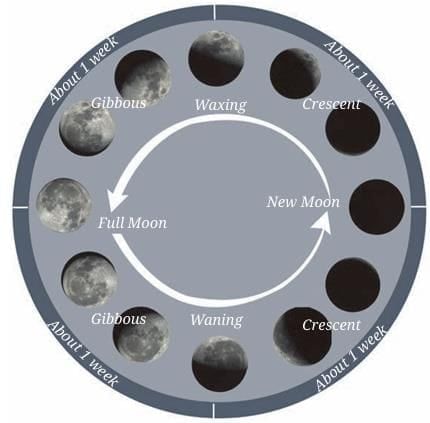 Waxing (Shukla Paksha) and waning period (Krishna Paksha) of the Moon as viewed from the Earth
Q2: Imagine you lived on the Moon instead of Earth. What would you mean by a day, a month or a year?
Ans:
- A day on the Moon (from one sunrise to the next) would be about 29.5 Earth days.
- A month might be defined by one complete orbit around Earth (which is also about 27.3 Earth days).
- A year is the time the Earth takes to complete one orbit around the Sun, which you could still observe from the Moon in about 365 Earth days.
Q3: What would happen if Earth had two moons instead of one? How would that change the night sky?
Ans: If Earth had two moons:
- The night sky would be brighter and more dynamic.
- There could be more frequent eclipses.
- The gravitational pull on Earth would be different, possibly affecting tides.
- The two moons might cross paths, creating fascinating views or even risks of collision over long periods.
Q4: If we didn't have clocks or calendars, how else could we measure time?
Ans: We could measure time by:
- Observing the position of the Sun (sunrise, noon, sunset).
- Using the phases of the Moon to count months.
- Tracking stars and constellations that change with the seasons.
- Using natural events, like plant flowering or animal behaviour, to mark the passage of time.
Q5: Share your questions
Ans: Here are some fun questions from the chapter:
- Why does the Moon change shapes?
- How do festivals link to Moon phases?
- Can we see satellites at night?
- Why do some calendars add extra days?
Intext (Pages 174 - 185)
Q1: Why does the illuminated portion of the Moon seen from the Earth decrease when it appears closer to the Sun? (Page 174)
Ans: The Moon does not have its own light; it shines because it reflects sunlight that falls on it.
When the Moon appears closer to the Sun in the sky, the side of the Moon that is illuminated by the Sun faces away from the Earth. As a result, from Earth we can see only a smaller part of the bright portion, and most of the Moon's surface visible to us is dark.
That is why the illuminated portion of the Moon seen from Earth decreases when it comes closer to the Sun - it appears as a crescent Moon and finally becomes invisible on the new Moon day.
Q2: So, changing phases of the Moon is a natural periodic event, with a cycle of almost a month, which can also be used for time keeping. Yes, along with the natural periodic events of day and night and the changing seasons about which we learnt earlier. But how are these periodic events used for keeping time? (Page 178)
Ans: The natural periodic events - like day and night, phases of the Moon, and changing seasons - help us measure time because they repeat regularly after fixed intervals.
Day and Night:
The rotation of the Earth on its axis causes day and night. One complete rotation takes 24 hours, which is used to define one day.Phases of the Moon:
The Moon revolves around the Earth and completes one full cycle of phases (from one full Moon to the next) in about 29.5 days, which forms the basis of a month.Changing Seasons:
The Earth revolves around the Sun once in about 365 days. This regular change in the position of the Earth causes seasons and gives us a year.
Thus, these periodic motions of celestial bodies - the Earth and the Moon - act as natural clocks and calendars that humans have used for keeping time since ancient times.
Q3: Why do most Indian festivals fall on different dates every year? (Page 183)
Ans: Most Indian festivals are based on the phases of the Moon and are decided according to the lunar or luni-solar calendars, not the regular Gregorian solar calendar that we use daily.
A lunar month is about 29.5 days, and a lunar year (12 lunar months) has about 354 days, which is 11 days shorter than the solar year of 365 days.
Because of this difference, festivals like Diwali, Holi, Eid-ul-Fitr, and Buddha Purnima, which follow the Moon's phases, appear on different Gregorian calendar dates each year.
To adjust this difference, the luni-solar calendars sometimes add an extra month called Adhika Maasa (extra month) every few years, which helps keep the festivals in the same season.
Q4: When I look at the night sky in early evening, I see some moving stars. What are they? Is their motion also periodic? (Page 185)
Ans: The moving "stars" seen in the night sky are actually artificial satellites, not real stars. These are man-made objects launched into space that revolve around the Earth. They reflect sunlight, which is why they appear as small moving points of light in the sky.
Yes, their motion is periodic.
Each satellite orbits the Earth in a fixed path and takes about 100 minutes to complete one round.
Artificial satellites are used for communication, weather forecasting, navigation, disaster management, and scientific research.
Keep the curiosity alive (Page 187)
Q1: State whether the following statements are True [T] or False [F].
(i) We can only see that part of the Moon which reflects sunlight towards us.
(ii) The shadow of Earth blocks sunlight from reaching the Moon causing phases.
(iii) Calendars are based on various astronomical cycles which repeat in a predictable manner.
(iv) The Moon can only be seen at night.
Ans: (i) True. We can only see the part of the Moon that reflects sunlight towards Earth.
(ii) False. The Earth's shadow causes lunar eclipses, not the regular phases of the Moon.
(iii) True. Calendars are based on repeating astronomical events like day-night, Moon phases, and seasons.
(iv) False. The Moon can also be seen during the daytime, depending on its phase and position in the sky.
Q2: Amol was born on 6th of May on a full Moon day. Does his birthday fall on the full Moon day every year? Explain your answer.
Ans: No, Amol's birthday does not fall on a full Moon Day every year. This is because the Moon's phases follow a lunar cycle of about 29.5 days, while the calendar year follows the solar cycle of about 365 days. So, the date of the full Moon changes each year in the Gregorian calendar.
Q3: Name two things that are incorrect in Fig. 11.10.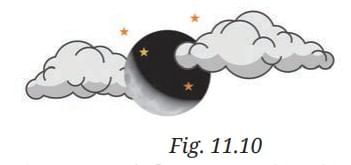 Ans: Two incorrect things are:
- Stars are shown near the Moon during the daytime, which is incorrect because stars are not visible in the daytime sky.
- The Moon's dark part is shaded incorrectly. The phases are caused by the Moon's position, not Earth's shadow.
Q4: Look at the pictures of the Moon in Fig. 11.11, and answer the following questions.
(i) Write the correct panel number corresponding to the phases of the Moon shown in the pictures above.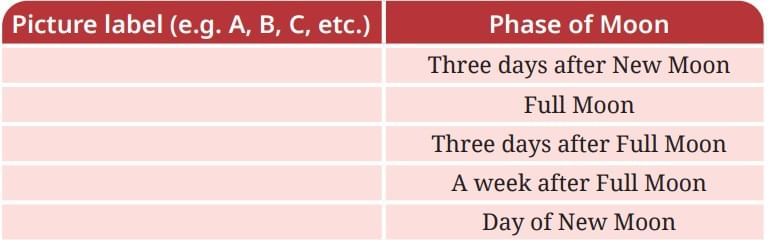
Ans: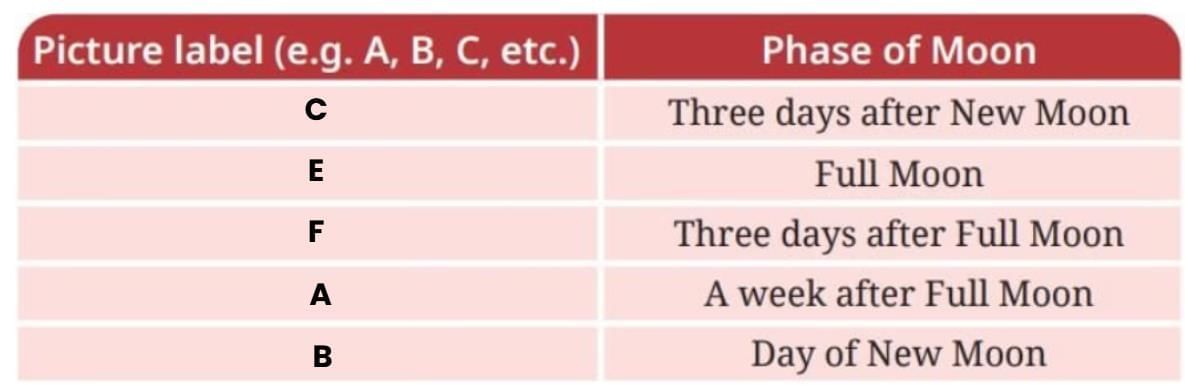
(ii) List the picture labels of the phases of the Moon that are never seen from Earth. Hint: You can use your observations from Activity 11.1 or Fig. 11.2 as reference.
Ans: Picture B (New Moon phase) is never seen from Earth because the illuminated side of the Moon is facing away from us.
Q5: Malini saw the Moon overhead in the sky at sunset.
(i) Draw the phase of the Moon that Malini saw.
(ii) Is the Moon in the waxing or the waning phase?
Ans:
(i) At sunset, the Moon is overhead only during the first quarter (a week after New Moon), when the right half is illuminated. So, we need to draw a half Moon (right half bright, left half dark). (ii) Waxing phase (because it occurs after New Moon and the bright part is increasing).
Q6: Ravi said, "I saw a crescent Moon, and it was rising in the East, when the Sun was setting." Kaushalya said, "Once I saw the gibbous Moon during the afternoon in the East." Who out of the two is telling the truth?
Ans: Kaushalya is telling the truth because gibbous Moons can be seen in the East during the afternoon. Ravi's statement is incorrect because Crescent Moons do not rise in the East at sunset. A crescent Moon appears just after the New Moon (waxing crescent) or just before the New Moon (waning crescent). Waxing crescent is visible after sunset in the western sky, not rising in the east, and waning crescent rises just before sunrise, not at sunset.
Q7: Scientific studies show that the Moon is getting farther away from the Earth and slower in its revolution. Will luni-solar calendars need an intercalary month more often or less often?
Ans: Less often. If the Moon's orbital period grows longer, one lunar month and therefore a lunar year would lengthen slightly. That makes the lunar year closer to the solar year, so an extra month (Adhika Maasa) would be needed less frequently to keep the luni-solar calendar in step with the seasons.
Q8: A total of 37 full Moons happen during 3 years in a solar calendar. Show that at least two of the 37 full moons must happen during the same month of the solar calendar.
Ans: Yes, at least two full Moons must happen in the same solar month.
- A solar calendar has 12 months × 3 years = 36 months.
- 37 full Moons in 36 months, at least one month must have 2 full Moons.
Q9: On a particular night, Vaishali saw the Moon in the sky from sunset to sunrise. What phase of the Moon would she have noticed?
Ans: As the Moon is visible all night long only on a Full Moon, it is a Full Moon.
Q10: If we stopped having leap years, in approximately how many years would the Indian Independence day happen in winter?
Ans: One leap year adds ~1 day every 4 years.
Without leap years, the calendar shifts by 1 day every 4 years.
There are roughly 183 days between 15 August (monsoon) and winter (mid-February).
183 days × 4 = 732 years
In approximately 730-732 years, 15 August would occur in winter.
Q11: What is the purpose of launching artificial satellites?
Ans: Artificial satellites are launched for:
- Communication
- Navigation
- Weather monitoring
- Scientific research
- Disaster management
- Earth observation
Q12: On which periodic phenomenon are the following measures of time based: (i) day (ii) month (iii) year?
Ans: (i) Day → Earth's rotation
(ii) Month → Moon's revolution (phases of the Moon)
(iii) Year → Earth's revolution around the Sun.
Discover, design, and debate
Q1: The Moon's crescent always faces towards the Sun (Fig. 11.12). On days when you see the crescent Moon, point your finger towards the Sun, and slowly move it across the sky towards the Moon taking as short a path as you can. Note how your finger always crosses the illuminated part of the Moon first and clearly shows us that we see sunlight reflected off the Moon. The line joining the tips of the crescent would correspond to the diameter of the Moon. 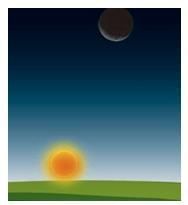
Ans: This is a fun way to prove the Moon shines by reflecting sunlight! Try it on a clear evening when the crescent Moon is visible (like during the waxing phase). Point at the Sun (but do not look directly at the Sun; shade your eyes with your hand), then swing your finger straight to the Moon. You'll see your finger path goes through the bright, curved side first-that's the part lit by the Sun. The tips of the crescent form an imaginary line that's like the Moon's full diameter, always pointing towards the Sun. It shows the Moon isn't glowing on its own; it's just bouncing back sunlight, and we only see the lit-up bits depending on its position.
Q2: Most of the dates in the Indian National Calendar always map to the same dates in the Gregorian calendar. Can you find out which ones may differ for certain years?
Ans: The Indian National Calendar (Saka calendar) is a solar calendar that starts on March 22 most years, lining up pretty well with the Gregorian calendar (the one we use daily). For example, Chaitra 1 is usually March 22, and other months follow similarly. But in leap years (like 2024 or 2028 in Gregorian), the Saka year might start on March 21 instead, so dates in Chaitra (the first month) can shift by one day. This happens because leap years add an extra day to keep things in sync with the seasons. Check a calendar app or website to compare-it's cool how they mostly match but tweak for accuracy!
Q3: Different states in India celebrate the New Year according to their local cultures. Find out the names of the New Year festival celebrated in any 10 states of India. Also find out whether it is based on the lunar calendar or the solar calendar or the lunisolar calendar.
Ans: India has so many ways to celebrate the New Year, tied to local traditions and calendars! Here's a list of 10 states with their festivals and calendar types (I picked a mix from across India):
- Andhra Pradesh: Ugadi (luni-solar calendar-uses Moon phases but adjusts for seasons).
- Punjab: Baisakhi (solar calendar-based on the Sun's position and harvest time).
- West Bengal: Pohela Boishakh (solar calendar-starts with the Bengali solar year).
- Maharashtra: Gudi Padwa (luni-solar calendar-begins after the new Moon in Chaitra).
- Kerala: Vishu (solar calendar-marks the Sun entering Aries, around April 14-15).
- Tamil Nadu: Puthandu (solar calendar-based on the Tamil solar year, usually April 14).
- Assam: Bohag Bihu (solar calendar-celebrates the Assamese solar new year in April).
- Manipur: Cheiraoba (luni-solar calendar-starts after the full Moon in March/April).
- Odisha: Pana Sankranti (solar calendar-begins when the Sun enters Aries).
- Karnataka: Yugadi (luni-solar calendar-similar to Ugadi, with Moon and season sync).
These festivals often include yummy food, dances, and family time, showing how the Sun and Moon help time our celebrations! You can look up more on a map or ask family from different states.
Q4: Collect Gregorian calendars (the regular calendar you use every day) for the last five years with the help of your family members or teachers or the internet. For each year, look for the dates on which the festivals Eid-ul-Fitr and Diwali were celebrated and list them year wise in a tabular form. Do you notice that the date of Eid-ul-Fitr moves earlier each year- by about 11 days? If you have a corresponding lunar calendar at home or on the internet, check that the month and the day for Eid-ul-Fitr according to the lunar calendar remains the same. Does Diwali follow the same steady pattern, or are there some sudden jumps? Based on your chart, try to guess which year might have included an intercalary month (Adhikamaasa). Obtain a luni-solar calendar and confirm if there is an intercalary month between Diwali in the previous year and that year.
Ans: This is a great activity to see how festivals move on our regular (Gregorian) calendar because of lunar cycles! On checking the dates for the last five years (2020-2024) using reliable sources. Here's a table with the dates: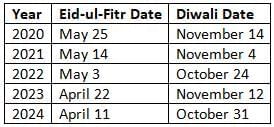
Yes, Eid-ul-Fitr moves earlier by about 10-11 days each year! For example, from 2020 (May 25) to 2021 (May 14) is 11 days earlier. This happens because it's based on a pure lunar calendar, which is shorter than the solar year by about 11 days. If you check a lunar calendar (like the Islamic Hijri one), Eid-ul-Fitr is always on the 1st of Shawwal, right after Ramadan ends-it stays the same in the lunar system.
Diwali doesn't follow a steady backward shift like Eid; it has some jumps! Look at 2022 (October 24) to 2023 (November 12)-that's a jump forward by about 19 days instead of moving back. Based on the chart, I guess 2023 had an intercalary month (Adhikamaasa) because Diwali shifted later than usual. When I checked a luni-solar calendar (like the Hindu Panchang), yes, there was an extra Ashadha month from July 18 to August 16 in 2023. This extra month keeps the calendar in sync with seasons and explains the jump. Try making your own table and spotting patterns-it's like being a calendar detective!
Q5: Every morning on your way to school, notice the direction in which the Sun rises. Decide on a spot and look towards east, with trees, poles, or buildings acting as markers. Sketch the eastern horizon in your notebook. For the next one year, at the start of each month, stand at the same spot and mark the Sun's position on your sketch. Label it with the name of the month. At the end of the year analyse your sketch. Do you find that the positions of sunrise shift in particular direction? Can you identify it with the Uttarayaan and Dakshinayaan that our ancestors noticed? (Refer the 'A step further' box on page 181).
Ans: This activity shows how the Sun's rising point changes through the year. Choose a fixed spot facing east with clear markers and mark the Sun's position at sunrise each month.
You will notice that the sunrise position moves northward from around December to June (Uttarāyan) when days lengthen, and it moves southward from around June to December (Dakshināyan) when days shorten.
On the equinoxes (around 21 March and 23 September) the Sun rises almost exactly in the east. This pattern happens because the Earth's axis is tilted while it orbits the Sun and it matches the observations our ancestors used to track seasons.
FAQs on NCERT Solutions: Keeping Time with the Skies
| 1. How do the Sun and Moon help us keep track of time in our daily lives? |  |
| 2. What's the difference between the solar day and the sidereal day in astronomy? | |
| 3. Why do we need leap years, and how does this connect to Earth's orbit around the Sun? | |
| 4. How does the Moon's position in the sky change throughout the month, and what causes lunar phases? | |
| 5. What are some practical ways ancient civilizations used celestial observations to create calendars and timekeeping systems? | |