NCERT Solutions: How Nature Works in Harmony

Probe and Ponder (Page 190)
Q1. How might the loss of forest cover and changes in rainfall patterns lead to elephants entering human farms and villages?Ans: The loss of forest cover reduces vegetation and habitat space for elephants. Additionally, changes in rainfall patterns can lead to the drying up of waterholes, making food and water scarce in their natural habitats. Consequently, elephants may wander into nearby farms and villages in search of food, such as crops like bananas and sugarcane. This behaviour can lead to crop damage and pose potential risks to both humans and animals.
Q2. Imagine you are a tree in a dense forest. What kind of relationships would you have with water, sunlight, other animals, and other components of the forest?
Ans: As a tree, I would:
- Water: Absorb water from the soil for photosynthesis and growth.
- Sunlight: Use sunlight to produce food via photosynthesis.
- Other Animals: Provide shelter, food (fruits, leaves), and oxygen for animals; animals like birds and insects aid in pollination and seed dispersal.
- Other Components: Interact with soil for nutrients and stability, contribute to air quality by releasing oxygen, and help retain soil moisture to prevent erosion.
Q3. Do you think the Earth can thrive without humans? Can humans survive without the Earth?
Ans: Earth without humans: Yes, the Earth can thrive without humans. Ecosystems, such as forests and aquatic systems, operate through natural interactions, such as food chains and nutrient cycling, without human intervention. Protected areas like national parks demonstrate that ecosystems can self-sustain. Humans without Earth: No, humans cannot survive without the Earth, as they rely on ecosystems for essential resources such as air, water, and food.
Q4. If two kinds of birds compete for the same fruit, how might their way of living change over time?
Ans: Competition between two bird species for the same fruit can lead to several adaptations over time. This phenomenon may result in niche differentiation, where each species alters its behaviour to minimise competition.
- One species might adapt by feeding at different times of the day.
- Another might target different parts of the fruit tree.
- Over generations, these adaptations could lead to distinct beak shapes or feeding behaviours.
- If one species becomes dominant, the other may be forced to seek alternative food sources or habitats.
Q5. Can human actions cause natural disasters?
Ans: Human actions cannot directly create natural disasters, but they can increase their frequency and severity. For example, deforestation can lead to floods and landslides by loosening soil, and climate change can make storms and droughts more intense. Thus, human activities can worsen the impact of natural disasters.
Q6. Share your questions
Ans:
- How does climate change affect ecosystems and food chains?
- What happens if one species becomes extinct in an ecosystem?
- How do human activities disturb ecological balance?
- Why is biodiversity important for ecosystem stability?
Keep the Curiosity Alive (Page 207 - 208)
Q1. Refer to the given diagram (Fig. 12.19) and select the wrong statement.(i) A community is larger than a population.
(ii) A community is smaller than an ecosystem.
(iii) An ecosystem is part of a community.
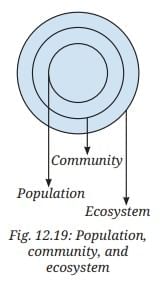
Ans: The wrong statement is: (iii) An ecosystem is part of a community. This is incorrect because a community is part of an ecosystem, not the reverse.
To select the incorrect statement regarding the relationships between a community, population, and ecosystem, consider the following:
- (i) A community is larger than a population.
- (ii) A community is smaller than an ecosystem.
- (iii) An ecosystem is part of a community.
Q2. A population is part of a community. If all decomposers suddenly disappear from a forest ecosystem, what changes do you think would occur? Explain why decomposers are essential.
Ans: Changes: The accumulation of dead plants and animals would occur, as nutrients would not return to the soil. This would lead to a decline in plant growth, ultimately reducing the populations of herbivores and carnivores due to food scarcity. Why Decomposers Are Essential: Decomposers, such as fungi and bacteria, are crucial because they break down dead matter into simpler substances. This process recycles nutrients, like nitrogen and carbon, back into the soil, making them available for plants. Without decomposers, the nutrient cycle would halt, disrupting the entire food web.
Q3. Selvam from Cuddalore district, Tamil Nadu, shared that his village was less affected by the 2004 Tsunami compared to nearby villages due to the presence of mangrove forests. This surprised Sarita, Shabnam, and Shijo. They wondered if mangroves were protecting the village. Can you help them understand this?
Ans: Yes, mangroves protected the village. Mangrove forests serve as natural barriers, slowing down strong winds and waves during storms and tsunamis. Their roots help to stabilize soil, which reduces erosion, and they absorb the impact of water, thereby protecting coastal areas. An excellent example of this protective role is the Sundarbans mangroves, which are a World Heritage Site. These forests demonstrate how mangroves can effectively shield nearby communities from the devastating effects of natural disasters.
Q4. Look at this food chain: Grass → Grasshopper → Frog → Snake. If frogs disappear from this ecosystem, what will happen to the population of grasshoppers and snakes? Why?
Ans: If frogs disappear from this ecosystem, the grasshopper population will increase significantly. This is because frogs are their natural predators; without frogs, there will be no control over the grasshoppers' numbers. Conversely, the snake population will likely decrease. Frogs constitute a major part of their diet, and without them, snakes will have less food available. This reduction in food sources may lead to a decline in their numbers. This situation illustrates how the removal of a species in the middle of a food chain can cause a trophic cascade, affecting both the species it preys on and those that prey on it.
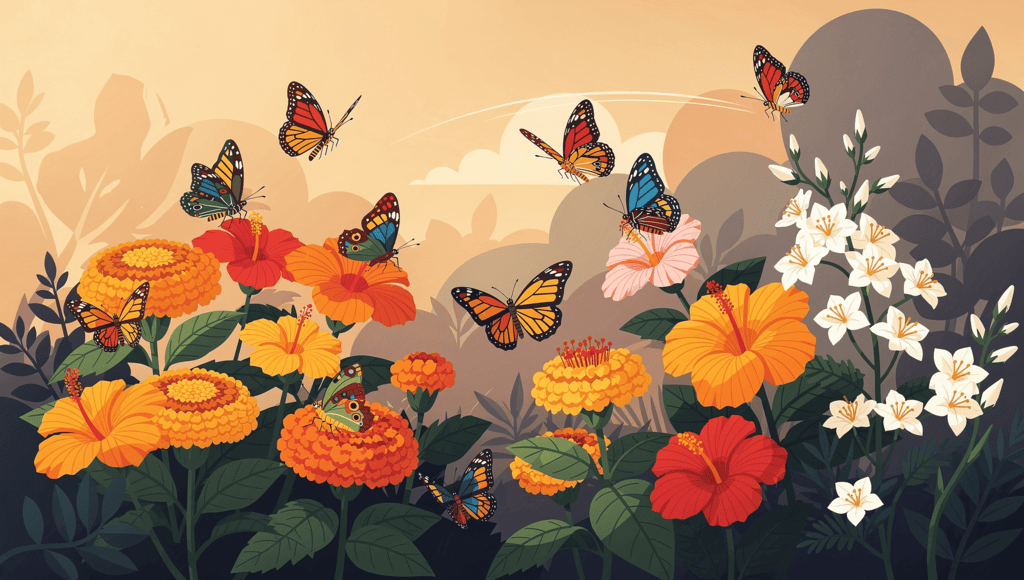
Q5. In a school garden, students noticed fewer butterflies the previous season. What could be the possible reasons? What steps can students take to have more butterflies on campus?
Ans: Possible reasons: The decline in butterfly population could be due to the use of pesticides, loss of nectar and host plants, habitat destruction, and pollution.
Steps to increase butterflies:
- Grow a variety of nectar-rich and host plants
- Avoid using pesticides
- Provide safe and undisturbed habitats
- Keep small water sources
Q6. Why is it not possible to have an ecosystem with only producers and no consumers or decomposers?
Ans: An ecosystem requires consumers to manage the populations of producers, such as herbivores that eat plants. Additionally, decomposers are essential to recycle dead matter into nutrients for producers. Without consumers, producers could overpopulate and eventually perish due to competition. Similarly, without decomposers, nutrient cycling would cease, leading to the collapse of the ecosystem.
Q7. Observe two different places near your home or school (e.g., a park and a roadside). List the living and non-living components you see. How are the two ecosystems different?
Ans: We can observe some common elements near our home and school:
- Park:
- Living: trees, birds, squirrels, grass
- Non-living: soil, water, benches, sunlight
- Roadside:
- Living: weeds, insects
- Non-living: asphalt, dust, car exhaust
Differences: The park is a designed ecosystem with a diverse range of plants and animals, supported by soil and water. In contrast, the roadside is a disturbed, human-altered area with fewer species and more pollution.
Q8. 'Human-made ecosystems like agricultural fields are necessary, but they must be made sustainable.' Comment on the statement.
Ans: Agree. Agricultural fields are essential for providing food, but they often rely on unsustainable practices such as synthetic fertilisers and monoculture, which can degrade soil quality and harm biodiversity. To ensure long-term productivity and environmental health, it is crucial to adopt sustainable methods like organic farming and crop rotation.
Q9. If the Indian hare population (Fig. 12.20) drops because of a disease, how would it affect the number of other organisms?
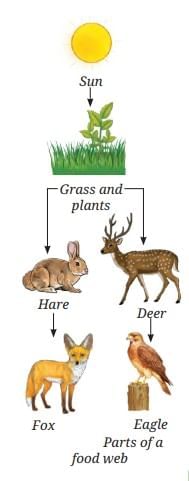
Ans: Predators: The number of foxes and eagles would decrease due to less availability of hares as food.
Plants: Grass and plant populations may increase initially due to reduced grazing by hares.
Why: The decline of a key herbivore like the hare disrupts the food web, affecting both predators (which lose food) and plants (which face less grazing pressure).
Discover, Design, and Debate (Page 208 - 209)
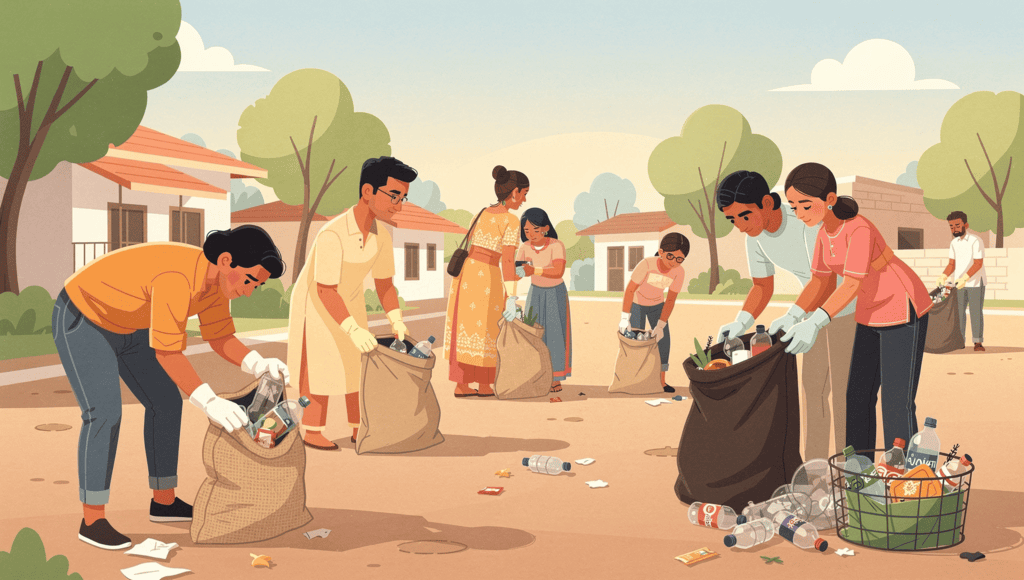
Q1. Plan a clean-up day at school or a nearby park. Wearing gloves and using bags, collect the litter you find. Discuss the kinds of waste you found. Which was the most common? How can we reduce such waste?Ans: Plastic waste is the most common because it is widely used in daily life and often disposed of improperly. Since plastics are non-biodegradable, they accumulate in the environment.
To reduce such waste:
- Use reusable bags and bottles
- Recycle materials properly
- Avoid single-use plastics
- Spread awareness about waste management
Q2. In Arunachal Pradesh, the Nyishi and Mishmi tribes treat the Tiger as sacred. In Chhattisgarh, the Baiga tribe worships Bagheshwar or Bagesur Dev and believes the Tiger is the protector of the forest. Find out about another Indian tribe that has a special bond with any animal.
Ans: The Bishnoi tribe in Rajasthan has a special bond with blackbucks (antelopes). They protect these animals as sacred, following the teachings of Guru Jambheshwar, which advocate for the preservation of wildlife by not harming animals or trees. This commitment to conservation is so strong that Bishnois have been known to risk their lives to save blackbucks. Their actions are a remarkable example of how culture can play a vital role in protecting ecosystems.
Q3. Pick a tree near your home or school. Observe it once a week for 4 weeks. Note any new leaves, flowers, fruits, or visiting birds and insects. Record your observations. You may even upload your findings to www.seasonwatch.in and become a young citizen scientist.
Ans: I picked a mango tree.
- Week 1: New green leaves budding, with ants crawling.
- Week 2: Small flowers blooming, attracting bees.
- Week 3: Tiny fruits forming, with birds like sparrows perching.
- Week 4: Fruits growing bigger, while squirrels are eating.
Upload your findings to Season Watch to track changes with the seasons. It's fun and helps scientists study the effects of climate on trees!
Q4. Interact with farmers and record indigenous practices followed by them for sustainable farming. Create a sustainable herbal garden/natural farm at home or at school. It could be a group activity with students from different grades.
Ans: During my interaction with a farmer, I learned that he uses cow dung as a natural fertiliser (compost) and plants marigolds to repel pests, opting for this method instead of chemicals. For our school garden, we should:
- Plant herbs such as tulsi and mint in pots filled with organic soil.
- Water wisely and rotate crops to maintain soil health.
- Involve junior students in weeding tasks and seniors in labelling the plants.
This approach is not only sustainable but also provides fresh herbs and teaches students about eco-farming!
Q5. Look at Fig. 12.21 to understand the different farming practices adopted by farmers or you may also visit a nearby farm with an elderly person to observe the same. List a few suggestions in your notebook to improve farming practices by adopting eco-friendly and sustainable techniques. You can also make posters or model and display while participating in school functions, science fairs or Krishi Mela. The school may also invite agricultural scientists, farmers, and experts to discuss the prevalent farming practices with the students.
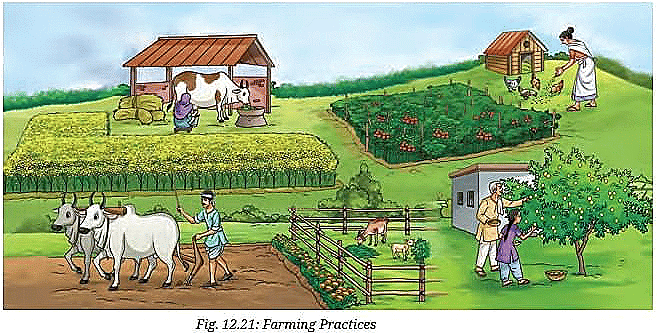
Ans: From the figure/visit, farmers use crop rotation, natural manure, and drip irrigation.
Suggestions:
- Use compost instead of chemicals.
- Plant diverse crops to boost soil health.
- Harvest rainwater.
Make posters like 'Go Organic for Healthy Soil!' and create a model farm using recycled materials. Invite experts for a talk to learn about Vrikshayurveda (ancient organic methods) and share insights at a school fair!
FAQs on NCERT Solutions: How Nature Works in Harmony
| 1. How does photosynthesis help plants maintain balance in nature? |  |
| 2. What are the main ways decomposers contribute to how nature stays balanced? | |
| 3. Why do food chains and food webs matter for keeping ecosystems stable? | |
| 4. How do herbivores, carnivores, and omnivores keep the animal population under control? | |
| 5. What is the carbon cycle and why is it important for environmental balance in Class 8 Science? | |