Worksheet Solutions: Light: Mirrors and Lenses

Multiple Choice Questions (MCQs)
Instruction: Select the correct option for each question.
Q1. Which mirror makes objects appear smaller but gives a wider field of view?
a) Plane mirror
b) Concave mirror
c) Convex mirror
d) Two-way mirror
Ans: (c)
Explanation: A convex mirror curves outward and causes parallel rays to diverge. It always forms a virtual, erect and diminished image of an object and shows a larger area of the scene. For these reasons convex mirrors are used as side-view mirrors in vehicles for a wider field of view.

Q2. Looking at the inner (curved inward) side of a shiny spoon, your face appears:
a) Erect and diminished
b) Inverted (upside down)
c) Erect and same size
d) Erect and magnified at all distances
Ans: (b)
Explanation: The inner side of a spoon behaves like a concave mirror. If your face is placed beyond its focal point, the concave mirror forms a real image which is inverted. Therefore at such distances the reflected face appears upside down.
Q3. The warning "Objects in mirror are closer than they appear" is written because a convex mirror:
a) Inverts images
b) Forms enlarged images
c) Forms diminished images
d) Does not follow reflection laws
Ans: (c)
Explanation: Convex mirrors form virtual, diminished images. Because the images are smaller they appear to be farther away than the actual objects. This is why vehicle mirrors carry the warning so drivers do not underestimate the closeness of following vehicles.
Q4. Which statement about a concave mirror is correct?
a) Always forms erect images
b) Always forms diminished images
c) Can form enlarged erect images when object is close
d) Never focuses light
Ans: (c)
Explanation: A concave mirror can behave differently depending on object distance. When an object is placed very close to a concave mirror (within its focal length), it produces an erect, enlarged virtual image. When the object is farther away, the mirror can form real, inverted images whose size depends on distance.
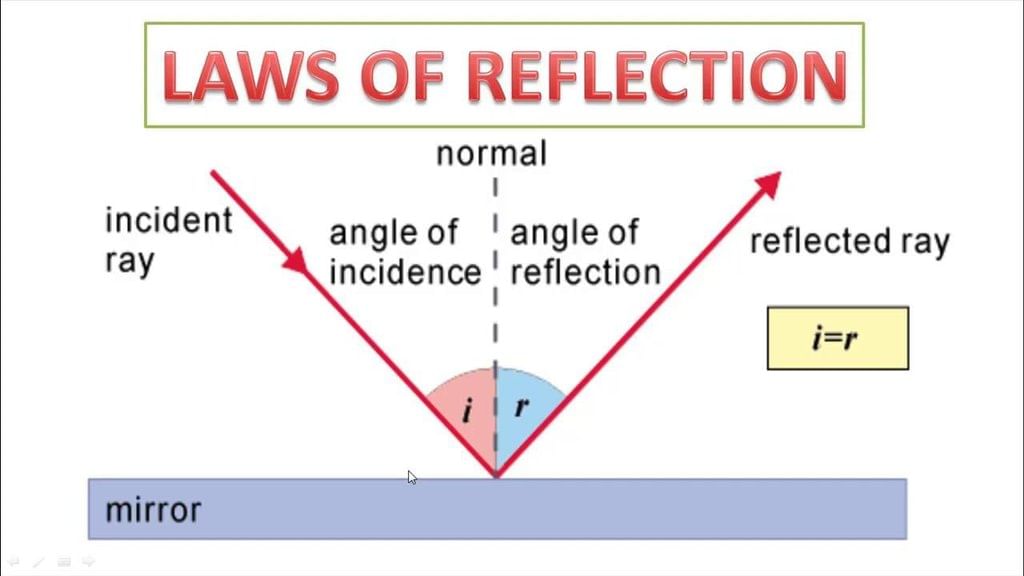
Q5. First law of reflection states:
a) i + r = 90°
b) i = r
c) i > r
d) i < r
Ans: (b)
Explanation: The first law of reflection states that the angle of incidence (i) is equal to the angle of reflection (r). This law holds for all reflecting surfaces and is the basis for predictable image formation in mirrors.
Fill in the Blanks
Instruction: Fill in the blanks with the correct word based on the chapter.
Q1. A concave mirror can form an __________ image when the object is very close.
Ans: enlarged and erect
When an object is within the focal length of a concave mirror, the image formed is upright and larger than the object.
Q2. A convex mirror always forms an __________ and __________ image.
Ans: erect; diminished
Convex mirrors produce virtual, upright images that are smaller than the object, giving a wider field of view.
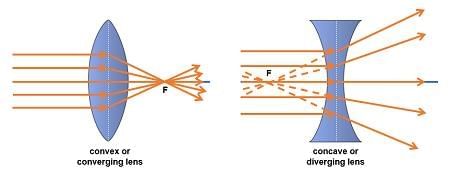
Q3. A convex lens is thicker at the __________ than at the edges.
Ans: middle
Because of this shape a convex lens converges parallel rays towards a point.
Q4. A concave lens is a __________ lens because it spreads light rays apart.
Ans: diverging
Concave lenses make parallel rays move away from each other after passing through the lens.
Q5. The human eye contains a __________ lens that changes shape to focus.
Ans: convex
The eye lens is convex and alters its shape to focus on near and far objects.
Very Short Answer Questions
Instruction: Answer the following questions in one line.
Q1. Why do vehicle side-view mirrors use convex mirrors?
Ans: They give a wider field of view and form erect, smaller (diminished) images so more area can be seen at once.
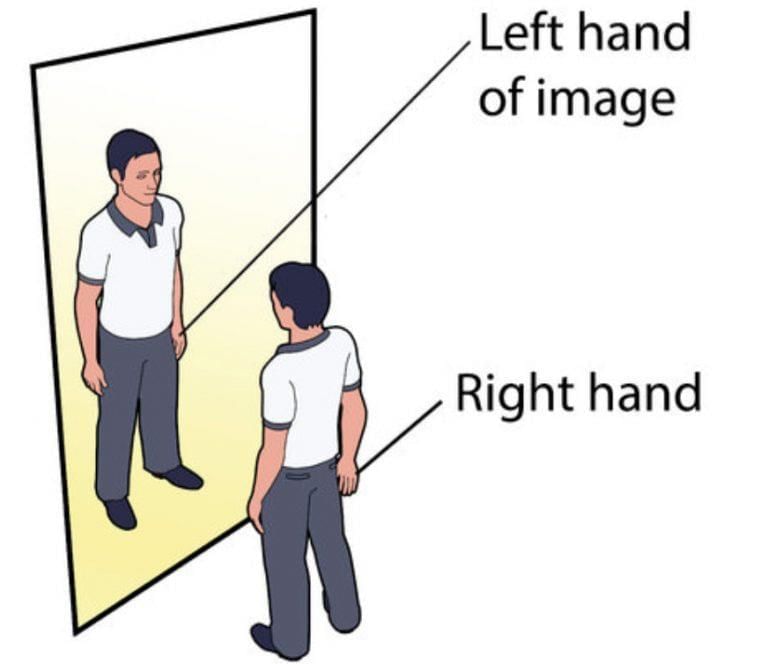
Q2. What is lateral inversion?
Ans: Lateral inversion is the left-right reversal of an image as seen in a plane mirror compared with the object.
Q3. State the two laws of reflection in words.
Ans: The angle of incidence equals the angle of reflection; and the incident ray, the reflected ray and the normal all lie in the same plane.
Q4. Which mirror can focus sunlight onto paper?
Ans: Concave mirror (it converges parallel rays to a point and can concentrate sunlight enough to burn paper).
Q5. Which lens always gives an erect and diminished image?
Ans: Concave lens (it diverges rays and always produces a virtual, upright and smaller image).
 Lateral Inversion
Q.6. What is angle of incidence?
Ans: The angle between the normal to the surface and the incident ray is called the angle of incidence (∠i).
Q.7. What is an 'incident ray'?
Ans: The light ray that strikes a surface is called the incident ray.
Short Answer Questions
Instruction: Answer the following questions in 2-3 lines.
Q1. How does a concave mirror's image change as the object moves away?
Ans: When the object is very close (within the focal length), the concave mirror forms an erect, enlarged virtual image. As the object moves beyond the focal point, the image becomes real and inverted. The image size decreases as the object is moved farther from the mirror.
Q2. Why do convex mirrors make objects seem farther away?
Ans: Convex mirrors form virtual images that are smaller than the object. Because the image is diminished, it appears to be located farther behind the mirror than the actual object, which is why the warning about closeness is used on vehicle mirrors.
Q3. Explain why a convex lens can burn paper but a concave lens cannot.
Ans: A convex lens converges parallel rays of sunlight to a small focal point, concentrating energy and producing heat sufficient to burn paper. A concave lens diverges rays so they cannot be brought to a single focused point and therefore cannot ignite paper.
Q4. How do we know the laws of reflection apply to spherical mirrors?
Ans: Experiments with rays striking different parts of a spherical (concave or convex) mirror show that each incident ray reflects so that the angle of incidence equals the angle of reflection and the rays and normal lie in the same plane. The curvature only changes the directions of reflected rays, not the basic laws of reflection.
Q5. What images do concave and convex lenses form at various distances?
Ans: A convex (converging) lens gives an erect, enlarged virtual image when the object is within the focal length, and a real, inverted image whose size varies (can be enlarged or diminished) when the object is beyond the focal length. A concave (diverging) lens always forms a virtual, erect and diminished image regardless of object distance.
Q.6. A ray of light is incident on a plane mirror at an angle of 40°. What is the angle of reflection?
Ans: The angle of reflection is 40 degrees because the law of reflection states that angle of incidence equals angle of reflection.
Match the Following
Instruction: Match Column A with the correct option in Column B.
Ans:
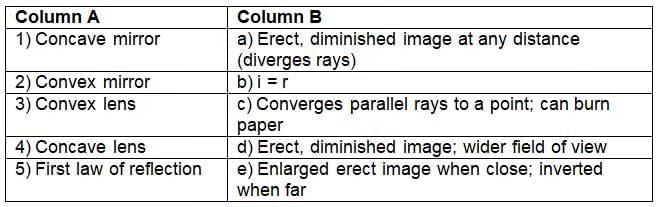
Concave mirror - e) Enlarged erect image when close; inverted when far
Image nature depends on object distance and position relative to the focal point.Convex mirror - d) Erect, diminished image; wider field of view
This is why they are used in vehicle mirrors and at road turns for safety.Convex lens - c) Converges parallel rays to a point; can burn paper
Convex lenses focus sunlight to a small, hot spot at the focal point.Concave lens - a) Erect, diminished image at any distance (diverges rays)
Concave lenses always produce smaller, upright virtual images.First law of reflection - b) i = r
The angle of incidence equals the angle of reflection for every reflecting surface.
FAQs on Worksheet Solutions: Light: Mirrors and Lenses
| 1. What are the basic differences between concave and convex mirrors? |  |
| 2. How do lenses work in focusing light, and what are the two main types of lenses? | |
| 3. What is the law of reflection, and how does it apply to mirrors? | |
| 4. What are some practical applications of lenses in everyday life? | |
| 5. How do optical instruments like microscopes and telescopes utilize mirrors and lenses? | |





