CBSE Class 5  >  Class 5 Notes  >  Our Wondrous World - New NCERT  >  Worksheet: Journey of a River

Worksheet: Journey of a River

Worksheet: Journey of a RiverQ1: Choose the correct option for each question.
(i) Where does the Godavari River originate?
A) Bay of Bengal
B) Western Ghats
C) Himalayas
D) Deccan Plateau

(ii) What is the primary use of the water from the Godavari River?
A) Recreation
B) Drinking, cooking, and irrigation
C) Industrial purposes
D) None of the above

(iii) How long is the Godavari River?
A) 1,100 kilometres
B) 1,465 kilometres
C) 2,000 kilometres
D) 800 kilometres

(iv) What is the name of the dam mentioned that affects the Godavari River?
A) Bhakra Nangal Dam
B) Polavaram Dam
C) Hirakud Dam
D) Sardar Sarovar Dam

(v) What is an important reason for keeping the Godavari River clean?
A) To maintain the beauty of the river
B) To ensure the health of people and wildlife
C) To increase tourism
D) To reduce flooding

Q2: Fill in the blanks with the correct words from the chapter.
(i) The Godavari River is also known as ________ Ganga.
(ii) The Godavari River flows into the ________ Sea.
(iii) The Godavari is the ________ longest river in India.
(iv) The Godavari River is a ________ river, meaning it flows all year.
(v) ___________ are smaller rivers that join the Godavari during its journey.

Q3: State whether the following statements are True or False. Correct the false statements.
(i) The Godavari River has several dams built on it for water storage.
(ii) The Godavari River is the longest in India.
(iii) Floods can cause damage to homes and agriculture.
(iv) The Godavari River flows only during the rainy season.
(v) The Godavari River is important

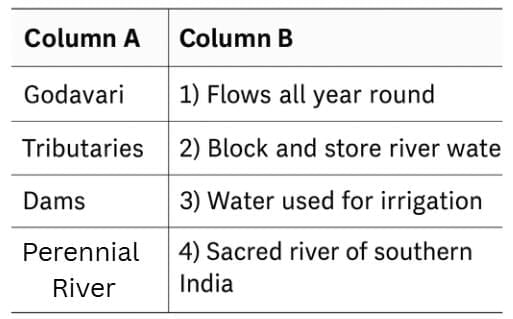
Q4: Match the items in Column A with the correct descriptions in Column B.
Worksheet: Journey of a River

Q5: Answer the following questions in 2-3 sentences each.
(i) Where does the Godavari River begin its journey?
(ii) What are tributaries?
(iii) Why is the Godavari River important for people living near it?
(iv) What happens when it rains a lot and the river overflows?
(v) How can we keep rivers clean?

Q6: Answer the following questions in 4-6 sentences each. Use examples from the chapter to support your answers.
(i) Describe the three main stages of a river's journey, using the Godavari River as an example.
(ii) Explain how the Godavari River supports life and helps people. Give at least three examples.
(iii) What challenges does the Godavari River face, and how do they affect it?
(iv) What is a delta? Describe where the Godavari River forms its delta and why it's important.

You can find Worksheet Solutions here: Worksheet Solutions: Journey of a River
The document Worksheet: Journey of a River is a part of the Class 5 Course Our Wondrous World Class 5 - New NCERT.
All you need of Class 5 at this link: Class 5

FAQs on Worksheet: Journey of a River

1. What are the different stages of a river's journey from source to mouth?
Ans. A river travels through three main stages: the source (where it begins in mountains or hills), the middle course (where it flows through valleys and plains), and the mouth (where it meets the sea or ocean). Each stage has distinct characteristics-the source has steep terrain and fast-flowing water, the middle course shows moderate slopes, and the mouth features wide, slow-moving channels. Understanding these stages helps explain how rivers shape landscapes and affect human settlements throughout their flow.
2. Why do rivers erode rocks and soil more in some areas than others along their journey?
Ans. River erosion varies based on water speed, rock hardness, and terrain steepness. In mountainous regions near the source, rapid water flow creates intense erosion, carving deep valleys and V-shaped gorges. In flatter plains downstream, slower movement reduces erosion but increases sediment deposition instead. Hard rocks resist erosion longer than soft soil, which crumbles quickly. These differences explain why river landscapes appear completely different from mountain springs to coastal deltas.
3. How do tributaries and distributaries change the main river's path during its journey?
Ans. Tributaries are smaller rivers joining the main river, increasing its water volume and flow strength as it progresses downstream. Distributaries occur near the mouth, where the main river splits into branches before reaching the sea. Tributaries narrow the main river's channel, while distributaries widen it across delta plains. This branching pattern helps distribute water across vast areas, creating fertile regions ideal for agriculture and human habitation.
4. What causes floods and how do they affect a river's journey across different terrains?
Ans. Floods occur when excessive rainfall or snowmelt causes rivers to overflow their banks, particularly during monsoon seasons in India. In hilly regions, floods create destructive force, eroding slopes rapidly. In plains, overflowing water spreads across flood plains, depositing nutrient-rich sediment that fertilises agricultural land. Understanding flood patterns helps communities prepare better defences and utilise the river's natural benefits safely during the seasonal variations of the river journey.
5. What is a river delta and why does it form at the mouth where the river meets the sea?
Ans. A river delta is a triangular or fan-shaped landform created where rivers deposit sediment as they slow down meeting the sea or ocean. The river loses its carrying capacity in calm coastal waters, dropping sand, silt, and clay to build new land gradually. Famous NCERT examples include the Ganges Delta and Nile Delta. Deltas are extremely fertile, supporting dense populations and rich agriculture, making them economically vital regions shaped entirely by the river's final stage of journey.
Explore Courses for Class 5 exam
Get EduRev Notes directly in your Google search
Related Searches
Exam, Extra Questions, Viva Questions, Worksheet: Journey of a River, Worksheet: Journey of a River, MCQs, Previous Year Questions with Solutions, Sample Paper, past year papers, ppt, video lectures, pdf , Semester Notes, Important questions, shortcuts and tricks, practice quizzes, Worksheet: Journey of a River, Summary, mock tests for examination, study material, Objective type Questions, Free;