CBSE Class 5  >  Class 5 Notes  >  Our Wondrous World - New NCERT  >  Worksheet: Clothes-How Things are Made

Worksheet: Clothes-How Things are Made

Worksheet: Clothes-How Things are Made

Q1: Choose the correct option for each question.
(i) What do birds like the male baya weaver build their nests from?
(a) Plastic
(b) Grass
(c) Leaves
(d) Twigs

(ii) What tool was used to weave fabrics in India 4,000 years ago?
(a) Needle
(b) Loom
(c) Charkha
(d) Spinning Wheel

(iii) Which of the following is a unique handloom tradition of Tamil Nadu?
(a) Ikat
(b) Pashmina
(c) Kanjeevaram
(d) Bandhani

(iv) What is the process called when cotton fibres are twisted into thread?
(a) Weaving
(b) Spinning
(c) Knitting
(d) Stitching

(v) Which material is used to make Pashmina shawls?
(a) Cotton
(b) Wool
(c) Silk
(d) Jute

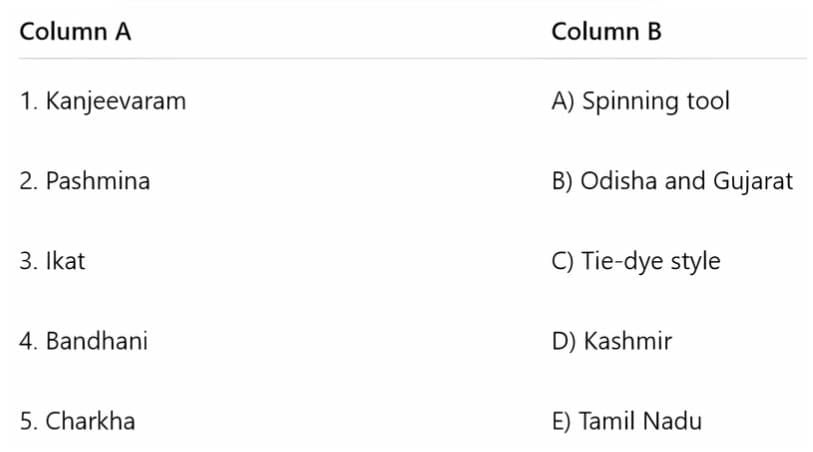
Q2: Match the items in Column A with the correct descriptions in Column B.
Worksheet: Clothes-How Things are Made

Q3: Fill in the blanks with the correct words from the chapter.
(i) The tailorbird stitches big leaves together to make a ______.
(ii) Indian muslin was so fine it was called "woven ______."
(iii) Weaving supports culture and people's ______.
(iv) The process of making thread from fibers using a charkha is known as ______.
(v) Old clothes can be turned into ______ by joining small pieces together.

Q4: State whether the following statements are True or False. Correct the false statements.
(i) The Baya weaver is an expert weaver who makes rough nests.
(ii) Handloom weaving requires the use of electricity.
(iii) Both natural and synthetic fibres are used in clothing.
(iv) The tailorbird uses its beak to sew leaves.
(v) India is the largest producer of silk in the world.

Q5: Answer the following questions in 2-3 sentences each.
(i) What do birds like the male baya weaver do to make their nests?
(ii) How do people in India keep the art of weaving alive?
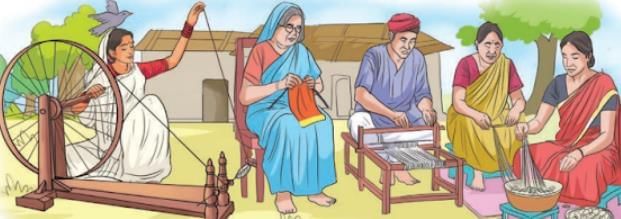
(iii) What is a charkha, and what is it used for?
(iv) What can you do with running stitches?
(v) How do people recycle old clothes in India?

Q6: Answer the following questions in 4-6 sentences each. Use examples from the chapter to support your answers.
(i) Explain the process of making thread from cotton and how it is used to make cloth.
(ii) How do natural and synthetic fibres differ? Give examples of each type.
(iii) Describe the traditional embroidery work done in different parts of India.
(iv) Why should we recycle and reuse old clothes? How can we do this?

You can find Worksheet Solutions here: Worksheet Solutions: Clothes-How Things are Made

The document Worksheet: Clothes-How Things are Made is a part of the Class 5 Course Our Wondrous World Class 5 - New NCERT.
All you need of Class 5 at this link: Class 5

FAQs on Worksheet: Clothes-How Things are Made

1. How are clothes made from raw materials like cotton and wool?
Ans. Clothes are made by converting raw fibres into yarn, then weaving or knitting the yarn into fabric, and finally cutting and stitching pieces together. Cotton comes from cotton plants, while wool comes from sheep. These natural fibres are cleaned, spun into thread, dyed for colour, and processed into finished garments through various manufacturing steps in textile factories.
2. What's the difference between natural fibres and synthetic fibres used in making clothes?
Ans. Natural fibres come directly from plants (cotton, jute, linen) or animals (wool, silk), while synthetic fibres are human-made from chemicals in laboratories. Natural fibres breathe well and feel comfortable, making them ideal for everyday wear. Synthetic fibres like polyester and nylon are durable, quick-drying, and affordable, so clothes manufacturers often blend both types together.
3. Why do different types of fabrics feel different when you touch them?
Ans. Fabric texture depends on the type of fibre used, how tightly yarn is woven, and the weaving pattern employed. Cotton feels soft and breathable, while silk feels smooth and glossy. Woollen fabrics feel rough or itchy because wool fibres have a scaly surface. The thickness of yarn and spacing between threads also determine whether fabric feels rough, smooth, or stretchy.
4. What are the main steps factories follow to turn yarn into finished clothes we wear?
Ans. Factories follow these key clothing manufacturing stages: weaving or knitting yarn into fabric sheets, dyeing fabric in desired colours, cutting fabric into pattern pieces, sewing pieces together with stitching, adding buttons and zips, and finally quality checking and packaging. Modern textile production combines both traditional weaving techniques and automated machinery to create clothes efficiently at scale.
5. How do workers make sure clothes fit properly before they're sold in shops?
Ans. Garment manufacturers use standardised size charts, pattern-making software, and sample testing before mass production begins. Workers check seams for strength, measure garment dimensions against specifications, and test zips and buttons for durability. Quality control teams inspect finished clothes for defects, colour consistency, and proper stitching. Refer to flashcards and mind maps on EduRev to visualise the complete quality assurance process in textile industries.
Explore Courses for Class 5 exam
Get EduRev Notes directly in your Google search
Related Searches
Extra Questions, Semester Notes, Objective type Questions, shortcuts and tricks, video lectures, pdf , ppt, past year papers, Previous Year Questions with Solutions, Worksheet: Clothes-How Things are Made, study material, Sample Paper, Free, Viva Questions, Summary, MCQs, mock tests for examination, Important questions, practice quizzes, Worksheet: Clothes-How Things are Made, Exam, Worksheet: Clothes-How Things are Made;