Which description correctly defines a mixture in scientific terms? Option A: A combination of substances where each component retains its own properties and no chemical reaction occurs Option B: A single substance with a fixed composition that cannot be separated physically Option C: Any item labeled "pure" in shops Option D: A substance formed only when elements react in fixed ratios
Solution:
Ans: (A) Explanation:
A mixture is formed when two or more pure substances are combined without chemical change; each component keeps its identity and original properties and can usually be separated by physical methods.
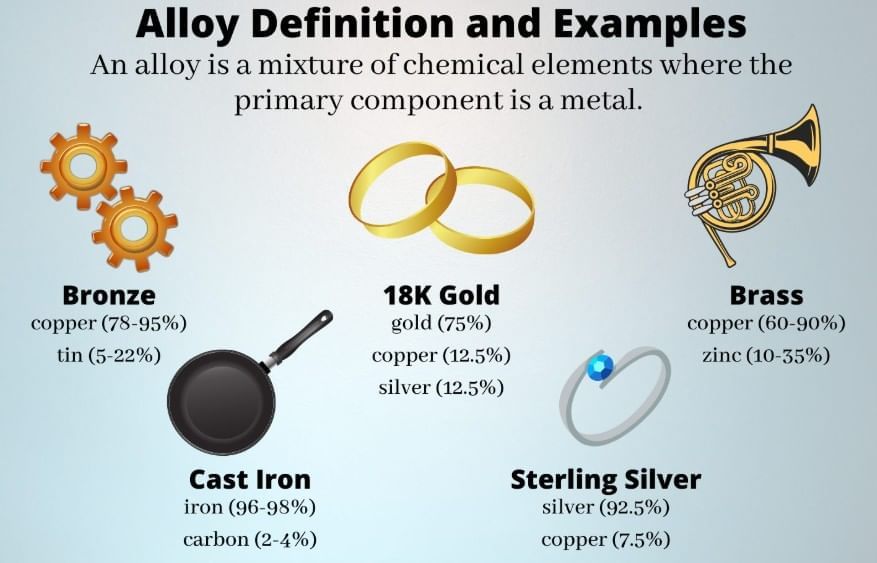
Examples are air, seawater, salad, sugar solution and alloys such as brass and stainless steel; in each case no new substance is formed.
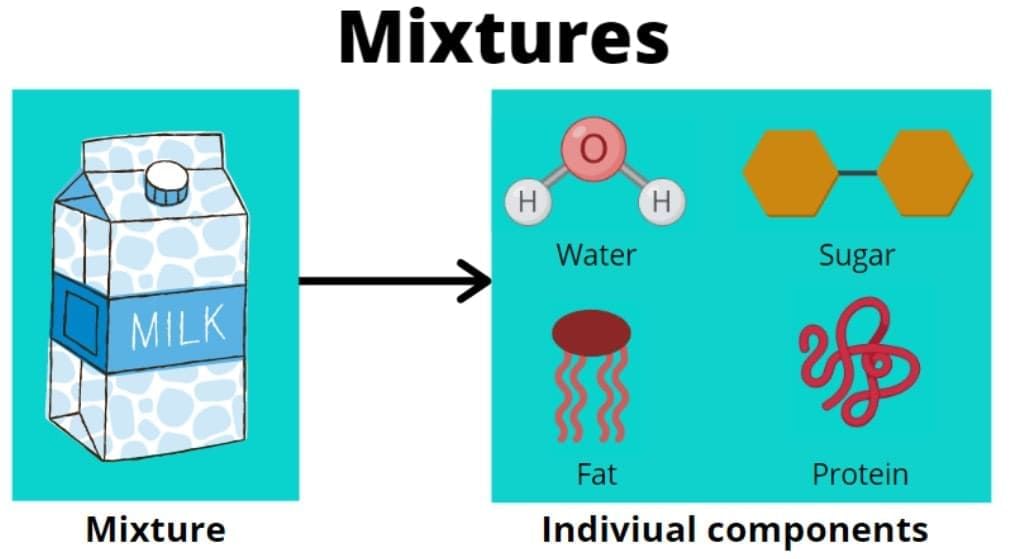
Why others are incorrect: Option B describes a pure substance (element or compound) with fixed composition; Option C is consumer language and need not imply scientific purity (for example, "pure" milk may still be a mixture); Option D describes a compound formed by chemical bonding in definite ratios, not a mixture.
Question 2:
Air is best classified as: Option A: A pure compound because nitrogen and oxygen are bonded Option B: A uniform (homogeneous) mixture of gases with variable pollutants Option C: A non-uniform (heterogeneous) mixture because dust is visible Option D: A single element because it is mostly nitrogen
Solution:
Ans: (B) Explanation:
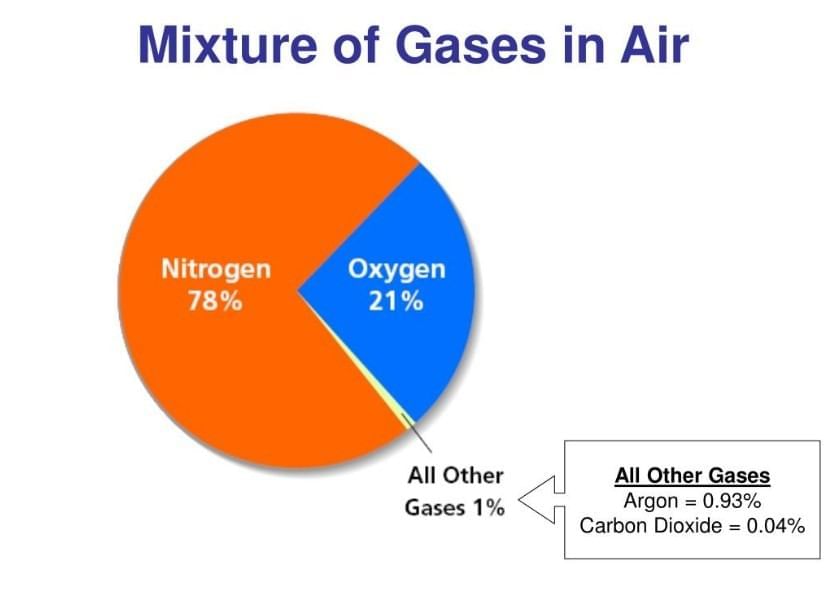
Air is a homogeneous mixture of gases - mainly N2, O2, Ar and CO2 - that are uniformly mixed at the macroscopic scale; small amounts of water vapour and pollutants can change composition locally but do not make the gas phase non-uniform overall.
Because the gases are not chemically bonded to one another and their proportions can vary, air is a mixture rather than a compound.
Why others are incorrect: Option A is wrong because bonding between different gases is not present; Option C mistakes temporary suspended particles for the basic gas mixture; Option D confuses abundance with being a single element.
Question 3:
Which set contains only pure substances as defined in science? Option A: Milk, seawater, air, soil Option B: Fruit juice, muddy water, deodorant spray, soil Option C: Brass, bronze, stainless steel, baking powder Option D: Iron, oxygen, carbon dioxide, sodium chloride
Solution:
Ans: (D) Explanation:
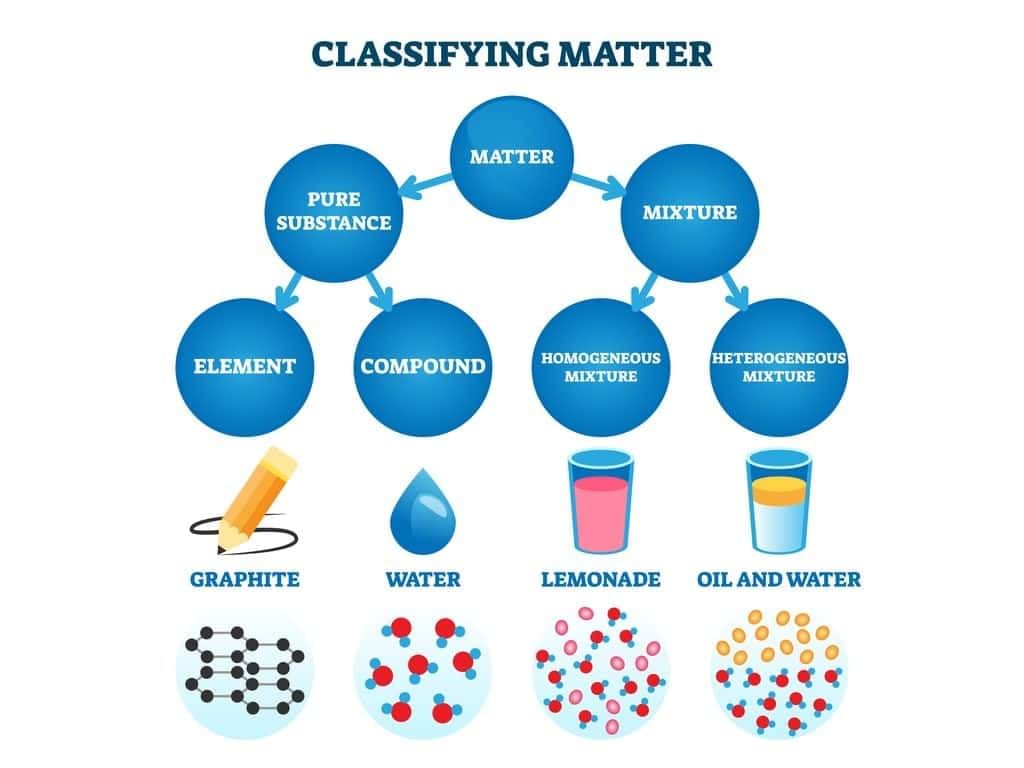
Iron and oxygen are elements; carbon dioxide and sodium chloride are compounds. Each of these has a definite chemical identity and fixed composition, so they are pure substances in the scientific sense.
Why others are incorrect: Options A, B and C list mixtures such as solutions, suspensions and alloys rather than pure substances.
Question 4:
During electrolysis of water, the gases collected at the electrodes are in the volume ratio: Option A: 1:1 hydrogen:oxygen Option B: 2:1 hydrogen:oxygen Option C: 1:2 hydrogen:oxygen Option D: Only water vapour is formed
Solution:
Ans: (B) Explanation:
Electrolysis decomposes water (H2O) into hydrogen and oxygen gas. For every two hydrogen atoms and one oxygen atom in the formula, twice the volume of hydrogen gas is produced compared with oxygen, giving a 2:1 volume ratio (H2:O2).
Hydrogen and oxygen are collected separately at the electrodes; hydrogen burns with a characteristic 'pop', while oxygen supports a glowing splint.
Why others are incorrect: Options A and C contradict the chemical composition of water; Option D is false because electrolysis yields gases, not only vapour.
Question 5:
Which statement best distinguishes an element from a compound? Option A: Elements contain identical atoms; compounds contain fixed ratios of different elements chemically combined Option B: Elements are separated by filtration; compounds by evaporation Option C: Elements and compounds are both mixtures Option D: Compounds always resemble their constituent elements
Solution:
Ans: (A) Explanation:
An element consists of only one kind of atom. A compound is made when two or more different elements chemically combine in a fixed ratio to form a substance with new properties; compounds require chemical methods to break into elements.
Why others are incorrect: Option B confuses physical separation techniques; Option C is wrong because elements and compounds are pure substances, not mixtures; Option D is false - many compounds have properties very different from their elements (for example, sodium chloride is very different from sodium metal and chlorine gas).
Question 6:
Stainless steel is classified as a mixture (alloy) because: Option A: It has a fixed chemical formula of FeCrNiC Option B: It is a homogeneous solid solution of metals (Fe, Cr, Ni) with small carbon, not a single compound Option C: It is 100% iron with better polishing Option D: It is a non-metallic ceramic
Solution:
Ans: (B) Explanation:
Stainless steel is an alloy - a homogeneous mixture of iron with chromium, nickel and small amounts of carbon. Its composition can vary and the metals remain distinct at the atomic level without forming one single compound of fixed stoichiometry.
Why others are incorrect: Option A implies a fixed formula which alloys do not have; Option C and D misidentify the material.
Question 7:
Which pairing correctly matches the mixture type, an example, and its uniformity? Option A: Solid-solid mixture → brass → uniform Option B: Liquid-liquid mixture → oil and water → uniform Option C: Gas-liquid mixture → muddy water → uniform Option D: Solid-gas mixture → smoke-free air → non-uniform
Solution:
Ans: (A) Explanation:
Brass is an alloy of copper and zinc and is a uniform (homogeneous) solid-solid mixture where the metals form a solid solution.
Why others are incorrect: Option B is wrong because oil and water form a heterogeneous mixture; Option C is incorrect because muddy water is a heterogeneous solid-liquid suspension; Option D mislabels air (a homogeneous gas mixture) and is not a solid-gas example.
Question 8:
Which statement about "pure" on food labels vs scientific purity is correct? Option A: "Pure" always means a single substance scientifically Option B: In science, pure means one kind of particle only; "pure" milk or ghee can still be mixtures of many substances Option C: Science does not classify foods Option D: All edible products are elements
Solution:
Ans: (B) Explanation:
In science, a pure substance contains only one kind of particle (one element or one compound). Consumer labels that say "pure" usually mean unadulterated or natural, but such products (for example, milk or ghee) are mixtures of many components like fats, proteins and water.
Why others are incorrect: Option A is not generally true for consumer products; Option C and D are incorrect general statements.
Question 9:
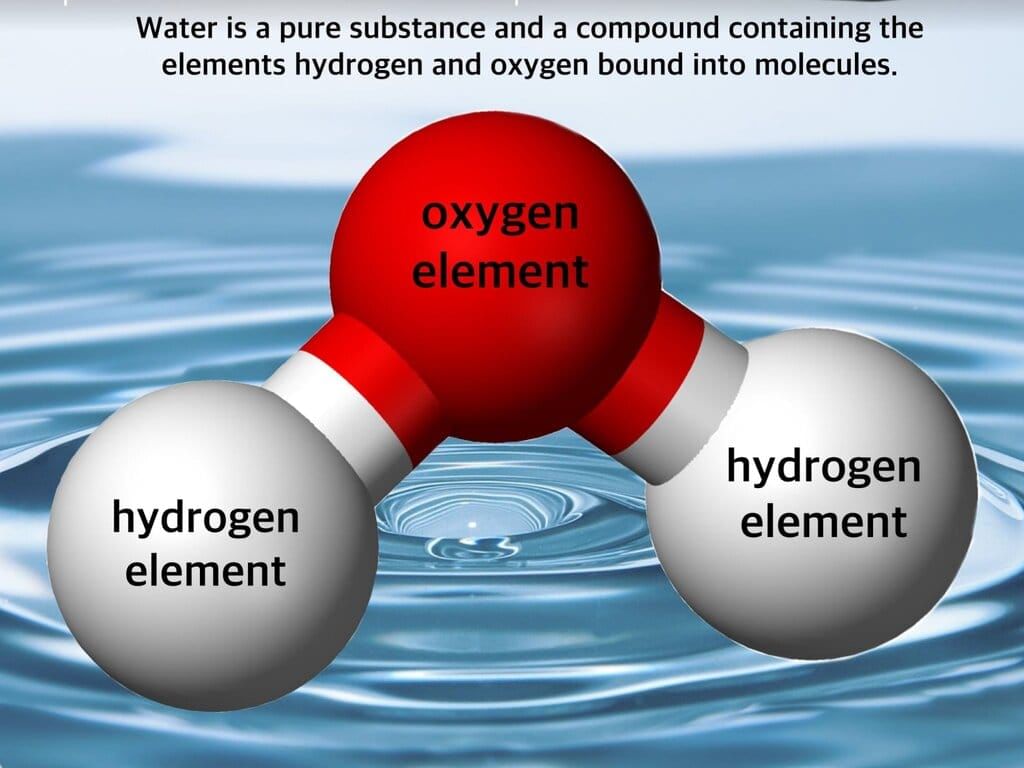
Why is water a compound whereas an unreacted blend of hydrogen and oxygen would be a mixture? Option A: Water can be filtered into hydrogen and oxygen easily Option B: Water has chemically bonded elements in a fixed 2:1 ratio and new properties; an unreacted blend lacks bonding and retains component properties Option C: Hydrogen and oxygen are solids at room temperature Option D: Mixtures always share the same properties as water
Solution:
Ans: (B) Explanation:
Water (H2O) is a compound in which hydrogen and oxygen atoms are chemically bonded in a fixed 2:1 ratio; the compound shows properties different from its elements. A physical mixture of H2 and O2 would simply retain the gases' original properties because no chemical bonds form.
Why others are incorrect: Option A is false because physical filtration cannot separate water into hydrogen and oxygen; Option C is factually wrong at room temperature; Option D is incorrect because mixtures need not resemble compounds like water.
Question 10:
Which observation proves Sample B (from heating iron + sulfur) is a compound, not a mixture? Option A: It is uniformly black Option B: It is still attracted to a magnet Option C: It is not attracted to a magnet and releases a rotten-egg smelling gas with dilute HCl Option D: Iron and sulfur can be separated by sieving
Solution:
Ans: (C) Explanation:
When iron and sulfur react on heating, they form iron sulfide (FeS), a compound with new properties: it is not attracted to a magnet and reacts with dilute hydrochloric acid to produce hydrogen sulphide (H2S), which smells of rotten eggs. These changes show a chemical compound has formed.
Why others are incorrect: Option A (uniform black colour) alone does not prove a compound; Option B describes the unreacted mixture where iron remains magnetic; Option D is true for a mixture but not for a compound.
Question 11:
Which list correctly classifies items as elements, compounds, or mixtures? Option A: Elements-water, nitrogen, iron, air Option B: Pure substances-CO₂, iron, oxygen, sugar Option C: Uniform mixtures-minerals, seawater, bronze, air Option D: Non-uniform mixtures-air, sand, brass, muddy water
Solution:
Ans: (B) Explanation:
CO₂ (carbon dioxide) and sugar are compounds; iron and oxygen are elements. All four are pure substances in the scientific sense because each has a definite chemical identity.
Why others are incorrect: Option A wrongly lists water and air as elements; Option C is incorrect because minerals may be compounds or mixtures and are not all uniform; Option D misclassifies air and brass, which are typically homogeneous mixtures.
Question 12:
Which statement accurately describes minerals? Option A: Minerals are only pure elements found in rocks Option B: Minerals are natural solids with fixed composition; most are compounds, some are native elements Option C: Minerals are man-made alloys Option D: Minerals are any dissolved substances in water
Solution:
Ans: (B) Explanation:
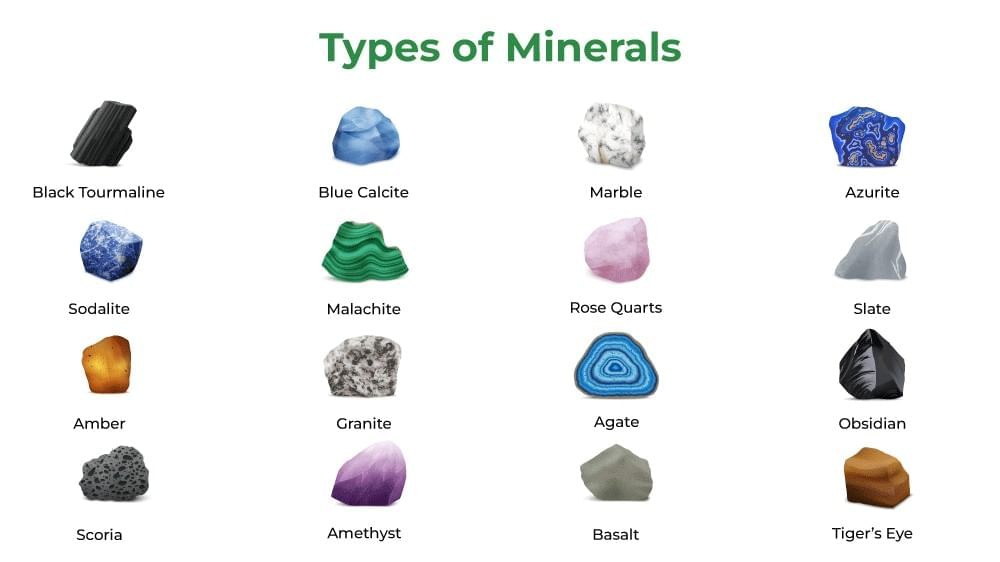
Minerals are naturally occurring solid substances with a definite chemical composition. Most minerals, such as quartz and calcite, are compounds; some occur as native elements (for example, gold and sulphur).
Why others are incorrect: Option A ignores compound minerals; Option C confuses natural minerals with man-made alloys; Option D misdefines minerals as dissolved substances.
Question 13:
Which row shows a correct "type → example → separation possibility (physical)"? Option A: Mixture → seawater → can separate salt by evaporation Option B: Compound → sodium chloride → separate Na and Cl by filtration Option C: Element → oxygen → separate into smaller substances by decantation Option D: Compound → water → separate into H₂ and O₂ by sieving
Solution:
Ans: (A) Explanation:
Seawater is a mixture of water and dissolved salts; salt can be recovered by evaporation, which is a physical separation method - this correctly links type, example and separation method.
Why others are incorrect: Options B and D suggest physical methods for separating elements from compounds, but compounds require chemical methods to break into elements; Option C is incorrect because elements cannot be split into simpler substances by decantation.
Question 14:
Which scenario aligns with using matter to address environmental challenges as highlighted? Option A: Developing a carbon-based aerogel that absorbs oil efficiently due to high porosity Option B: Mixing random elements for instant medicines Option C: Replacing water with H₂/O₂ gas mix for safety Option D: Calling air a compound to regulate emissions
Solution:
Ans: (A) Explanation:
Engineered materials such as graphene-based aerogels are extremely light and porous and can absorb large amounts of oil, so they are practical examples of applying knowledge about materials to solve environmental problems like oil spills.
Why others are incorrect: Option B is unscientific and unsafe; Option C is hazardous and impractical; Option D is a misclassification and would not help emission control.
Question 15:
Which conclusion about the iron-sulfur system is correct? Option A: The unheated mixture (Sample A) is non-magnetic Option B: The heated product (Sample B) shows the same properties as iron and sulfur Option C: Sample A is a mixture whose components retain properties; Sample B is a compound with new properties and fixed composition Option D: Both A and B can be separated by magnets
Solution:
Ans: (C) Explanation:
Sample A (a physical mixture of iron and sulfur) is heterogeneous: iron remains magnetic and can be separated by a magnet, while sulfur does not react. After heating, Sample B is iron sulphide (FeS), a compound with new properties - it is non-magnetic and reacts differently (for example, gives H2S with dilute HCl) - showing a fixed chemical composition.
Why others are incorrect: Option A is false because iron in the unheated mixture is magnetic; Option B is incorrect because the heated product does not show the original properties of iron and sulfur; Option D is wrong because only Sample A is magnetically separable, not Sample B.
The document MCQ (Solution) - Nature of Matter: Elements, Compounds, and Mixtures is a part of the Class 8 Course Science Class 8.
FAQs on MCQ (Solution) - Nature of Matter: Elements, Compounds, and Mixtures
1. What is the difference between an element, a compound, and a mixture?
Ans. An element is a pure substance that cannot be broken down into simpler substances by chemical means. Examples include hydrogen (H), oxygen (O), and gold (Au). A compound is a substance formed when two or more elements chemically bond together in fixed proportions, such as water (H₂O) or carbon dioxide (CO₂). A mixture, on the other hand, contains two or more substances that are not chemically combined and can be separated by physical methods, like air (a mixture of gases) or salad (a mixture of various ingredients).
2. How are compounds formed from elements?
Ans. Compounds are formed when two or more elements react chemically. This process involves the formation of chemical bonds, which can be ionic or covalent. For example, when hydrogen (H) reacts with oxygen (O), they form water (H₂O) through a chemical reaction where the hydrogen atoms bond with oxygen atoms in a specific ratio. The properties of the compound are different from those of the individual elements.
3. What are some examples of mixtures, and how can they be separated?
Ans. Mixtures can be homogeneous or heterogeneous. Homogeneous mixtures, like saltwater or air, have a uniform composition throughout, while heterogeneous mixtures, like sand and iron filings, do not. Mixtures can be separated using physical methods such as filtration (for solids and liquids), distillation (for separating liquids based on boiling points), and chromatography (for separating different substances based on their movement through a medium).
4. What role do elements play in forming compounds?
Ans. Elements are the fundamental building blocks of compounds. Each element has unique properties and can combine with other elements in specific ways to form compounds. For example, in carbon dioxide (CO₂), carbon (C) combines with two oxygen (O) atoms. The properties of the resulting compound are determined by the types of elements involved and the nature of their bonds, leading to substances with distinct characteristics that differ from the individual elements.
5. Can mixtures have varying compositions, and what does this mean for their properties?
Ans. Yes, mixtures can have varying compositions, meaning the proportions of the components can change. This variability in composition affects the properties of the mixture. For example, a mixture of sand and salt can have different amounts of sand and salt, leading to different textures and solubility properties. Unlike compounds, where the composition is fixed, mixtures retain the individual properties of their components, which can lead to a wide range of physical characteristics.
shortcuts and tricks, and Mixtures, MCQs, Compounds, and Mixtures, practice quizzes, study material, Important questions, past year papers, Extra Questions, MCQ (Solution) - Nature of Matter: Elements, Previous Year Questions with Solutions, video lectures, Sample Paper, ppt, MCQ (Solution) - Nature of Matter: Elements, MCQ (Solution) - Nature of Matter: Elements, Semester Notes, mock tests for examination, pdf , Exam, Viva Questions, Summary, Compounds, and Mixtures, Compounds, Free, Objective type Questions;