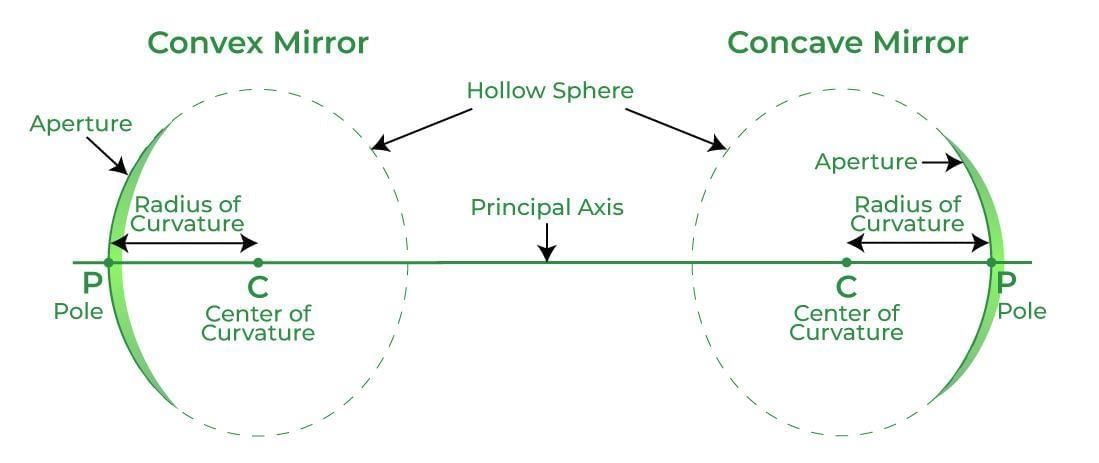
Which statement correctly distinguishes concave and convex spherical mirrors? Option A: Concave mirrors curve outward; convex mirrors curve inward Option B: Concave mirrors curve inward; convex mirrors curve outward Option C: Both concave and convex mirrors are flat Option D: Concave mirrors never form inverted images
Solution:
Answer: Option B Solution:
A concave mirror has an inward-curving reflecting surface; a convex mirror has an outward-curving reflecting surface.
Concave mirrors can produce inverted images when the object is sufficiently far; convex mirrors never produce inverted images for real objects.
Why others are incorrect: A swaps definitions; C confuses spherical with plane mirrors; D is false-concave mirrors do invert for larger object distances.
Question 2:
A convex mirror used as a vehicle's side-view mirror shows: Option A: Always erect and diminished images with a wider field of view Option B: Sometimes inverted, sometimes erect images with same size Option C: Always inverted and enlarged images Option D: Erect and same-sized images with narrow field of view
Solution:
Answer: Option A Solution:
Convex mirrors always give erect, diminished images and cover a larger area, hence the safety warning "Objects in mirror are closer than they appear."
Why others are incorrect: B and C contradict convex mirror image nature; D confuses with plane mirrors and ignores wide field of view.
Question 3:
When an object is placed close to a concave mirror, the image seen is typically: Option A: Erect and enlarged Option B: Erect and diminished Option C: Inverted and diminished for all distances Option D: Inverted and same-sized
Solution:
Answer: Option A Solution:
Near a concave mirror, the image is erect and magnified; farther away, the image becomes inverted (initially enlarged, then diminishing with distance).
Why others are incorrect: B describes convex mirror behavior; C and D ignore distance-dependent image changes for concave mirrors.
Question 4:
Which pair correctly matches device and the mirror type used? Option A: Dentist's mouth mirror - convex mirror Option B: Road intersection safety mirror - concave mirror Option C: Torch reflector - concave mirror Option D: Side-view mirror of a car - concave mirror
Solution:
Answer: Option C Solution:
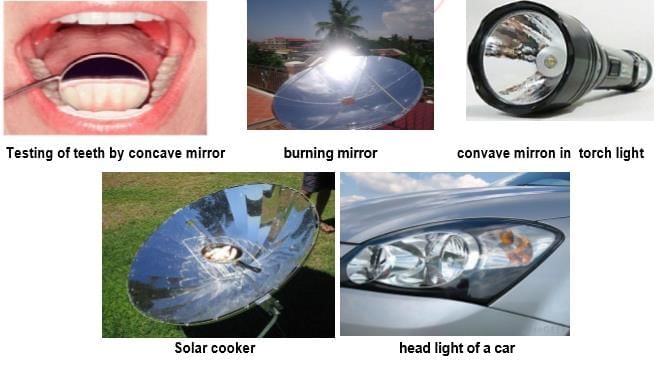
Concave reflectors converge light into a beam (torch/headlights); convex mirrors are used for wide-angle viewing (side-view mirrors, intersection mirrors).
Dentists use concave mirrors to get enlarged, close-up views.
Why others are incorrect: A: dentist needs concave; B: safety mirror is convex; D: vehicles use convex, not concave.
Uses of Concave Mirrors
Question 5:
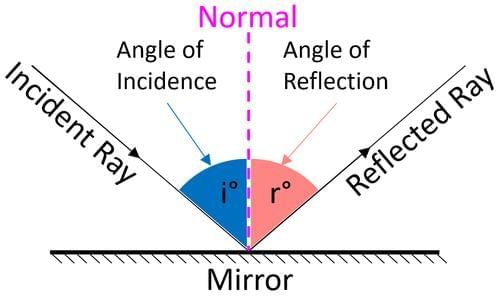
The first law of reflection states that: Option A: Angle of incidence equals angle of reflection Option B: Incident ray equals reflected ray Option C: Incident and reflected rays are perpendicular Option D: Reflection occurs only on plane mirrors
Solution:
Answer: Option A Solution:
Law 1: ∠i = ∠r for any reflecting surface (plane or spherical), measured from the normal at the point of incidence.
Why others are incorrect: B is meaningless; C is not general; D is false-laws hold for all mirrors.
Question 6:
The second law of reflection states that the incident ray, normal, and reflected ray: Option A: Lie in different planes Option B: Lie in the same plane Option C: Are all parallel Option D: Coincide for any angle
Solution:
Answer: Option B Solution:
Law 2: The incident ray, the normal at the point of incidence, and the reflected ray all lie in the same plane.
Why others are incorrect: A contradicts the law; C and D are special/impossible cases, not the general rule.
Question 7:
Multiple parallel light rays fall on a concave mirror. After reflection, the rays: Option A: Remain parallel Option B: Converge Option C: Diverge Option D: Disappear
Solution:
Answer: Option B Solution:
Concave mirrors converge parallel incident rays; convex mirrors cause divergence; plane mirrors keep them parallel.
Why others are incorrect: A applies to plane mirrors; C applies to convex; D is unphysical.
Question 8:
A convex lens is placed in front of text at a small distance. The text appears: Option A: Erect and enlarged Option B: Inverted and enlarged Option C: Erect and diminished Option D: Inverted and same-sized
Solution:
Answer: Option A Solution:
For close objects, a convex lens acts as a magnifier producing an erect, enlarged image (basis of magnifying glasses and reading lenses).
Farther objects may produce inverted images whose size varies with distance.
Why others are incorrect: B and D occur for certain object distances but inverted is not for close viewing; C describes concave lens behavior.
Question 9:
Which statement about a concave lens is always true for real objects? Option A: It always forms an erect and diminished image Option B: It always forms an inverted and enlarged image Option C: It can form an erect enlarged image Option D: It produces no image
Solution:
Answer: Option A Solution:
Concave lenses are diverging; they always produce virtual, erect, and diminished images of real objects.
Why others are incorrect: B and C contradict the diverging nature; D is false-images exist (virtual).
Question 10:
Why can a concave mirror or a convex lens burn paper when used with sunlight in the right setup? Option A: They absorb light and convert it to electricity Option B: They converge sunlight to a small bright spot, concentrating energy and heating the paper Option C: They block infrared rays Option D: They create light from darkness
Solution:
Answer: Option B Solution:
Concave mirrors and convex lenses can concentrate parallel sun rays to a small area, raising temperature enough to char or ignite paper (principle of solar concentrators).
Why others are incorrect: A, C, D do not describe the optical focusing mechanism.
Question 11:
Looking through a thin, flat glass plate at text produces what change compared to looking through a convex lens? Option A: Flat glass enlarges; convex lens leaves size unchanged Option B: Flat glass leaves size unchanged; convex lens can enlarge for close objects Option C: Both always diminish Option D: Both always invert
Solution:
Answer: Option B Solution:
A thin flat window simply transmits light without magnification; a convex lens can produce an erect, enlarged image for close viewing.
Why others are incorrect: A reverses; C and D are false in general use.
Question 12:
Which pairing is correct for "optical element → beam behavior" with parallel incident rays? Option A: Plane mirror → diverge Option B: Concave mirror → converge Option C: Convex mirror → remain parallel Option D: Concave lens → converge
Solution:
Answer: Option B Solution:
Parallel rays reflect to converge for concave mirrors; remain parallel for plane mirrors; diverge for convex mirrors; concave lenses diverge transmitted rays.
Why others are incorrect: A, C, D mismatch observed beam behavior.
Question 13:
If a light ray falls on a plane mirror along the normal, then: Option A: Angle of incidence is 0° and the ray reflects back on itself Option B: Angle of incidence is 90° and no reflection occurs Option C: The reflected ray is perpendicular to the incident ray Option D: The ray gets absorbed completely
Solution:
Answer: Option A Solution:
Incidence along the normal implies ∠i=0°, so ∠r=0°; the ray retraces its path.
Why others are incorrect: B misstates the angle; C is not general; D contradicts the reflective behavior.
Question 14:
Why do convex mirrors give a larger field of view than plane mirrors of the same size? Option A: They magnify everything Option B: Their outward curvature allows them to capture rays from a wider angular region Option C: They focus light to a point Option D: They block peripheral rays
Solution:
Answer: Option B Solution:
Convex curvature lets more peripheral rays reflect towards the observer, showing a wider scene (basis for use in vehicles and safety mirrors).
Why others are incorrect: A is false (they diminish); C describes concave focusing; D is opposite of wider view.
Question 15:
Which matching of lens type with consistently observed image property for real objects is correct? Option A: Convex lens - always erect and enlarged Option B: Concave lens - always erect and diminished Option C: Convex lens - always inverted and diminished Option D: Concave lens - sometimes inverted and enlarged
Solution:
Answer: Option B Solution:
A concave (diverging) lens always produces erect, diminished, virtual images of real objects; a convex lens can produce erect enlarged (near) or inverted images (far), so its behavior varies with distance.
Why others are incorrect: A and C wrongly claim "always" for convex; D is contrary to concave lens behavior.
The document MCQ (Solution) - Light: Mirrors and Lenses is a part of the Class 8 Course Science Class 8.
FAQs on MCQ (Solution) - Light: Mirrors and Lenses
1. What are the basic principles of reflection and how do they apply to mirrors?
Ans. The basic principles of reflection state that when light rays hit a smooth surface, they bounce back. This is known as the law of reflection, which states that the angle of incidence is equal to the angle of reflection. In mirrors, this principle allows us to see our image clearly because the smooth surface reflects light in a uniform manner, creating a clear and distinct reflection.
2. How do convex and concave mirrors differ in terms of their images?
Ans. Convex mirrors are curved outward and produce virtual, upright, and smaller images. They provide a wider field of view, making them useful for security and vehicle side mirrors. In contrast, concave mirrors are curved inward and can produce real, inverted images when the object is placed beyond the focal point, or virtual, upright images when the object is within the focal length. Concave mirrors are commonly used in makeup mirrors and telescopes.
3. What is the role of lenses in focusing light and how do they differ from mirrors?
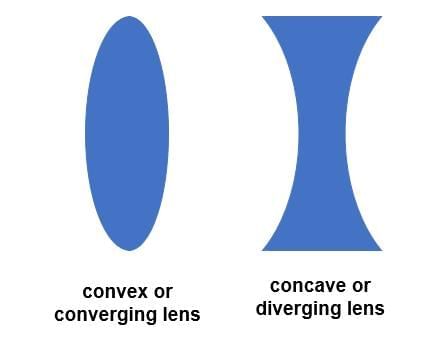
Ans. Lenses are transparent devices that refract (bend) light rays to focus them. There are two main types of lenses: convex (converging) lenses, which bring light rays together to a point, and concave (diverging) lenses, which spread light rays apart. Unlike mirrors, which reflect light, lenses change the direction of light through refraction. This property is utilized in glasses, cameras, and microscopes to enhance vision or magnify images.
4. How do we determine the focal length of a lens or mirror?
Ans. The focal length of a lens or mirror can be determined using the lens formula (1/f = 1/v - 1/u) for lenses, where f is the focal length, v is the image distance, and u is the object distance. For mirrors, a similar approach can be taken. By measuring the distances of the object and the image from the lens or mirror, one can calculate the focal length. The focal length is a critical parameter that determines how much the lens or mirror can converge or diverge light.
5. What practical applications do mirrors and lenses have in everyday life?
Ans. Mirrors and lenses have numerous practical applications in everyday life. Mirrors are used in bathrooms for personal grooming, in vehicles for visibility, and in optical devices. Lenses are essential in eyeglasses for correcting vision, in cameras for capturing images, and in microscopes for magnifying small objects. Both mirrors and lenses are fundamental components in various optical instruments, enhancing our ability to see and interact with the world around us.
Summary, past year papers, pdf , MCQ (Solution) - Light: Mirrors and Lenses, Semester Notes, MCQ (Solution) - Light: Mirrors and Lenses, study material, Objective type Questions, practice quizzes, Exam, MCQs, video lectures, Viva Questions, Free, ppt, MCQ (Solution) - Light: Mirrors and Lenses, mock tests for examination, Extra Questions, Previous Year Questions with Solutions, Sample Paper, Important questions, shortcuts and tricks;