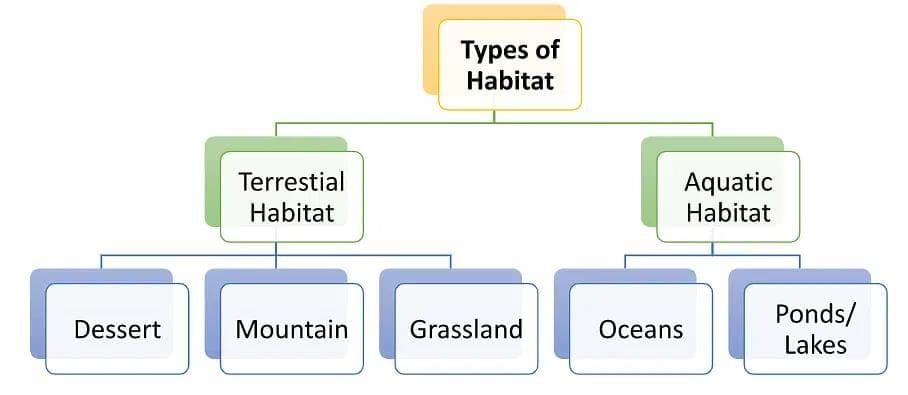
Which option best defines a habitat? Option A: Only the plants present in a forest Option B: The place where an organism lives, including living and non-living components Option C: A group of similar animals living together Option D: Any human-made area like a farm or park
Solution:
Ans: (b)
Explanation:
A habitat is the place where an organism lives and includes both biotic (living) and abiotic (non-living) components such as plants, animals, soil, water and climate that together provide conditions for survival.
Option A mentions only plants and so is incomplete; Option C describes a population rather than a habitat; Option D may be a habitat but is only one example and not the definition.
Question 2:
Pond water level drops and many aquatic plants die from pollution. Which change is most likely next within that ecosystem? Option A: Oxygen in water decreases and fish population drops Option B: Oxygen in water increases and fish thrive Option C: Soil moisture rises around the pond Option D: Decomposers stop working
Solution:
Ans: (a)
Explanation:
When aquatic plants die, the level of dissolved oxygen in the water falls because there are fewer plants producing oxygen and decomposers use oxygen to break down the dead matter. Lower oxygen stresses fish and many may die, so the fish population is likely to drop.
Option B is incorrect because oxygen would not increase; Option C is unrelated as pond water loss usually lowers nearby soil moisture; Option D is incorrect because decomposers continue to work and may temporarily increase oxygen consumption.
Question 3:
In the "pond with fish vs without fish" example, what indirect effect did fish have on nearby flowering plants? Option A: Fish directly pollinated flowers Option B: Fish reduced dragonflies, increasing pollinators and seed set Option C: Fish increased dragonflies, reducing pollinators and seed set Option D: Fish increased water nutrients taken up by flowers
Solution:
Ans: (b)
Explanation:
Fish eat dragonfly larvae, so ponds with fish have fewer dragonflies. With fewer dragonflies, pollinators such as bees and butterflies face less predation and their numbers can rise, improving pollination and seed production of nearby flowering plants.
Option A is wrong because fish do not pollinate; Option C states the opposite of what happens; Option D is not the main indirect link described here.
Question 4:
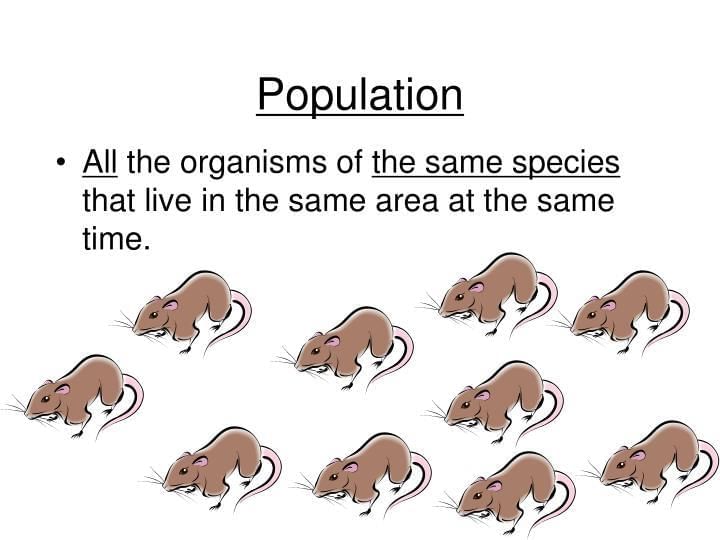
A population is best described as: Option A: All living and non-living components of an area Option B: All different species living together Option C: Individuals of the same species in a given area at a given time Option D: The abiotic conditions only
Solution:
Ans: (c)
Explanation:
A population consists of individuals of the same species living in a particular area at a specific time.
By contrast, Option B describes a community (all different species together), Option A describes an ecosystem (community plus abiotic factors), and Option D mentions only abiotic conditions and so is not correct.
Question 5:
Which pair correctly matches role and example? Option A: Producer - deer Option B: Consumer - mushroom Option C: Decomposer - fungi/bacteria Option D: Producer - vulture
Solution:
Ans: (c)
Explanation:
Decomposers such as fungi and bacteria break down dead organic matter and recycle nutrients back into the soil, so Option C is correct.
Producers are green plants that make their own food (not deer or vultures); mushrooms are decomposers (not consumers in the usual sense), and deer and vultures are consumers.
Question 6:
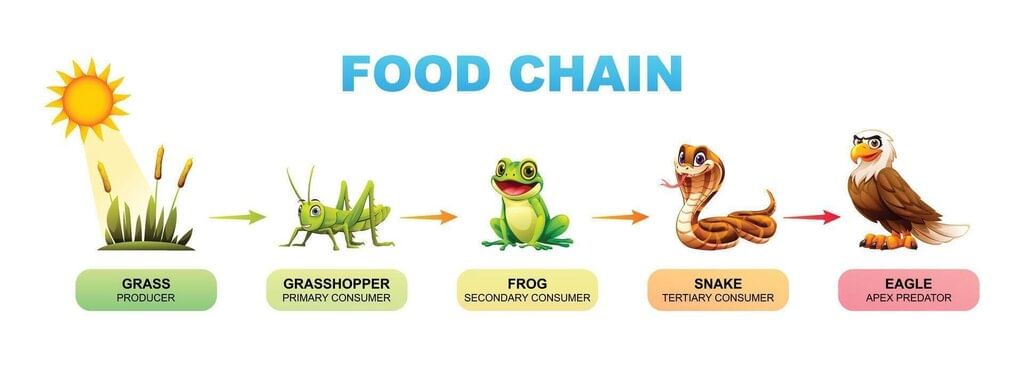
Which example is a correct simple food chain in a grassland? Option A: Snake → frog → grasshopper → grass Option B: Grass → hare → fox Option C: Eagle → snake → frog → grasshopper Option D: Grasshopper → grass → frog → snake
Solution:
Ans: (b)
Explanation:
Energy flows from producers to consumers. Option B shows this correctly: grass (producer) → hare (primary consumer) → fox (secondary/tertiary consumer).
Options A and D list the sequence in the wrong direction; Option C begins with a top predator, not a producer, so it is not a simple correct chain from producer upwards.
Question 7:
In a crop field with millet, mice, and eagles, which trophic level is at the base of the ecological pyramid? Option A: Eagle Option B: Mouse Option C: Millet plants Option D: Decomposers
Solution:
Ans: (c)
Explanation:
Producers such as millet plants form the first trophic level and are the base of the ecological pyramid. They supply energy to primary consumers (mice), which in turn support secondary consumers (eagles).
Decomposers operate at all levels after organisms die but are not the base of the living-tissue pyramid.
Question 8:
Why are food webs more realistic than single food chains? Option A: They show abiotic factors only Option B: Most organisms feed on or are eaten by multiple species, forming interconnected chains Option C: They exclude decomposers Option D: They are simpler to draw and read
Solution:
Ans: (b)
Explanation:
Food webs show multiple feeding connections because most species eat or are eaten by more than one other species. This interconnection gives a more accurate picture of ecosystem feeding relationships than single linear chains.
Options A and C are incorrect descriptions; Option D is the opposite-food webs are usually more complex than single chains.
Question 9:
If frogs vanish from a grassland food web, which immediate outcome is most likely? Option A: Grasshopper population increases; snake population declines Option B: Grasshopper population decreases; snake population increases Option C: Both grasshopper and snake populations increase Option D: No change in other populations
Solution:
Ans: (a)
Explanation:
Frogs feed on grasshoppers and also serve as prey for snakes. If frogs disappear, grasshopper numbers are likely to rise because one of their predators is gone, while snakes may decline because they lose a food source. These are typical cascading effects in food webs.
Question 10:
What is the primary ecosystem service of decomposers like mushrooms and bacteria? Option A: Fix atmospheric nitrogen directly Option B: Produce glucose by photosynthesis Option C: Break down dead organic matter, returning nutrients to soil Option D: Control climate by absorbing CO2 at large scales
Solution:
Ans: (c)
Explanation:
Decomposers break down dead plants and animals into simpler substances, returning nutrients to the soil so plants can use them again. This recycling is essential for maintaining soil fertility and ecosystem productivity.
They do not perform photosynthesis (Option B) and, while some microbes are involved in nutrient cycles like nitrogen, their primary service here is decomposition rather than direct large-scale climate control (Option D).
Question 11:
Which interaction is correctly matched with its example? Option A: Mutualism - ticks on dogs Option B: Commensalism - orchids on tree branches Option C: Parasitism - bees pollinating flowers Option D: Mutualism - epiphytes taking space
Solution:
Ans: (b)
Explanation:
Orchids that grow on tree branches (epiphytes) gain support and better access to light without harming the tree-this is commensalism. Ticks on dogs are parasitism, and bees pollinating flowers is mutualism because both benefit.
Question 12:
Large-scale harvesting of frogs led to pest outbreaks in fields. Which principle does this illustrate? Option A: Abiotic factors are more important than biotic ones Option B: Producers do not affect consumers Option C: Pesticides enhance biodiversity Option D: Removing a predator can disrupt balance and increase prey/pest populations
Solution:
Ans: (d)
Explanation:
Removing predators such as frogs reduces natural control of pest species, allowing pest numbers to rise and unbalancing the ecosystem. This often leads to increased pesticide use and further negative effects.
Options A-C are incorrect: biotic interactions are important, producers do affect consumers, and pesticides usually harm biodiversity rather than enhance it.
Question 13:
Which statement about Sundarbans mangroves is most accurate? Option A: They only provide timber, not protection Option B: They buffer coasts against storms and floods, store carbon, and support biodiversity Option C: They are not threatened by human activities Option D: They are unimportant to nearby communities
Solution:
Ans: (b)
Explanation:
Sundarbans mangroves protect coasts by reducing wave and wind energy, help store carbon, and provide habitat for many species including endangered ones. They are vital for nearby communities but face threats like deforestation, pollution and sea-level rise.
Question 14:
Which farming practice is most aligned with sustaining soil health and ecosystem balance? Option A: Diversified crops, organic amendments/composts, natural pest control Option B: Continuous monoculture with heavy synthetic inputs Option C: Increasing pesticide doses to overcome resistance Option D: Maximizing irrigation and repeated ploughing regardless of soil biota
Solution:
Ans: (a)
Explanation:
Practices such as crop diversification, using organic composts and biological pest control maintain soil structure, support beneficial soil organisms, reduce erosion and chemical dependency, and sustain long-term productivity.
Options B-D rely on intensive inputs or harmful practices that degrade soil health and biodiversity over time.
Question 15:
What is the most complete description of an ecosystem? Option A: Only the animals and plants in an area Option B: A community plus its abiotic environment and the interactions among them Option C: A single food chain in a habitat Option D: Only human-made systems like farms and parks
Solution:
Ans: (b)
Explanation:
An ecosystem includes a biological community together with the abiotic environment (air, water, soil, light, temperature) and all interactions among these components. This definition covers natural and human-influenced systems and the network of processes that link living and non-living parts.
The document MCQ (Solution) - How Nature Works in Harmony is a part of the Class 8 Course Science Class 8.
FAQs on MCQ (Solution) - How Nature Works in Harmony
1. What are the key components of nature that work in harmony?
Ans. The key components of nature that work in harmony include the ecosystem, biodiversity, and the interdependence of various species. Ecosystems consist of living organisms, such as plants and animals, and their physical environment, working together to maintain balance. Biodiversity enhances resilience, allowing ecosystems to adapt to changes. The interdependence among species, such as predators, prey, and plants, ensures the stability of food chains and overall ecosystem health.
2. How does human activity impact the natural harmony of ecosystems?
Ans. Human activity significantly impacts the natural harmony of ecosystems through deforestation, pollution, urbanization, and climate change. Deforestation reduces habitat availability for many species, leading to biodiversity loss. Pollution contaminates air, water, and soil, adversely affecting living organisms. Urbanization disrupts natural habitats, while climate change alters weather patterns, threatening the survival of various species and the balance of ecosystems.
3. What role does biodiversity play in maintaining ecological balance?
Ans. Biodiversity plays a crucial role in maintaining ecological balance by ensuring that different species can fulfill various ecological roles, such as pollination, nutrient cycling, and pest control. High biodiversity increases the resilience of ecosystems, enabling them to withstand environmental stressors like climate change and disease. This diversity also supports food security and provides resources for medicine, agriculture, and other human needs.
4. What are some examples of natural phenomena that illustrate harmony in nature?
Ans. Some examples of natural phenomena that illustrate harmony in nature include the symbiotic relationships between species, such as bees pollinating flowers while obtaining nectar, and the nutrient cycling in forests, where decomposers break down organic matter, returning nutrients to the soil. Additionally, predator-prey dynamics, where populations of predators and prey regulate each other, demonstrate natural balance and harmony.
5. How can individuals contribute to preserving the harmony of nature?
Ans. Individuals can contribute to preserving the harmony of nature by adopting sustainable practices, such as reducing waste, recycling, and conserving water. Supporting local wildlife through habitat preservation and planting native species can enhance biodiversity. Additionally, advocating for environmental policies and educating others about the importance of ecological balance can collectively foster a greater awareness and commitment to protecting nature.
Previous Year Questions with Solutions, Sample Paper, MCQ (Solution) - How Nature Works in Harmony, Important questions, MCQ (Solution) - How Nature Works in Harmony, Objective type Questions, Extra Questions, practice quizzes, MCQ (Solution) - How Nature Works in Harmony, Exam, video lectures, Semester Notes, MCQs, Summary, Free, ppt, study material, Viva Questions, pdf , past year papers, shortcuts and tricks, mock tests for examination;