UPSC Exam > UPSC Notes > Mains: Ethics, Integrity & Aptitude > Mind Map: What are Laws, Rules and Regulations
Mind Map: What are Laws, Rules and Regulations

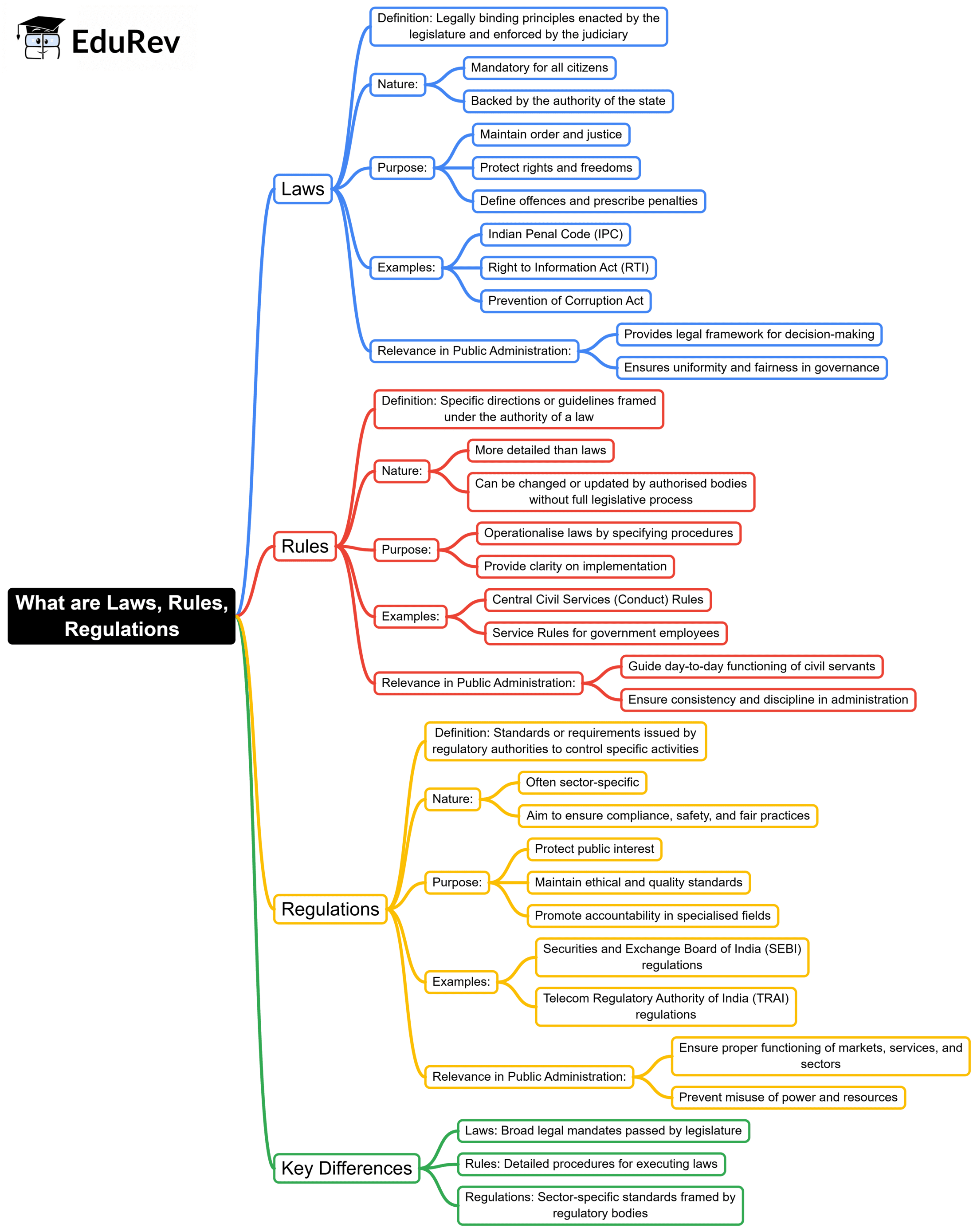
The document Mind Map: What are Laws, Rules and Regulations is a part of the UPSC Course UPSC Mains: Ethics, Integrity & Aptitude.
All you need of UPSC at this link: UPSC
FAQs on Mind Map: What are Laws, Rules and Regulations
| 1. What are the key differences between laws, rules, and regulations? |  |
Ans.Laws are formal legal statutes enacted by a legislative body, representing the highest authority in a jurisdiction. Rules are specific directives or guidelines created to implement laws, often established by governmental agencies. Regulations are detailed provisions that govern specific activities, providing clarity and enforcement mechanisms for laws and rules.
| 2. How are laws created and enacted in a democratic system? | |
Ans.In a democratic system, laws are created through a legislative process that typically involves several stages: proposal (drafting of a bill), discussion (debate among legislators), approval (voting), and enactment (signing by the head of state). Public participation and input may also be encouraged during the process to ensure representation of citizens' views.
| 3. What role do regulations play in the enforcement of laws? | |
Ans.Regulations serve as a practical framework for enforcing laws. They provide specific details on how the laws should be applied, outline procedures for compliance, and establish penalties for violations. This helps ensure that laws are implemented effectively and consistently across different sectors and issues.
| 4. Can laws and regulations change over time? If so, how? | |
Ans.Yes, laws and regulations can change over time through a process known as amendment or repeal. Laws may be amended by the same legislative body that enacted them, while regulations can be updated by the relevant governmental agency in response to new information, societal needs, or technological advancements. Public feedback can also influence these changes.
| 5. What are some examples of major laws and regulations that impact society? | |
Ans.Examples of major laws include civil rights legislation, environmental protection laws, and labor laws. Regulations stemming from these laws might involve standards for workplace safety, emissions controls for industries, and guidelines for non-discrimination. These laws and regulations collectively shape societal norms and protect public interests.
About this Document

4.73/5 Rating

Apr 19, 2026 Last updated
Related Exams
Document Description: Mind Map: What are Laws, Rules and Regulations for UPSC 2026 is part of UPSC Mains: Ethics, Integrity & Aptitude preparation. The notes and questions for Mind Map: What are Laws, Rules and Regulations have been prepared according to the UPSC exam syllabus. Information about Mind Map: What are Laws, Rules and Regulations covers topics like and Mind Map: What are Laws, Rules and Regulations Example, for UPSC 2026 Exam. Find important definitions, questions, notes, meanings, examples, exercises and tests below for Mind Map: What are Laws, Rules and Regulations.
Introduction of Mind Map: What are Laws, Rules and Regulations in English is available as part of our UPSC Mains: Ethics, Integrity & Aptitude for UPSC & Mind Map: What are Laws, Rules and Regulations in Hindi for UPSC Mains: Ethics, Integrity & Aptitude course. Download more important topics related with notes, lectures and mock test series for UPSC Exam by signing up for free. UPSC: Mind Map: What are Laws, Rules and Regulations
Description
Mind Map: What are Laws, Rules & Regulations of UPSC Mains provides you one-page visual summary of the chapter covering all the important topics. Download the PDF from EduRev.
Information about Mind Map: What are Laws, Rules and Regulations
In this doc you can find the meaning of Mind Map: What are Laws, Rules and Regulations defined & explained in the simplest way possible. Besides explaining types of Mind Map: What are Laws, Rules and Regulations theory, EduRev gives you an ample number of questions to practice Mind Map: What are Laws, Rules and Regulations tests, examples and also practice UPSC tests



Related Searches
video lectures, Mind Map: What are Laws, Viva Questions, MCQs, Extra Questions, shortcuts and tricks, practice quizzes, Mind Map: What are Laws, Sample Paper, mock tests for examination, Semester Notes, Summary, Mind Map: What are Laws, Rules and Regulations, Important questions, ppt, Free, pdf , Previous Year Questions with Solutions, study material, Objective type Questions, Rules and Regulations, Exam, past year papers, Rules and Regulations;