UPSC Exam > UPSC Notes > Mains: Internal Security & Disaster Management > Mind Map: Money Laundering and Black Money
Mind Map: Money Laundering and Black Money

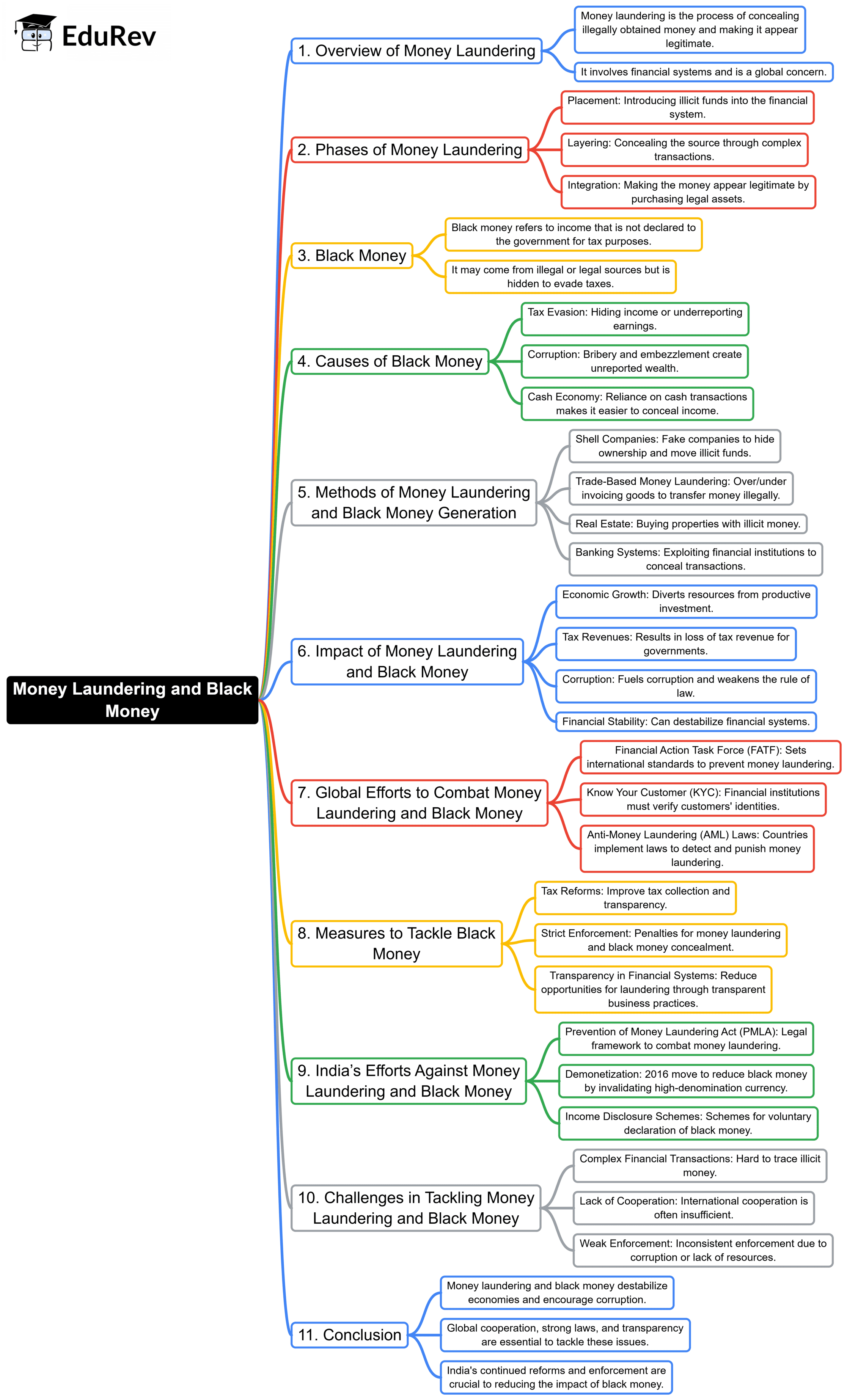
The document Mind Map: Money Laundering and Black Money is a part of the UPSC Course UPSC Mains: Internal Security & Disaster Management.
All you need of UPSC at this link: UPSC
FAQs on Mind Map: Money Laundering and Black Money
| 1. What is money laundering and how does it impact the economy? |  |
Ans. Money laundering is the process of disguising the origins of illegally obtained money, typically by passing it through a complex sequence of banking transfers or commercial transactions. This practice has significant negative impacts on the economy as it can undermine the integrity of financial institutions, distort international capital flows, and contribute to corruption and organized crime.
| 2. What are the stages of money laundering? | |
Ans. Money laundering typically involves three key stages: placement, layering, and integration. Placement is the initial introduction of illicit funds into the financial system. Layering involves conducting a series of transactions to obscure the origin of the money, making it difficult to trace. Finally, integration is the process of reintroducing the laundered money into the economy, making it appear legitimate.
| 3. What are the laws and regulations in place to combat money laundering? | |
Ans. Various laws and regulations have been established to combat money laundering, including the Prevention of Money Laundering Act (PMLA) in many jurisdictions. These laws typically require financial institutions to implement Know Your Customer (KYC) protocols, report suspicious activities, and maintain records of transactions to prevent and detect money laundering activities.
| 4. How does black money relate to money laundering? | |
Ans. Black money refers to funds that are earned through illegal means and are not reported to tax authorities. Money laundering is often used to make black money appear legitimate. Individuals or entities might engage in money laundering to avoid detection by authorities and to utilize unaccounted wealth without facing legal repercussions.
| 5. What are the global efforts to tackle money laundering? | |
Ans. Global efforts to combat money laundering include initiatives led by organizations such as the Financial Action Task Force (FATF), which sets international standards and promotes measures to combat money laundering and terrorist financing. Countries are encouraged to adopt and enforce effective anti-money laundering regulations, share information, and cooperate in investigations to address this issue on a global scale.
About this Document

4.96/5 Rating

Apr 19, 2026 Last updated
Related Exams
Document Description: Mind Map: Money Laundering and Black Money for UPSC 2026 is part of UPSC Mains: Internal Security & Disaster Management preparation. The notes and questions for Mind Map: Money Laundering and Black Money have been prepared according to the UPSC exam syllabus. Information about Mind Map: Money Laundering and Black Money covers topics like and Mind Map: Money Laundering and Black Money Example, for UPSC 2026 Exam. Find important definitions, questions, notes, meanings, examples, exercises and tests below for Mind Map: Money Laundering and Black Money.
Introduction of Mind Map: Money Laundering and Black Money in English is available as part of our UPSC Mains: Internal Security & Disaster Management for UPSC & Mind Map: Money Laundering and Black Money in Hindi for UPSC Mains: Internal Security & Disaster Management course. Download more important topics related with notes, lectures and mock test series for UPSC Exam by signing up for free. UPSC: Mind Map: Money Laundering and Black Money
Description
Mind Map: Money Laundering & Black Money of UPSC Mains provides you one-page visual summary of the chapter covering all the important topics. Download the PDF from EduRev.
Information about Mind Map: Money Laundering and Black Money
In this doc you can find the meaning of Mind Map: Money Laundering and Black Money defined & explained in the simplest way possible. Besides explaining types of Mind Map: Money Laundering and Black Money theory, EduRev gives you an ample number of questions to practice Mind Map: Money Laundering and Black Money tests, examples and also practice UPSC tests



Related Searches
Free, Semester Notes, Exam, Mind Map: Money Laundering and Black Money, Mind Map: Money Laundering and Black Money, Mind Map: Money Laundering and Black Money, past year papers, ppt, MCQs, Summary, shortcuts and tricks, study material, Previous Year Questions with Solutions, Extra Questions, video lectures, Viva Questions, practice quizzes, mock tests for examination, Important questions, Sample Paper, Objective type Questions, pdf ;