CBSE Class 8 > Class 8 Notes > Science > NCERT Based Activity: Our Home: Earth, a Unique Life Sustaining Planet
NCERT Based Activity: Our Home: Earth, a Unique Life Sustaining Planet

Activity 13.1: Let us find out
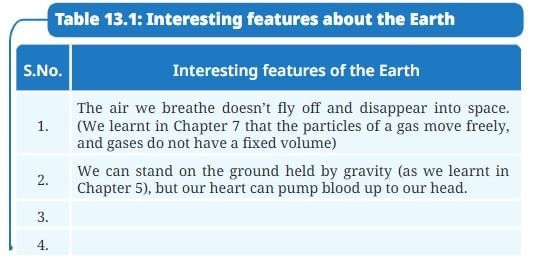
List some features of the Earth that we often take for granted, but are interesting and important to us. Write them in Table 13.1. We have filled in a few for you.
Ans:
- Sunlight and warmth from the Sun - these provide the energy needed for photosynthesis in plants and keep the global temperature within a range that supports life.
- Water in all three forms - solid (ice), liquid (water) and gas (water vapour). This allows the continuous movement of water through the water cycle and supports all forms of life.
- An atmosphere - a mixture of gases (mainly nitrogen and oxygen) that supplies air for breathing, helps regulate temperature, and protects organisms from harmful solar radiation.
- A protective ozone layer - a layer in the upper atmosphere that absorbs most of the Sun's harmful ultraviolet (UV) radiation, reducing damage to living tissues.
- A magnetic field - generated by the motion of liquid iron in the core; it shields the Earth from charged particles of the solar wind and helps retain the atmosphere.
- Suitable distance from the Sun (the Goldilocks zone) - the Earth is at a distance where temperatures allow liquid water to exist on the surface.
- Gravity - keeps the atmosphere and oceans bound to the planet and allows structures such as mountains and rivers to form and persist.
- Rotation and revolution - rotation of the Earth causes day and night; revolution around the Sun together with the axial tilt causes the seasons.
- The axial tilt and the Moon's stabilising effect - the tilt of the Earth's axis produces seasonal changes; the Moon helps keep this tilt relatively stable over long timescales.
- Diverse spheres and habitats - the lithosphere (land), hydrosphere (water), atmosphere (air) and biosphere (living organisms) interact to create many different habitats supporting biodiversity.
- Plate tectonics and recycling of materials - movement of Earth's plates causes earthquakes and volcanoes, forms mountains and recycles minerals and gases essential for life.
- Availability of essential elements - elements such as carbon, hydrogen, oxygen, nitrogen and phosphorus occur in usable forms and participate in biological cycles.
Activity 13.2: Let us find out
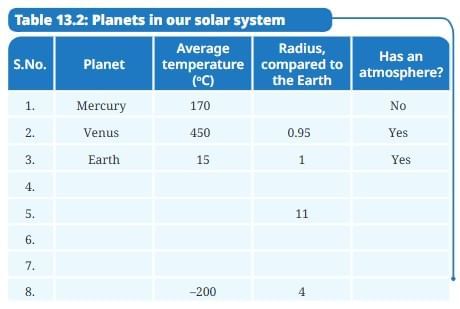
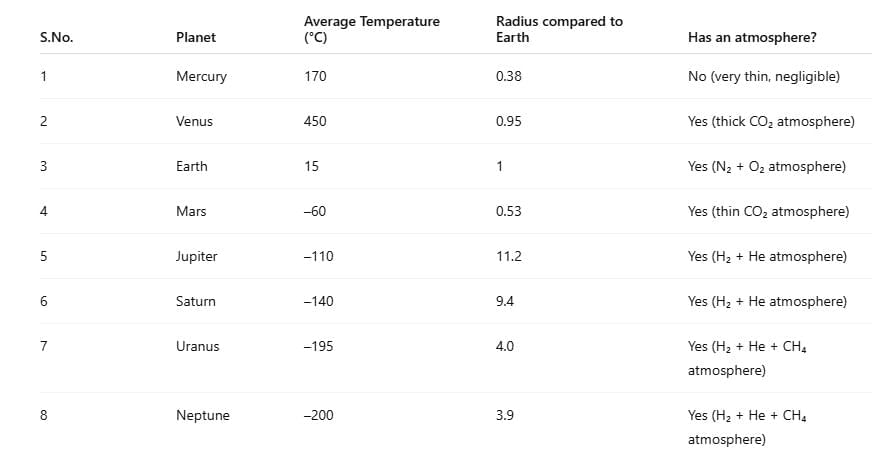
- Collect information about the temperature and size of the planets in the Solar System, and check if they have an atmosphere.
- You may collect this information from books in your school library, trusted websites, or discuss with your teachers.
- Fill out the missing information in Table 13.2.
Ans:
Activity 13.3: Let us find out
- Take some parts of plants such as a stem cutting of a money plant, the 'eyes' of a sprouted potato, or a piece of ginger.
- Plant each of them separately in moist soil (not too deep). For the money plant, you can also place a cutting in a glass container with water so that it is easy to observe root formation.
- Ensure proper conditions - provide suitable water, air, and sunlight; avoid waterlogging; keep them at a stable temperature.
- Observe daily and note how many days it takes for roots, stems and leaves to appear; record when the first new leaf appears.
Observation:
- Roots may appear in about 3-7 days for money plant cuttings placed in water, and about 7-14 days for potato eyes or ginger placed in moist soil depending on temperature and moisture.
- Stems and leaves typically emerge within about 10-20 days after planting; the first new leaf often appears around 15-25 days, but this varies with plant type and environmental conditions (money plant in water often shows leaves sooner than tubers in soil).
Explanation and additional points to record
- Vegetative propagation - the process used here is a form of asexual reproduction where a new plant develops from a part of the parent plant (stem, tuber, rhizome). The new plant is genetically identical to the parent.
- Role of plant hormones - natural hormones such as auxins promote root formation at cut surfaces; availability of these hormones and their movement affect how quickly roots form.
- Why roots often form first - roots are essential for water and mineral uptake; when a cutting is placed in water or soil, cells near the cut differentiate into root initials under the influence of hormones and moisture.
- Factors affecting growth - temperature, light intensity, humidity, the quality of the cutting or tuber, and the cleanliness of tools; warmer but not hot temperatures usually speed up rooting.
- Recording observations - maintain a simple table with columns: date, plant part, condition (water/soil), first root observed (date), first leaf observed (date), notes on health/colour/size. This helps compare species and conditions.
- Precautions - use clean pots and scissors to avoid infection; do not overwater; label each sample so you can track observations correctly.
- Conclusion/Application - this activity demonstrates how many common plants can reproduce asexually, and it shows conditions necessary for growth. Such techniques are used in gardening and agriculture to propagate desirable plants quickly and reliably.
The document NCERT Based Activity: Our Home: Earth, a Unique Life Sustaining Planet is a part of the Class 8 Course Science Class 8.
All you need of Class 8 at this link: Class 8
FAQs on NCERT Based Activity: Our Home: Earth, a Unique Life Sustaining Planet
| 1. What makes Earth a unique planet for sustaining life? |  |
Ans.Earth is unique in its ability to sustain life due to several key factors: it is located in the habitable zone of the solar system, where temperatures are just right for liquid water to exist. Earth has a diverse atmosphere composed primarily of nitrogen and oxygen, which is essential for life. The presence of water in various forms, such as oceans, rivers, and ice, supports a wide range of ecosystems. Additionally, Earth's magnetic field protects it from harmful solar radiation, and its geological activity contributes to nutrient cycling necessary for living organisms.
| 2. How does the water cycle contribute to life on Earth? | |
Ans.The water cycle is crucial for sustaining life on Earth as it regulates climate, supports ecosystems, and replenishes water sources. It involves processes such as evaporation, condensation, precipitation, and runoff. Through evaporation, water from oceans and lakes turns into vapor, which then cools and condenses to form clouds. Precipitation returns water to the surface, where it can support plants, animals, and human needs. This continuous cycle ensures that water is distributed across different regions, maintaining the balance necessary for life.
| 3. What role does the atmosphere play in supporting life on Earth? | |
Ans.The atmosphere plays several critical roles in supporting life on Earth. It provides essential gases, such as oxygen for respiration and carbon dioxide for photosynthesis. The atmosphere also helps regulate temperature by trapping heat through the greenhouse effect, making the planet habitable. Additionally, it protects living organisms from harmful solar radiation and meteor impacts. The presence of weather patterns and climate systems, influenced by atmospheric conditions, further supports diverse life forms.
| 4. Why is biodiversity important for the health of our planet? | |
Ans.Biodiversity is vital for the health of our planet as it contributes to ecosystem stability, resilience, and productivity. A diverse range of species ensures that ecosystems can withstand environmental changes and disturbances. Different organisms play unique roles, such as pollination, nutrient cycling, and decomposition, which are essential for maintaining balanced ecosystems. Moreover, biodiversity provides resources for humans, including food, medicine, and raw materials, while also enriching cultural and recreational experiences.
| 5. What threats does Earth face that could impact its ability to sustain life? | |
Ans.Earth faces several significant threats that could impact its ability to sustain life, including climate change, habitat destruction, pollution, and overexploitation of natural resources. Climate change leads to rising temperatures, altered weather patterns, and more frequent extreme weather events, which can disrupt ecosystems and species. Habitat destruction from urbanization and deforestation reduces the areas available for wildlife. Pollution affects air, water, and soil quality, harming both human health and ecosystems. Overexploitation of resources can lead to species extinction and depletion of vital resources necessary for survival.
About this Document

4.84/5 Rating

Apr 20, 2026 Last updated
Related Exams
Document Description: NCERT Based Activity: Our Home: Earth, a Unique Life Sustaining Planet for Class 8 2026 is part of Science Class 8 preparation. The notes and questions for NCERT Based Activity: Our Home: Earth, a Unique Life Sustaining Planet have been prepared according to the Class 8 exam syllabus. Information about NCERT Based Activity: Our Home: Earth, a Unique Life Sustaining Planet covers topics like and NCERT Based Activity: Our Home: Earth, a Unique Life Sustaining Planet Example, for Class 8 2026 Exam. Find important definitions, questions, notes, meanings, examples, exercises and tests below for NCERT Based Activity: Our Home: Earth, a Unique Life Sustaining Planet.
Introduction of NCERT Based Activity: Our Home: Earth, a Unique Life Sustaining Planet in English is available as part of our Science Class 8 for Class 8 & NCERT Based Activity: Our Home: Earth, a Unique Life Sustaining Planet in Hindi for Science Class 8 course. Download more important topics related with notes, lectures and mock test series for Class 8 Exam by signing up for free. Class 8: NCERT Based Activity: Our Home: Earth, a Unique Life Sustaining Planet
Description
NCERT Based Activity: Our Home: Earth, a Unique Life Sustaining Planet of Science Class 8 covers all the important topics, helping you prepare for the Class 8 exam on EduRev.
Information about NCERT Based Activity: Our Home: Earth, a Unique Life Sustaining Planet
In this doc you can find the meaning of NCERT Based Activity: Our Home: Earth, a Unique Life Sustaining Planet defined & explained in the simplest way possible. Besides explaining types of NCERT Based Activity: Our Home: Earth, a Unique Life Sustaining Planet theory, EduRev gives you an ample number of questions to practice NCERT Based Activity: Our Home: Earth, a Unique Life Sustaining Planet tests, examples and also practice Class 8 tests



Related Searches
mock tests for examination, Previous Year Questions with Solutions, practice quizzes, Summary, Important questions, video lectures, NCERT Based Activity: Our Home: Earth, Exam, pdf , a Unique Life Sustaining Planet, shortcuts and tricks, NCERT Based Activity: Our Home: Earth, study material, past year papers, ppt, Objective type Questions, Viva Questions, Sample Paper, Extra Questions, Semester Notes, a Unique Life Sustaining Planet, MCQs, a Unique Life Sustaining Planet, Free, NCERT Based Activity: Our Home: Earth;