B.Ed Entrance Exam > B.Ed Entrance Notes > Teaching Aptitude for Teaching Exam > Mind Map: Personality
Mind Map: Personality

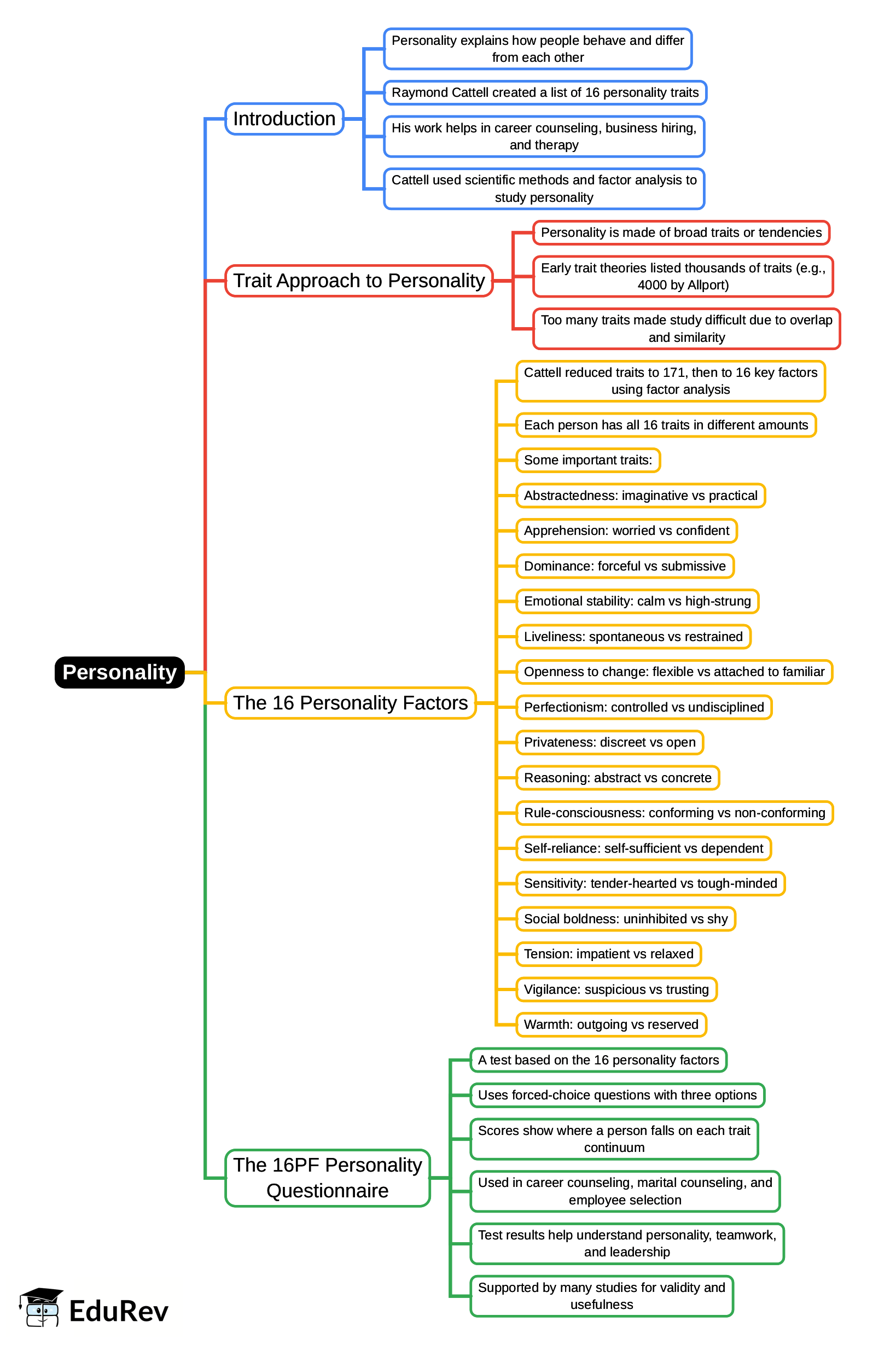
The document Mind Map: Personality is a part of the B.Ed Entrance Course Teaching Aptitude for Teaching Exam.
All you need of B.Ed Entrance at this link: B.Ed Entrance
FAQs on Mind Map: Personality
| 1. What are the main traits that define personality in psychology? |  |
Ans. Personality comprises stable patterns of thoughts, emotions, and behaviours that distinguish individuals from one another. Key personality dimensions include openness, conscientiousness, extraversion, agreeableness, and neuroticism-commonly remembered as the Big Five model. These traits influence how people interact, make decisions, and respond to their environment, forming the foundation of personality psychology for teaching aptitude exams.
| 2. How do nature and nurture shape a person's personality development? | |
Ans. Personality develops through both genetic factors (nature) and environmental influences (nurture) working together. Genetics provide predispositions toward certain traits, while family environment, social experiences, culture, and personal interactions mould these tendencies. Understanding this interplay helps educators recognise that students' personalities aren't fixed but continuously shaped by experiences, making it crucial knowledge for effective teaching strategies.
| 3. What's the difference between personality and temperament for B.Ed entrance exams? | |
Ans. Temperament refers to innate, biologically-based emotional and behavioural characteristics present from birth, while personality encompasses broader patterns developed through life experiences and social learning. Temperament is more stable and unchanging, whereas personality is more flexible and influenced by education and environment. For teaching aptitude, recognising this distinction helps educators adapt their approach to individual student needs.
| 4. Why do teachers need to understand different personality types in the classroom? | |
Ans. Teachers who understand personality differences can tailor instruction to match students' learning preferences and emotional needs. Recognising introversion, extraversion, and other traits helps educators design inclusive activities, manage classroom dynamics effectively, and provide appropriate support. This awareness directly improves student engagement, reduces behavioural issues, and creates psychologically safe learning environments-a critical component of the teaching aptitude assessment.
| 5. How can I remember the Big Five personality traits for my B.Ed exam? | |
Ans. The Big Five traits are remembered using the acronym OCEAN: Openness (creativity and curiosity), Conscientiousness (organisation and discipline), Extraversion (sociability and assertiveness), Agreeableness (compassion and cooperation), and Neuroticism (emotional instability). Students preparing for teaching exams should refer to mind maps and flashcards on EduRev that visualise these dimensions, making retention easier during revision and helping connect personality theory to classroom teaching practice.
About this Document

1.2K Views

4.78/5 Rating

Apr 18, 2026 Last updated
Related Exams
Document Description: Mind Map: Personality for B.Ed Entrance 2026 is part of Teaching Aptitude for Teaching Exam preparation. The notes and questions for Mind Map: Personality have been prepared according to the B.Ed Entrance exam syllabus. Information about Mind Map: Personality covers topics like and Mind Map: Personality Example, for B.Ed Entrance 2026 Exam. Find important definitions, questions, notes, meanings, examples, exercises and tests below for Mind Map: Personality.
Introduction of Mind Map: Personality in English is available as part of our Teaching Aptitude for Teaching Exam for B.Ed Entrance & Mind Map: Personality in Hindi for Teaching Aptitude for Teaching Exam course. Download more important topics related with notes, lectures and mock test series for B.Ed Entrance Exam by signing up for free. B.Ed Entrance: Mind Map: Personality
Description
Mind Map: Personality of Teaching Aptitude provides you one-page visual summary of the chapter covering all the important topics. Download the PDF from EduRev.
Information about Mind Map: Personality
In this doc you can find the meaning of Mind Map: Personality defined & explained in the simplest way possible. Besides explaining types of Mind Map: Personality theory, EduRev gives you an ample number of questions to practice Mind Map: Personality tests, examples and also practice B.Ed Entrance tests



Related Searches
pdf , Important questions, Exam, shortcuts and tricks, Previous Year Questions with Solutions, Summary, Sample Paper, Viva Questions, MCQs, study material, ppt, Mind Map: Personality, past year papers, Mind Map: Personality, Free, video lectures, Objective type Questions, Extra Questions, practice quizzes, Mind Map: Personality, Semester Notes, mock tests for examination;