B.Ed Entrance Exam > B.Ed Entrance Notes > Teaching Aptitude for Teaching Exam > Mind Map: Evaluation System
Mind Map: Evaluation System

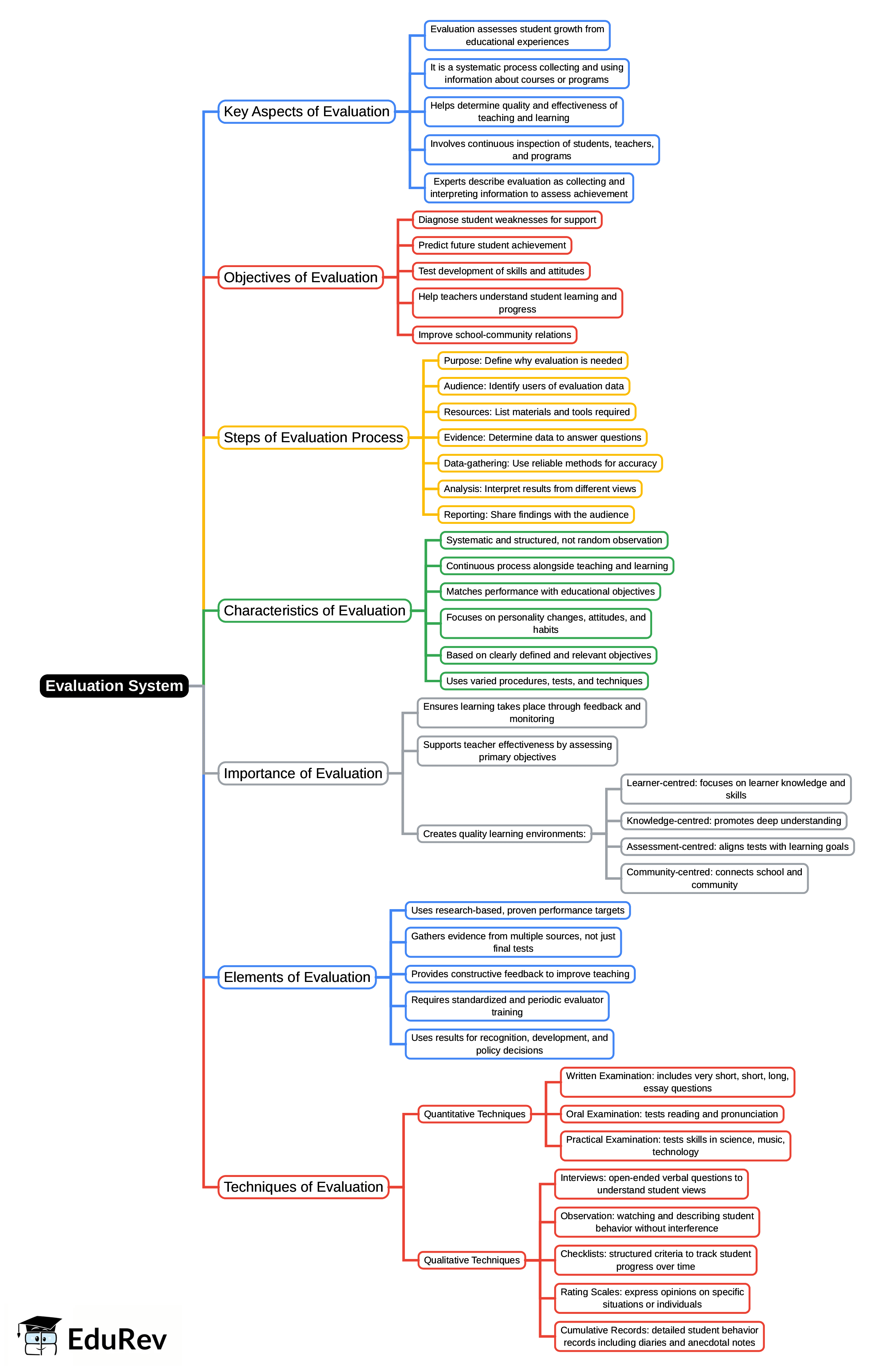
The document Mind Map: Evaluation System is a part of the B.Ed Entrance Course Teaching Aptitude for Teaching Exam.
All you need of B.Ed Entrance at this link: B.Ed Entrance
FAQs on Mind Map: Evaluation System
| 1. What are the main components of an evaluation system in education? |  |
Ans. An evaluation system consists of three core components: formative assessment (ongoing feedback during learning), summative assessment (final evaluation of achievement), and diagnostic assessment (identifying student strengths and weaknesses). Together, these elements create a comprehensive framework for measuring student progress and informing instructional decisions in the classroom.
| 2. How do formative and summative assessments differ in teaching practice? | |
Ans. Formative assessments occur continuously throughout instruction-quizzes, class discussions, observations-providing real-time feedback to guide teaching. Summative assessments happen at the end of a unit or term-final exams, projects-to measure overall learning outcomes. While formative assessments shape teaching methods, summative assessments evaluate total student achievement and inform grades.
| 3. What's the difference between norm-referenced and criterion-referenced evaluation? | |
Ans. Norm-referenced evaluation compares a student's performance against peers' performance, ranking students relative to each other. Criterion-referenced evaluation measures performance against fixed, predetermined standards or learning objectives. Schools use criterion-referenced methods more often today because they focus on mastery of specific skills rather than ranking students competitively.
| 4. Why is continuous evaluation important for student learning outcomes? | |
Ans. Continuous evaluation monitors learning progress regularly, identifying gaps before they widen and enabling teachers to adjust instruction immediately. This approach reduces exam anxiety, motivates consistent effort, provides frequent feedback for improvement, and ensures no student falls behind. Regular assessments also help teachers personalise teaching strategies based on individual learning needs.
| 5. How should teachers select appropriate evaluation methods for different learning objectives? | |
Ans. Teachers must align evaluation methods with specific learning objectives-use written tests for knowledge recall, practical assessments for skill demonstration, and observations for attitude development. Consider the cognitive level being assessed: lower-order thinking requires objective tests; higher-order thinking demands essays, projects, or presentations. Matching assessment type to objective ensures valid, meaningful measurement of student achievement.
About this Document

1.1K Views

4.75/5 Rating

Apr 18, 2026 Last updated
Related Exams
Document Description: Mind Map: Evaluation System for B.Ed Entrance 2026 is part of Teaching Aptitude for Teaching Exam preparation. The notes and questions for Mind Map: Evaluation System have been prepared according to the B.Ed Entrance exam syllabus. Information about Mind Map: Evaluation System covers topics like and Mind Map: Evaluation System Example, for B.Ed Entrance 2026 Exam. Find important definitions, questions, notes, meanings, examples, exercises and tests below for Mind Map: Evaluation System.
Introduction of Mind Map: Evaluation System in English is available as part of our Teaching Aptitude for Teaching Exam for B.Ed Entrance & Mind Map: Evaluation System in Hindi for Teaching Aptitude for Teaching Exam course. Download more important topics related with notes, lectures and mock test series for B.Ed Entrance Exam by signing up for free. B.Ed Entrance: Mind Map: Evaluation System
Description
Mind Map: Evaluation System of Teaching Aptitude provides you one-page visual summary of the chapter covering all the important topics. Download the PDF from EduRev.
Information about Mind Map: Evaluation System
In this doc you can find the meaning of Mind Map: Evaluation System defined & explained in the simplest way possible. Besides explaining types of Mind Map: Evaluation System theory, EduRev gives you an ample number of questions to practice Mind Map: Evaluation System tests, examples and also practice B.Ed Entrance tests



Related Searches
study material, practice quizzes, past year papers, Semester Notes, MCQs, pdf , Objective type Questions, Sample Paper, Free, Viva Questions, video lectures, Mind Map: Evaluation System, Extra Questions, Important questions, ppt, Mind Map: Evaluation System, Previous Year Questions with Solutions, Exam, Summary, shortcuts and tricks, mock tests for examination, Mind Map: Evaluation System;