UPSC Exam > UPSC Notes > CSAT Preparation > Mind Map: Coding & Decoding
Mind Map: Coding & Decoding

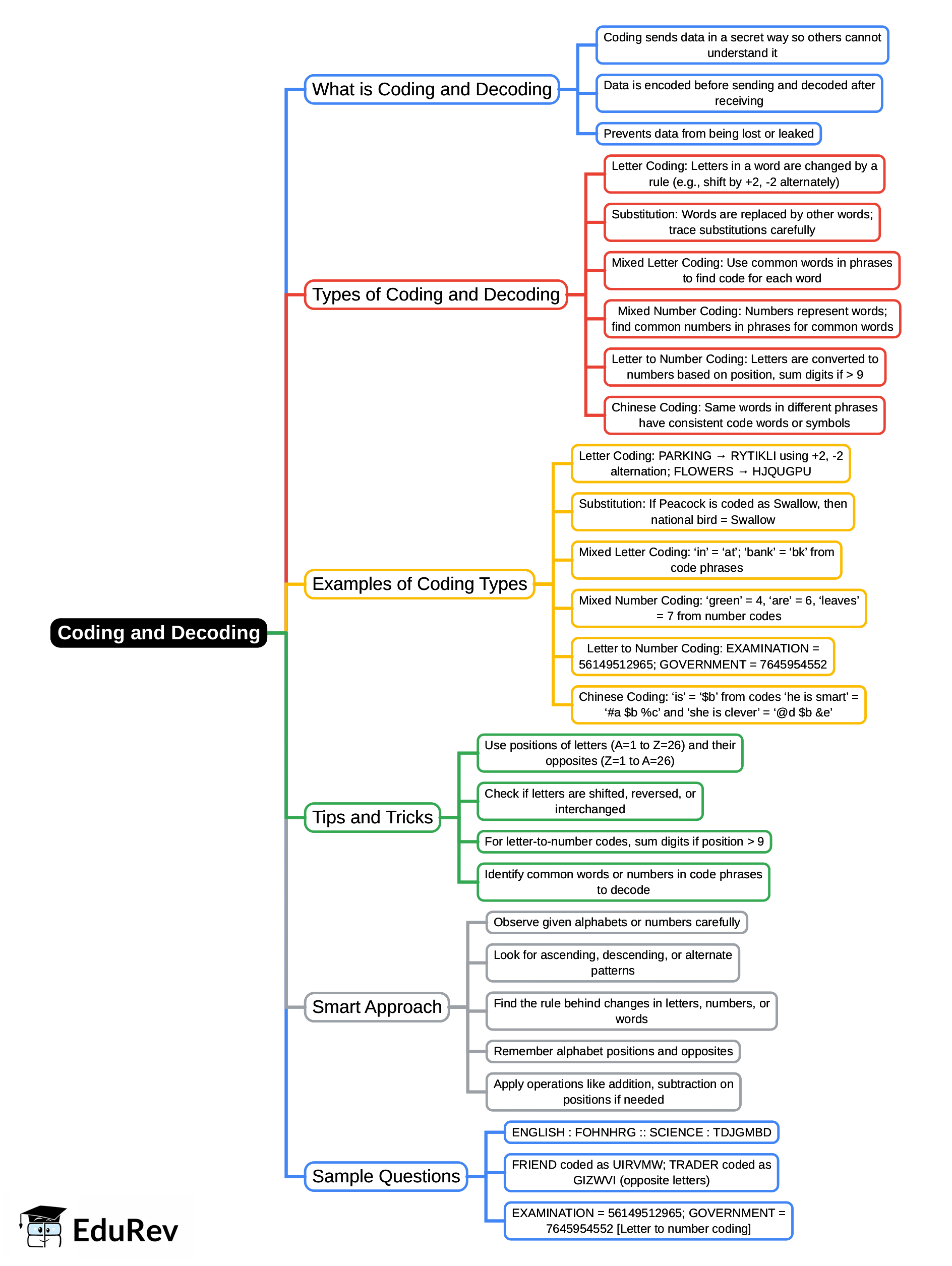
The document Mind Map: Coding & Decoding is a part of the UPSC Course CSAT Preparation.
All you need of UPSC at this link: UPSC
FAQs on Mind Map: Coding & Decoding
| 1. What's the difference between coding and decoding in UPSC CSAT reasoning? |  |
Ans. Coding transforms information into symbols or patterns following specific rules, while decoding reverses the process to retrieve original meaning. In CSAT, coding questions present a cipher rule and ask you to apply it; decoding questions give you encoded text and require you to identify the underlying pattern. Both test logical reasoning and pattern recognition skills essential for the exam.
| 2. How do I identify letter substitution patterns in coding-decoding questions? | |
Ans. Letter substitution involves replacing each alphabet with another in a fixed sequence. To identify the pattern, compare the original word with its coded version and calculate the shift value-how many positions forward or backward each letter moves. Common patterns include Caesar cipher (fixed shift), reverse alphabets, or position-based shifts. Spotting these systematically saves time during problem-solving.
| 3. What are the most common types of coding-decoding questions asked in UPSC exams? | |
Ans. The primary categories include direct letter coding, number-based coding, positional coding, and conceptual coding patterns. Direct letter coding uses alphabet shifts; number-based assigns digits to letters; positional coding depends on word position; conceptual coding involves logical relationships like opposite meanings or synonyms. Understanding each type helps you recognize question patterns quickly and select appropriate decoding strategies.
| 4. Why do I keep making mistakes with reverse sequence coding problems? | |
Ans. Reverse sequence coding reverses alphabets (A↔Z, B↔Y) and commonly causes confusion when students apply incomplete rules or forget that vowels and consonants follow the same pattern. The mistake often lies in miscounting positions or applying different shifts to different letters. Double-check by writing the reverse alphabet key first, then systematically match each letter, ensuring consistency across the entire word or phrase.
| 5. How can I solve number-substitution coding problems faster for CSAT? | |
Ans. Number-substitution assigns numerical values to letters, typically A=1, B=2, and so on. Solve faster by memorizing basic positions (A=1, Z=26, M=13) and recognizing common operations like addition, multiplication, or position-based sums. Practice identifying whether numbers represent letter positions, alphabetical order values, or mathematical calculations. Using mind maps and flashcards helps reinforce these patterns and reduces calculation time significantly.
About this Document

1.5K Views

4.96/5 Rating

Apr 19, 2026 Last updated
Related Exams
Document Description: Mind Map: Coding & Decoding for UPSC 2026 is part of CSAT Preparation preparation. The notes and questions for Mind Map: Coding & Decoding have been prepared according to the UPSC exam syllabus. Information about Mind Map: Coding & Decoding covers topics like and Mind Map: Coding & Decoding Example, for UPSC 2026 Exam. Find important definitions, questions, notes, meanings, examples, exercises and tests below for Mind Map: Coding & Decoding.
Introduction of Mind Map: Coding & Decoding in English is available as part of our CSAT Preparation for UPSC & Mind Map: Coding & Decoding in Hindi for CSAT Preparation course. Download more important topics related with notes, lectures and mock test series for UPSC Exam by signing up for free. UPSC: Mind Map: Coding & Decoding
Description
Mind Map: Coding & Decoding of CSAT Preparation provides you one-page visual summary of the chapter covering all the important topics. Download the PDF from EduRev.
Information about Mind Map: Coding & Decoding
In this doc you can find the meaning of Mind Map: Coding & Decoding defined & explained in the simplest way possible. Besides explaining types of Mind Map: Coding & Decoding theory, EduRev gives you an ample number of questions to practice Mind Map: Coding & Decoding tests, examples and also practice UPSC tests



Related Searches
Mind Map: Coding & Decoding, Semester Notes, pdf , video lectures, ppt, Previous Year Questions with Solutions, shortcuts and tricks, Mind Map: Coding & Decoding, Summary, study material, MCQs, Mind Map: Coding & Decoding, practice quizzes, past year papers, Objective type Questions, Important questions, mock tests for examination, Extra Questions, Free, Viva Questions, Sample Paper, Exam;