UPSC Exam > UPSC Notes > Indian Polity CSE > Mind Map: Supreme Court
Mind Map: Supreme Court

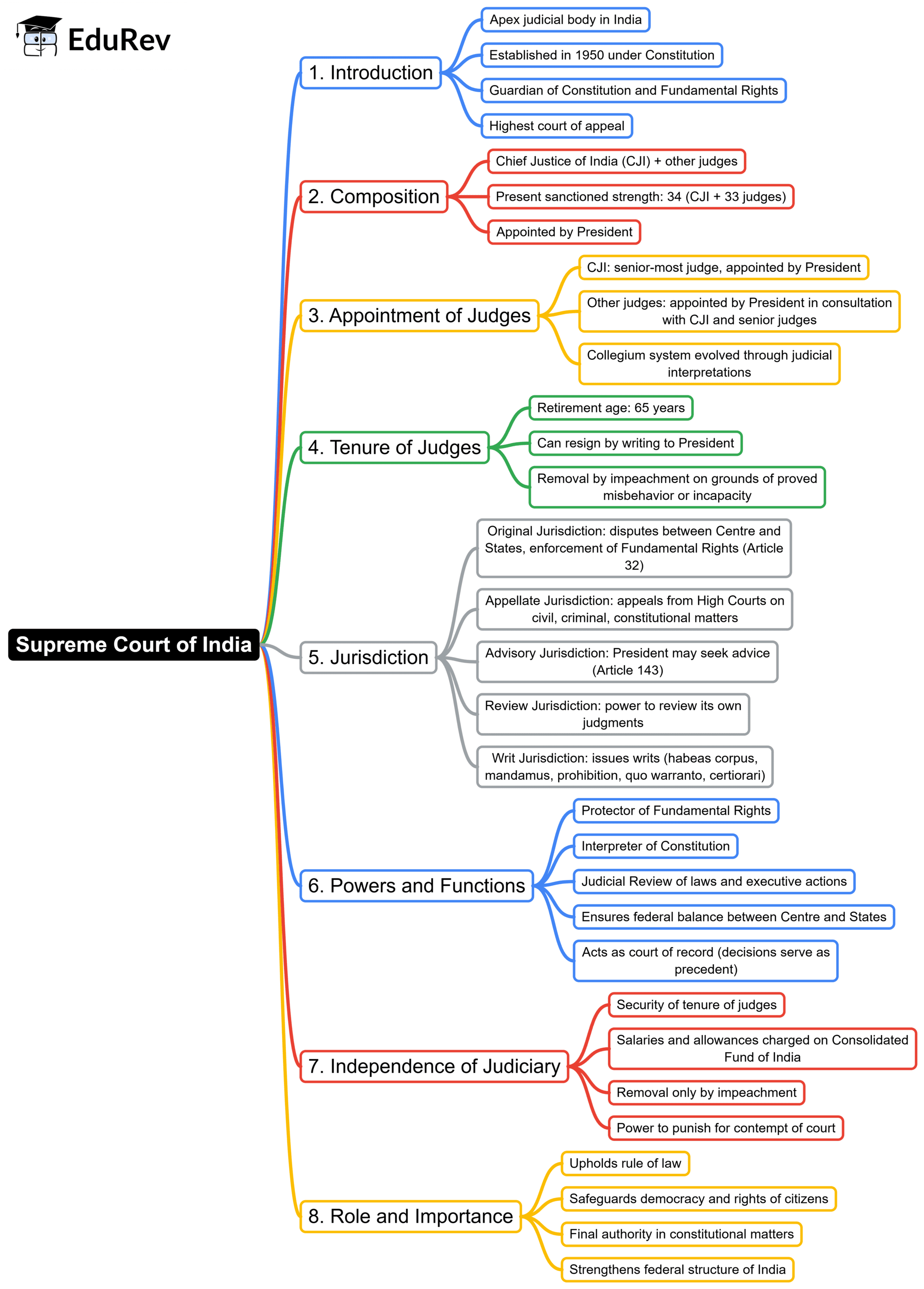
The document Mind Map: Supreme Court is a part of the UPSC Course Indian Polity for UPSC CSE.
All you need of UPSC at this link: UPSC
FAQs on Mind Map: Supreme Court
| 1. What is the role of the Supreme Court in the Indian judicial system? |  |
Ans. The Supreme Court is the highest judicial forum and final court of appeal under the Constitution of India. It has the authority to interpret the Constitution, safeguard fundamental rights, and settle disputes between states or between the central government and states. The Court also has the power to review laws passed by the Parliament and can strike down any legislation that it finds unconstitutional.
| 2. How does the appointment process for Supreme Court judges work? | |
Ans. Judges of the Supreme Court are appointed by the President of India, based on the recommendations of the Prime Minister and the Chief Justice of India. The appointment process involves consultation with other judges of the Supreme Court and High Courts to ensure a diverse and competent judiciary. The procedure aims to maintain judicial independence and integrity.
| 3. What are the different types of jurisdiction exercised by the Supreme Court? | |
Ans. The Supreme Court exercises original, appellate, and advisory jurisdiction. Original jurisdiction pertains to cases involving the enforcement of fundamental rights and federal disputes. Appellate jurisdiction allows the Court to hear appeals against decisions from lower courts and tribunals. Advisory jurisdiction permits the Court to provide legal advice to the President on constitutional matters when requested.
| 4. What is the significance of Public Interest Litigation (PIL) in the Supreme Court? | |
Ans. Public Interest Litigation (PIL) is a tool that allows individuals or groups to seek judicial intervention in matters of public interest. The Supreme Court has broadened access to justice through PIL, enabling citizens to address issues such as environmental protection, social justice, and human rights violations. This mechanism has empowered marginalized communities and has played a crucial role in societal reform.
| 5. How does the Supreme Court ensure the protection of fundamental rights? | |
Ans. The Supreme Court plays a vital role in protecting fundamental rights by acting as the guardian of the Constitution. It has the power to issue writs for the enforcement of these rights under Article 32 of the Constitution. The Court hears cases of rights violations and can provide remedies such as injunctions or compensations to ensure justice is served, thereby upholding the rule of law.
About this Document

4.81/5 Rating

Apr 18, 2026 Last updated
Related Exams
Document Description: Mind Map: Supreme Court for UPSC 2026 is part of Indian Polity for UPSC CSE preparation. The notes and questions for Mind Map: Supreme Court have been prepared according to the UPSC exam syllabus. Information about Mind Map: Supreme Court covers topics like and Mind Map: Supreme Court Example, for UPSC 2026 Exam. Find important definitions, questions, notes, meanings, examples, exercises and tests below for Mind Map: Supreme Court.
Introduction of Mind Map: Supreme Court in English is available as part of our Indian Polity for UPSC CSE for UPSC & Mind Map: Supreme Court in Hindi for Indian Polity for UPSC CSE course. Download more important topics related with notes, lectures and mock test series for UPSC Exam by signing up for free. UPSC: Mind Map: Supreme Court
Description
Mind Map: Supreme Court of Indian Polity provides you one-page visual summary of the chapter covering all the important topics. Download the PDF from EduRev.
Information about Mind Map: Supreme Court
In this doc you can find the meaning of Mind Map: Supreme Court defined & explained in the simplest way possible. Besides explaining types of Mind Map: Supreme Court theory, EduRev gives you an ample number of questions to practice Mind Map: Supreme Court tests, examples and also practice UPSC tests



Related Searches
Previous Year Questions with Solutions, Free, Mind Map: Supreme Court, study material, Mind Map: Supreme Court, pdf , practice quizzes, Summary, shortcuts and tricks, Mind Map: Supreme Court, past year papers, Viva Questions, video lectures, Objective type Questions, Extra Questions, Important questions, MCQs, ppt, Semester Notes, mock tests for examination, Exam, Sample Paper;