CLAT Exam > CLAT Notes > Legal Reasoning > Mind Map: Important Legal Terms
Mind Map: Important Legal Terms

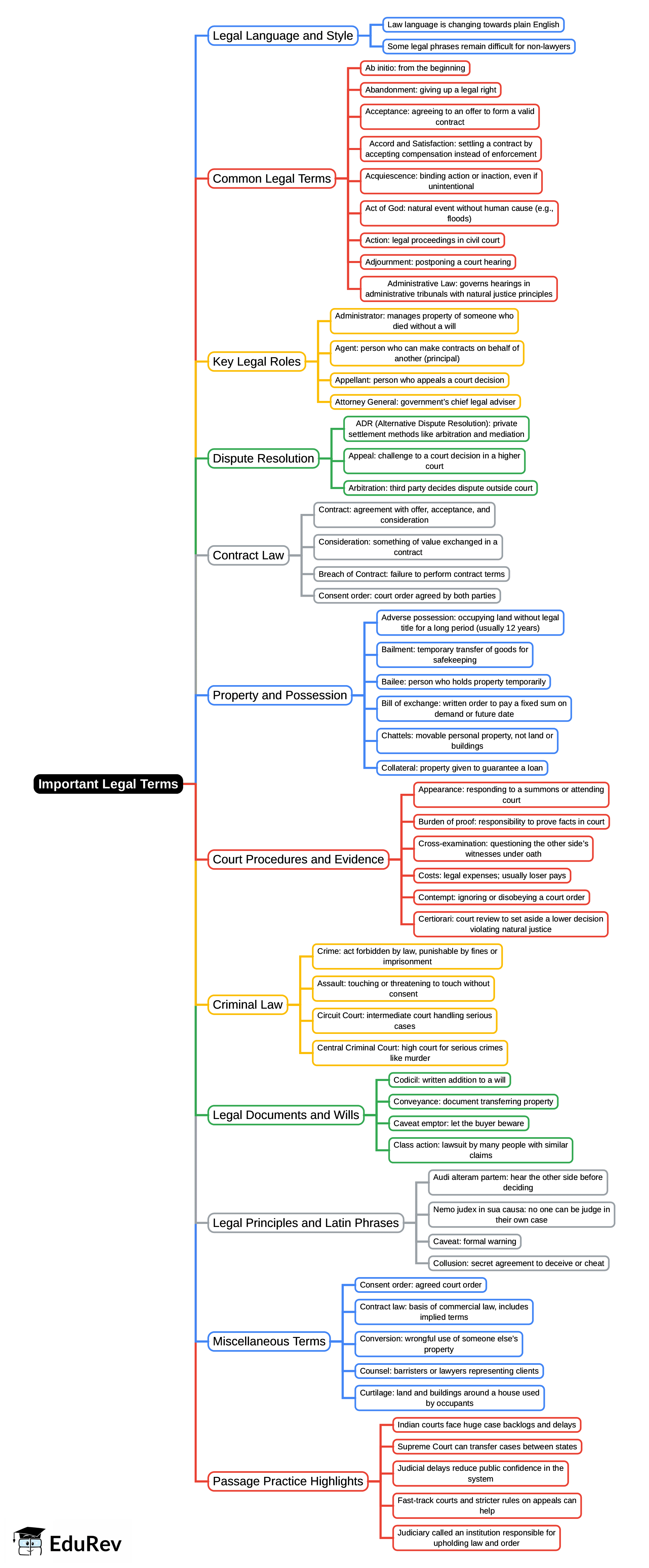
The document Mind Map: Important Legal Terms is a part of the CLAT Course Legal Reasoning for CLAT.
All you need of CLAT at this link: CLAT
FAQs on Mind Map: Important Legal Terms
| 1. What are the most important legal terms I need to memorise for CLAT? |  |
Ans. CLAT requires understanding foundational legal terminology like mens rea (guilty mind), actus reus (guilty act), tort, contract, and jurisdiction. Rather than pure memorisation, students should grasp how these terms function in legal reasoning scenarios. Use mind maps and flashcards to visualise relationships between terms and their applications in case law, which strengthens retention and exam performance.
| 2. How do legal terms like "mens rea" and "actus reus" differ in criminal law? | |
Ans. Mens rea refers to criminal intent or mental state, while actus reus describes the physical guilty act itself. Both elements must be present simultaneously to establish criminal liability in most cases. Understanding this distinction is crucial for CLAT legal reasoning questions, as examiners test whether candidates can identify which element is missing in hypothetical scenarios or case judgements.
| 3. What's the difference between tort and contract in simple terms? | |
Ans. A tort is a civil wrongdoing causing harm, where the injured party sues for damages; a contract involves a mutual agreement between parties with enforceable obligations. Torts don't require consent, while contracts do. CLAT candidates often confuse these, but recognising whether a case involves breach of duty or breach of agreement is essential for solving legal reasoning problems correctly.
| 4. Why do legal terms like "jurisdiction" and "liability" matter in CLAT questions? | |
Ans. Jurisdiction determines which court has authority to hear a case, while liability establishes who is legally responsible for damages or wrongs. CLAT examiners frequently test whether candidates can identify correct jurisdiction and assess liability in complex factual scenarios. Misunderstanding these terms leads to incorrect legal conclusions, directly affecting marks in the legal reasoning section.
| 5. How can I learn and retain all the important legal terms for CLAT exams? | |
Ans. Create organised study materials using mind maps to show how terms interconnect-for example, linking mens rea to criminal law, and tort to civil law. Flashcards help with quick recall during revision. Refer to comprehensive mind map resources and visual study guides available on EduRev to understand contextual definitions rather than isolated meanings, improving both retention and application.
About this Document

4.65/5 Rating

Apr 19, 2026 Last updated
Related Exams
Document Description: Mind Map: Important Legal Terms for CLAT 2026 is part of Legal Reasoning for CLAT preparation. The notes and questions for Mind Map: Important Legal Terms have been prepared according to the CLAT exam syllabus. Information about Mind Map: Important Legal Terms covers topics like and Mind Map: Important Legal Terms Example, for CLAT 2026 Exam. Find important definitions, questions, notes, meanings, examples, exercises and tests below for Mind Map: Important Legal Terms.
Introduction of Mind Map: Important Legal Terms in English is available as part of our Legal Reasoning for CLAT for CLAT & Mind Map: Important Legal Terms in Hindi for Legal Reasoning for CLAT course. Download more important topics related with notes, lectures and mock test series for CLAT Exam by signing up for free. CLAT: Mind Map: Important Legal Terms
Description
Mind Map: Important Legal Terms of Legal Reasoning provides you one-page visual summary of the chapter covering all the important topics. Download the PDF from EduRev.
Information about Mind Map: Important Legal Terms
In this doc you can find the meaning of Mind Map: Important Legal Terms defined & explained in the simplest way possible. Besides explaining types of Mind Map: Important Legal Terms theory, EduRev gives you an ample number of questions to practice Mind Map: Important Legal Terms tests, examples and also practice CLAT tests


Related Searches
Semester Notes, Viva Questions, Extra Questions, practice quizzes, video lectures, Mind Map: Important Legal Terms, Sample Paper, mock tests for examination, Exam, Mind Map: Important Legal Terms, pdf , ppt, past year papers, Objective type Questions, Mind Map: Important Legal Terms, Free, shortcuts and tricks, Important questions, Previous Year Questions with Solutions, Summary, study material, MCQs;