Case Based Questions: Polynomials

Case Study 1
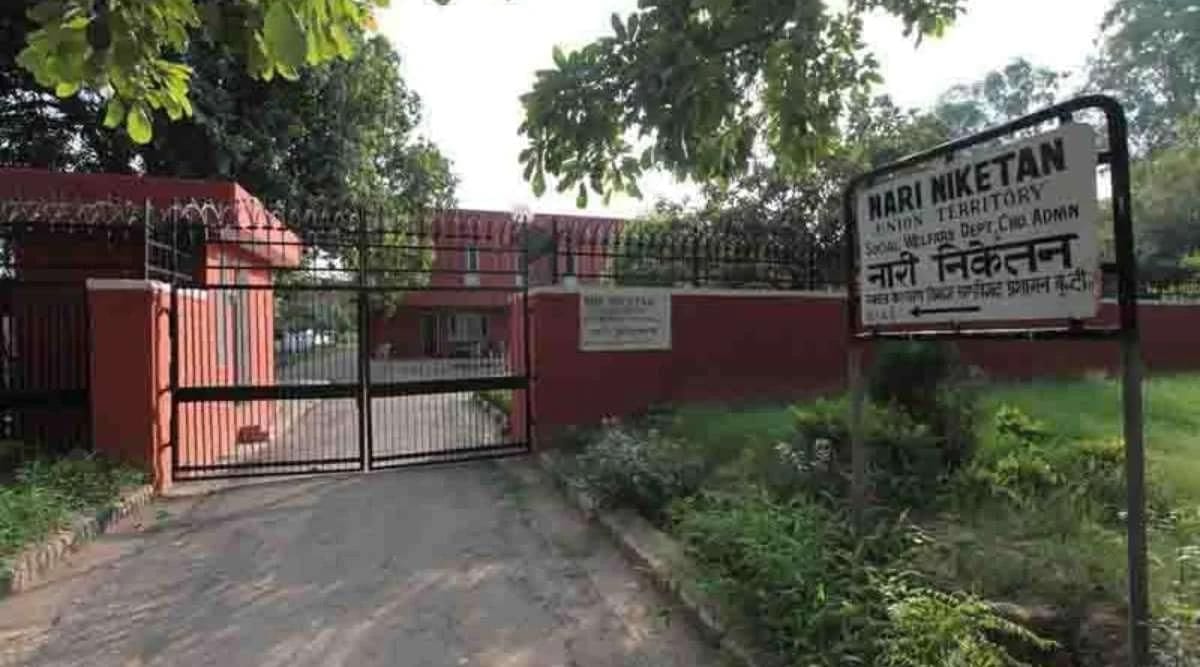
Nari Niketan is an organisation to help the women and child having distress. Swati donated some amount to this organisation for betterment. The amount of donation is represented by the expression
She also discussed with her friends about this organisation. Some of her friends wanted to know the amount of donation, but she did not disclose this amount to anyone. Somehow her friend got to know that she gave
amount having expression
whose value is ₹ 90.
On the basis of the above information, solve the following questions:
Q1. The amount donated by Swati in the expression form is:
a) linear equation
b) quadratic equation
c) algebraic expression
d) polynomial
Sol: (c) algebraic expression
Given amount
It has a negative power term
, so it is not a polynomial or an equation. It is an algebraic expression.
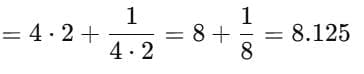
Q2. If x=√2, then the amount donated by Swati is:
a) ₹ 8
b) ₹ 8.125
c) ₹ 8.75
d) ₹ 9
Sol: (b) ₹ 8.125

Q3. The value of 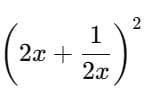 is:
is:
a) 8000
b) 8100
c) 8200
d) 8300
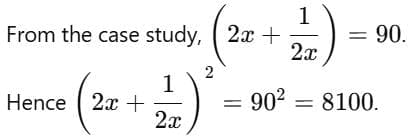
Sol: (b) 8100
Q4. The amount donated by Swati (in ₹) is:
a) ₹ 9020
b) ₹ 8098
c) ₹ 8090
d) ₹ 9000
Sol: (b) ₹ 8098
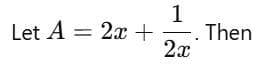
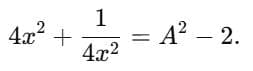
So,
Given A = 90
⇒ A2= 8100.
Therefore, amount

Q5. If x = 5, then the value of the donated expression is:
a) 
b) 
c) 
d) 
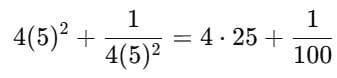
Sol: (a)
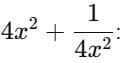
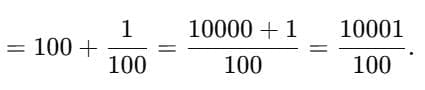
Using the donated expression
Case Study 2
Amit along with his four friends visited the house of Rohit, who was a common friend. There they met his father, who was having keen interest in mathematics. Rohit's father wanted to test the practical knowledge of all his friends, so he showed some objects like a cuboid shaped geometry box, a rectangular photo frame, a circular cardboard, square shaped files and a cube. He started asking the following questions one by one.
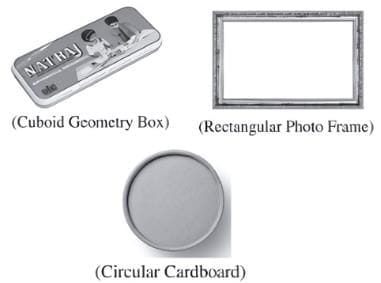
On the basis of the above information, solve the following questions:
Q1. If the area of circular cardboard is 49x² + 70x + 25π, what is the radius of this object?
a) (7x + 5)
b) π(7x + 5)
c) -5/7
d) 7/5
Sol: (a) (7x + 5)
Area of a circle = πr²
The given expression represents π(7x + 5)², hence r² = (7x + 5)²
⇒ r = 7x + 5.
Q2. If the volume of the geometry box is x³ - 2x² - x + 2, then the possible dimensions of this box are:
a) (x + 1), (x + 1), (x - 2)
b) (x + 1), (x - 1), (x + 2)
c) (x - 1), (x + 1), (x - 2)
d) (x - 1), (x - 1), (x + 2)
Sol: (c) (x - 1), (x + 1), (x - 2)
Volume = x³ - 2x² - x + 2
= x³ - 2x² - x + 2
= x²(x - 2) - 1(x - 2)
= (x² - 1)(x - 2)
= (x - 1)(x + 1)(x - 2)
Hence, possible dimensions are (x - 1), (x + 1), (x - 2).
Q3. If the area of a file is 4x² + 4x + 1, what is the perimeter of this file?
a) 2x + 1
b) 4x + 1
c) (4x + 1)
d) (8x + 4)
Sol: (d) (8x + 4)
We have, area of a square shape file = 4x² + 4x + 1
We know that,
Area of square = (Side)²
(Side)² = (4x² + 4x + 1) = (2x + 1)²
[Using (a + b)² = a² + b² + 2ab]
Therefore, Perimeter = 4 × (2x + 1) = 4(2x + 1)
Q4. If the area of a rectangular photo frame is 12x² - 7x + 1, what are the possible dimensions of the photo frame?
a) (3x - 1), (4x - 1)
b) (3x + 1), (4x + 1)
c) (3x - 1), (4x + 1)
d) (3x - 1), (4x + 1)
Sol: (a) (3x - 1), (4x - 1)
Area of rectangle = l × b = 12x² - 7x + 1
= 12x² - 4x - 3x + 1
= 4x(3x - 1) - 1(3x - 1)
= (4x - 1)(3x - 1)
Hence, possible dimensions are (4x - 1), (3x - 1).
Q5. If the volume of the cube is 8a³ - b³ - 12a²b + 6ab², what is the side of the cube?
a) (2a + b)
b) (2a - b)
c) (2a + 3b)
d) (3a - 2b)81
Sol: (b) (2a - b)
Volume of cube = 8a³ - b³ - 12a²b + 6ab²
= (2a)³ - b³ - 6ab(2a - b)
= [4a² + 2ab + b²] - 6ab[2a - b]
= (2a - b)(4a² + 2ab + b²)
= (2a - b)³
Hence, the side of cube is (2a - b).
FAQs on Case Based Questions: Polynomials
| 1. What are polynomials and how are they classified? |  |
| 2. How do you add and subtract polynomials? | |
| 3. What is the importance of the degree of a polynomial? | |
| 4. What are the different methods for factoring polynomials? | |
| 5. How can polynomials be used in real-life applications? | |





