CBSE Class 8 > Class 8 Notes > Science > Important Diagrams: Electricity: Magnetic and Heating Effects
Important Diagrams: Electricity: Magnetic and Heating Effects

Q1: Answer the following questions based on the diagram given below:
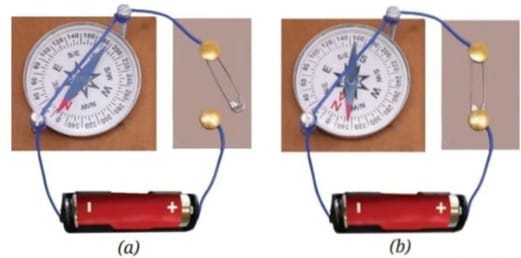
(i) What components are shown in the diagram to demonstrate the magnetic effect of electric current?
Ans: The diagram shows an electric cell placed in a cell holder, a simple switch made using drawing pins and a safety pin, a long insulated wire stretched and fixed to two nails on a cardboard, a magnetic compass placed beneath the wire to detect magnetic effects, and connecting wires completing the circuit.
(ii) Define the magnetic effect of electric current based on the diagram.
Ans: The magnetic effect of electric current is the phenomenon in which a current-carrying conductor produces a magnetic field around it. In the diagram, this is seen because the magnetic compass needle near the wire gets deflected when the current flows through the wire, showing that a magnetic field is produced by the electric current.
(iii) How does the diagram illustrate the behaviour of the magnetic compass when the circuit is switched on and off?
Ans: When the switch is closed (ON), current flows through the wire and the magnetic field produced around the wire causes the compass needle to deflect from its original position. When the switch is opened (OFF), the current stops, the magnetic field from the wire disappears, and the compass needle returns to its original position. This reversible change shows a direct link between the presence of current and the magnetic effect.
(iv) What happens to the compass needle in the diagram when the switch is in the OFF position?
(a) It deflects to the left
(b) It deflects to the right
(c) It remains in its original position
(d) It spins continuously
Ans: (c)
Explanation: With the switch OFF, no current flows through the wire, so the wire does not produce a magnetic field. Only the Earth's magnetic field acts on the compass needle, so the needle remains in its original position and does not show the deflection caused by a current-carrying wire.
(v) What is the significance of the observation shown in the diagram for understanding electricity and magnetism?
Ans: The observation shows that when an electric current flows through a conductor, it produces a magnetic field around it. This proves that electricity and magnetism are closely related phenomena. This principle is important because it is used in making electromagnets and in the working of devices such as electric motors and generators, where electrical energy is converted into mechanical energy.
Q2: Answer the following questions based on the diagram given below:
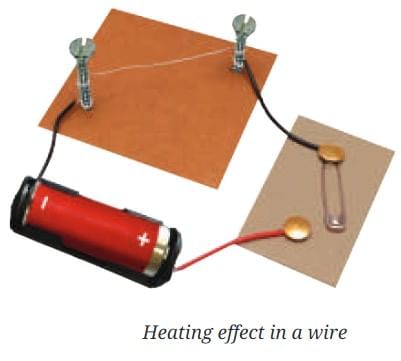
(i) What components are shown in the diagram to demonstrate the heating effect of electric current?
Ans: The diagram shows a nichrome wire stretched and tied between two nails fixed on a cardboard, an electric cell in a cell holder, a switch to open or close the circuit, and connecting wires that form the complete circuit so that current can pass through the nichrome wire.
(ii) Define the heating effect of electric current based on the diagram's context.
Ans: The heating effect of electric current is the phenomenon where electrical energy is converted into heat when current passes through a conductor having resistance. In the diagram, the nichrome wire has a relatively high resistance, so when current flows through it the wire becomes warm or hot as electrical energy turns into heat.
(iii) How does the diagram illustrate the change in the nichrome wire when the switch is turned on?
Ans: When the switch is turned on, current flows through the circuit and passes through the nichrome wire. Because nichrome has high resistance, it resists the flow of current and so electrical energy is converted into heat; the wire becomes hot and this heating can be felt or observed after a short time (for example, about 30 seconds in a simple demonstration).
(iv) Which of the following materials is used in the diagram to demonstrate the heating effect?
(a) Copper wire
(b) Nichrome wire
(c) Aluminium wire
(d) Iron wire
Ans: (b)
Explanation: Nichrome is used because it has a higher electrical resistance than materials like copper or aluminium and a high melting point. These properties make nichrome suitable for converting electrical energy into heat without melting quickly.
(v) What is the significance of the heating effect shown in the diagram for practical applications?
Ans: The heating effect explains how electrical energy can be used to produce heat.
- This principle is applied in many household and industrial appliances such as electric heaters, stoves, electric irons and toasters.
- Devices use high-resistance wires (like nichrome) to produce controlled heat for cooking, warming or ironing, making them useful and convenient in everyday life.
Q3. Answer the following questions based on the diagram given below:
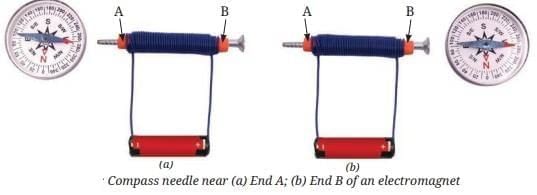
(i) What is the purpose of the compass needle in the diagram?
Ans: The compass needle is used as a simple detector of the magnetic field produced by the electromagnet. It aligns with the magnetic field lines and therefore helps to show both the direction and the presence of the magnetic field produced by the current in the coil.
(ii) How does the position of the compass needle differ when placed near end A compared to end B of the electromagnet?
Ans: The compass needle points in opposite directions near ends A and B because the two ends act as opposite magnetic poles. Near one end (for example A) the needle points as it would near a north pole, while near the other end (B) it points as it would near a south pole; the exact directions depend on the direction of the current in the coil.
(iii) What does the diagram suggest about the nature of ends A and B of the electromagnet?
Ans: The diagram suggests that ends A and B of the electromagnet behave like the poles of a magnet. When current flows through the coil around the iron core, it produces a magnetic field so that one end becomes a north pole and the other end becomes a south pole, similar to the two poles of a bar magnet.
(iv) What role does the battery play in the setup shown in the diagram?
Ans: The battery provides the electrical energy that drives current through the coil of wire. This current produces the magnetic field around the coil and magnetises the iron core, turning it into an electromagnet with distinct poles at ends A and B.
(v) Explain why the compass needle moves when placed near the electromagnet.
Ans: The compass needle is a small magnet and it experiences a force in the presence of another magnetic field. When the coil carries current, it creates a magnetic field around the electromagnet; this field interacts with the magnetic field of the compass needle and causes the needle to rotate until it aligns with the electromagnet's field lines, thus showing the direction and polarity of the electromagnet.
The document Important Diagrams: Electricity: Magnetic and Heating Effects is a part of the Class 8 Course Science Class 8.
All you need of Class 8 at this link: Class 8
FAQs on Important Diagrams: Electricity: Magnetic and Heating Effects
| 1. What are the magnetic effects of electricity? |  |
Ans.The magnetic effects of electricity refer to the phenomenon where an electric current produces a magnetic field. When an electric current flows through a conductor, such as a wire, it generates a circular magnetic field around the conductor. This effect is the principle behind electromagnets, where coiling the wire around a ferromagnetic core enhances the magnetic field. The right-hand rule is often used to determine the direction of the magnetic field relative to the current flow.
| 2. How does the heating effect of electricity work? | |
Ans.The heating effect of electricity, also known as Joule heating, occurs when electric current passes through a conductor and produces heat due to the resistance of the material. The heat generated is proportional to the square of the current (I²) multiplied by the resistance (R) of the conductor, expressed as Heat = I²R. This principle is utilized in devices like electric heaters, toasters, and incandescent bulbs, where the heat is used for practical purposes.
| 3. What is an electromagnet, and how is it made? | |
Ans.An electromagnet is a type of magnet where the magnetic field is produced by an electric current. It is typically made by winding a wire into a coil and passing an electric current through it. The magnetic field can be intensified by placing a ferromagnetic material, like iron, inside the coil. When the current is turned on, the electromagnet becomes magnetized; when the current is turned off, the magnetic effect disappears.
| 4. What are some applications of the magnetic and heating effects of electricity? | |
Ans.Both the magnetic and heating effects of electricity have numerous applications. The magnetic effect is used in various devices such as electric motors, generators, and transformers. Meanwhile, the heating effect is commonly applied in household appliances like electric stoves, heaters, and hair dryers. Additionally, the heating effect is used in industries for processes like welding and metal cutting.
| 5. How can the magnetic effects of electricity be demonstrated through experiments? | |
Ans.The magnetic effects of electricity can be demonstrated through simple experiments, such as using a compass to visualize the magnetic field around a current-carrying wire. Another common experiment involves wrapping a wire around a nail and connecting it to a battery, creating an electromagnet. When the current flows, small metallic objects can be attracted to the nail, showcasing the magnetic effect.
About this Document

1.3K Views

4.97/5 Rating

Apr 22, 2026 Last updated
Related Exams
Document Description: Important Diagrams: Electricity: Magnetic and Heating Effects for Class 8 2026 is part of Science Class 8 preparation. The notes and questions for Important Diagrams: Electricity: Magnetic and Heating Effects have been prepared according to the Class 8 exam syllabus. Information about Important Diagrams: Electricity: Magnetic and Heating Effects covers topics like and Important Diagrams: Electricity: Magnetic and Heating Effects Example, for Class 8 2026 Exam. Find important definitions, questions, notes, meanings, examples, exercises and tests below for Important Diagrams: Electricity: Magnetic and Heating Effects.
Introduction of Important Diagrams: Electricity: Magnetic and Heating Effects in English is available as part of our Science Class 8 for Class 8 & Important Diagrams: Electricity: Magnetic and Heating Effects in Hindi for Science Class 8 course. Download more important topics related with notes, lectures and mock test series for Class 8 Exam by signing up for free. Class 8: Important Diagrams: Electricity: Magnetic and Heating Effects
Description
Important Diagrams: Electricity: Magnetic & Heating Effects of Science Class 8 on EduRev - Fully labelled, exam-ready diagrams, memorize all the concepts easily with diagrams. Download free PDF from EduRev.
Information about Important Diagrams: Electricity: Magnetic and Heating Effects
In this doc you can find the meaning of Important Diagrams: Electricity: Magnetic and Heating Effects defined & explained in the simplest way possible. Besides explaining types of Important Diagrams: Electricity: Magnetic and Heating Effects theory, EduRev gives you an ample number of questions to practice Important Diagrams: Electricity: Magnetic and Heating Effects tests, examples and also practice Class 8 tests



Related Searches
Important Diagrams: Electricity: Magnetic and Heating Effects, Previous Year Questions with Solutions, ppt, Viva Questions, Exam, Objective type Questions, shortcuts and tricks, Important Diagrams: Electricity: Magnetic and Heating Effects, Free, pdf , Extra Questions, video lectures, mock tests for examination, MCQs, study material, practice quizzes, Summary, Important Diagrams: Electricity: Magnetic and Heating Effects, Important questions, past year papers, Semester Notes, Sample Paper;