CBSE Class 8 > Class 8 Notes > Mathematics (Maths) > Visual Worksheet: Proportion and Ratio
Visual Worksheet: Proportion and Ratio

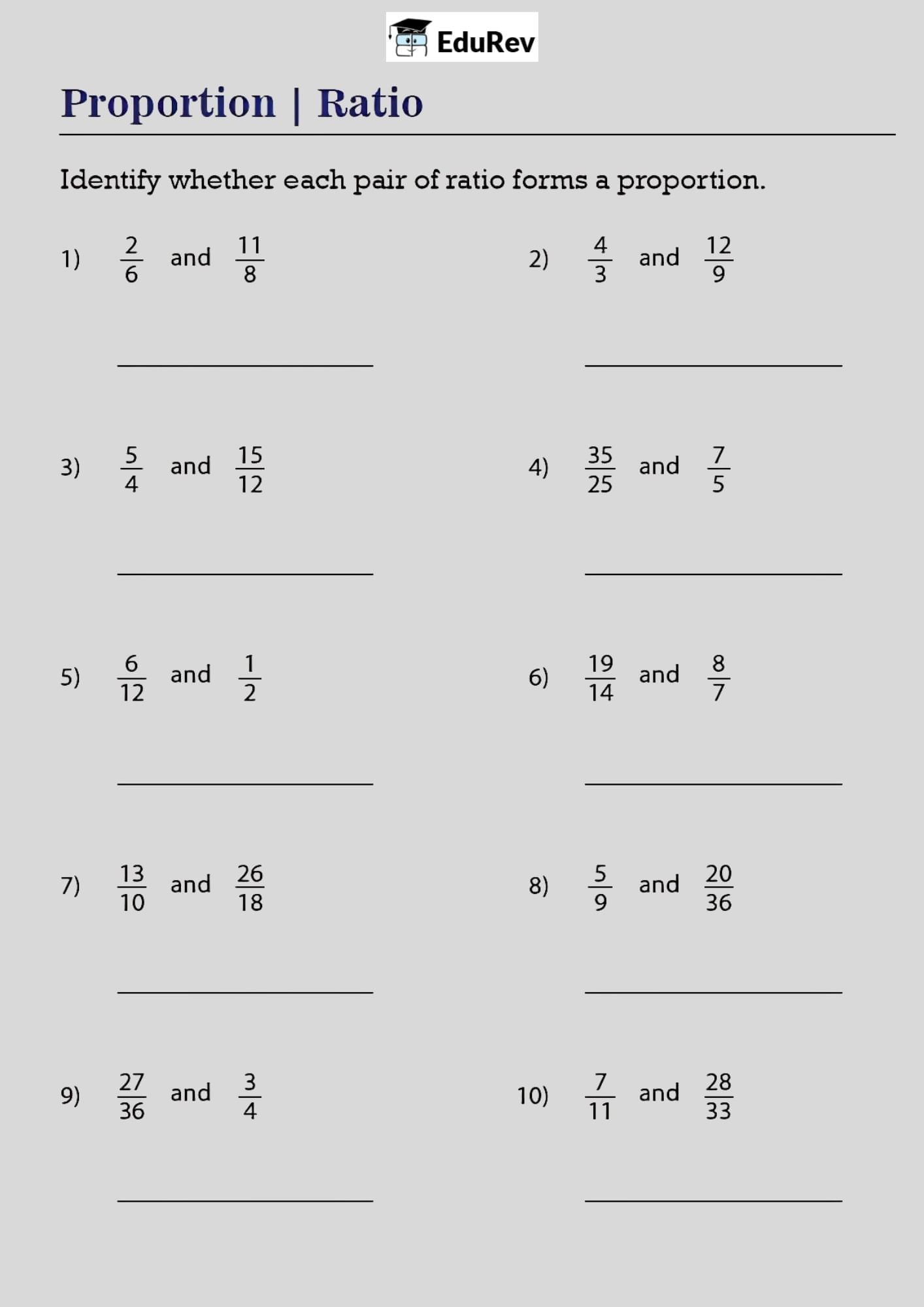
The document Visual Worksheet: Proportion and Ratio is a part of the Class 8 Course Mathematics (Maths) Class 8.
All you need of Class 8 at this link: Class 8
FAQs on Visual Worksheet: Proportion and Ratio
| 1. What are the basic concepts of ratio and proportion? |  |
Ans. A ratio is a relationship between two numbers that indicates how many times the first number contains the second. It is expressed in the form of a fraction or with a colon (e.g., 3:4). Proportion, on the other hand, is an equation that states that two ratios are equal (e.g., 3:4 = 6:8). Understanding these concepts is essential for solving problems related to comparing quantities and scaling.
| 2. How do you simplify a ratio? | |
Ans. To simplify a ratio, divide both terms by their greatest common divisor (GCD). For example, to simplify the ratio 8:12, first find the GCD, which is 4. Then divide both terms: 8 ÷ 4 = 2 and 12 ÷ 4 = 3. Thus, the simplified ratio is 2:3.
| 3. How can proportions be used in real-life situations? | |
Ans. Proportions are widely used in everyday life, such as in cooking (adjusting recipes), in finance (calculating interest rates), and in construction (determining scale models). For instance, if a recipe requires 2 cups of flour for every 3 cups of sugar, you can use proportions to adjust the ingredients based on how many servings you need.
| 4. What is the difference between direct and inverse proportion? | |
Ans. In direct proportion, as one quantity increases, the other quantity also increases at the same rate (e.g., distance and time when speed is constant). In contrast, inverse proportion means that as one quantity increases, the other decreases (e.g., speed and time when distance is constant). Understanding these differences helps in solving various mathematical problems effectively.
| 5. What are some common mistakes to avoid when working with ratios and proportions? | |
Ans. Common mistakes include forgetting to simplify ratios, incorrectly setting up proportions, and failing to check for unit consistency (e.g., mixing different measurement units). It's important to carefully review each step and ensure that all terms are correctly represented to avoid errors in calculations.
About this Document

4.65/5 Rating

Apr 25, 2026 Last updated
Document Description: Visual Worksheet: Proportion and Ratio for Class 8 2026 is part of Mathematics (Maths) Class 8 preparation. The notes and questions for Visual Worksheet: Proportion and Ratio have been prepared according to the Class 8 exam syllabus. Information about Visual Worksheet: Proportion and Ratio covers topics like and Visual Worksheet: Proportion and Ratio Example, for Class 8 2026 Exam. Find important definitions, questions, notes, meanings, examples, exercises and tests below for Visual Worksheet: Proportion and Ratio.
Introduction of Visual Worksheet: Proportion and Ratio in English is available as part of our Mathematics (Maths) Class 8 for Class 8 & Visual Worksheet: Proportion and Ratio in Hindi for Mathematics (Maths) Class 8 course. Download more important topics related with notes, lectures and mock test series for Class 8 Exam by signing up for free. Class 8: Visual Worksheet: Proportion and Ratio
Description
Visual Worksheet: Proportion & Ratio of Maths Class 8 - variety of important questions with solutions, helping you prepare for exam. Download free PDF from EduRev.
Information about Visual Worksheet: Proportion and Ratio
In this doc you can find the meaning of Visual Worksheet: Proportion and Ratio defined & explained in the simplest way possible. Besides explaining types of Visual Worksheet: Proportion and Ratio theory, EduRev gives you an ample number of questions to practice Visual Worksheet: Proportion and Ratio tests, examples and also practice Class 8 tests



Related Searches
Viva Questions, Sample Paper, Visual Worksheet: Proportion and Ratio, Objective type Questions, ppt, practice quizzes, shortcuts and tricks, study material, mock tests for examination, Semester Notes, MCQs, past year papers, Summary, Visual Worksheet: Proportion and Ratio, pdf , video lectures, Important questions, Previous Year Questions with Solutions, Free, Extra Questions, Exam, Visual Worksheet: Proportion and Ratio;