CBSE Class 5 > Class 5 Notes > Mathematics > Mind Map: Decimals
Mind Map: Decimals

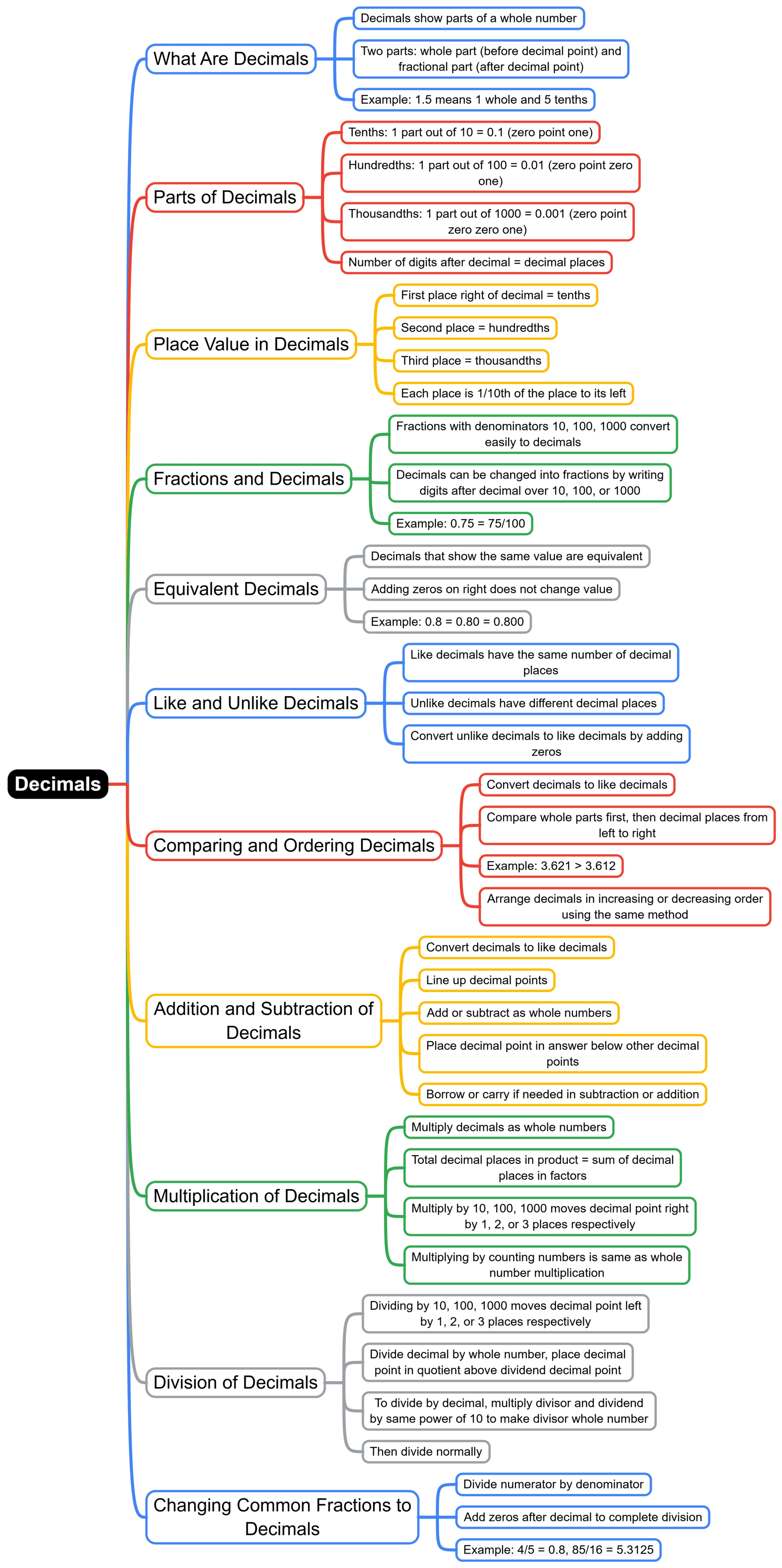
The document Mind Map: Decimals is a part of the Class 5 Course Mathematics for Class 5.
All you need of Class 5 at this link: Class 5
FAQs on Mind Map: Decimals
| 1. What are decimals? |  |
Ans. Decimals are a way of expressing numbers that are not whole. They consist of a whole number part and a fractional part, separated by a decimal point. For example, in the number 3.75, 3 is the whole number and 0.75 is the decimal part, indicating that it is three and seventy-five hundredths.
| 2. How do you convert a fraction into a decimal? | |
Ans. To convert a fraction into a decimal, you divide the numerator (the top number) by the denominator (the bottom number). For instance, to convert ½ into a decimal, you divide 1 by 2, which equals 0.5. This method applies to any fraction.
| 3. What is the importance of the place value in decimals? | |
Ans. Place value is crucial in decimals as it determines the value of each digit based on its position relative to the decimal point. For example, in the number 5.32, the digit 5 is in the units place, 3 is in the tenths place, and 2 is in the hundredths place. This distinction helps in understanding the number's magnitude and performing calculations accurately.
| 4. How do you add and subtract decimals? | |
Ans. To add or subtract decimals, you must first align the decimal points of the numbers being added or subtracted. Then, perform the operation as you would with whole numbers, ensuring that the decimal point in the result is placed directly below the aligned decimal points. For example, when adding 1.5 and 2.75, align the numbers as follows: 1.50 + 2.75 Then, add them to get 4.25.
| 5. What are some common applications of decimals in everyday life? | |
Ans. Decimals are commonly used in various real-life situations, such as in financial transactions, where money is often expressed in decimal form (e.g., £10.99). They are also used in measurements, such as height and weight (e.g., 1.75 metres), and in calculating grades and scores where percentages may include decimal points (e.g., 85.5%). These applications highlight the importance of understanding decimals in practical contexts.
About this Document

4.87/5 Rating

Apr 29, 2026 Last updated
Document Description: Mind Map: Decimals for Class 5 2026 is part of Mathematics for Class 5 preparation. The notes and questions for Mind Map: Decimals have been prepared according to the Class 5 exam syllabus. Information about Mind Map: Decimals covers topics like and Mind Map: Decimals Example, for Class 5 2026 Exam. Find important definitions, questions, notes, meanings, examples, exercises and tests below for Mind Map: Decimals.
Introduction of Mind Map: Decimals in English is available as part of our Mathematics for Class 5 for Class 5 & Mind Map: Decimals in Hindi for Mathematics for Class 5 course. Download more important topics related with notes, lectures and mock test series for Class 5 Exam by signing up for free. Class 5: Mind Map: Decimals
Description
Mind Map: Decimals of Mathematics provides you one-page visual summary of the chapter covering all the important topics. Download the PDF from EduRev.
Information about Mind Map: Decimals
In this doc you can find the meaning of Mind Map: Decimals defined & explained in the simplest way possible. Besides explaining types of Mind Map: Decimals theory, EduRev gives you an ample number of questions to practice Mind Map: Decimals tests, examples and also practice Class 5 tests



Related Searches
past year papers, Summary, study material, Extra Questions, Mind Map: Decimals, Semester Notes, Important questions, Mind Map: Decimals, Viva Questions, Free, mock tests for examination, practice quizzes, Objective type Questions, Sample Paper, Previous Year Questions with Solutions, Exam, ppt, Mind Map: Decimals, MCQs, shortcuts and tricks, pdf , video lectures;