Unit Test (Solutions): Timeline and Sources of History

Time: 1 hour
M.M: 30
Attempt all questions.
- Question numbers 1 to 5 carry 1 mark each.
- Question numbers 6 to 8 carry 2 marks each.
- Question numbers 9 to 11 carry 3 marks each.
- Question numbers 12 & 13 carry 5 marks each.
Q1: How is time measured in history? (1 Mark)
Ans: Currently, the Gregorian Calendar is used worldwide to measure current time and historical time line.
Q2: Which profession studies the physical features of the Earth like soil and mountains? (1 Mark)
Ans: Geologists.
Q3: What is the term used for the impressions of footprints or parts of plants and animals preserved in soil or rocks? (1 Mark)
Ans: Fossils.
Q4: In which year did the last Ice Age end according to the timeline? (1 Mark)
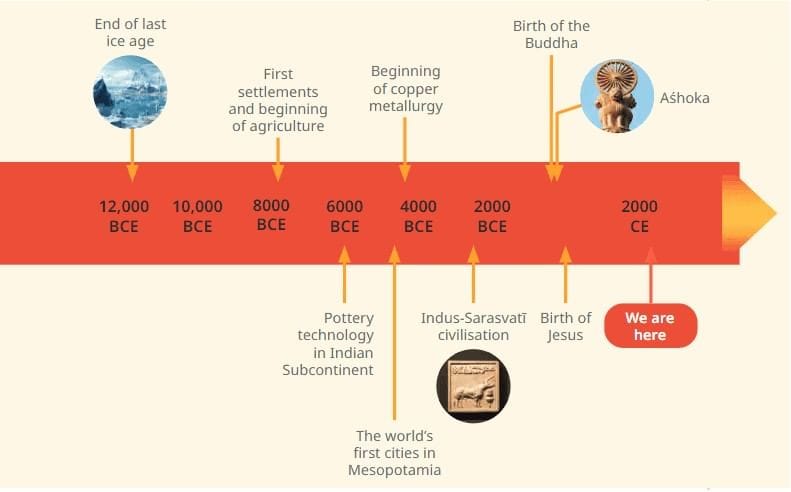
Ans: 12,000 BCE.
Q5: What is the primary source of food for early humans? (1 Mark)
Ans: Hunting and gathering.
Q6: Explain the difference between BCE and CE in the Gregorian calendar. (2 Marks)
Ans: BCE (Before Common Era) refers to years counted backward from the conventional date of Jesus Christ's birth, while CE (Common Era) refers to years counted forward from that point. For example, 560 BCE is before 2000 CE.
Q7: What is a panchanga? (2 Marks)
Ans: A panchanga is a traditional Indian calendar based on the sun and moon. It lists the days of each month and gives information like sunrise and sunset times, solar and lunar eclipses, festival dates, and sometimes weather predictions.
Q8: How did early humans use fire and tools to improve their lives? (2 Marks)
Ans: Early humans used fire for warmth, cooking food, and protection from wild animals. They made stone tools like axes, blades, and arrowheads to hunt, cut wood, and gather food more easily, which made their lives safer and more comfortable.
Q9: Describe how timelines help in understanding historical events. (3 Marks)
Ans:Timelines are helpful because they show a clear sequence of dates and events from the beginning of humanity to the present. They help us understand the order of events, for example, that the birth of Buddha happened before the birth of Jesus without even looking at the exact dates. Timelines also mark important landmarks and make it easier to compare events across centuries or millenniums, which helps us remember history in an organized way.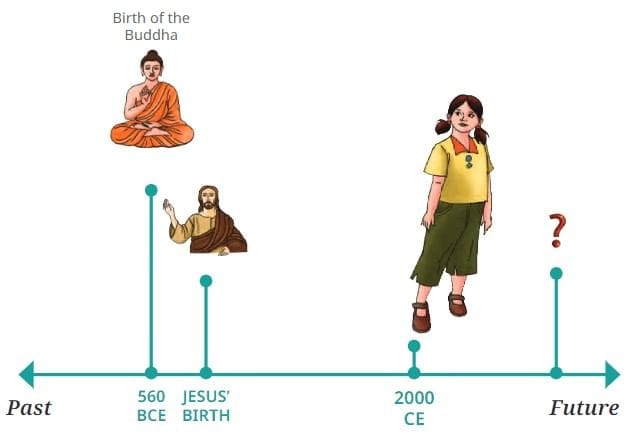
Q10: Explain the role of different professionals in studying the past. (3 Marks)
Ans: Different experts help us understand the past.
- Geologists study soil, rocks, mountains, rivers, and seas to know how the Earth has changed.
- Palaeontologists study fossils of plants, animals, and humans from millions of years ago.
- Anthropologists study human societies and cultures from early times to the present.
- Archaeologists dig up remains like tools, pottery, bones, grains, and house parts to learn how early humans lived.
Q11: How did the end of the last Ice Age impact human settlements? (3 Marks)
Ans: The end of the last Ice Age around 12,000 BCE warmed the climate and melted ice, which made rivers swell and water more available. This improved living conditions, allowing humans to settle in one place. They began cultivating cereals and grains, domesticated animals like cattle and goats, and often settled near rivers with fertile soil, marking the start of farming communities and a settled way of life.
Q12: Discuss the significance of various sources of history in reconstructing the past. (5 Marks)
Ans: Various sources help historians understand and reconstruct the past. Archaeological sources like tools, weapons, pottery, coins, monuments, and human or animal remains tell us how people lived, what they ate, and what they built. Literary sources such as Vedas, Itihasas, poems, plays, manuscripts, and historical texts give information about ideas, beliefs, and events. Oral sources, including folklore and stories passed through generations, provide details of everyday life and traditions. Artistic sources, like paintings, sculptures, and panels, show culture, clothing, and celebrations. Foreign accounts and travelogues describe life in other lands and help compare societies.
Historians use all these sources like pieces of a jigsaw puzzle. Sometimes the pieces match and confirm each other, making the history clear; other times, sources may contradict, and historians have to decide which to trust more. Experts like archaeologists, anthropologists, epigraphists, and literature scholars all contribute to understanding the past. In recent times, scientific studies of climate, genetics, and chemical analysis of materials also help reconstruct history. For more recent periods, newspapers, television, and the internet serve as additional sources. Using many sources together gives a complete and accurate picture of history.
Q13: Describe the lifestyle of early humans and the changes that led to the first crops. (5 Marks)
Ans: Early humans lived in small groups or bands and faced many challenges from nature. They were hunters and gatherers, depending on animals, fruits, and edible plants for food. They lived in caves or rock shelters and used fire for warmth, cooking, and protection from wild animals. They made stone tools like axes, blades, and arrowheads to hunt animals and gather food more easily. They also made rock paintings showing scenes of animals and people and decorated themselves with ornaments made from shells, stones, and animal teeth.
Around 12,000 BCE, the last Ice Age ended, the climate became warmer, and ice melted, which made rivers swell and provided plenty of water. People began to settle near rivers because the soil was fertile and good for growing crops. They started cultivating cereals and grains and domesticating animals like cattle, goats, and sheep. As food became more regular, groups grew into larger communities. These early farming villages worked together to sow and harvest crops. Slowly, these villages exchanged goods like food, clothing, and tools, and some grew into small towns. New inventions like pottery and metal tools appeared, making life easier. These changes marked the beginning of agriculture and prepared the way for the rise of early civilisations.
FAQs on Unit Test (Solutions): Timeline and Sources of History
| 1. What is the significance of understanding timelines in history? |  |
| 2. How can historical sources be categorized? | |
| 3. What are some examples of primary sources in history? | |
| 4. Why is it essential to evaluate sources when studying history? | |
| 5. How do timelines help in understanding historical events? | |