Chapter Notes: Domestic violence and sexual assault


Introduction
- The impact of domestic violence, rape, and child sexual abuse is evident in the daily work of obstetricians and gynaecologists.
- Therefore, it is crucial to understand these issues and how to provide appropriate care for victims.
Domestic Violence
- Domestic violence (DV) is a major factor contributing to maternal mortality and morbidity.
- Here are some key points to consider:
- One in four women experiences domestic violence.
- The effects of domestic violence are not limited to accident and emergency (A&E) departments; they are increasingly recognized in the fields of obstetrics and gynaecology.
- Identifying a victim of domestic violence may not always be easy, but it is important to make the effort.
- Domestic violence can manifest physically, but it also includes:
- The threat of financial control.
- Psychological manipulation.
Identification
- Abuse should be considered as a potential factor when identifying a victim. In the past, professionals either overlooked this issue or thought of domestic violence as a private concern between the victim and their partner or family.
- However, since health services address the consequences of such violence, it's important to include domestic violence as a factor in medical diagnosis.
- Domestic violence can impact anyone, regardless of their social class or education level. Nevertheless, those who find it difficult to seek help often face greater challenges and may turn to alcohol or drugs as coping mechanisms.
- The recent CEMACH report titled 'Why Mothers Die' and the RCOG publication 'Violence Against Women' have emphasized the importance of acknowledging domestic violence.
- Women who are experiencing abuse often struggle with low self-confidence and self-esteem.
- They may feel embarrassed and find it difficult to reach out for help.
- It is crucial for all women to have the opportunity for at least one consultation alone, without the presence of their partner, friends, or family, to discuss the issue of domestic violence.
- Despite the challenges in arranging this, standard questionnaires can be provided to women when they are alone, allowing them to fill them out privately.
'Red Spot' System:
- A straightforward yet impactful method to encourage victims to come forward is the 'red spot' system. Notices placed in women's restrooms at clinics and wards pose the question, 'Are You Living with Fear? You are not alone.
- 1 in 4 women experience domestic violence. If you wish to talk, place a red spot on your urine sample, and we will schedule a confidential conversation.' It is important to provide plastic bags and adhesive red spots, ensuring that no one accompanying the woman notices the red spot before submission.
- Staff members should then make sure they can speak to the woman privately.
Specific Questions Needed:
- Asking victims specific questions is crucial, rather than using vague inquiries like 'Are things alright at home?' Women may be inclined to share their experiences, but only if approached directly and in a confidential setting.
- The consultation should occur in a room with closed doors and windows, away from relatives or friends, as interpreters from the same community may hinder open communication.
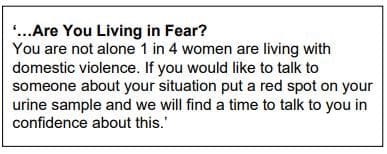
If you would like to talk to someone about your situation put a red spot on your urine sample and we will find a time to talk to you in confidence about this
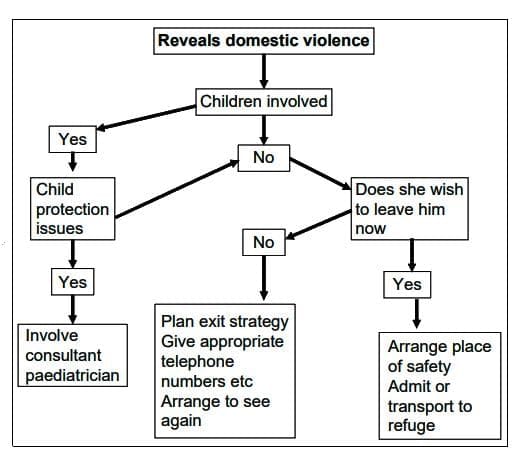 Diagram of management of DV
- Merely drawing the curtains around a bed in a ward does not guarantee privacy.
- Research indicates that inquiring about domestic violence multiple times is advantageous, regardless of whether someone else has already asked the question.
Steps to Take When Domestic Violence is Disclosed
- Acknowledge how difficult it has been for the woman to share her experiences with someone else.
- Reassure her that what has happened to her is completely wrong and that she did not deserve it.
- Ensure her about confidentiality. Explain who will know about her situation and how much information will be shared. Show her or agree on what is written in the notes to build trust. It's important to remember that she has the right to see her notes, but in a hospital, many people may have access to this information. There's a chance that someone connected to the perpetrator might read what is in the notes.
- Ask her what she would like to do next. She might want to go back home despite the circumstances. She could be concerned about her children, afraid of her partner, or hopeful that he will change.
- It is important that the woman is not forced to leave her home since that would be another form of bullying and controlling behavior, which would add to the abuse.
- Offer advice about leaving the perpetrator if she wants it. This could include providing her with telephone numbers for national help lines and local women's refuges, as well as the names of local solicitors who specialize in family law.
- It is important to reassure her that the police are now taking domestic violence very seriously.
- Recent changes in the law have made it stronger, allowing the police to take more effective action.
- The police have new tools and resources to help victims of domestic violence.
- There are also more training programs for officers to understand domestic violence better and respond appropriately.
- This means that victims can expect a more supportive and responsive approach from law enforcement.
- The legal system now provides better protection for those affected by domestic violence.
- Local communities are also becoming more aware and involved in addressing domestic violence issues.
Child Protection Issues
- Legal Duty: When children are involved, there is a legal obligation to assess whether they are at significant risk. If they are, the woman's preferences may need to be overridden.
- Child Protection Protocols: Follow the established child protection protocols for the area. Involve the consultant paediatrician on call and contact hospital social work departments for guidance.
- Not Always Necessary: It is not required to initiate child protection protocols in every case of domestic violence, but it should always be a consideration.
- Compromise: Often, the woman may agree to a compromise if there are serious concerns for child protection.
Support for Staff
- Confidence in Communication Skills: Staff should feel assured in their communication abilities when they have identified serious incidents of abuse.
- Empowering the Victim: The woman confided in the staff and was given a choice regarding her situation, which is crucial in such cases.
- Managing Potential Outcomes: Staff should understand that if the perpetrator is seriously injured or killed later, it is not their fault. The important thing is that the woman had the chance to discuss ways to improve her situation.
- Importance of Inquiring About Domestic Violence: Failing to ask about domestic violence and not giving the victim the opportunity to share their experience would be a significant failure on the part of the staff.
Health Consequences
- Conducting research on the health consequences of domestic violence is challenging.
- Double-blind randomized control trials are not practical, and cohort studies rely on the accuracy of the 'non-abused' group, which may not be truthful due to fear.
- The likelihood of a woman disclosing domestic violence increases with the frequency of private meetings with the researcher. As a result, there is conflicting evidence regarding the effects of domestic violence.
- However, some generalizations can be made:
Obstetrics
- Pregnancy is a period when domestic violence often starts or worsens, especially in cases of teenage pregnancies.
- There is an association with an increased risk of:
- The 'Why Mothers Die' report indicates that women who are murdered often present late or miss appointments frequently.
- It is crucial to understand that women in this vulnerable group may face barriers that prevent them from attending hospital appointments.
- It is important to consider the reasons behind a woman's absence from a clinic and offer additional appointment opportunities.
- A 'one strike and you are out' policy will only further victimise these individuals.
- Partners who engage in violent behaviour often exhibit controlling and dominating attitudes, staying with their partners constantly.
Presentation of DV
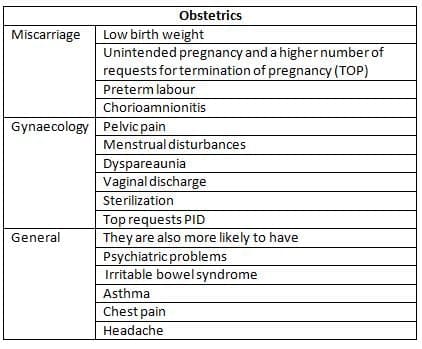
Sexual Assault
- Any woman visiting Obstetric and Gynaecology clinics may have experienced sexual assault.
- The British Crime Survey revealed that 1 in 20 women have been sexually assaulted.
- After an assault, many women tend to view their health as poor or fair rather than good.
- Victims often use healthcare services more frequently than others.
- They may present with:
- Vaginal discharge
- Psychiatric problems
- Menstrual disorders
- Dyspareunia (Painful intercourse)
- Abdominal pain
- IBS (Irritable Bowel Syndrome)
- Headaches
- It is crucial to provide good initial care for victims, which may not always involve the police, to support their long-term health needs.
- This care should be given in a sensitive and accurate manner to preserve possible forensic evidence.
- Many victims hesitate to go to the police for several reasons, including:
- Fear of not being believed
- Fear of the court process
- Fear of the assailant, especially if they are known to the victim
- Embarrassment and fear of additional examinations
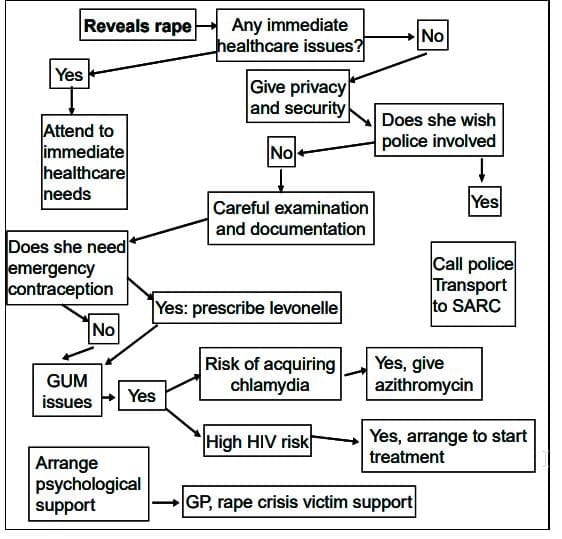 Diagram of management of acute sexual assault
- The development of post-traumatic stress disorders and the fear of repercussions from the assault lead to frequent visits to healthcare providers.
Initial action following a revelation of an acute sexual assault
- A victim might reveal that she has been assaulted recently during a medical consultation, a visit to the Emergency department, or during admission for a different medical issue.
- Assess Immediate Health Needs: First and foremost, check the victim's immediate health needs. If she is experiencing heavy bleeding, she will need intravenous (IV) fluids and close monitoring for signs of shock.
- Ensure Stability: Once the victim is stable, take her to a private room to ensure her comfort and privacy.
- Involvement of Authorities: Ask the victim if she would like the police to be involved in the situation.
- Urine Sample: If the victim passes urine before the police arrive, save it, as the authorities may want to screen it for drugs.
- Inquiry About Forced Oral Sex: Gently inquire if there was any forced oral sex involved in the assault. If the answer is yes, do not offer the victim any drinks until the police can provide an early evidence kit for a mouth sample to collect potential evidence of sperm.
Sexual Assault Referral Centers
- Police forces throughout the country are urged to collaborate with health services to establish Sexual Assault Referral Centres (SARCs) akin to the existing centres at St Mary's in Manchester and REACH in northeastern England.
- Victims can visit these SARCs for examinations, and they also offer counselling and support. Most SARCs do not require victims to have reported to the police beforehand.
- Upon arrival at a SARC, the doctor must assess whether the victim can consent to the examination. If the victim has been drugged or is significantly intoxicated, she may need additional time before the examination can proceed.
- Initially, a general history should be gathered, including inquiries about bleeding and any psychiatric issues the victim may have.
- It is not the doctor's role to investigate or determine whether the woman has been raped. Believing the victim is crucial for her long-term recovery and support.
- If a written statement is required for court, it should be independent and not prepared on behalf of the victim or the defendant.
- The doctor will meet with the victim before she has provided a statement to the police and should avoid probing too deeply into the incident to prevent unintentionally suggesting details.
Examination of Sexual Assault Victims
Benefits of SARC for Examination
- SARC (Sexual Assault Referral Centre) is specifically designed to minimize the risk of DNA contamination during examinations.
- If examination in a SARC is not possible and it has to be done in a ward or emergency department, it is crucial to limit contact with others before the examination to prevent contamination.
Management of Rape Victims
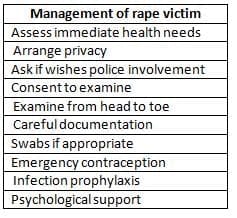
Examination Procedure:
- Use of Gloves and Protective Clothing: During the examination, it is important to wear gloves to prevent contamination.
- Additionally, theatre clothes or gowns are recommended as they are less contaminated compared to regular clothes.
Head-to-Toe Examination:
- Focus on Injuries: Detailed head-to-toe examination should be conducted to look for various injuries
- Including:
- Bruises
- Scratches
- Grazes
Collection of Swabs for DNA:
- Swabs moistened with sterile water can be collected from areas where the perpetrator has kissed the victim, such as the face and nipples, or from areas where he has held the victim.
- These swabs can yield DNA if collected promptly after the incident.
Common Injuries:
- Genital Injuries: Typically, sexually active victims do not have genital injuries.
- However, they may have other injuries, such as marks from being forcibly held down.
Documentation of Findings:
- Importance of Accurate Documentation: Accurate documentation of findings is crucial. Using body diagrams can help illustrate the location of injuries.
- Documentation of Bruises: For bruises, it is important to record the size, shape, and colour. It is worth noting that it is not possible to determine the age of bruises accurately.
- Documentation of Abrasions: Sizes and shapes of abrasions, such as scratches and grazes, should also be documented. The direction of force in a scratch can sometimes be inferred, especially if it is fresh, as the loops of skin will be present until they dry.
Guidelines for Examining Victims Under 18:
- Use of Colposcope: Since April 2004, the guidelines from the Royal College of Paediatrics and Child Health & Association of Forensic Physicians (RCPCH & AFP) recommend using a colposcope for genital examinations of victims under 18.
- This is considered best practice for all female victims.
Benefits of Using a Colposcope:
- Better Documentation:. colposcope helps in better documenting injuries during genital examinations.
- Respect for Victim's Privacy: Unlike using a magnifying glass and light, which can feel invasive, a colposcope allows for intimate examinations while respecting the victim's personal space.
- Detection of More Injuries:. colposcope can also detect more injuries compared to other methods.
Consent for Photographs and Videos:
- Obtaining Consent: Consent must be obtained for any photographs or videos taken during the examination, and access to these records should be restricted.
- Medical Documentation: These records become part of the medical documentation, not police notes. Photos related to an assault should only be shown to a medical expert who must ensure they will not share them without the victim's consent or under a judge's orders.
- Risk of Misuse: There have been instances where these images have ended up in the wrong hands, which risks discouraging women from allowing these essential records to be collected.
Swab Collection Order:
- Order of Swab Collection:
- Swabs should be taken during the genital examination in the following order:
- Perineum
- Labia
- Introitus
- Lower vagina
- Higher vagina
- Cervix
- Swabs should be taken during the genital examination in the following order:
Considerations for Swab Collection:
- Time and Incident Details: The time elapsed since the assault and the details of the incident are crucial for determining which swabs to take.
Aftercare
- After the examination, the woman may want to take a shower or bath because she might feel uncomfortable.
- Here are some other important topics to discuss:
- Emergency contraception if it's suitable.
- Infection. Offer Azithromycin if there's a possibility of Chlamydia infection.
- HIV prophylaxis. Consider these questions:
- Is the perpetrator likely to have HIV?
- Is he an IV drug user or from a high-risk area for HIV?
- Were there multiple attackers, anal intercourse, or severe injuries?If the answers raise concern, HIV prophylaxis may be necessary. Most hospitals have procedures for providing treatment outside regular hours.
- Encourage victims to visit their local genitourinary medicine (GUM) clinic in the coming days to discuss HIV risk and hepatitis vaccination.
- Psychological support: If the local Sexual Assault Referral Centre (SARC) lacks counselling services, involve the GP early. Proper initial management reduces long-term health risks. The GP will be crucial when these issues arise, so it's important to support the victim from the beginning.
- Victims often feel guilt as part of their emotional response. It's helpful to emphasize that they are not at fault; the guilt and shame belong to the perpetrator.
The Statement
- It is the responsibility to provide a statement to the court, even if the police make a request.
- If a doctor provides misleading evidence or statements to the court, the General Medical Council (GMC) takes this matter seriously.
- A 'professional' statement must make it clear to the police, Crown Prosecution Service (CPS), and, if necessary, to the judge, that the doctor has acted only in a professional capacity and does not have the expertise to interpret the injuries.
- When evaluating an expert opinion, it is crucial to consider the cause while keeping in mind all reasonable alternative causes for each injury.
- Certainty regarding causation can be rated on a scale from one to five:
- (1) - no indication that the injury relates to any specific cause.
- (5) - complete certainty that the injury was caused by a specific factor.
- Any statement must be precise and convey a professional image.
- Qualifications and experience should be clearly outlined.
- Conclusions should align with both causation and the provided history.
- The statement should end with a phrase like 'based on information given to me to date,' as new information may necessitate a reevaluation of conclusions.
- Assistance in drafting a statement can be sought from the nurse or doctor responsible for child protection in your hospital or area.
Child sexual abuse
- Many women who visit gynecology clinics have experienced sexual abuse as children.
- Similar to rape victims, these women often have more gynecological issues compared to those who have not been abused.
- They might struggle with pelvic exams, and it is important to help them feel in control during these procedures.
- Allowing the woman to insert the speculum herself can make the process easier for her.
- Having a male doctor may increase their anxiety and trigger flashbacks to their past abuse.
- This can lead to feelings of being violated and a reluctance to seek further treatment.
- Some women may not be suitable for outpatient procedures; in such cases, day care admission and anesthesia could be better options.
- There is evidence that child sexual abuse (CSA) is often underdiagnosed.
- When a gynecologist sees a child, it is important to consider the possibility of CSA.
- This does not imply that every child is a victim, but many of their symptoms might resemble those of abuse, making it a frequent part of the differential diagnosis.
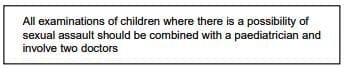 All examinations of children where there is a possibility of sexual assault should be combined with a paediatrician and involve doctors
- For instance, when a child presents with an injury, it should be questioned whether they truly fell off a bicycle or if it resulted from abuse.
- A child with a vaginal discharge should also be evaluated carefully.
- Children who are old enough to communicate will share their experiences if they feel safe and are given the chance to use their own words.
- Often, the right amount of privacy is not provided for them to disclose their experiences.
- Unlike physical abuse, sexual abuse rarely shows clear signs immediately, and the examination results are just a small part of determining if abuse occurred.
- Frequently, there are no obvious signs of abuse during the examination.
- If a gynecologist suspects sexual abuse, it is crucial to consult a pediatrician with experience in this field or the pediatric consultant on call.
- A joint examination with a pediatrician is considered best practice, allowing two professionals to independently assess any injuries.
- The initial examination should follow the same protocol as any forensic examination, involving a thorough assessment for bruises and other injuries.
- The stage of puberty must always be noted during the examination.
- If there is a possibility of abuse, the child's genitalia should be examined, preferably during a joint examination using a colposcope to record findings.
- Younger children may feel more secure if they can sit on their mother's lap during the examination.
- Interpreting a normal hymen can be challenging; minor clefts or bumps may be normal, while folds might obscure significant tears.
- The hymen should be gently inspected from all angles.
- Applying gentle traction to the hymen or using warmed saline can help improve visibility during the examination.
- Inserting a small catheter into the vagina and gently inflating the balloon can also assist in visualizing the entire hymen.
- It is now understood that the size of the hymenal orifice varies significantly, especially in obese children, so measurements should not be overemphasized.
- When examining the anus, care must be taken to avoid excessive pressure, which can cause problems.
- Many children who have been sexually abused show no visible abnormalities, even if the abuser has admitted to full penetration.
- Just like with adult assaults, a lack of injury does not mean that nothing has happened.
FAQs on Chapter Notes: Domestic violence and sexual assault
| 1. What should be the initial action taken when a person reveals an acute sexual assault? |  |
| 2. What services do sexual assault referral centers offer? | |
| 3. What is involved in the examination process following a sexual assault? | |
| 4. What aftercare options are available for survivors of sexual assault? | |
| 5. How should a statement be taken from a survivor of domestic violence or sexual assault? | |