Final Exam Paper Mathematics Set 1 (Solutions)

Maximum Marks: 80
Time: 3 Hours
General Instructions:
(i) All questions are compulsory.
(ii) Marks for each question are indicated against it.
(iii) Section A consists of 12 MCQs carrying 1 mark each.
(iv) Section B consists of 12 questions carrying 2 marks each.
(v) Section C consists of 8 questions carrying 3 marks each.
(vi) Section D consists of 5 questions carrying 4 marks each.
(vii) Use of calculators is not allowed.
Syllabus: The Final Examination is based on the following chapters: Geometric Twins, Operations with Integers, Finding Common Ground, Another Peek Beyond the Point, Connecting the Dots..., Constructions and Tilings, and Finding the Unknown.
Section A (12 × 1 = 12 Marks)
Q1. Figures that are exact copies of each other or have the same shape and size are said to be:
(a) Parallel
(b) Factors
(c) Congruent
(d) Outliers
Ans: (c) Congruent
Figures having the same shape and the same size can be placed exactly over one another.
Q2. What is the value of 5 + (-7)?
(a) 12
(b) -2
(c) 2
(d) -12
Ans: (b) -2
Start from 5 on the number line and move 7 units to the left to reach -2.
Q3. The Highest Common Factor (HCF) of 12 and 16 is:
(a) 2
(b) 4
(c) 6
(d) 48
Ans: (b) 4
Common factors of 12 and 16 are 1, 2, and 4. The greatest among them is 4.
Q4. To multiply 5.96 by 24.8, the product will have how many decimal places?
(a) 1
(b) 2
(c) 3
(d) 4
Ans: (c) 3
5.96 has two decimal places and 24.8 has one decimal place. Their sum is 3.
Q5. The arithmetic mean is also known as:
(a) Median
(b) Outlier
(c) Average
(d) Mode
Ans: (c) Average
Arithmetic mean is obtained by dividing the total by the number of values.
Q6. What is the value of n in 2n + 1 = 9?
(a) 4
(b) 5
(c) 8
(d) 10
Ans: (a) 4
Subtract 1 from both sides: 2n = 8. Divide by 2 to get n = 4.
Q7. Which congruence condition involves two sides and the angle between them?
(a) SSS
(b) ASA
(c) SAS
(d) RHS
Ans: (c) SAS
When two sides and the included angle are equal, the triangles are congruent.
Q8. The product of (-4) × (-2) is:
(a) -8
(b) 8
(c) -6
(d) 6
Ans: (b) 8
The product of two negative numbers is always positive.
Q9. What is 3.9 ÷ 10?
(a) 39
(b) 0.039
(c) 0.39
(d) 3.90
Ans: (c) 0.39
Dividing by 10 shifts the decimal one place to the left.
Q10. A value that differs greatly from other values in a data set is called:
(a) Median
(b) Mean
(c) Outlier
(d) Range
Ans: (c) Outlier
An outlier lies far away from the majority of data values.
Q11. A 60° angle can be constructed using which triangle?
(a) Isosceles
(b) Right-angled
(c) Equilateral
(d) Scalene
Ans: (c) Equilateral
All angles of an equilateral triangle measure 60°.
Q12. If a term is added on one side of an equation, moving it to the other side requires:
(a) Multiplication
(b) Addition
(c) Subtraction
(d) Division
Ans: (c) Subtraction
The same operation with opposite sign must be applied to both sides.
Section B (12 × 2 = 24 Marks)
Q13. In triangles ABC and XYZ, AB = XY, BC = YZ, and AC = XZ. Are the triangles congruent?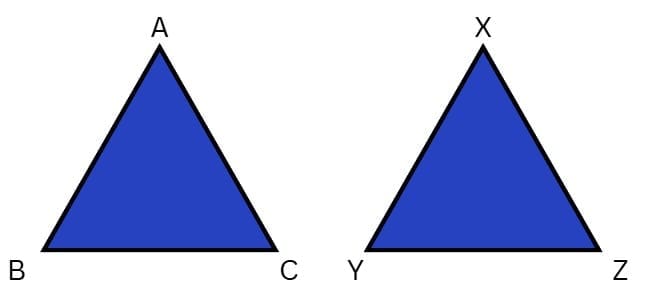
Ans:
All three corresponding sides are equal.
The triangles are congruent by the SSS congruence condition.
Q14. Find the value of 14 × (-15).
Ans:
14 × 15 = 210.
One number is negative, so the product is negative.
Final answer = -210.
Q15. Find the prime factorisation of 90.
Ans:
90 = 2 × 45
45 = 3 × 15
15 = 3 × 5
Prime factorisation = 2 × 3 × 3 × 5.
Q16. Find the HCF of 30 and 72.
Ans:
30 = 2 × 3 × 5
72 = 2 × 2 × 2 × 3 × 3
Common primes are 2 and 3.
HCF = 6.
Q17. A car covers 12.5 km per litre. How far will it travel using 5 litres?
Ans:
Distance = 12.5 × 5
= 62.5 km.
Q18. Solve: 5x - 4 = 11.
Ans:
Add 4 to both sides: 5x = 15.
Divide by 5: x = 3.
Q19. Find the average of: 6, 2, 9, 5, 4, 6, 3, 5.
Ans:
Sum = 40.
Number of values = 8.
Average = 40 ÷ 8 = 5.
Q20. State the rule for dividing a decimal by 100.
Ans:
Move the decimal point two places to the left.
Example: 18.7 ÷ 100 = 0.187.
Q21. Why is the line joining two points equidistant from the ends of a segment its perpendicular bisector?
Ans:
The triangles formed on either side are congruent.
This shows the line cuts the segment into two equal parts at 90°.
Q22. Find the LCM of 14 and 35.
Ans:
14 = 2 × 7
35 = 5 × 7
LCM = 2 × 5 × 7 = 70.
Q23. If y = 5 is the solution, frame an equation.
Ans:
3y = 15 is a valid equation when y = 5.
Q24. Define tiling.
Ans:
Covering a region using shapes without gaps or overlaps is called tiling.
Section C (8 × 3 = 24 Marks)
Q25. In an examination of 50 questions, 5 marks are awarded for each correct answer and 2 marks are deducted for each wrong answer. Mala answered 30 questions correctly and 20 questions wrongly. Find her total score.
Ans:
Step 1: Marks for correct answers.
Number of correct answers = 30.
Marks for each correct answer = 5.
Total marks for correct answers = 30 × 5 = 150.
Step 2: Marks deducted for wrong answers.
Number of wrong answers = 20.
Marks deducted for each wrong answer = 2.
Total marks deducted = 20 × 2 = 40.
Step 3: Find the final score.
Final score = 150 - 40 = 110 marks.
Q26. Find the largest possible weight for equal bags of 84 kg and 108 kg rice.
Ans:
HCF of 84 and 108 = 12.
Each bag should weigh 12 kg.
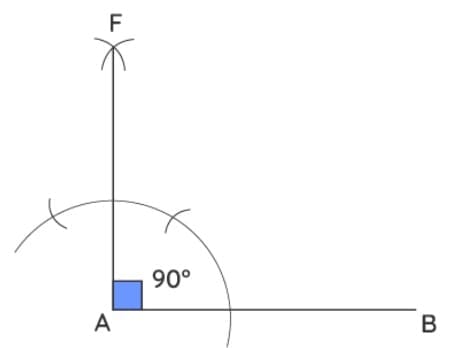
Q27. Construct a 90° angle using ruler and compass.
Ans:
Draw a line and mark point A.
Mark point B on side of A.
Draw arcs to meet .
Join OA to get a right angle.
Q28. Find the median of: 118, 165, 170, 173, 175.
Ans:
The data is already arranged.
The middle value is 170.
Median = 170.
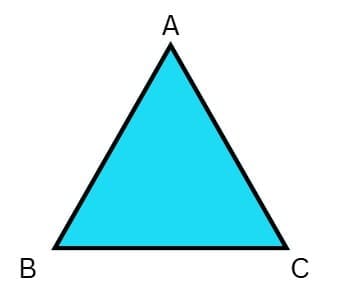
Q29. Prove that angles of an equilateral triangle are 60°.
Ans:
In a triangle ABC , all sides are equal, so all angles are equal.
Sum of angles = 180°.
Angle A + Angle B + Angle c = 180°
Each angle = 180° ÷ 3 = 60°.
Q30. Solve: 28(x + 4) = 700.
Ans:
Divide by 28:
x + 4 = 25.
Subtract 4:
x = 21.
Q31. Explain average as fair-share using an example.
Ans:
Average means equal sharing.
30 guavas shared among 5 people gives 6 each.
Q32. Write 10 ÷ 3 in decimal form.
Ans:
10 ÷ 3 = 3.333...
The remainder never becomes zero, so the decimal continues.
Section D (5 × 4 = 20 Marks)
Q33. Two friends, Jahnavi and Sunita, save money every month. Jahnavi already has ₹4000 and saves ₹650 every month. Sunita already has ₹5050 and saves ₹500 every month. After how many months will both of them have the same amount of money? Find the amount they will each have at that time.
Ans: 7 months
Step 1: Let the number of months be m.
Step 2: Write expressions for their total savings.
Money saved by Jahnavi after m months = 4000 + 650m.
Money saved by Sunita after m months = 5050 + 500m.
Step 3: Form the equation.
Since both amounts are equal:
4000 + 650m = 5050 + 500m.
Step 4: Simplify the equation.
650m - 500m = 5050 - 4000.
150m = 1050.
Step 5: Solve for m.
m = 1050 ÷ 150.
m = 7.
Step 6: Find the equal amount.
Substitute m = 7 in Jahnavi's savings:
4000 + (650 × 7) = 4000 + 4550 = ₹8550.
Q34. A farmer has two fields of sizes 180 m and 252 m. He wants to divide both fields into smaller rectangular plots of the same size such that no land is wasted. What is the largest possible length of each plot? Also, how many plots will he get from each field?
Ans:
Largest possible plot length = HCF of 180 and 252
Prime factorisation:
180 = 2² × 3² × 5
252 = 2² × 3² × 7Common primes = 2² × 3²
HCF = 4 × 9 = 36 mNow number of plots:
Field 1:
180 ÷ 36 = 5 plotsField 2:
252 ÷ 36 = 7 plots
Largest plot length = 36 m
Number of plots = 5 and 7
Q35. In ΔABC, AB = AC. A line AD is drawn such that it bisects ∠A. Show that BD = DC.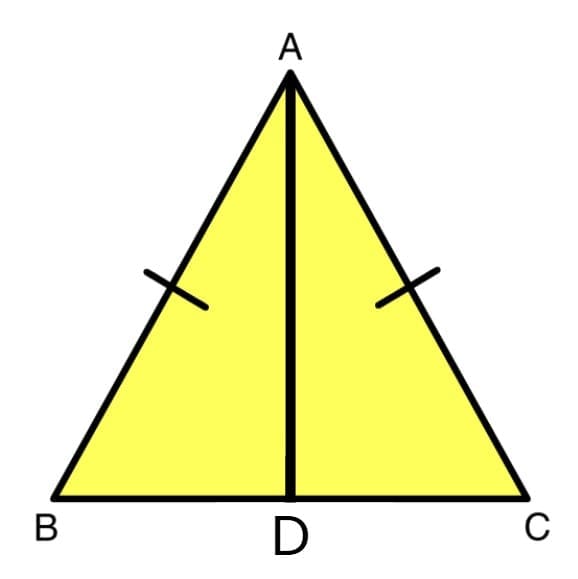
Ans:
Since AB = AC, ΔABC is an isosceles triangle.
In an isosceles triangle, the angle bisector of the vertex angle also bisects the opposite side.
- AB = AC (given)
- AD is the angle bisector, so ∠BAD = ∠CAD
- In ΔABD and ΔACD:
- AB = AC (given)
- ∠BAD = ∠CAD (angle bisector)
- AD is commonHence, by SAS rule, ΔABD ≅ ΔACD
⇒ BD = DC as corresponding sides of congruent triangles.
Q36. Three bells ring at intervals of 12 minutes, 18 minutes, and 24 minutes. If they all ring together at 6:00 a.m., at what time will they ring together next? Find the answer using LCM and explain the steps.
Ans:
To find when all three bells ring together again, we find the LCM of 12, 18, and 24.
Prime factorisation:
12 = 2² × 3
18 = 2 × 3²
24 = 2³ × 3Take highest powers of each prime:
2 → 3 times
3 → 2 timesLCM = 2³ × 3²
= 8 × 9
= 72 minutes72 minutes after 6:00 a.m.:
6:00 + 1 hour 12 minutes = 7:12 a.m.So, all three bells will ring together at 7:12 a.m.
Q37. The heights (in cm) of five students are: 170, 173, 165, 118, 175. (a) Find the Mean and Median of the data. (b) Identify the outlier. (c) State which measure (Mean or Median) better represents the data and why.
Ans:
Step 1: Arrange the data in ascending order.
118, 165, 170, 173, 175.
Step 2: Find the Mean.
Formula for Mean:
Mean = (Sum of all observations) ÷ (Number of observations).
Sum = 118 + 165 + 170 + 173 + 175 = 801.
Number of observations = 5.
Mean = 801 ÷ 5 = 160.2 cm.
Step 3: Find the Median.
Since the number of observations is odd (5), the median is the middle value.
Median = 170 cm.
Step 4: Identify the outlier.
The value 118 cm is much smaller than the other heights.
So, 118 cm is the outlier.
Step 5: Compare Mean and Median.
The mean (160.2 cm) is pulled down because of the very small value 118 cm.
The median (170 cm) lies closer to the majority of the data values.
Final Answer:
Mean = 160.2 cm, Median = 170 cm.
The median better represents the data because it is not affected by the outlier.
FAQs on Final Exam Paper Mathematics Set 1 (Solutions)
| 1. What is the structure of the Term 2 Mathematics Exam for Class 7? |  |
| 2. How can students prepare effectively for the Term 2 Mathematics Exam? | |
| 3. What types of questions can students expect in the exam sections? | |
| 4. Are there any specific topics that are commonly emphasized in the Term 2 Mathematics Exam? | |
| 5. What is the importance of time management during the exam? | |