Final Exam Paper Mathematics Set 2 (Solutions)

Maximum Marks: 80
Time: 3 Hours
General Instructions:
(i) All questions are compulsory.
(ii) Marks for each question are indicated against it.
(iii) Section A consists of 12 MCQs carrying 1 mark each.
(iv) Section B consists of 12 questions carrying 2 marks each.
(v) Section C consists of 8 questions carrying 3 marks each.
(vi) Section D consists of 5 questions carrying 4 marks each.
(vii) Use of calculators is not allowed.
Syllabus: The Final Examination is based on the following chapters: Geometric Twins, Operations with Integers, Finding Common Ground, Another Peek Beyond the Point, Connecting the Dots..., Constructions and Tilings, and Finding the Unknown.
Section A (12 × 1 = 12 Marks)
Q1. In ancient Indian notation, a negative number was often indicated by:
(a) A minus sign
(b) A dot over the number
(c) Underlining the number
(d) A zero beside it
Ans: (b)
A dot above a number was used to represent a debt, which indicates a negative value.
Q2. Which congruence condition is satisfied if two angles and the non-included side are equal?
(a) SSS
(b) SAS
(c) AAS
(d) RHS
Ans: (c)
When two angles and a side not between them are equal, triangles are congruent by AAS.
Q3. If the first movement of a carrom coin is -4 units and the final position is 5, the second movement was:
(a) 1
(b) 9
(c) -9
(d) -1
Ans: (b)
Final position = first movement + second movement.
5 = -4 + b, so b = 9.
Q4. The process of dividing a geometrical quantity into two equal parts is called:
(a) Multiplication
(b) Tiling
(c) Bisection
(d) Prime factorisation
Ans: (c)
Bisection means dividing a line or angle into two identical parts.
Q5. In the expression 7 + 4m, what is the coefficient of m?
(a) 7
(b) m
(c) 4
(d) 11
Ans: (c)
The coefficient is the number multiplying the variable, which is 4.
Q6. What is the HCF of two co-prime numbers?
(a) 0
(b) 1
(c) Their product
(d) Their sum
Ans: (b)
Co-prime numbers have no common factor other than 1.
Q7. To divide 123.45 by 1000, the decimal point is moved how many places to the left?
(a) One
(b) Two
(c) Three
(d) Four
Ans: (c)
Dividing by 1000 moves the decimal three places left.
Q8. What is the parity of the sum of three odd numbers?
(a) Even
(b) Odd
(c) Zero
(d) None
Ans: (b)
Odd + odd = even, and even + odd = odd.
Q9. If an isosceles triangle has a vertex angle of 80°, what are the other two angles?
(a) 80°, 20°
(b) 50°, 50°
(c) 60°, 60°
(d) 40°, 40°
Ans: (b)
Sum of angles = 180°. Remaining = 100°, divided equally = 50° each.
Q10. Machine gives output a + b - c. For input (-10, -12, -9), the result is:
(a) -31
(b) -13
(c) -11
(d) -7
Ans: (b)
-10 - 12 - (-9) = -22 + 9 = -13.
Q11. Why can a 5 × 7 grid not be tiled with 2 × 1 tiles?
(a) It is too small
(b) Total squares is odd
(c) Sides are prime
(d) It is not square
Ans: (b)
There are 35 squares, which is not divisible by 2.
Q12. In the term "Bījagaṇita", what does "Bīja" mean?
(a) Tree
(b) Hidden
(c) Seed
(d) Known
Ans: (c)
"Bīja" means seed, representing the unknown value.
Section B (12 × 2 = 24 Marks)
Q13. State Brahmagupta's rule for the product of two debts.
Ans:
A debt represents a negative number.
The product of two negative numbers is positive.
So, the product of two debts is a fortune.
Q14. If ΔHEN ≅ ΔBIG, write other correct congruence statements.
Ans:
HEN ≅ BIG
ENH ≅ IGB
Corresponding order of vertices is maintained.
Q15. Find the LCM of 30 and 72.
Ans:
30 = 2 × 3 × 5
72 = 2³ × 3²
LCM = 2³ × 3² × 5 = 360.
Q16. Using integer rules, find (-16) × (-5).
Ans:
Negative × negative = positive.
16 × 5 = 80.
Q17. Define Median and find the median of 15, 20, 10, 25, 30.
Ans:
Arrange: 10, 15, 20, 25, 30.
The middle value is 20.
Q18. Solve: 11y - 5 = 61.
Ans:
11y = 61 + 5 = 66.
y = 66 ÷ 11 = 6.
Q19. Convert 7/20 into a decimal.
Ans:
7/20 = 35/100 = 0.35.
Q20. What is a perpendicular bisector?
Ans:
It is a line that divides a segment into two equal parts at right angles.
Q21. A car travels 12.5 km per litre. Find the distance covered using 7.5 litres.
Ans:
Distance = 12.5 × 7.5 = 93.75 km.
Q22. Find the HCF of 45 and 75.
Ans:
45 = 3² × 5
75 = 3 × 5²
HCF = 3 × 5 = 15.
Q23. Four people share ₹132. The 2nd gets twice the 1st, the 3rd thrice the 2nd, and the 4th four times the 3rd. Find the 1st share.
Ans:
Let first = x.
Total = x + 2x + 6x + 24x = 33x.
33x = 132 ⇒ x = 4.
Q24. If m and n are even, can an m × n grid be tiled with 2 × 1 tiles?
Ans:
An even number of squares can be paired fully using 2 × 1 tiles, so tiling is possible.
Section C (8 × 3 = 24 Marks)
Q25. In a test, 4 marks are awarded for each correct answer and 2 marks are deducted for each wrong answer. Anita answered 15 questions correctly and scored a total of 40 marks. Find the number of questions she answered wrongly.
Ans:
Step 1: Find the marks obtained for correct answers.
Marks for one correct answer = 4.
Total correct answers = 15.
Marks for correct answers = 15 × 4 = 60.
Step 2: Let the number of wrong answers be w.
Marks deducted for one wrong answer = 2.
Total deduction = 2w.
Step 3: Form the equation for total score.
60 - 2w = 40.
Step 4: Solve the equation.
2w = 60 - 40 = 20.
w = 10.
Anita answered 10 questions wrongly.
Q26. Describe the construction of a 45° angle using only a ruler and compass.
Ans:
Step 1: Draw a straight line and mark a point O on it.
Step 2: Construct a 90° angle at point O using ruler and compass.
Step 3: From O, draw equal arcs on both arms of the 90° angle.
Step 4: Join the point of intersection of the arcs to O.
The 90° angle is divided into two equal parts, each measuring 45°.
Q27. Find the prime factorisation of 360. Also, determine the total number of factors of 360.
Ans:
Step 1: Prime factorise 360.
360 = 2 × 180
= 2 × 2 × 90
= 2 × 2 × 2 × 45
= 2³ × 3 × 15
= 2³ × 3² × 5.
Step 2: Write the formula for number of factors.
If n = aᵖ × bᑫ × cʳ, then number of factors = (p + 1)(q + 1)(r + 1).
Step 3: Apply the formula.
Number of factors = (3 + 1)(2 + 1)(1 + 1) = 4 × 3 × 2 = 24.
Prime factorisation = 2³ × 3² × 5.
Total number of factors = 24.
Q28. The enrolment of students in a school over six years is: 1555, 1670, 1750, 2013, 2040, 2126. Find the mean enrolment.
Ans:
Step 1: Write the formula for mean.
Mean = (Sum of all observations) ÷ (Number of observations).
Step 2: Find the sum.
1555 + 1670 + 1750 + 2013 + 2040 + 2126 = 11154.
Step 3: Divide by the number of years.
Number of years = 6.
Mean = 11154 ÷ 6 = 1859.
The mean enrolment is 1859 students.
Q29. Explain the process of creating a regular tiling pattern using congruent triangles. Describe the steps and explain how symmetry plays a key role in creating the pattern.
Ans:
To create a regular tiling pattern using congruent triangles, follow these steps:
- Choose the type of triangle: Select a congruent triangle (e.g., equilateral triangle) to use for tiling.
- Start with one triangle: Place the first triangle on the surface where the tiling is to begin. Ensure it is placed with one edge aligned to the edge of the surface.
- Repeat the triangle: Place the second congruent triangle next to the first one. The side of the second triangle should be aligned with the side of the first triangle. Continue placing the triangles in this way, ensuring that each new triangle shares a side with its neighbor.
- Complete the tiling: Continue this process, ensuring that all triangles are arranged to form a repeating pattern without any gaps or overlaps.
- Symmetry role: Symmetry ensures that each triangle fits perfectly with its neighboring triangles. For example, an equilateral triangle has rotational and reflectional symmetry, meaning the triangle can be rotated or reflected, and it will still fit with others to create a regular pattern. This symmetry ensures that the tiling pattern is uniform and balanced across the entire surface.
Q30. Solve the equation: 3u - 7 = 2u + 3.
Ans:
Step 1: Bring like terms together.
3u - 2u = 3 + 7.
Step 2: Simplify both sides.
u = 10.
Q31. A sailfish swims at 109 km/h and a humpback whale swims at 26 km/h. Compare their speeds.
Ans:
Step 1: Write the comparison as a ratio.
109 ÷ 26.
Step 2: Perform division.
109 ÷ 26 ≈ 4.19.
The sailfish is approximately 4.19 times faster than the whale.
Q32. Calculate 237 ÷ 8 using place value division.
Ans:
Step 1: Divide 237 by 8.
8 × 29 = 232, remainder = 5.
Step 2: Convert remainder into decimals.
5 ÷ 8 = 0.625.
237 ÷ 8 = 29.625.
Section D (5 × 4 = 20 Marks)
Q33. The number of rockets launched by a space agency in three consecutive years is given below: 2021: 31 launches 2022: 61 launches 2023: 96 launches Study the data and describe the trend.
Ans:
Step 1: Find the increase from 2021 to 2022.
61 - 31 = 30 launches.
Step 2: Find the increase from 2022 to 2023.
96 - 61 = 35 launches.
Step 3: Observe the pattern.
The increase itself is growing each year.
The data shows a strong upward trend with a rapid increase in the number of rocket launches.
Q34. Ramesh has 30 more marbles than Suresh. Together, they have 60 marbles. Find the number of marbles each one has.
Ans:
Step 1: Let the number of marbles Suresh has be y.
Then Ramesh has y + 30 marbles.
Step 2: Form the equation.
y + (y + 30) = 60.
Step 3: Solve the equation.
2y + 30 = 60.
2y = 30.
y = 15.
Step 4: Find Ramesh's marbles.
15 + 30 = 45.
Suresh has 15 marbles and Ramesh has 45 marbles.
Q35. Verify the relationship: Product of two numbers = HCF × LCM for the numbers 105 and 95.
Ans:
Step 1: Prime factorise the numbers.
105 = 3 × 5 × 7.
95 = 5 × 19.
Step 2: Find HCF and LCM.
HCF = 5.
LCM = 3 × 5 × 7 × 19 = 1995.
Step 3: Verify the relationship.
105 × 95 = 9975.
HCF × LCM = 5 × 1995 = 9975.
Since both products are equal, the relationship is verified.
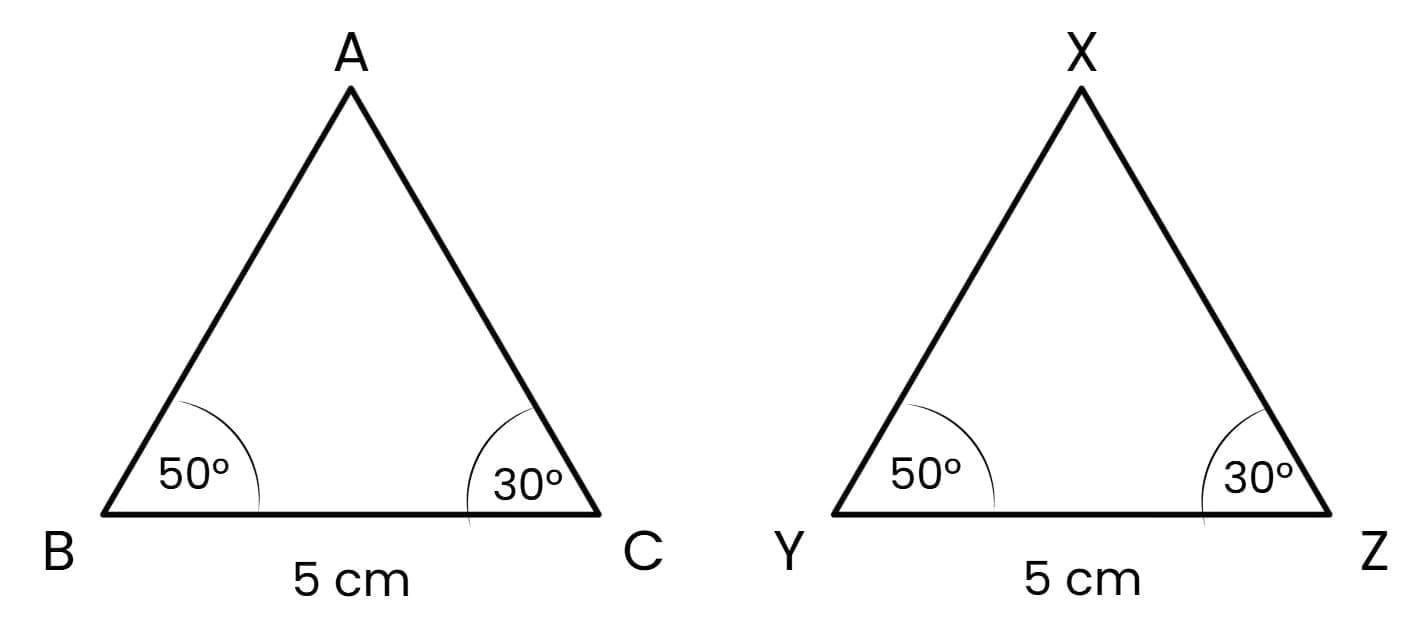
Q36. ΔABC and ΔXYZ have ∠B = ∠Y = 50°, ∠C = ∠Z = 30°, and BC = YZ = 5 cm. Are the triangles congruent? Justify.
Ans:
∠B = 180° - (50° + 30°) = 100°.
Similarly, ∠Y = 50°.
Thus ∠B = ∠Y, BC = YZ, and ∠C = ∠Z.
They satisfy the ASA condition.
Therefore, ΔABC ≅ ΔXYZ.
Q37. Using a black-and-white colouring method, show why a 5 × 3 grid with one corner removed cannot be tiled using 2 × 1 tiles.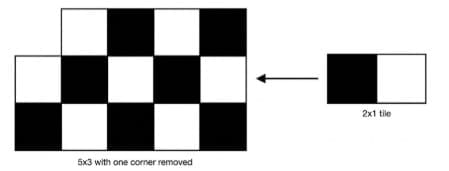
Ans:
Step 1: Colour the grid like a chessboard using black and white squares.
Step 2: Removing one corner creates unequal numbers of black and white squares.
Step 3: Each 2 × 1 tile always covers one black and one white square.
Since the numbers of black and white squares are not equal, complete tiling is not possible.
FAQs on Final Exam Paper Mathematics Set 2 (Solutions)
| 1. What is the structure of the Term 2 Mathematics Exam for Class 7? |  |
| 2. How should students prepare for the different sections of the exam? | |
| 3. What types of questions can students expect in each section of the exam? | |
| 4. How important is time management during the exam? | |
| 5. What resources can students use to prepare for the Term 2 Mathematics Exam? | |