Final Exam Paper Mathematics Set 3 (Solutions)

Maximum Marks: 80
Time: 3 Hours
General Instructions:
(i) All questions are compulsory.
(ii) Marks for each question are indicated against it.
(iii) Section A consists of 12 MCQs carrying 1 mark each.
(iv) Section B consists of 12 questions carrying 2 marks each.
(v) Section C consists of 8 questions carrying 3 marks each.
(vi) Section D consists of 5 questions carrying 4 marks each.
(vii) Use of calculators is not allowed.
Syllabus: The Final Examination is based on the following chapters: Geometric Twins, Operations with Integers, Finding Common Ground, Another Peek Beyond the Point, Connecting the Dots..., Constructions and Tilings, and Finding the Unknown.
Section A (12 × 1 = 12 Marks)
Q1. Which triangle congruence condition uses the hypotenuse?
(a) SSS
(b) SAS
(c) RHS
(d) ASA
Ans: (c)
RHS applies only to right-angled triangles and uses the hypotenuse and one side.
Q2. Solve the equation 2x + 3 = 4x + 5 using a suitable method.
(a) 1
(b) -1
(c) 4
(d) -4
Ans: (b)
Using x = (D - B)/(A - C) gives (5 - 3)/(2 - 4) = 2/-2 = -1.
Q3. The LCM of two different prime numbers m and n is:
(a) 1
(b) m + n
(c) m × n
(d) m - n
Ans: (c)
Prime numbers have no common factors, so the LCM is their product.
Q4. Write 7,89,12,345 in expanded form using powers of 10. The highest place value term is:
(a) 7 × 10⁷
(b) 7 × 10⁸
(c) 7 × 10⁶
(d) 7 × 10⁹
Ans: (a)
7 crore corresponds to the power 10⁷ in the Indian place value system.
Q5. If a data set has an even number of values, the median is:
(a) The middle value
(b) The total sum
(c) The average of the two middle values
(d) The mode
Ans: (c)
With an even count, the median lies midway between the two central values.
Q6. When copying an angle ∠A to ∠X, the SSS condition is used because:
(a) A ruler is used
(b) Three corresponding lengths are equal
(c) Angles are equal
(d) Radius is fixed
Ans: (b)
Equal radii and arc lengths form triangles with three equal sides.
Q7. A 210 g packet costs ₹70.50 and a 110 g packet costs ₹33.25. Which is cheaper per gram?
(a) 210 g packet
(b) 110 g packet
(c) Both same
(d) Cannot be determined
Ans: (b)
Cost per gram of 110 g packet is lower when divided.
Q8. The HCF of two consecutive even numbers is always:
(a) 1
(b) 2
(c) 4
(d) Their average
Ans: (b)
All even numbers are divisible by 2, and consecutive ones share only this factor.
Q9. Dividing a number by 0.1 is equivalent to multiplying it by:
(a) 0.1
(b) 1
(c) 10
(d) 100
Ans: (c)
Dividing by 0.1 is the same as multiplying by 10.
Q10. A 60° angle can be constructed using which polygon?
(a) Square
(b) Regular hexagon
(c) Equilateral triangle
(d) Pentagon
Ans: (c)
Each angle of an equilateral triangle measures 60°.
Q11. Parag's group has 30 guavas shared among 6 members. What is the fair-share?
(a) 4
(b) 5
(c) 6
(d) 30
Ans: (b)
Fair-share is total divided by number of members: 30 ÷ 6 = 5.
Q12. Which term was used by Bhaskaracharya for "Mean"?
(a) Samarajju
(b) Samamiti
(c) Samikarana
(d) Bijaganita
Ans: (b)
"Samamiti" refers to equal distribution or mean value.
Section B (12 × 2 = 24 Marks)
Q13. Find the prime factorisation of 105.
Ans:
105 ÷ 3 = 35.
35 ÷ 5 = 7.
So, 105 = 3 × 5 × 7.
Q14. How can a 30° angle be constructed from a 60° angle?
Ans:
Construct a 60° angle using an equilateral triangle.
Bisect the angle to obtain 30°.
Q15. Solve: 4k + 1 = 13.
Ans:
4k = 13 - 1 = 12.
k = 3.
Q16. State the result of -1 × a.
Ans:
Multiplying by -1 gives the additive inverse.
So, -1 × a = -a.
Q17. Compare 6.78 and 6.87.
Ans:
Whole parts are equal.
Tenths: 7 < 8.
So, 6.78 < 6.87.
Q18. Find the HCF of 84 and 180 using common factor division.
Ans:
Divide both by 2 → 42, 90.
Divide by 2 → 21, 45.
Divide by 3 → 7, 15.
HCF = 2 × 2 × 3 = 12.
Q19. Describe the historical origin of the "rod" as a unit of length.
Ans:
Sixteen adult males stood toe-to-heel in a line.
This length was taken as one rod, later standardised into feet.
Q20. Solve: 2y = 60.
Ans:
y = 60 ÷ 2 = 30.
Q21. Evaluate: 0.018 × 0.012.
Ans:
18 × 12 = 216.
Total decimal places = 6.
Result = 0.000216.
Q22. What is special about tangram piece number 4?
Ans:
Piece 4 is the only square in the standard tangram set.
Q23. Find the HCF of n and 5n.
Ans:
n is a factor of 5n.
So, HCF = n.
Q24. Define the RHS congruence condition.
Ans:
Two right-angled triangles are congruent if their hypotenuse and one corresponding side are equal.
Section C (8 × 3 = 24 Marks)
Q25. Bhaskaracharya's problem: One person owns ₹300 and 6 horses. Another person owns 10 horses but has a debt of ₹100. If both persons are equally rich, find the price of one horse.
Ans:
Step 1: Let the price of one horse be ₹x.
Step 2: Write the total wealth of each person.
First person's wealth = 300 + 6x.
Second person's wealth = 10x - 100.
Step 3: Form the equation since both are equally rich.
300 + 6x = 10x - 100.
Step 4: Solve the equation.
300 + 100 = 10x - 6x.
400 = 4x.
x = 100.
The price of one horse is ₹100.
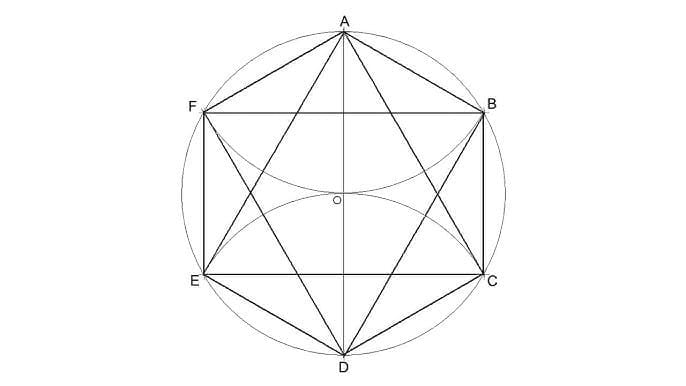
Q26. Describe the steps to construct a 6-pointed star using a ruler and compass.
Ans:
Step 1: Draw a circle with any convenient radius and mark its centre O.
Step 2: Choose a point A on the circle.
Step 3: Using OA as the radius, step off six equal arcs on the circumference to mark six points.
Step 4: Join alternate points to form an equilateral triangle.
Step 5: Join the remaining alternate points to form another equilateral triangle overlapping the first.
The two overlapping equilateral triangles form a 6-pointed star.
Q27. Find the LCM of 14 and 35 using the prime factorisation method.
Ans:
Step 1: Prime factorise the numbers.
14 = 2 × 7.
35 = 5 × 7.
Step 2: Write each prime factor the greatest number of times it occurs.
LCM = 2 × 5 × 7.
The LCM of 14 and 35 is 70.
Q28. A dot plot shows most data values clustered between 0 and 2, and one value far away at 25. Describe the nature of the data.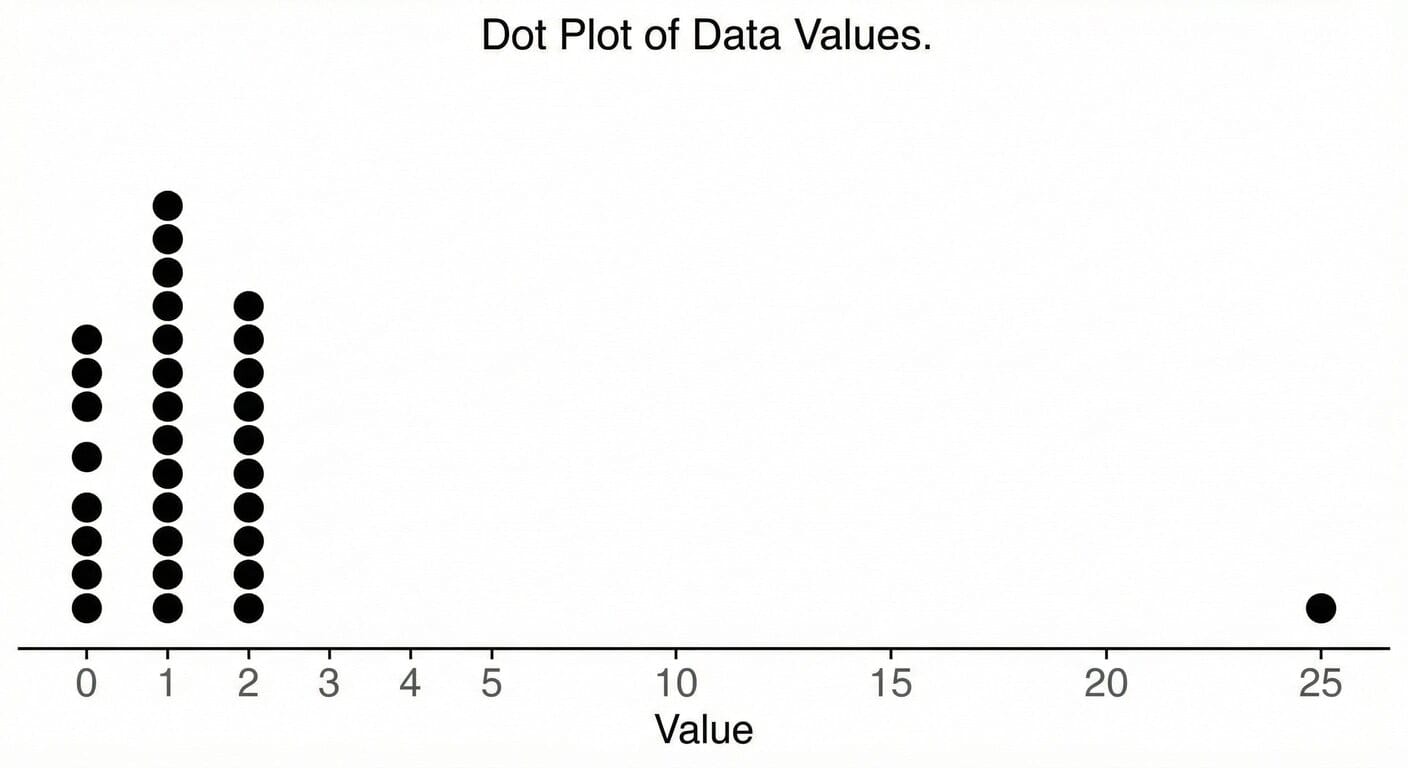
Ans:
Step 1: Observe the clustering of values between 0 and 2.
Step 2: Note that 25 lies far away from the rest of the data.
The data is unevenly spread and contains an outlier at 25, which can affect the mean more than the median.
Q29. Solve the equation 3k + 1 = 100 and state the value of k.
Ans:
Step 1: Subtract 1 from both sides.
3k = 99.
Step 2: Divide both sides by 3.
k = 33.
Q30. A shopkeeper divides 9.5 kg of sugar equally into 4 bags. Find the weight of sugar in each bag.
Ans:
Step 1: Write the division.
9.5 ÷ 4.
Step 2: Perform the division.
9.5 ÷ 4 = 2.375.
Each bag contains 2.375 kg of sugar.
Q31. A cricket team scores a total of 407 runs. Can the median score of the team be 0? Give a reason.
Ans:
Step 1: Arrange individual scores in ascending order.
Step 2: If more than half the players scored 0, the middle value will be 0.
Yes, the median can be 0 even if the total score is high.
Q32. Find the total number of factors of 840 using its prime factorisation.
Ans:
Step 1: Prime factorise 840.
840 = 2³ × 3 × 5 × 7.
Step 2: Use the formula for number of factors.
Number of factors = (3 + 1)(1 + 1)(1 + 1)(1 + 1).
Step 3: Calculate.
= 4 × 2 × 2 × 2 = 32.
840 has 32 factors.
Section D (5 × 4 = 20 Marks)
Q33. A balanced weighing scale shows the following arrangement: On the left pan, there are 3 identical sacks and a 6 kg weight. On the right pan, there are 2 identical sacks and a 14 kg weight. (a) Let the weight of one sack be x kg and frame an equation. (b) Solve the equation using the balance method. (c) Find the weight of one sack.
Ans:
Step 1: Let the weight of one sack be x kg.
Step 2: Write the expressions for both pans.
Left pan weight = 3x + 6.
Right pan weight = 2x + 14.
Step 3: Frame the equation.
Since the scale is balanced:
3x + 6 = 2x + 14.
Step 4: Remove equal quantities from both sides.
Subtract 2x from both sides:
x + 6 = 14.
Step 5: Solve for x.
Subtract 6 from both sides:
x = 8.
Q34. A matchstick pattern is formed such that the first figure has 3 matchsticks, the second figure has 5 matchsticks, and the third figure has 7 matchsticks.
(a) Write an algebraic expression for the number of matchsticks in the nth figure.
(b) Frame an equation to find the position of a figure that uses 99 matchsticks.
(c) Find the position number.
Ans:
Step 1: Observe the pattern.
Figure 1 → 3 matchsticks.
Figure 2 → 5 matchsticks.
Figure 3 → 7 matchsticks.
Step 2: Write the general expression.
Number of matchsticks increases by 2 each time.
So, for the nth figure:
Number of matchsticks = 2n + 1.
Step 3: Frame the equation.
2n + 1 = 99.
Step 4: Solve the equation.
Subtract 1 from both sides:
2n = 98.
Divide both sides by 2:
n = 49.
The figure using 99 matchsticks is at position 49.
Q35. Prove that adding or subtracting the same number on both sides of an equation does not change its solution. Use the equation: 5x + 4 = 24.
Ans:
Step 1: Given equation.
5x + 4 = 24.
Step 2: Remove 4 from the left side.
Subtract 4 from both sides:
5x + 4 - 4 = 24 - 4.
5x = 20.
Step 3: Solve for x.
Divide both sides by 5:
x = 4.
Step 4: Justification.
The same number (4) was subtracted from both sides.
The equality remained true, and the correct solution was obtained.
Hence, Adding or subtracting the same number on both sides preserves equality.
Q36. Two students solve the equation 3y + 2 = 20. Student A uses the trial method, while Student B uses the balance method. (a) Solve the equation using the balance method. (b) State why the balance method is more efficient.
Ans:
Step 1: Given equation.
3y + 2 = 20.
Step 2: Remove 2 from both sides.
3y = 18.
Step 3: Divide both sides by 3.
y = 6.
Step 4: Comparison of methods.
The balance method uses inverse operations systematically.
It gives the exact solution in fewer steps than guessing values.
The value of y is 6, and the balance method is faster and more reliable.
Q37. In a weighing scale, equal weights are removed from both pans and the scale remains balanced.
(a) Write the corresponding algebraic principle.
(b) Use this principle to solve the equation: 2x + 7 = x + 15.
Ans:
Step 1: Algebraic principle.
If the same number is added, subtracted, multiplied, or divided on both sides of an equation, the equality remains unchanged.
Step 2: Given equation.
2x + 7 = x + 15.
Step 3: Remove x from both sides.
2x - x + 7 = 15.
x + 7 = 15.
Step 4: Remove 7 from both sides.
x = 8.
FAQs on Final Exam Paper Mathematics Set 3 (Solutions)
| 1. What topics are typically covered in a Class 7 Mathematics exam? |  |
| 2. How can students prepare effectively for their Term 2 Mathematics exam? | |
| 3. What strategies can be used to solve word problems in mathematics? | |
| 4. Are calculators allowed in Class 7 Mathematics exams, and if so, under what conditions? | |
| 5. How can parents assist their children in preparing for their mathematics exams? | |

