JEE Exam > JEE Notes > Physics Main & Advanced > Infographic: Work, Energy and Power
Infographic: Work, Energy and Power

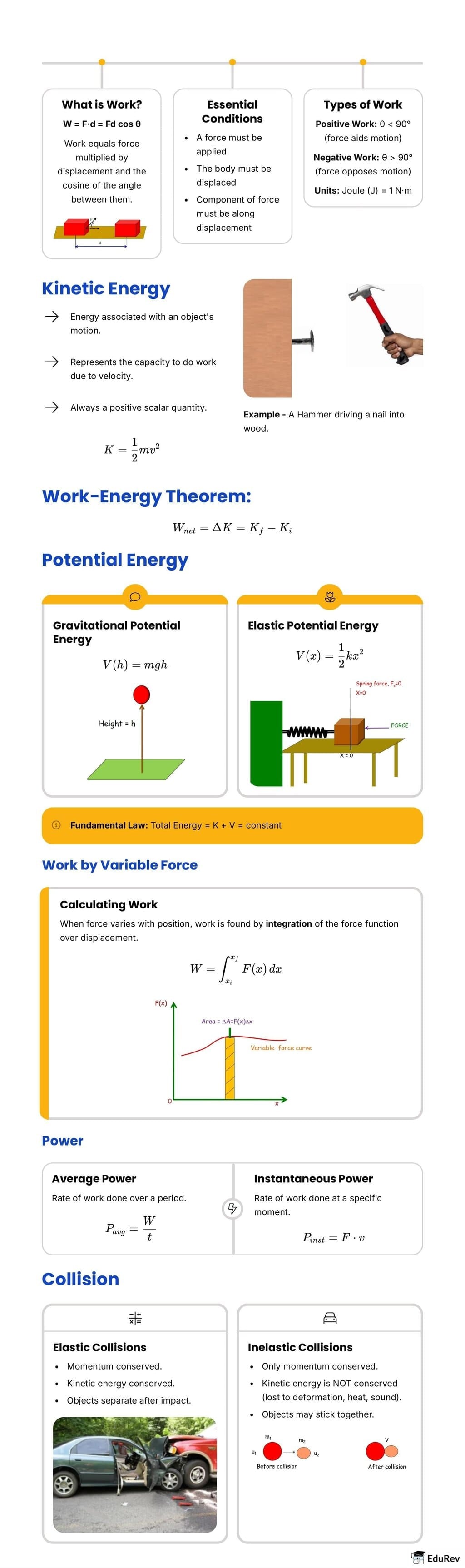
The document Infographic: Work, Energy and Power is a part of the JEE Course Physics for JEE Main & Advanced.
All you need of JEE at this link: JEE
FAQs on Infographic: Work, Energy and Power
| 1. What is the relationship between work, energy, and power in physics? |  |
Ans. Work, energy, and power are fundamental concepts in physics that are closely related. Work is defined as the transfer of energy that occurs when a force is applied over a distance. Energy is the capacity to do work, and it can exist in various forms such as kinetic energy, potential energy, thermal energy, etc. Power, on the other hand, is the rate at which work is done or energy is transferred over time. It is calculated as Power = Work / Time. In summary, work involves energy transfer, and power quantifies how quickly that transfer occurs.
| 2. How is mechanical work calculated in different scenarios? | |
Ans. Mechanical work can be calculated using the formula Work = Force × Distance × cos(θ), where Force is the applied force, Distance is the displacement of the object, and θ is the angle between the force and the direction of displacement. In scenarios where the force is applied in the same direction as the displacement (θ = 0°), the formula simplifies to Work = Force × Distance. If the force is applied at an angle, the cosine component accounts for the direction of the force relative to the movement.
| 3. What are the units of work, energy, and power, and how are they related? | |
Ans. The SI unit of work and energy is the joule (J), which is defined as the amount of work done when a force of one newton displaces an object by one meter in the direction of the force. The unit of power is the watt (W), which is equal to one joule per second (1 W = 1 J/s). Therefore, the relationship can be summarized as follows: 1 watt equals the rate of doing 1 joule of work in 1 second, highlighting how power quantifies the speed of energy transfer or work done.
| 4. What is the principle of conservation of energy? | |
Ans. The principle of conservation of energy states that energy cannot be created or destroyed; it can only be transformed from one form to another. In any closed system, the total amount of energy remains constant over time. For example, when potential energy is converted to kinetic energy during free fall, the total energy of the system remains unchanged. This principle is fundamental in physics and underlies many concepts in mechanics and thermodynamics.
| 5. How do potential energy and kinetic energy differ in a system? | |
Ans. Potential energy and kinetic energy are two primary forms of mechanical energy in a system. Potential energy is the energy stored in an object due to its position or configuration, such as gravitational potential energy, which depends on the height of an object above the ground (Potential Energy = mgh, where m is mass, g is gravitational acceleration, and h is height). Kinetic energy, on the other hand, is the energy of an object in motion and is calculated using the formula Kinetic Energy = 1/2 mv², where m is mass and v is velocity. The key difference lies in the fact that potential energy relates to an object's position, while kinetic energy relates to its motion.
About this Document

4.91/5 Rating

Apr 19, 2026 Last updated
Document Description: Infographic: Work, Energy and Power for JEE 2026 is part of Physics for JEE Main & Advanced preparation. The notes and questions for Infographic: Work, Energy and Power have been prepared according to the JEE exam syllabus. Information about Infographic: Work, Energy and Power covers topics like and Infographic: Work, Energy and Power Example, for JEE 2026 Exam. Find important definitions, questions, notes, meanings, examples, exercises and tests below for Infographic: Work, Energy and Power.
Introduction of Infographic: Work, Energy and Power in English is available as part of our Physics for JEE Main & Advanced for JEE & Infographic: Work, Energy and Power in Hindi for Physics for JEE Main & Advanced course. Download more important topics related with notes, lectures and mock test series for JEE Exam by signing up for free. JEE: Infographic: Work, Energy and Power
Description
Infographic: Work, Energy & Power of Physics provides you one-page visual summary of the chapter covering all the important topics. Download the PDF from EduRev.
Information about Infographic: Work, Energy and Power
In this doc you can find the meaning of Infographic: Work, Energy and Power defined & explained in the simplest way possible. Besides explaining types of Infographic: Work, Energy and Power theory, EduRev gives you an ample number of questions to practice Infographic: Work, Energy and Power tests, examples and also practice JEE tests



Related Searches
Semester Notes, Energy and Power, study material, Infographic: Work, Infographic: Work, practice quizzes, Viva Questions, Objective type Questions, MCQs, Previous Year Questions with Solutions, Important questions, ppt, Summary, past year papers, Energy and Power, Energy and Power, Free, Extra Questions, Sample Paper, Exam, shortcuts and tricks, Infographic: Work, pdf , video lectures, mock tests for examination;