Electrical Engineering (EE) Exam > Electrical Engineering (EE) Notes > Electrical Machines > Mind Map: Synchronous Machines
Mind Map: Synchronous Machines

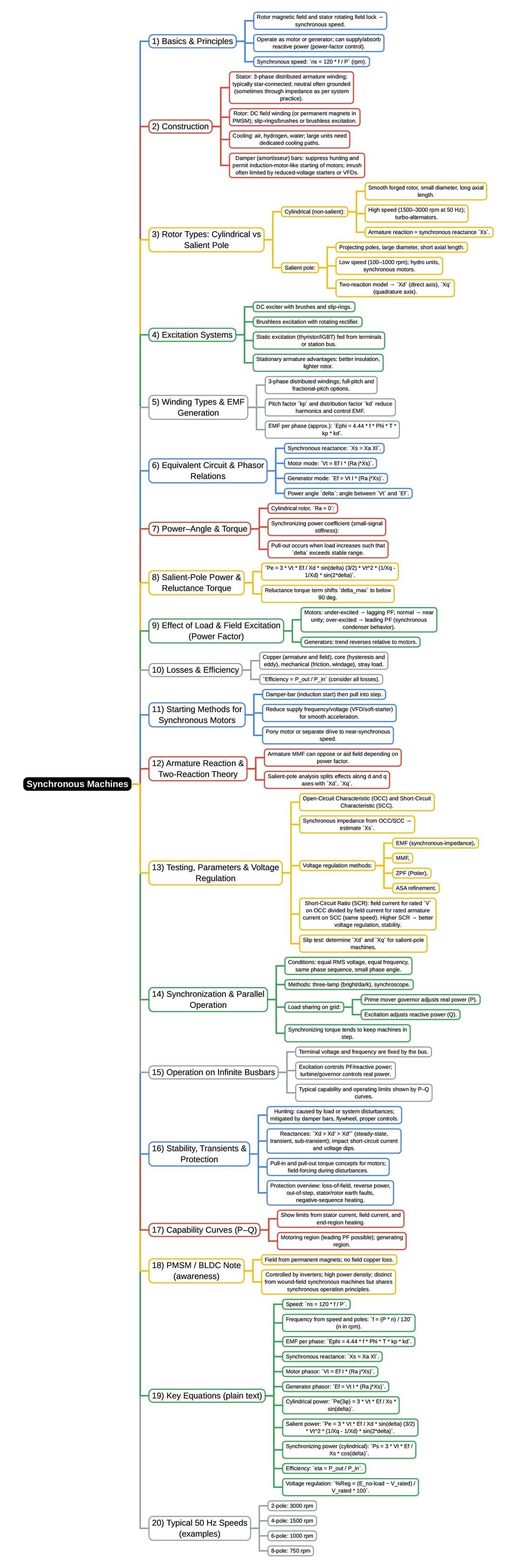
The document Mind Map: Synchronous Machines is a part of the Electrical Engineering (EE) Course Electrical Machines.
All you need of Electrical Engineering (EE) at this link: Electrical Engineering (EE)
FAQs on Mind Map: Synchronous Machines
| 1. What are the main components of a synchronous machine? |  |
Ans. A synchronous machine primarily consists of a stator, rotor, and excitation system. The stator is the stationary part that generates the magnetic field, while the rotor, which can be either salient-pole or non-salient-pole, rotates within the stator's magnetic field. The excitation system supplies the necessary current to the rotor winding to create a magnetic field that interacts with the stator field.
| 2. How does a synchronous machine operate in synchronization with the grid? | |
Ans. A synchronous machine operates in synchronization with the grid by maintaining a constant speed that corresponds to the frequency of the electrical grid. The rotor's magnetic field locks in with the rotating magnetic field of the stator, allowing the machine to produce electricity at the same frequency as the grid. This synchronization ensures efficient power generation and stability in the electrical system.
| 3. What are the advantages of using synchronous machines over induction machines? | |
Ans. Synchronous machines offer several advantages over induction machines, such as higher efficiency, better power factor control, and the ability to operate at a constant speed regardless of load variations. They also provide reactive power support to the grid, which is essential for voltage regulation, making them suitable for various applications in power systems.
| 4. What is the role of the excitation system in a synchronous machine? | |
Ans. The excitation system in a synchronous machine is crucial as it provides the necessary direct current (DC) to the rotor winding, creating a magnetic field. This magnetic field interacts with the stator's alternating magnetic field, enabling the machine to generate electricity. The excitation system also regulates the output voltage and stabilizes the machine's operation under varying load conditions.
| 5. How is the performance of synchronous machines evaluated? | |
Ans. The performance of synchronous machines is evaluated based on several parameters including efficiency, power factor, voltage regulation, and load capability. Tests such as synchronous speed tests, efficiency tests, and load tests are conducted to assess these parameters. Additionally, performance curves and characteristics are analyzed to determine how the machine operates under different loads and conditions.
About this Document

4.64/5 Rating

Apr 19, 2026 Last updated
Related Exams
Document Description: Mind Map: Synchronous Machines for Electrical Engineering (EE) 2026 is part of Electrical Machines preparation. The notes and questions for Mind Map: Synchronous Machines have been prepared according to the Electrical Engineering (EE) exam syllabus. Information about Mind Map: Synchronous Machines covers topics like and Mind Map: Synchronous Machines Example, for Electrical Engineering (EE) 2026 Exam. Find important definitions, questions, notes, meanings, examples, exercises and tests below for Mind Map: Synchronous Machines.
Introduction of Mind Map: Synchronous Machines in English is available as part of our Electrical Machines for Electrical Engineering (EE) & Mind Map: Synchronous Machines in Hindi for Electrical Machines course. Download more important topics related with notes, lectures and mock test series for Electrical Engineering (EE) Exam by signing up for free. Electrical Engineering (EE): Mind Map: Synchronous Machines
Description
Mind Map: Synchronous Machines of Electrical Machines provides you one-page visual summary of the chapter covering all the important topics. Download the PDF from EduRev.
Information about Mind Map: Synchronous Machines
In this doc you can find the meaning of Mind Map: Synchronous Machines defined & explained in the simplest way possible. Besides explaining types of Mind Map: Synchronous Machines theory, EduRev gives you an ample number of questions to practice Mind Map: Synchronous Machines tests, examples and also practice Electrical Engineering (EE) tests
 | Explore Courses for Electrical Engineering (EE) exam |  |
 | Get EduRev Notes directly in your Google search | |
Related Searches
Extra Questions, shortcuts and tricks, Mind Map: Synchronous Machines, Sample Paper, MCQs, Semester Notes, mock tests for examination, Viva Questions, video lectures, Mind Map: Synchronous Machines, past year papers, Previous Year Questions with Solutions, Objective type Questions, ppt, Mind Map: Synchronous Machines, Summary, pdf , study material, Free, Exam, practice quizzes, Important questions;