Computer Science Engineering (CSE) Exam > Computer Science Engineering (CSE) Notes > Algorithms > Mind Map: Asymptotic Analysis of Algorithms
Mind Map: Asymptotic Analysis of Algorithms

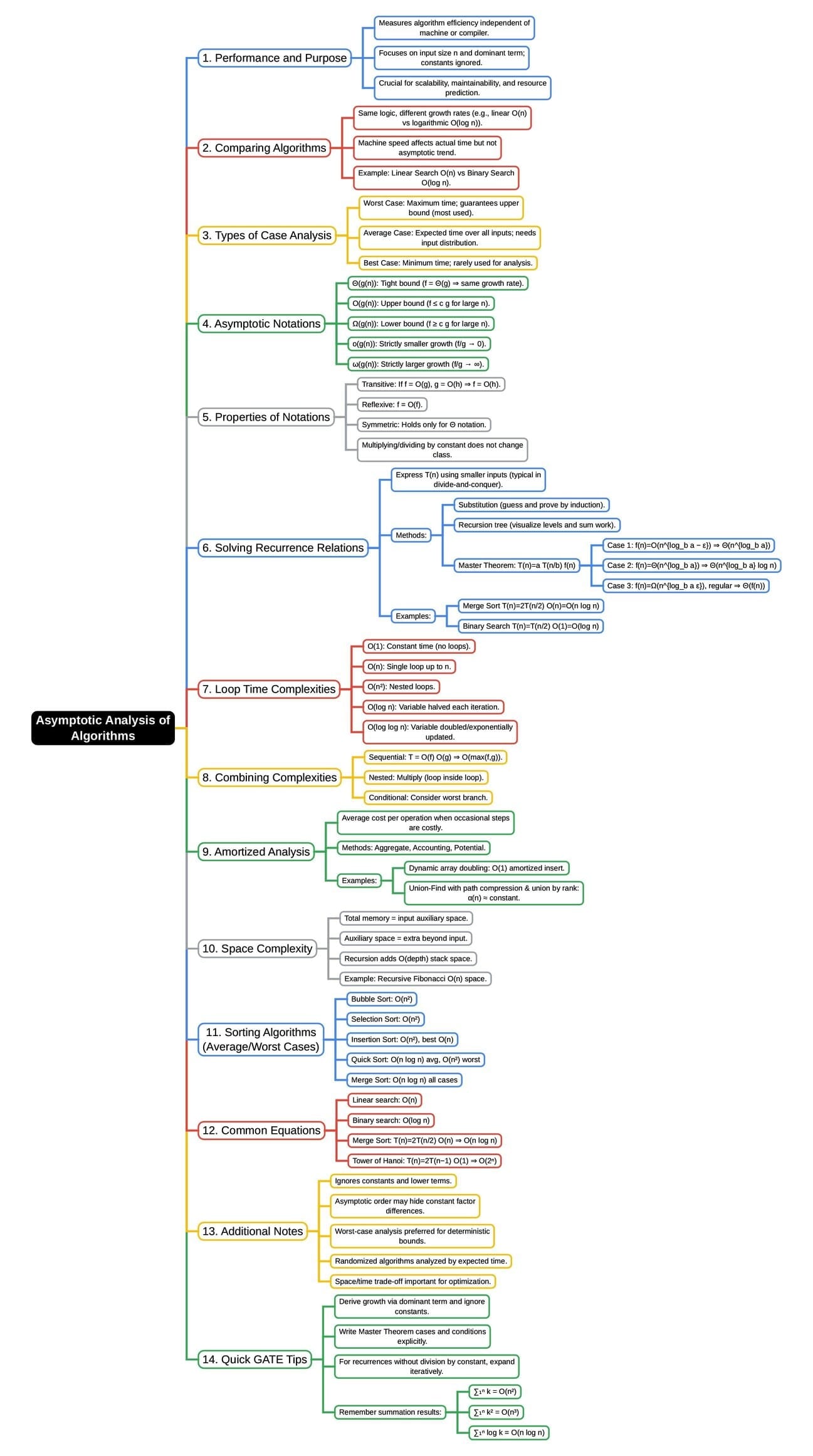
The document Mind Map: Asymptotic Analysis of Algorithms is a part of the Computer Science Engineering (CSE) Course Algorithms.
All you need of Computer Science Engineering (CSE) at this link: Computer Science Engineering (CSE)
FAQs on Mind Map: Asymptotic Analysis of Algorithms
| 1. What is asymptotic analysis and why is it important in computer science? |  |
Ans. Asymptotic analysis is a method used to describe the running time or space requirements of an algorithm in relation to the size of the input. It provides a way to compare the efficiency of different algorithms by focusing on their behavior as the input size approaches infinity. This type of analysis is important in computer science because it helps in understanding the limitations of algorithms, aiding in the selection of the most efficient algorithm for a given problem.
| 2. What are the different notations used in asymptotic analysis? | |
Ans. The three primary notations used in asymptotic analysis are Big O notation, Omega notation, and Theta notation. Big O notation (O) describes the upper bound of an algorithm's running time, indicating the worst-case scenario. Omega notation (Ω) provides a lower bound, representing the best-case scenario, and Theta notation (Θ) characterizes a tight bound, meaning the algorithm's running time is both upper and lower bounded by the same function.
| 3. How do you determine the time complexity of an algorithm? | |
Ans. To determine the time complexity of an algorithm, you analyze the algorithm's code to identify the number of operations it performs as a function of the input size. This usually involves examining loops, recursive calls, and conditional statements. By estimating the maximum number of operations for the largest input size, you can express the time complexity using asymptotic notation, typically identifying the most significant term that dominates the growth rate as the input size increases.
| 4. Can you explain the difference between average case, worst case, and best case analyses? | |
Ans. The worst-case analysis considers the maximum time an algorithm can take for any input of a given size, providing a guarantee of performance under the least favorable conditions. The best-case analysis examines the minimum time taken for the most favorable input, while the average-case analysis computes the expected time based on all possible inputs and their probabilities. Understanding these cases helps in evaluating algorithm performance comprehensively.
| 5. What is the significance of polynomial time complexity in algorithms? | |
Ans. Polynomial time complexity, represented as O(n^k) where k is a constant, is significant because it indicates that an algorithm's running time grows at a manageable rate relative to the input size. Algorithms with polynomial time complexity are considered efficient and feasible for practical use, as opposed to exponential time complexities, which can become impractical even for relatively small input sizes.
About this Document

4.61/5 Rating

Apr 30, 2026 Last updated
Related Exams
Document Description: Mind Map: Asymptotic Analysis of Algorithms for Computer Science Engineering (CSE) 2026 is part of Algorithms preparation. The notes and questions for Mind Map: Asymptotic Analysis of Algorithms have been prepared according to the Computer Science Engineering (CSE) exam syllabus. Information about Mind Map: Asymptotic Analysis of Algorithms covers topics like and Mind Map: Asymptotic Analysis of Algorithms Example, for Computer Science Engineering (CSE) 2026 Exam. Find important definitions, questions, notes, meanings, examples, exercises and tests below for Mind Map: Asymptotic Analysis of Algorithms.
Introduction of Mind Map: Asymptotic Analysis of Algorithms in English is available as part of our Algorithms for Computer Science Engineering (CSE) & Mind Map: Asymptotic Analysis of Algorithms in Hindi for Algorithms course. Download more important topics related with notes, lectures and mock test series for Computer Science Engineering (CSE) Exam by signing up for free. Computer Science Engineering (CSE): Mind Map: Asymptotic Analysis of Algorithms
Description
Mind Map: Asymptotic Analysis of Algorithms of Algorithms provides you one-page visual summary of the chapter covering all the important topics. Download the PDF from EduRev.
Information about Mind Map: Asymptotic Analysis of Algorithms
In this doc you can find the meaning of Mind Map: Asymptotic Analysis of Algorithms defined & explained in the simplest way possible. Besides explaining types of Mind Map: Asymptotic Analysis of Algorithms theory, EduRev gives you an ample number of questions to practice Mind Map: Asymptotic Analysis of Algorithms tests, examples and also practice Computer Science Engineering (CSE) tests
 | Explore Courses for Computer Science Engineering (CSE) exam |  |
 | Get EduRev Notes directly in your Google search | |
Related Searches
Sample Paper, Important questions, pdf , Mind Map: Asymptotic Analysis of Algorithms, study material, Exam, shortcuts and tricks, practice quizzes, Mind Map: Asymptotic Analysis of Algorithms, Previous Year Questions with Solutions, Free, past year papers, Extra Questions, Mind Map: Asymptotic Analysis of Algorithms, video lectures, Objective type Questions, Semester Notes, mock tests for examination, ppt, Summary, Viva Questions, MCQs;