Electronics and Communication Engineering (ECE) Exam > Electronics and Communication Engineering (ECE) Notes > Digital Circuits > Mind Map: Encoders & Decoders
Mind Map: Encoders & Decoders

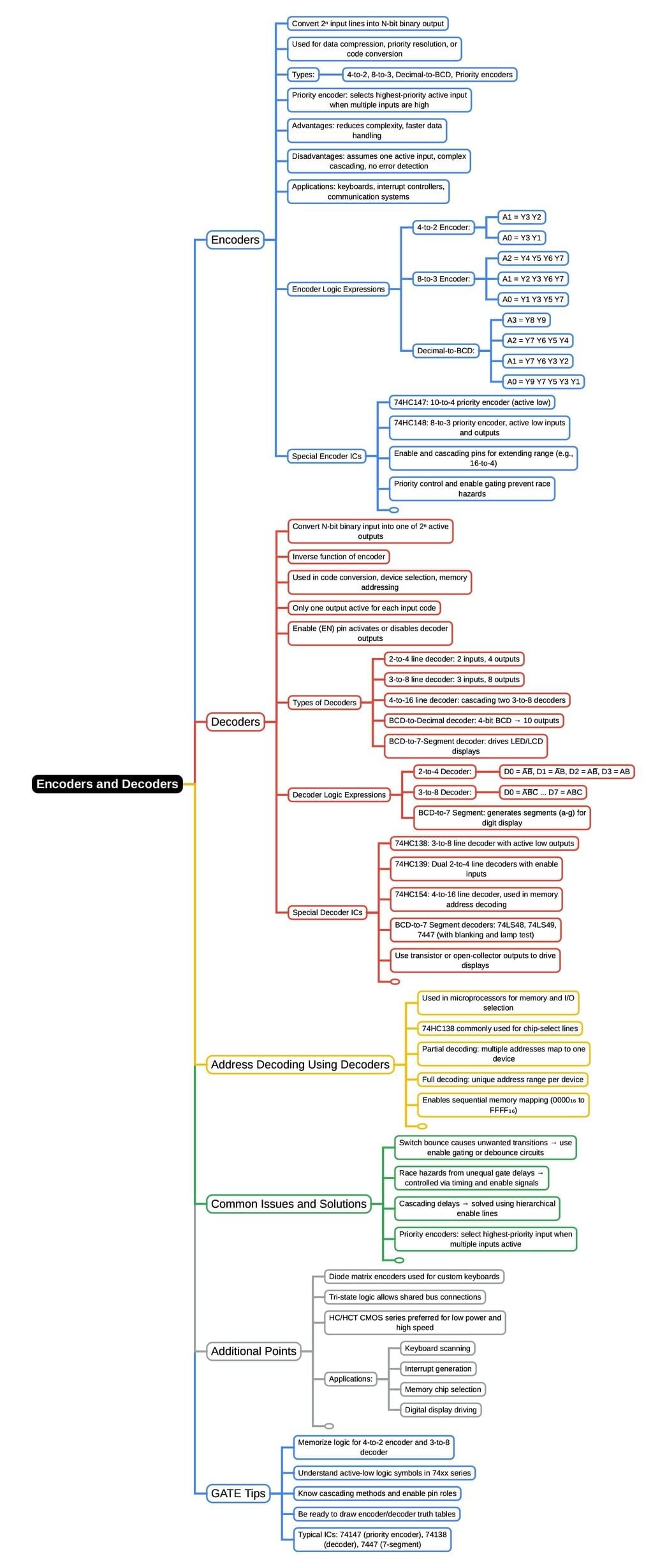
The document Mind Map: Encoders & Decoders is a part of the Electronics and Communication Engineering (ECE) Course Digital Circuits.
All you need of Electronics and Communication Engineering (ECE) at this link: Electronics and Communication Engineering (ECE)
FAQs on Mind Map: Encoders & Decoders
| 1. What is the basic difference between encoders and decoders in electronics? |  |
Ans. Encoders are devices that convert information from one format to another, often from analog signals to digital codes, while decoders perform the reverse operation, converting coded data back into its original format. Encoders reduce the number of bits needed to represent data, while decoders reconstruct the original information from the encoded data.
| 2. Can you explain the different types of encoders used in communication systems? | |
Ans. There are several types of encoders used in communication systems, including binary encoders, priority encoders, and rotary encoders. Binary encoders convert multiple input lines into fewer output lines representing the binary value of the active input. Priority encoders determine which input line is highest in priority when multiple inputs are active. Rotary encoders are used to convert the angular position of a shaft into an analog or digital code.
| 3. What are some common applications of decoders in electronic systems? | |
Ans. Decoders are widely used in various applications, such as memory address decoding in computer architecture, data demultiplexing, and digital display systems. They are crucial in enabling devices to interpret binary-coded information, allowing for tasks such as selecting specific memory locations or displaying information on LED or LCD screens.
| 4. How does a 2-to-4 line decoder function, and what is its truth table? | |
Ans. A 2-to-4 line decoder takes 2 input lines and decodes them into 4 output lines, where only one output line is activated based on the binary value of the inputs. The truth table for a 2-to-4 decoder is as follows: | Input A | Input B | Output 0 | Output 1 | Output 2 | Output 3 | |---------|---------|----------|----------|----------|----------| | 0 | 0 | 1 | 0 | 0 | 0 | | 0 | 1 | 0 | 1 | 0 | 0 | | 1 | 0 | 0 | 0 | 1 | 0 | | 1 | 1 | 0 | 0 | 0 | 1 |
| 5. What role do encoders and decoders play in digital communication systems? | |
Ans. In digital communication systems, encoders and decoders are essential for data transmission and reception. Encoders compress and encode data for efficient transmission, minimizing bandwidth usage while maintaining data integrity. Decoders then interpret the received signals, converting them back to the original data format, thus ensuring accurate communication between devices.
About this Document

4.75/5 Rating

Apr 18, 2026 Last updated
Related Exams
Document Description: Mind Map: Encoders & Decoders for Electronics and Communication Engineering (ECE) 2026 is part of Digital Circuits preparation. The notes and questions for Mind Map: Encoders & Decoders have been prepared according to the Electronics and Communication Engineering (ECE) exam syllabus. Information about Mind Map: Encoders & Decoders covers topics like and Mind Map: Encoders & Decoders Example, for Electronics and Communication Engineering (ECE) 2026 Exam. Find important definitions, questions, notes, meanings, examples, exercises and tests below for Mind Map: Encoders & Decoders.
Introduction of Mind Map: Encoders & Decoders in English is available as part of our Digital Circuits for Electronics and Communication Engineering (ECE) & Mind Map: Encoders & Decoders in Hindi for Digital Circuits course. Download more important topics related with notes, lectures and mock test series for Electronics and Communication Engineering (ECE) Exam by signing up for free. Electronics and Communication Engineering (ECE): Mind Map: Encoders & Decoders
Description
Mind Map: Encoders & Decoders of Digital Circuits provides you one-page visual summary of the chapter covering all the important topics. Download the PDF from EduRev.
Information about Mind Map: Encoders & Decoders
In this doc you can find the meaning of Mind Map: Encoders & Decoders defined & explained in the simplest way possible. Besides explaining types of Mind Map: Encoders & Decoders theory, EduRev gives you an ample number of questions to practice Mind Map: Encoders & Decoders tests, examples and also practice Electronics and Communication Engineering (ECE) tests
 | Explore Courses for Electronics and Communication Engineering (ECE) exam |  |
 | Get EduRev Notes directly in your Google search | |
Related Searches
Semester Notes, ppt, Important questions, shortcuts and tricks, pdf , Mind Map: Encoders & Decoders, past year papers, Summary, Sample Paper, MCQs, practice quizzes, Objective type Questions, Mind Map: Encoders & Decoders, Exam, Mind Map: Encoders & Decoders, Previous Year Questions with Solutions, study material, mock tests for examination, Viva Questions, Free, Extra Questions, video lectures;