Electronics and Communication Engineering (ECE) Exam > Electronics and Communication Engineering (ECE) Notes > Electronic Devices > Mind Map: Field Effect Transistor (FET)
Mind Map: Field Effect Transistor (FET)

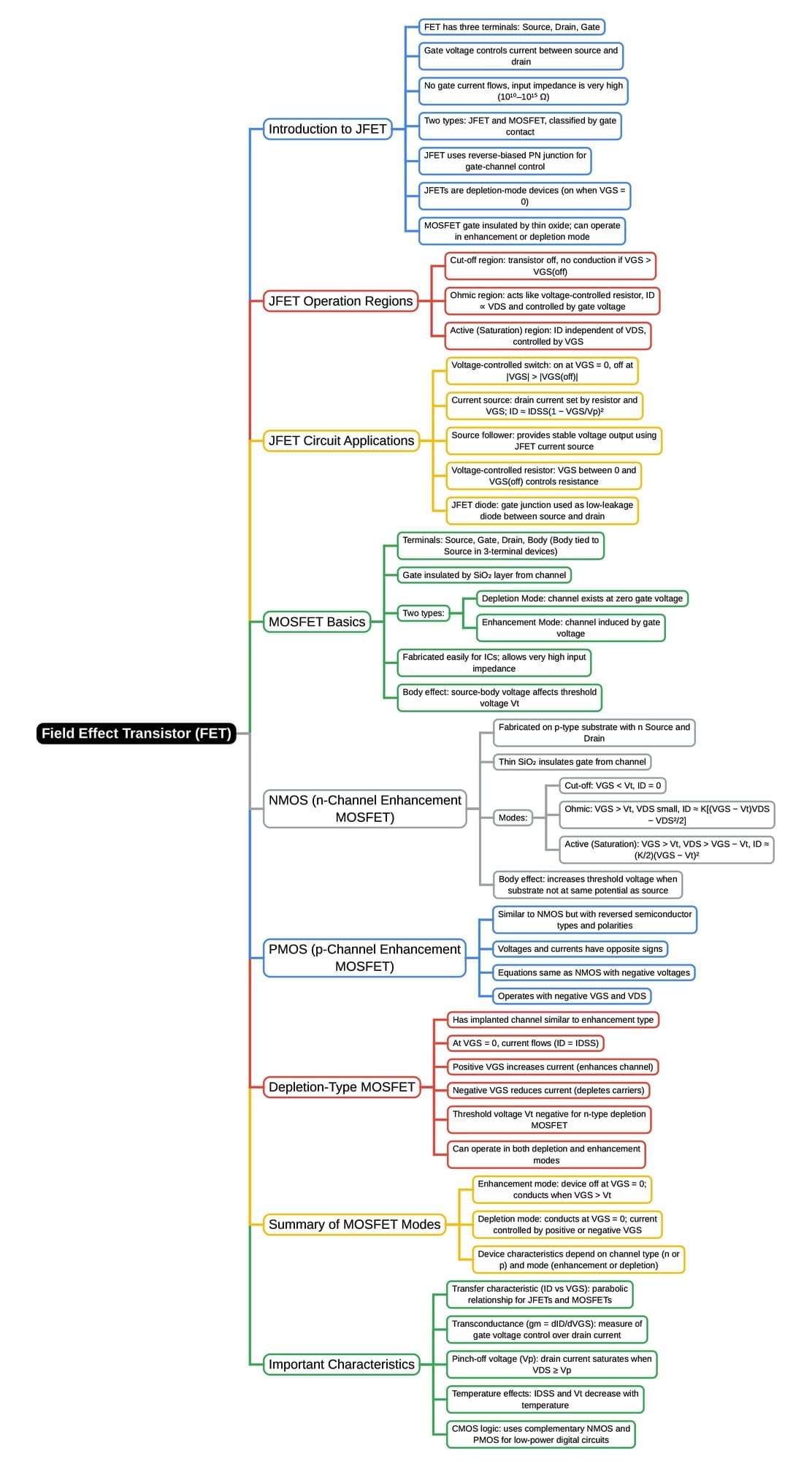
The document Mind Map: Field Effect Transistor (FET) is a part of the Electronics and Communication Engineering (ECE) Course Electronic Devices.
All you need of Electronics and Communication Engineering (ECE) at this link: Electronics and Communication Engineering (ECE)
FAQs on Mind Map: Field Effect Transistor (FET)
| 1. What is a Field Effect Transistor (FET) and how does it work? |  |
Ans. A Field Effect Transistor (FET) is a type of transistor that controls the flow of current using an electric field. It consists of three terminals: the source, drain, and gate. The voltage applied to the gate terminal creates an electric field that influences the conductivity of a semiconductor channel between the source and drain. When a voltage is applied to the gate, it either enhances or depletes the flow of charge carriers (electrons or holes) in the channel, thus controlling the output current. FETs are essential in various electronic applications, including amplifiers and switches.
| 2. What are the different types of FETs? | |
Ans. The primary types of Field Effect Transistors include Junction FET (JFET) and Metal-Oxide-Semiconductor FET (MOSFET). JFETs use a p-n junction to control the current flow and can be either n-channel or p-channel based on the type of semiconductor used. MOSFETs, on the other hand, utilize an insulating layer of oxide between the gate and the channel, allowing for higher input impedance and better performance in digital circuits. Additionally, there are variations like enhancement-mode and depletion-mode MOSFETs, which differ in their operational characteristics.
| 3. What are the key advantages of using FETs in electronic circuits? | |
Ans. FETs offer several advantages in electronic circuits, including high input impedance, low power consumption, and reduced noise. The high input impedance allows them to draw minimal current from preceding stages, making them ideal for use in sensitive applications such as amplifiers. Moreover, FETs can operate at high speeds and are less susceptible to thermal runaway compared to bipolar junction transistors (BJTs). These characteristics make FETs suitable for various applications, including RF amplifiers, analog switches, and digital circuits.
| 4. How is a MOSFET different from a BJT in terms of operation? | |
Ans. A MOSFET (Metal-Oxide-Semiconductor Field Effect Transistor) and a BJT (Bipolar Junction Transistor) operate differently due to their distinct structures and mechanisms. A MOSFET is voltage-controlled, where the gate voltage determines the channel conductivity, while a BJT is current-controlled, where the base current influences the collector-emitter current. Additionally, MOSFETs have higher input impedance and lower power consumption compared to BJTs, making them more efficient for digital applications. However, BJTs are often preferred in analog applications due to their superior linearity.
| 5. What are some common applications of FETs in Electronics and Communication Engineering? | |
Ans. FETs are widely used in Electronics and Communication Engineering for various applications. Common uses include amplifiers in audio and radio frequency (RF) applications, voltage-controlled resistors, and analog switches. In digital circuits, MOSFETs are fundamental components for constructing logic gates and memory devices due to their fast switching capabilities. FETs are also utilized in signal processing, modulation, and demodulation circuits, as well as in integrated circuits for improved performance and efficiency.
About this Document

4.75/5 Rating

Apr 21, 2026 Last updated
Related Exams
Document Description: Mind Map: Field Effect Transistor (FET) for Electronics and Communication Engineering (ECE) 2026 is part of Electronic Devices preparation. The notes and questions for Mind Map: Field Effect Transistor (FET) have been prepared according to the Electronics and Communication Engineering (ECE) exam syllabus. Information about Mind Map: Field Effect Transistor (FET) covers topics like and Mind Map: Field Effect Transistor (FET) Example, for Electronics and Communication Engineering (ECE) 2026 Exam. Find important definitions, questions, notes, meanings, examples, exercises and tests below for Mind Map: Field Effect Transistor (FET).
Introduction of Mind Map: Field Effect Transistor (FET) in English is available as part of our Electronic Devices for Electronics and Communication Engineering (ECE) & Mind Map: Field Effect Transistor (FET) in Hindi for Electronic Devices course. Download more important topics related with notes, lectures and mock test series for Electronics and Communication Engineering (ECE) Exam by signing up for free. Electronics and Communication Engineering (ECE): Mind Map: Field Effect Transistor (FET)
Description
Mind Map: Field Effect Transistor (FET) of Electronic Devices provides you one-page visual summary of the chapter covering all the important topics. Download the PDF from EduRev.
Information about Mind Map: Field Effect Transistor (FET)
In this doc you can find the meaning of Mind Map: Field Effect Transistor (FET) defined & explained in the simplest way possible. Besides explaining types of Mind Map: Field Effect Transistor (FET) theory, EduRev gives you an ample number of questions to practice Mind Map: Field Effect Transistor (FET) tests, examples and also practice Electronics and Communication Engineering (ECE) tests
 | Explore Courses for Electronics and Communication Engineering (ECE) exam |  |
 | Get EduRev Notes directly in your Google search | |
Related Searches
Extra Questions, Sample Paper, Semester Notes, Important questions, Previous Year Questions with Solutions, video lectures, Mind Map: Field Effect Transistor (FET), mock tests for examination, pdf , Summary, MCQs, Objective type Questions, study material, ppt, Viva Questions, Exam, shortcuts and tricks, past year papers, Free, practice quizzes, Mind Map: Field Effect Transistor (FET), Mind Map: Field Effect Transistor (FET);