UGC NET Paper 2: Commerce 27th June 2025 Shift 1

Q1: Which of the following is NOT the feature of business environment?
(a) Complex
(b) Dynamic
(c) Multi faceted
(d) Static
Ans: D
Key Points
- Business environment refers to the external and internal factors that influence business operations.
- The following features characterize the business environment:
- Complex: It consists of various interrelated and interdependent factors such as economic, political, social, and technological aspects.
- Dynamic: The business environment constantly changes due to evolving market trends, policies, and technologies.
- Multi-faceted: It is perceived differently by different organizations based on their operational areas and perspectives.
- Static: This is NOT a feature of the business environment because it is ever-changing and never remains constant.
- Therefore, the correct answer is Static, as it does not align with the dynamic nature of business environments.
Additional Information
- Importance of understanding the business environment:
- Helps businesses identify opportunities and threats.
- Aids in strategic planning and decision-making.
- Assists in adapting to changes in external factors such as government policies and market trends.
- Components of the business environment:
- Economic environment: Includes inflation, interest rates, and economic growth.
- Political environment: Government policies, regulations, and political stability.
- Technological environment: Innovations, automation, and advancements in technology.
- Social environment: Cultural values, social norms, and demographic factors.
- Examples of dynamic changes in the business environment:
- Adoption of digital payment systems due to technological advancements.
- Policy changes such as the implementation of GST (Goods and Services Tax).
- Shifts in consumer preferences towards sustainable and eco-friendly products.
Q2: Which of the following Ind AS specifically deals with consolidated financial statements?
(a) Ind AS 29
(b) Ind AS 101
(c) Ind AS 110
(d) Ind AS 41
Ans: C
Key Points
- Ind AS 110
- Ind AS 110 specifically addresses the principles for the presentation and preparation of consolidated financial statements.
- The standard applies when an entity controls one or more other entities (subsidiaries) and is required to prepare consolidated financial statements.
- It establishes the definition of control as the basis for consolidation, which requires:
- Power over the investee.
- Exposure or rights to variable returns from involvement with the investee.
- Ability to use power to affect the amount of returns.
- Ind AS 110 replaces the previous concept of consolidation under Ind AS 27.
Additional Information
- Ind AS 29
- This standard deals with financial reporting in hyperinflationary economies.
- It is not related to consolidated financial statements and is applicable in specific economic conditions.
- Ind AS 101
- Focuses on first-time adoption of Indian Accounting Standards.
- It provides transition guidance for entities moving to Ind AS for the first time.
- Ind AS 41
- Relates to agriculture, including biological assets and agricultural produce.
- It is not relevant to the preparation of consolidated financial statements.
Q3: What is the Harmonic Mean of two numbers whose Arithmetic Mean and Geometric Mean are 30 and 24 respectively?
(a) 4.8
(b) 9.6
(c) 19.2
(d) 76.8
Ans: C
Key Points
- Harmonic Mean (HM) is calculated using the formula:
- HM = (2 × a × b) / (a + b), where a and b are the two numbers.
- We are given:
- Arithmetic Mean (AM) = 30, which means: (a + b)/2 = 30.
- Geometric Mean (GM) = 24, which means: √(a × b) = 24.
- Solving these equations:
- a + b = 60 (from AM).
- a × b = 576 (from GM).
- Substitute the values of a + b and a × binto the HM formula:
- HM = (2 × 576) / 60.
- HM = 1152 / 60 = 19.2.
Additional Information
- Arithmetic Mean (AM):
- It is the sum of two numbers divided by 2: AM = (a + b)/2.
- AM is always greater than or equal to the Geometric Mean (GM) for non-negative numbers.
- Geometric Mean (GM):
- It is the square root of the product of two numbers: GM = √(a × b).
- GM is always less than or equal to the Arithmetic Mean (AM).
- Harmonic Mean (HM):
- It is calculated as: HM = (2 × a × b) / (a + b).
- For non-negative numbers, HM ≤ GM ≤ AM.
- Relationship between AM, GM, and HM:
- The inequality AM ≥ GM ≥ HM holds for any two positive numbers.
- This relationship is known as the AM-GM-HM inequality.
Q4: An unsecured short term promissory note, negotiable and transferable by endorsement and delivery with a fixed maturity period, issued at a discount by creditworthy corporates, primary dealers and all-India financial institutions is known as:
(a) Treasury Bill
(b) Commercial Paper
(c) Certificates of Deposit
(d) Repo
Ans: B
Key Points
- Commercial Paper (CP):
- A short-term, unsecured promissory note issued by creditworthy corporates, primary dealers, and financial institutions.
- Issued at a discount to face value and is negotiable and transferable by endorsement and delivery.
- Has a fixed maturity period ranging from 7 days to 1 year.
- Used as a tool for short-term financing to meet working capital requirements.
- Commercial Paper is an alternative to other instruments like Treasury Bills and Certificates of Deposit.
Additional Information
- Comparison with Other Instruments:
- Treasury Bills (T-Bills)
- Issued by the Government of India, making them a risk-free investment.
- Have maturities of 91 days, 182 days, and 364 days.
- Certificates of Deposit (CDs)
- Issued by banks and financial institutions as a time deposit.
- Have a fixed tenure, typically ranging from 7 days to 1 year.
- Repo (Repurchase Agreement)
- A secured short-term borrowing instrument involving the sale and repurchase of securities.
- Primarily used by banks and financial institutions.
- Treasury Bills (T-Bills)
- Regulations and Eligibility
- Corporates must meet credit rating requirements to issue Commercial Paper.
- Governed by the guidelines of the Reserve Bank of India (RBI).
Q5: Arrange the following stages of Adoption process in correct order:
A. Interest
B. Awareness
C. Trial
D. Evaluation
E. Adoption
Choose the correct answer from the options given below:
(a) A, D, C, B, E
(b) A, B, C, D, E
(c) B, C, A, E, D
(d) B, A, D, C, E
Ans: D
Key Points
- Stages of the Adoption Process
- B - Awareness: This is the first stage where individuals become aware of the product or innovation but lack detailed information about it.
- A - Interest: In this stage, the individual develops an interest and seeks more information about the product.
- D - Evaluation: Here, the individual evaluates the product's advantages and disadvantages to determine its suitability.
- C - Trial: The individual tries or tests the product on a limited basis to assess its utility or value.
- E - Adoption: Finally, the individual decides to fully adopt or reject the product based on their experience and evaluation.
- The correct sequence B, A, D, C, E aligns with the natural progression of human decision-making during the adoption process.
Additional Information
- Key Concepts in the Adoption Process
- The adoption process is a series of mental and behavioral stages that an individual goes through when considering a new product or innovation.
- It is commonly used in marketing and consumer behavior studies to understand how consumers make purchasing decisions.
- Factors Influencing Adoption
- Innovativeness: The degree to which an individual is open to trying new ideas or products.
- Social Influence: Recommendations, reviews, and social norms can impact the adoption process.
- Product Characteristics: Features such as relative advantage, compatibility, complexity, trialability, and observability play a significant role.
- Examples of the Adoption Process
- Introduction of a new smartphone model.
- Adoption of innovative technologies like electric vehicles or solar panels.
Q6: Match the LIST-I with LIST-II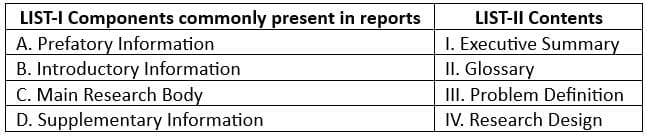
(a) A-I, B-II, C-III, D-IV
(b) А-II, В-I, C-IV, D-III
(c) A-I, B-III, C-II, D-IV
(d) A-I, B-III, C-IV, D-II
Ans: D
Key Points
- Matching LIST-I with LIST-II
- Prefatory Information (A) corresponds to Executive Summary (I) because it provides a concise overview of the report before diving into details.
- Introductory Information (B) matches with Problem Definition (III) as it sets the context and outlines the key issue being addressed.
- Main Research Body (C) aligns with Research Design (IV), which outlines the methodology and findings of the research.
- Supplementary Information (D) is linked to Glossary (II), which provides additional details such as definitions or explanations for key terms.
- The correct answer option is 4 based on the logical alignment of the components in LIST-I with their respective contents in LIST-II.
Additional Information
- Prefatory Information
- Includes elements like the title page, acknowledgments, and executive summary.
- Designed to offer a high-level overview for readers who may not read the entire report.
- Introductory Information
- Defines the problem statement and the objectives of the research.
- Provides clarity on the scope and purpose of the report.
- Main Research Body
- Focuses on the methodology, including research design, data collection, and analysis.
- Forms the core of the report, presenting detailed findings and interpretations.
- Supplementary Information
- Includes materials like appendices, glossaries, and references.
- Supports the main content by providing additional context or clarifications.
Q7: A company produces and sells 10,000 toys. The selling price per toy is ₹500, variable cost is 200 per unit and fixed operating cost is ₹25,00,000. Calculate operating Leverage.
(a) 4 times
(b) 5 times
(c) 6 times
(d) 8 times
Ans: C
Key Points
- Operating Leverage:
- It measures the impact of a percentage change in sales on the operating income of a company.
- The formula to calculate operating leverage is:
Operating Leverage = Contribution ÷ Operating Profit.
- Calculation:
- Contribution per unit: Selling Price per unit - Variable Cost per unit = ₹500 - ₹200 = ₹300.
- Total Contribution: Contribution per unit × Total units sold = ₹300 × 10,000 = ₹30,00,000.
- Operating Profit: Total Contribution - Fixed Costs = ₹30,00,000 - ₹25,00,000 = ₹5,00,000.
- Operating Leverage: Total Contribution ÷ Operating Profit = ₹30,00,000 ÷ ₹5,00,000 = 6 times.
Additional Information
- Importance of Operating Leverage
- High operating leverage indicates that a company has a significant proportion of fixed costs.
- This means that a small change in sales can result in a large change in operating income.
- Limitations of Operating Leverage
- It assumes that fixed costs remain constant, which may not always be true in real-world scenarios.
- It does not account for changes in variable costs or other operating factors.
- Applications
- Helps businesses evaluate the impact of sales fluctuations on profitability.
- Useful for decision-making in cost structure optimization and pricing strategies.
Q8: Who can file petition to the Tribunal for the Winding up of a Limited Liability Partnership?
(a) A, B, C Only
(b) A and B Only
(c) A, B, C and D Only
(d) B, C and E Only
Ans: C
Key Points
- Who can file a petition to the Tribunal for the winding up of a Limited Liability Partnership (LLP)?
- Secured Creditors: They can file a petition if the LLP fails to repay its debts or meet its obligations.
- LLP or its Partners: The LLP itself or any of its partners can apply for winding up due to insolvency or other valid reasons under the LLP Act.
- Registrar of Companies (RoC): The RoC can file a petition if it notices statutory non-compliance by the LLP that warrants its winding up.
- Any Person Authorized by the Central Government: This includes individuals or authorities empowered by the Central Government to file such petitions.
- Option E (Any Voluntary Association) is incorrect because voluntary associations do not have the legal authority to initiate a petition for winding up an LLP.
Additional Information
- Grounds for Winding Up of LLP
- Inability to Pay Debts: If the LLP cannot repay its creditors, it may be wound up.
- Decision by Partners: Partners may decide to voluntarily wind up the LLP.
- Non-compliance with LLP Act: Serious violations of the LLP Act can lead to winding up.
- Tribunal's Opinion: If the Tribunal deems it just and equitable to wind up the LLP.
- Role of the Tribunal
- The Tribunal ensures that the winding-up process adheres to the legal framework of the LLP Act, 2008.
- It protects the interests of creditors, partners, and other stakeholders during the process.
- Registrar of Companies (RoC)
- The RoC monitors LLPs for compliance with statutory requirements.
- In cases of non-compliance, the RoC can recommend or initiate the winding-up process.
Q9: The cross price elasticity between two goods 'A' and 'B' is (-) 0.8. If the price of good 'B' rise by 20%, how will the demand for'A' change?
(a) (-) 16%
(b) 6%
(c) (-) 8%
(d) (-) 12%
Ans: A
Key Points
- Cross Price Elasticity
- Cross price elasticity measures how the demand for one good changes in response to a change in the price of another good.
- A negative cross price elasticity (-0.8) indicates that the two goods are complements, meaning they are consumed together.
- Calculation
- Formula: % Change in Demand for Good A = Cross Price Elasticity × % Change in Price of Good B.
- Substitute the values: (-0.8) × 20% = (-) 16%.
- This means the demand for Good A will decrease by 16% as the price of Good B rises by 20%.
Additional Information
- Types of Cross Price Elasticity
- Negative: Indicates goods are complements, e.g., coffee and sugar.
- Positive: Indicates goods are substitutes, e.g., tea and coffee.
- Zero: Indicates goods are independent, e.g., books and shoes.
- Importance of Cross Price Elasticity
- Helps businesses understand market relationships and plan pricing strategies.
- Useful for policymakers to assess the impact of taxation or subsidies on complementary and substitute goods.
Q10: Which of the following are the discounted cash flow techniques of capital budgeting?
A. Payback Period
B. Accounting rate of return (ARR)
C. Net Percent Value (NPV)
D. Internal Rate of Return (IRR)
E. Profitability Index
Choose the correct answer from the options given below:
(a) A, C, D Only
(b) B, C, E Only
(c) C and D Only
(d) C, D and E Only
Ans: D
Key Points
- Discounted Cash Flow (DCF) Techniques
- Discounted cash flow techniques consider the time value of money, which is critical in capital budgeting.
- These methods incorporate future cash inflows and outflows, discounted to present value.
- Examples of DCF techniques include:
- Net Present Value (NPV): Calculates the difference between the present value of cash inflows and outflows over a project's life.
- Internal Rate of Return (IRR): Identifies the discount rate that equates the net present value of cash inflows to zero.
- Profitability Index (PI): Measures the ratio of the present value of future cash inflows to the initial investment.
- Options A (Payback Period) and B (Accounting Rate of Return) are not DCF techniques as they do not account for the time value of money.
Additional Information
- Non-Discounted Cash Flow Techniques
- Payback Period: Measures the time required to recover the initial investment. It does not consider the time value of money, making it less accurate for long-term projects.
- Accounting Rate of Return (ARR): Calculates the average accounting profit as a percentage of the initial investment. It does not use cash flows or discounting, making it a non-DCF method.
- Importance of DCF Techniques
- DCF techniques are widely used in capital budgeting because they provide more accurate and reliable evaluations of project viability.
- They help in comparing projects with different cash flow timings and amounts, ensuring better decision-making.
Q11: In case the income of an individual includes the income of ₹25,000 of his minor child in terms of section 64(IA) such individual shall be entitled to an exemption under section 10 (32) of:
(a) ₹25,000
(b) ₹1,500
(c) ₹2,500
(d) ₹15,000
Ans: B
Key Points
- Section 10(32) Exemption
- Under Section 10(32) of the Income Tax Act, an individual is entitled to an exemption in respect of income of a minor child that is clubbed with their income under Section 64(1A).
- The exemption amount is limited to ₹1,500 per minor child.
- If the income of the minor child exceeds ₹1,500, only ₹1,500 is allowed as an exemption, and the balance is taxable in the hands of the individual.
- Applicability of Clubbing Provisions
- Income of a minor child is clubbed with the income of the parent whose income is higher, as per Section 64(1A).
- Exemption under Section 10(32) applies only for clubbed income and not for income earned separately by the child.
Additional Information
- Income of Minor Child
- Income earned by a minor child from manual work or skill, talent, or specialized knowledge is not clubbed under Section 64(1A).
- Income derived from investments made by the parent in the name of the child is subject to clubbing provisions.
- Exclusions from Clubbing
- If the minor child suffers from a disability specified under Section 80U, their income is not clubbed with the parent's income.
- Examples of disabilities include blindness, cerebral palsy, autism, etc., as defined under the Income Tax Act.
- Taxation of Clubbed Income
- Clubbed income is taxed at the tax rate applicable to the parent whose income is higher.
- Parents must ensure proper documentation to claim exemptions under Section 10(32).
Q12: The ongoing process of systematically identifying, assessing and developing organisational leadership to enhance performance is known as:
(a) Strategy and Workforce planning
(b) Predictive Workforce Monitoring
(c) Succession Planning
(d) Managerial Judgement
Ans: C
Key Points
- Succession Planning
- Succession planning refers to the ongoing process of systematically identifying, assessing, and developing leadership within an organization.
- Its primary goal is to ensure the availability of qualified individuals to fill critical roles, thereby sustaining organizational performance and continuity.
- Key activities include:
- Recognizing high-potential employees.
- Providing targeted training and development opportunities.
- Building a talent pipeline to mitigate risks associated with sudden vacancies.
- Succession planning is integral to long-term organizational strategy and is widely adopted across industries.
Additional Information
- Related Concepts
- Strategy and Workforce Planning:
- Focuses on aligning workforce capabilities with organizational goals and future needs.
- Includes identifying skills gaps, forecasting talent needs, and developing strategies to address them.
- Predictive Workforce Monitoring:
- Uses data analytics to forecast workforce trends such as attrition, performance, and engagement.
- Helps organizations proactively address challenges before they impact operations.
- Managerial Judgement:
- Refers to subjective decision-making based on experience, intuition, and situational analysis.
- While useful, it is not a structured process like succession planning.
- Strategy and Workforce Planning:
- Benefits of Succession Planning:
- Ensures business continuity during leadership transitions.
- Reduces operational disruptions and minimizes risks.
- Builds employee morale and enhances engagement by providing career growth opportunities.
Q13: Which of the following is a horizontal agreement?
(a) Tie in arrangement
(b) Resale Price maintenance
(c) Cartel
(d) Exclusive Distribution
Ans: C
Key Points
- Horizontal Agreements
- These are agreements between competitors operating at the same level in the production or distribution chain.
- A cartel is a classic example of a horizontal agreement where competing firms collaborate to fix prices, limit production, or divide markets.
- Cartels are deemed anti-competitive and are prohibited under most competition laws.
- Other Options
- Tie-in Arrangement: This is a vertical agreement where a buyer is required to purchase a secondary product along with the primary product.
- Resale Price Maintenance: A vertical agreement in which the supplier restricts the resale price of goods.
- Exclusive Distribution: A vertical agreement where a distributor is granted exclusive rights for a specific market or region.
Additional Information
- Cartels:
- Common in industries with homogeneous products like oil, steel, or cement.
- Cartels aim to reduce competition, maximize profits, and maintain control over market dynamics.
- Examples include agreements to fix prices, limit output, or allocate customers/markets.
- Legal Implications:
- Most countries prohibit cartels under their competition laws.
- Organizations like the Competition Commission of India (CCI) actively investigate and penalize such agreements.
- Horizontal vs. Vertical Agreements:
- Horizontal agreements involve competitors, while vertical agreements involve entities at different levels of the supply chain.
- Examples of vertical agreements include tie-in arrangements and exclusive distribution.
Q14: Which of the following formula correctly show the relationship Average Revenue (AR), Margianl Revenue (MR) and Price elasticity of demand?
(a) MR = AR + e - 1
(b) AR = MRxe - 1 / e
(c) MR = ARx(e - 1) / e
(d) MR = AR + e - 1 / e + 1
Ans: C
Key Points
- Marginal Revenue (MR)
- It represents the additional revenue generated by selling one more unit of a good or service.
- MR is derived from the relationship between Average Revenue (AR) and the Price Elasticity of Demand (e).
- Correct Relationship:
- The formula MR = AR x (e - 1) / e is derived from the following:
- Price Elasticity of Demand (e) measures the percentage change in quantity demanded in response to a percentage change in price.
- The Marginal Revenue is linked to the price elasticity of demand, where:
- If demand is elastic (e > 1), MR is positive.
- If demand is inelastic (e < 1), MR is negative.
- Formula Application:
- The given relationship MR = AR x (e - 1) / e ensures the correct calculation of MR by incorporating AR and Price Elasticity of Demand.
Additional Information
- Price Elasticity of Demand (e):
- It is calculated as: e = (% Change in Quantity Demanded) / (% Change in Price).
- When e = 1, demand is unit elastic, and MR is zero.
- When e > 1, demand is elastic, and MR is positive.
- When e < 1, demand is inelastic, and MR is negative.
- Relationship between AR and MR:
- AR represents the revenue per unit sold.
- When price elasticity of demand is known, MR can be derived using the formula MR = AR x (e - 1) / e.
- The formula shows that MR depends on both AR and the price elasticity of demand.
- Revenue Concepts:
- Total Revenue (TR) = Price x Quantity Sold.
- Average Revenue (AR) = TR / Quantity.
- Marginal Revenue (MR) = Change in TR / Change in Quantity.
Q15: Arrange the following in chronological order of their establishment (Old to New)
A. NAFTA
B. European Union
C. SAARC
D. ASEAN
Choose the correct answer from the options given below:
(a) A, B, C, D
(b) B, A, D, C
(c) D, C, B, A
(d) C, D, A, B
Ans: C
Key Points
- Chronological order of establishment
- ASEAN (D): Established in 1967, ASEAN (Association of Southeast Asian Nations) is a regional organization promoting economic and political cooperation among Southeast Asian countries.
- SAARC (C): Established in 1985, SAARC (South Asian Association for Regional Cooperation) aims to enhance regional integration and development in South Asia.
- European Union (B): Formally established in 1993 with the Maastricht Treaty, the EU is a political and economic union comprising European nations.
- NAFTA (A): Came into effect in 1994, NAFTA (North American Free Trade Agreement) was a trade agreement between Canada, the USA, and Mexico, aiming to eliminate trade barriers.
Additional Information
- Asean:
- Member countries include Indonesia, Malaysia, Singapore, Thailand, and others.
- Focuses on economic, political, and security cooperation.
- Saarc:
- Includes countries like India, Pakistan, Sri Lanka, Nepal, and others.
- Key areas of cooperation include agriculture, education, and health.
- European Union:
- Originally evolved from earlier coalitions like the European Coal and Steel Community (1951) and the European Economic Community (1957).
- Key institutions include the European Parliament, European Commission, and European Council.
- Nafta:
- Replaced in 2020 by the United States-Mexico-Canada Agreement (USMCA).
- Significantly impacted trade and investment flows in North America.
Q16: The term 'marketing myopia' was coined by:
(a) Philip Kotler
(b) Gary Armstrong
(c) Peter Drucker
(d) Theodore Levitt
Ans: D
Key Points
- Theodore Levitt
- The term "marketing myopia" was introduced by Theodore Levitt in his famous 1960 Harvard Business Review article.
- It describes a short-sighted and inward-looking approach to marketing, where businesses focus solely on their products rather than on customer needs.
- This concept emphasizes the importance of understanding and addressing long-term customer satisfaction instead of just immediate sales or production goals.
- The theory suggests that businesses should define their industry broadly to avoid becoming obsolete as customer needs evolve over time.
Additional Information
- Key Components of Marketing Myopia
- Product centric mindset: Businesses focus too much on improving their products rather than understanding the needs of their customers.
- Neglecting customer orientation: Companies fail to recognize that customers buy benefits and solutions, not just products.
- Complacency with past success: Firms may rely on their previous achievements and fail to adapt to changing market conditions.
- Failure to innovate: A narrow focus on current products can lead to a lack of innovation and eventual decline.
- Examples of Marketing Myopia:
- Railroad industry: Companies focused only on railroads, ignoring the broader transportation industry, which led to a decline as air and automobile travel grew.
- Kodak: The company focused on film-based photography and failed to adapt to the rise of digital photography, leading to its downfall.
- Solutions to Overcome Marketing Myopia:
- Adopt a customer first approach by identifying and fulfilling customer needs and preferences.
- Define the business in terms of the value or solution it provides, not just the product it sells.
- Continuously innovate and stay updated with market trends to remain relevant.
Q17: Match the LIST-I with LIST-II
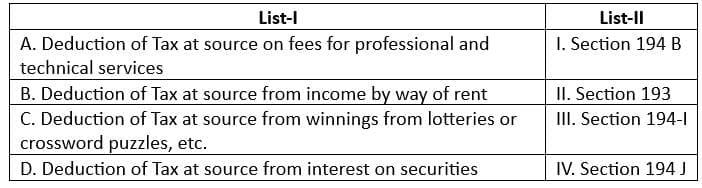
(a) A-I, B-II, C-III, D-IV
(b) A-IV, B-III, C-II, D-I
(c) A-IV, B-III, C-I, D-II
(d) A-II, B-I, C-IV, D-III
Ans: C
Key Points
- Deduction of Tax at Source (TDS) on fees for professional and technical services
- Covered under Section 194J of the Income Tax Act.
- Applies to payments for services such as professional, technical, royalty, or non-compete fees.
- Deduction of Tax at Source from income by way of rent
- Covered under Section 194-I.
- Includes payments for renting land, buildings, furniture, or machinery.
- Deduction of Tax at Source from winnings from lotteries or crossword puzzles
- Covered under Section 194B.
- Applies to winnings exceeding a specific threshold, subject to TDS at applicable rates.
- Deduction of Tax at Source from interest on securities
- Covered under Section 193.
- Refers to interest income earned on securities like bonds or debentures.
Additional Information
- Thresholds for TDS
- Each section has specific thresholds for tax deduction.
- For example:
- Section 194J: TDS applies if the payment exceeds ₹30,000 in a financial year.
- Section 194-I: Threshold varies for rent of land/buildings (₹2,40,000 annually).
- Rates of TDS
- TDS rates are determined under each section:
- Section 194J: 10% for professional fees.
- Section 194-I: 10% for land/building rent, 2% for plant/machinery rent.
- Section 194B: 30% on winnings.
- Section 193: 10% on interest on securities.
- TDS rates are determined under each section:
- Applicability
- These sections are applicable to both individuals and businesses, with some exceptions (e.g., individuals not subject to tax audit).
Q18: What rights does an unpaid seller have against the goods?
A. Right of lien
B. Right to sue for specific performance
C. Right of resale
D. Right of stoppage of goods in transit
E. Right to reorganise possession of goods
Choose the correct answer from the options given below:
(a) A, B and C Only
(b) B, C and D Only
(c) C, D and E Only
(d) A, C, D Only
Ans: D
Key Points
- Right of Lien
- An unpaid seller has the right to retain possession of the goods until payment is made.
- This applies when the goods are in the seller's possession and the payment has not been received.
- Right of Resale
- If the buyer defaults on payment, the unpaid seller has the right to resell the goods.
- This right is exercised under specific conditions, such as when the goods are perishable or after giving notice to the buyer.
- Right of Stoppage in Transit
- The seller can stop the goods while they are in transit if the buyer becomes insolvent.
- This right is available until the goods are delivered to the buyer or their agent.
Additional Information
- Unpaid Seller's Rights
- An unpaid seller is defined as someone who has not received the full price of the goods sold or where the payment has been dishonored.
- These rights are categorized into two broad types:
- Against the Goods: Includes rights of lien, stoppage in transit, and resale.
- Against the Buyer: Includes the right to sue for the price or damages for non-acceptance.
- Rights Not Applicable in This Case
- Right to Sue for Specific Performance: This is not applicable to unpaid sellers as it is generally related to contracts involving unique goods or property.
- Right to Reorganize Possession: This is not a recognized legal right under the Sale of Goods Act, 1930.
Q19: A term loan becomes Non Performing Asset (NPA) if its interest and/or instalment of principal remains overdue for a period of more than:
(a) 30 days
(b) 60 days
(c) 75 days
(d) 90 days
Ans: D
Key Points
- Non-Performing Asset (NPA)
- A term loan is classified as a Non-Performing Asset (NPA) when the borrower fails to pay either the interest or the principal amount for a specified period.
- The threshold period for a loan to be classified as NPA is 90 days as per the Reserve Bank of India (RBI) guidelines.
- Overdue Status
- If the interest or principal repayment remains unpaid for more than 90 days, it is considered overdue, leading to NPA classification.
- This classification helps financial institutions maintain their asset quality and monitor risks effectively.
Additional Information
- Categories of NPAs
- NPAs are categorized based on the duration for which the asset has remained non-performing:
- Substandard Asset: When the asset has been non-performing for a period less than or equal to 12 months.
- Doubtful Asset: When the asset remains non-performing for more than 12 months.
- Loss Asset: When the asset is identified as uncollectible by the bank or auditors.
- Importance of NPA Classification
- Classifying loans as NPAs ensures that banks maintain transparency in their financial records.
- It helps regulators and stakeholders assess the financial health of banks and other financial institutions.
- Role of RBI Guidelines
- The Reserve Bank of India (RBI) has set strict guidelines for the classification of NPAs to ensure uniformity across all banks.
- These guidelines are crucial for maintaining the stability of the banking sector and protecting the interests of depositors.
Q20: Identify the correct sequence of Research Design Process
A. Measurement technique selection
B. Research approach selection
C. Data collection technique selection
D. Sample design selection
E. Data analysis method selection
Choose the correct answer from the options given below:
(a) A, B, C, D, E
(b) B, A, D, C, E
(c) D, C, E, A, В
(d) C, E, D, B, A
Ans: B
Key Points
- Research Design Process
- The sequence of steps in the research design process helps ensure that the study is systematic, logical, and reliable.
- The correct sequence is:
- B: Research approach selection - It is the first step where the researcher decides the overall approach (qualitative, quantitative, or mixed methods).
- A: Measurement technique selection - The researcher identifies and selects appropriate techniques or tools for measuring variables.
- D: Sample design selection - The process of selecting the sample group that represents the population under study.
- C: Data collection technique selection - The researcher determines how data will be collected (e.g., surveys, interviews, experiments).
- E: Data analysis method selection - Finally, the researcher decides on the methods and tools for analyzing the collected data.
- Following this sequence ensures that the research is conducted in a structured and logical manner.
Additional Information
- Details of Each Step
- Research approach selection (B)
- This step determines the overall strategy for the research.
- Approaches include qualitative (exploratory, narrative-based), quantitative (statistical, numerical), or mixed methods.
- Measurement technique selection (A)
- Involves identifying scales, tools, or instruments to measure the variables.
- Examples include questionnaires, rating scales, or standardized tests.
- Sample design selection (D)
- Defines the sampling method (e.g., random, stratified, cluster sampling) and size.
- Ensures that the sample is representative of the target population.
- Data collection technique selection (C)
- Includes methods like surveys, interviews, focus groups, or observational techniques.
- The choice depends on the research question and approach.
- Data analysis method selection (E)
- Involves selecting methods such as statistical analysis, thematic analysis, or content analysis.
- Software tools like SPSS, Excel, or NVivo may be used to assist in analysis.
- Research approach selection (B)
- Importance of Following the Correct Sequence
- Ensures logical consistency and minimizes errors in the research process.
- Improves the validity and reliability of research outcomes.
Q21: Match the LIST-I with LIST-II

(a) A-I, B-II, C-III, D-IV
(b) A-II, B-I, C-III, D-IV
(c) A-III, B-II, C-IV, D-I
(d) A-IV, B-III, C-I, D-II
Ans: B
Key Points
- Nostro Account
- A Nostro Account is an account that a bank holds in a foreign currency in another bank.
- For example, an Indian bank's account in Swiss Francs with a Swiss bank is considered a Nostro Account.
- Vostro Account
- A Vostro Account is the account that a foreign bank holds with a local bank in the local currency.
- It represents the foreign bank's funds held on deposit by the local bank.
- Bid Price
- The Bid Price is the price at which a currency dealer is willing to buy another currency.
- This is typically lower than the offer price and is a key part of forex trading.
- Offer Price
- The Offer Price is the price at which a currency dealer is willing to sell another currency.
- This is higher than the bid price, and the difference is known as the spread.
Additional Information
- Forex Market
- The forex market is the largest financial market in the world, where currencies are traded globally.
- It operates 24/7, and participants include banks, governments, corporations, and individual traders.
- Currency Pair
- Forex transactions involve trading one currency for another, forming a currency pair (e.g., USD/INR).
- The first currency is the base currency, and the second is the quote currency.
- Spread
- The spread is the difference between the bid price and the offer price in forex trading.
- A smaller spread indicates higher market liquidity, while a larger spread indicates lower liquidity.
- Role of Nostro and Vostro Accounts
- These accounts help facilitate international trade and foreign exchange transactions between banks in different countries.
- They ensure smooth cross-border transactions by maintaining balances in foreign and local currencies.
Q22: Match the LIST-I with LIST-II
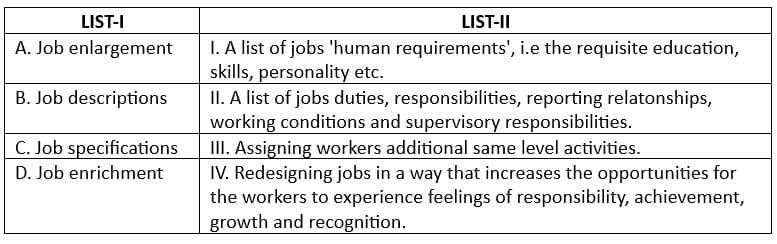 Choose the correct answer from the options given below:
(a) A-III, B-II, C-I, D-IV
(b) A-IV, B-II, C-I, D-III
(c) A-III, B-I, C-II, D-IV
(d) A-IV, B-II, C-III, D-I
Ans: A
Key Points
- Job enlargement
- Refers to assigning workers additional same-level activities to reduce monotony and increase variety in tasks.
- It does not involve a change in skill level or job complexity.
- Job descriptions
- Provide a detailed list of job duties, responsibilities, reporting relationships, working conditions, and supervisory roles.
- It acts as a guideline for employees and recruiters to understand the scope of a particular role.
- Job specifications
- Define the human requirements for a job, such as requisite education, skills, personality traits, and experience.
- These are critical for recruitment and selection processes.
- Job enrichment
- Involves redesigning jobs to increase opportunities for workers to experience feelings of responsibility, achievement, growth, and recognition.
- It is aimed at enhancing employee satisfaction and motivation.
Additional Information
- Importance of job analysis
- Job analysis is the foundation for creating job descriptions and job specifications.
- It helps organizations in workforce planning, recruitment, training, and performance evaluation.
- Difference between job enlargement and job enrichment
- While job enlargement increases the number of tasks at the same skill level, job enrichment focuses on improving job quality by adding elements of responsibility and growth.
- Job enrichment is more effective for enhancing employee motivation and satisfaction.
- Applications of job specifications
- Used in recruitment to match candidates with the required qualifications and skills.
- Helps in identifying training needs and succession planning.
Q23: The State Bank Of India came into existence in the year:
(a) 1947
(b) 1950
(c) 1955
(d) 1969
Ans: C
Key Points
- State Bank of India (SBI)
- SBI is India's largest and oldest public sector bank.
- The bank was established on July 1, 1955, following the reconstitution of the Imperial Bank of India.
- The reconstitution was done under the State Bank of India Act, 1955.
- Historical Significance
- The transformation of the Imperial Bank of India into SBI marked a crucial step toward providing banking services across rural and urban areas of India.
- SBI was tasked with the role of acting as a principal agent for the Reserve Bank of India (RBI) in handling banking transactions for government bodies.
- Reason for Establishment
- The aim was to create a strong banking institution capable of driving economic development post-independence.
- The bank's establishment was part of India's efforts to strengthen its financial infrastructure.
Additional Information
- Imperial Bank of India
- The Imperial Bank of India was formed in 1921 by merging three presidency banks: Bank of Bengal, Bank of Bombay, and Bank of Madras.
- It operated as a commercial bank and was one of the largest banking institutions during the British era.
- Post-independence, it was converted into SBI to better serve the nation's financial needs.
- Nationalization of Banks
- India witnessed the nationalization of banks in two phases, in 1969 and 1980.
- However, SBI was already a state-owned entity since its inception in 1955.
- Role of SBI
- SBI plays a pivotal role in supporting India's economy by providing banking services to diverse sectors such as agriculture, industry, and infrastructure.
- It has a vast network of branches, which makes banking accessible to remote areas.
Q24: In case of transmission of shares, which of the following is correct?
A. No instrument of transfer is required.
B. Transmission of securities is generally made without any consideration.
C. Shares continue to be subject to the original liabilities.
D. Transmission takes place on death or insolvency of a holder of securities.
E. Stamp duty is payable on transmission of securities.
Choose the correct answer from the options given below:
(a) A, B, C and D Only
(b) B, C and D Only
(c) C, D and E Only
(d) A, B, C Only
Ans: A
Key Points
- No instrument of transfer is required
- In the case of transmission of shares, the legal ownership is transferred due to operation of law, such as inheritance, death, or insolvency.
- Hence, no separate transfer deed or instrument of transfer is required.
- Transmission of securities is generally made without any consideration
- The transfer occurs without monetary consideration since it is based on legal events like inheritance or insolvency.
- Unlike a sale or transfer, transmission does not involve a buyer-seller transaction.
- Shares continue to be subject to the original liabilities
- In a transmission, the shares are still subject to any existing liabilities or obligations attached to them.
- The new holder inherits both the rights and liabilities associated with the shares.
- Transmission takes place on death or insolvency of a holder of securities
- The process of transmission is triggered by events like the death or insolvency of the original shareholder.
- The shares are transferred to the legal heir, nominee, or official assignee as per applicable laws.
Additional Information
- Stamp duty is not payable on transmission
- Unlike the transfer of shares, where stamp duty is applicable, no stamp duty is required in the case of transmission.
- This is because transmission occurs due to operation of law, not through a contractual transfer.
- Nomination simplifies transmission
- If the shareholder has registered a nominee with the company, the transmission process becomes simpler.
- The shares are directly transmitted to the nominee upon the death of the shareholder.
- Documents required for transmission
- For smooth processing, certain documents such as a death certificate (in case of death) or insolvency order (in case of insolvency) are required.
- Other documents like succession certificates, probate, or letters of administration may also be necessary depending on the case.
(a) B and C Only
(b) B, C, and E Only
(c) A and C Only
(d) B, D and E Only
Ans: A
Key Points
- Standard deviation is independent of change of origin but not of scale
- When a constant is added or subtracted from all data points (change of origin), the standard deviation remains unchanged.
- However, when all data points are multiplied or divided by a constant (change of scale), the standard deviation is affected proportionally.
- The standard deviation of the first n natural numbers is sqrt((n² - 1)/12)
- The formula for the standard deviation of the first n natural numbers is derived using the properties of summation and variance.
- It is mathematically proven that the standard deviation is sqrt((n² - 1)/12).
- Statement A is incorrect
- Statement A says that "Standard deviation is independent of both origin and scale," which is false, as standard deviation is affected by changes in scale.
Additional Information
- Standard deviation and its properties:
- Variance is the square of the standard deviation, which measures the spread of data points around the mean.
- Standard deviation is always non-negative, as it represents the distance from the mean.
- It is a robust measure for comparing variability in datasets with similar scales.
- Mean deviation and its relationship with standard deviation:
- For moderately skewed distributions, the standard deviation is approximately 1.25 times the mean deviation.
- This approximation depends on the shape of the distribution and may not hold for highly skewed datasets.
- Formulas for standard deviation:
- For ungrouped data: SD = sqrt(Σ(xi - x̄)² / n)
- For grouped data: SD = sqrt(Σf(xi - x̄)² / Σf)
- For the first n natural numbers: SD = sqrt((n² - 1)/12)
(a) On or before June 15 of the previous year
(b) On or before September 15 of the previous year
(c) On or before December 15 of the previous year
(d) On or before March 15 of the previous year
Ans: C
Key Points
- Advance Tax
- An assessee is required to pay advance tax if their total tax liability exceeds ₹10,000 in a financial year.
- Advance tax is paid in installments during the financial year rather than at the end of the year.
- Installment Requirements
- For an assessee (except those covered under Section 44AD or Section 44ADA), the advance tax is payable in four installments:
- 15% of the total tax liability by June 15
- 45% (cumulative) by September 15
- 75% (cumulative) by December 15
- 100% by March 15
- As per the question, the assessee must pay up to 75% of advance tax by December 15.
- For an assessee (except those covered under Section 44AD or Section 44ADA), the advance tax is payable in four installments:
- Exception
- Taxpayers opting for presumptive taxation under Section 44AD or Section 44ADA are required to pay their entire advance tax liability in a single installment by March 15.
Additional Information
- Section 44AD
- This section provides a presumptive taxation scheme for eligible businesses with a turnover of up to ₹2 crore.
- Under this scheme, income is presumed to be 8% (or 6% for digital transactions) of turnover or gross receipts.
- Section 44ADA
- This section provides a presumptive taxation scheme for professionals with gross receipts of up to ₹50 lakh.
- Under this scheme, income is presumed to be 50% of gross receipts.
- Consequences of Non-Payment
- Failure to pay advance tax or underpayment of installments results in interest under Section 234B and Section 234C of the Income Tax Act.
- Section 234B: Interest for non-payment of 90% of total tax by March 31.
- Section 234C: Interest for delayed or insufficient payment of advance tax installments.
(a) A and C Only
(b) A, B and D Only
(c) B, C and E Only
(d) A, C and E Only
Ans: D
Key Points
- Conservatism principle
- This accounting principle requires that potential losses be recognized as soon as they are probable, but gains should only be recorded when they are realized.
- It ensures that financial statements provide a realistic picture of the financial position, avoiding overstatement of assets or income.
- Application in the question
- Valuation of stock in trade at the lower of cost or market value (A)
- This application ensures that the value of inventory is not overstated in case market value falls below cost.
- Making provision for bad and doubtful debts (C)
- Recognizing potential losses from customers' inability to pay ensures realistic representation of accounts receivable.
- Creation of investment fluctuation fund (E)
- This safeguards against potential losses arising from fluctuations in investment values.
- Valuation of stock in trade at the lower of cost or market value (A)
Additional Information
- Other examples of the conservatism principle
- Provision for contingent liabilities:
- Contingent liabilities, such as lawsuits or warranties, are recorded if they are probable and can be reasonably estimated.
- Amortization of intangible assets:
- Gradual reduction in the value of intangible assets is applied to avoid overstatement in the financial statements.
- Common misconceptions:
- Conservatism principle does not allow deliberate understatement of income or assets; it only ensures that potential risks are accounted for reasonably.
- Provision for contingent liabilities:
Q28: Match the LIST-I with LIST-II

(a) A-I, B-II, C-III, D-IV
(b) A-IV, B-III, C-II, D-I
(c) A-II, B-III, C-IV, D-I
(d) A-III, B-IV, C-I, D-II
Ans: B
Key Points
- Karl Pearson's coefficient of skewness
- Uses the formula: (Mean - Mode) / Standard Deviation.
- It measures the degree of skewness based on the relationship between mean and mode.
- Applicable for datasets where mode is well-defined.
- Bowley's coefficient of skewness
- Uses the formula: (Q3 + Q1 - 2 Median) / (Q3 - Q1).
- Relies on quartiles and median, making it robust for skewness in distributions.
- Useful for measuring asymmetry in datasets with extreme values.
- Kelly's coefficient of skewness
- Uses the formula: (P90 + P10 - 2 Median) / (P90 - P10).
- Based on deciles (P90, P10) and median, providing a measure of skewness for distributions.
- Moment coefficient of skewness
- Uses the formula: (μ3)² / (μ1)³, where μ3 and μ1 are central moments.
- Measures skewness using moments, offering a mathematical approach.
- Applicable for continuous distributions.
Additional Information
- Skewness
- Skewness quantifies the asymmetry of a distribution.
- A positive skew indicates a distribution with a longer tail on the right, while a negative skew indicates a longer tail on the left.
- Common measures include relative measures (e.g., Pearson, Bowley) and moment measures.
- Central moments
- Used to calculate skewness and kurtosis.
- Third central moment (μ3) captures asymmetry, while first moment (μ1) represents mean.
- Percentile-based measures
- Kelly's coefficient utilizes specific percentiles like P90 and P10 for robust skewness measurement.
- Bowley's coefficient focuses on quartiles, ensuring resilience against outliers.
(a) A, B, C, D
(b) B, A, D, C
(c) A, B, D, C
(d) D, C, B, A
Ans: D
Key Points
- Defining target population
- The first step in the sampling design process is identifying the target population, which refers to the group of individuals or units relevant to the study.
- It ensures the sample is representative of the population being studied.
- Selection of sampling frame
- Once the target population is defined, a sampling frame is established. This is a list or database of elements from which the sample will be drawn.
- It is critical that the sampling frame accurately represents the target population.
- Selecting a sampling technique
- In this step, the researcher chooses an appropriate sampling technique such as random sampling, stratified sampling, or cluster sampling, depending on the study objectives and constraints.
- The choice of technique influences the validity and reliability of the results.
- Determine the sample size
- Finally, the sample size is determined based on statistical considerations like margin of error, confidence level, and variability in the population.
- A well-calculated sample size ensures that the study findings are statistically significant and generalizable.
Additional Information
- Types of Sampling Techniques
- Probability Sampling
- Includes methods like simple random sampling, stratified sampling, and cluster sampling.
- Ensures that every element in the population has an equal chance of being selected.
- Non-Probability Sampling
- Includes methods like convenience sampling, quota sampling, and judgmental sampling.
- Does not guarantee equal representation but may be used in exploratory studies.
- Probability Sampling
- Importance of Sampling Design
- A robust sampling design minimizes bias and maximizes the reliability and validity of study results.
- It is crucial in ensuring that study findings are representative of the population and generalizable to broader contexts.
(a) A and C Only
(b) B and D Only
(c) B, D and E Only
(d) A, C and E Only
Ans: C
Key Points
- Section 91 Deduction
- This deduction is available to prevent double taxation of income for Indian residents.
- The assessee must be a resident in India during the relevant previous year.
- Income Accrued Outside India
- The income must have accrued or arisen outside India during the previous year.
- This ensures the foreign-sourced income is eligible for the deduction.
- Taxes Paid Outside India
- The assessee must have paid tax (either by deduction or otherwise) on this foreign-sourced income.
- The tax payment must be under the law in force in the foreign country.
Additional Information
- Double Taxation Avoidance
- Double taxation occurs when the same income is taxed in two different countries.
- To mitigate this, India provides relief under Section 91 if no Double Taxation Avoidance Agreement (DTAA) exists.
- Applicability of Section 91
- Applies only when the assessee is a resident and the income has been taxed both in India and the foreign country.
- The relief is computed based on the lower of the Indian tax rate or the foreign tax rate.
- Scope of Resident Status
- Resident status is determined based on the residential rules under the Income Tax Act, 1961.
- Non-residents are not eligible for the deduction under Section 91.
(a) A, B, C, D
(b) C, A, B, D
(c) D, C, B, A
(d) B, A, D, C
Ans: D
Key Points
- B, A, D, C is the correct order for multinational capital budgeting because it aligns logically with the steps required to evaluate a project.
- Step 1: Determine net investment outlay (B)
- This step involves calculating the initial costs of the project, such as setup expenses, equipment costs, and working capital requirements.
- It forms the foundation for subsequent analysis as it represents the upfront cash flow.
- Step 2: Estimate net cash flow from the project (A)
- This step focuses on forecasting future cash flows generated from the project, including revenues, operating costs, and taxes.
- It is critical to assess the profitability and sustainability of the project over its lifetime.
- Step 3: Identify appropriate discount rate (D)
- A discount rate is used to adjust future cash flows to their present value, accounting for the time value of money and risk.
- This rate is typically the cost of capital or required rate of return for the project.
- Step 4: Apply appropriate evaluation technique (C)
- This step involves using tools such as Net Present Value (NPV), Internal Rate of Return (IRR), or Payback Period to assess the project's viability.
- It helps decision-makers determine whether the project is worth pursuing based on objective financial criteria.
Additional Information
- Multinational Capital Budgeting
- It is the process of evaluating investments or projects conducted in international markets.
- It considers factors such as exchange rate fluctuations, political risk, and tax implications specific to the host country.
- Importance of Discount Rate (D)
- The discount rate reflects the opportunity cost of capital and the risk associated with the project.
- A higher discount rate is applied for projects with greater risk, reducing the present value of future cash flows.
- Evaluation Techniques (C)
- Net Present Value (NPV): Measures the difference between the present value of cash inflows and outflows.
- Internal Rate of Return (IRR): Calculates the discount rate at which NPV becomes zero.
- Payback Period: Determines the time required to recover the initial investment.
(a) 38
(b) 48
(c) 56
(d) 62
Ans: B
Key Points
- Price Elasticity of Demand (PED)
- Formula: PED = (% Change in Quantity Demanded) ÷ (% Change in Price).
- Given: PED = 1.5, Original Price = 100, New Price = 60.
- % Change in Price = \((-40 ÷ 100) × 100 = -40\%\).
- % Change in Quantity Demanded = 1.5 × (-40%) = -60%.
- Since price falls, quantity demanded rises by +60%.
- New Quantity = \(30 + (30 × 0.6) = 48\).
Additional Information
- Types of Price Elasticity
- Elastic demand: PED > 1 (quantity demanded changes more than price).
- Inelastic demand: PED < 1 (quantity demanded changes less than price).
- Unitary elasticity: PED = 1 (proportional change in price and quantity).
- Factors affecting PED
- Availability of substitutes More substitutes make demand more elastic.
- Nature of the good Necessities are inelastic; luxuries are elastic.
- Proportion of income spent Higher share increases elasticity.
- Time period - Demand is more elastic in the long run than in the short run.
- Exam Tip
- Always apply the formula correctly: PED = %ΔQ ÷ %ΔP.
- Remember: A negative price change leads to a positive change in demand (law of demand).
(a) A and B Only
(b) A, B and C Only
(c) B and C Only
(d) A, C and D Only
Ans: D
Key Points
- Modified Audit Reports
- As per SA 705, modified audit reports refer to reports that differ from the standard "Unmodified Opinion" due to specific circumstances.
- Types of modified audit reports include:
- Qualified Opinion: Issued when there are material misstatements or scope limitations but not pervasive.
- Disclaimer of Opinion: Issued when the auditor is unable to obtain sufficient evidence and the issue is both material and pervasive.
- Adverse Opinion: Issued when the financial statements contain material misstatements that are pervasive.
- Emphasis of Matter Paragraph
- An "Emphasis of Matter" paragraph does not modify the audit opinion; it is used to highlight significant matters.
- It is included in an Unmodified Opinion report and does not fall under the category of modified audit reports.
Additional Information
- Qualified Opinion
- Used when there are material misstatements or scope limitations that are significant but not pervasive.
- The auditor provides a clear explanation of the reasons for qualification in the report.
- Disclaimer of Opinion
- Issued when the auditor is unable to obtain sufficient evidence to form an opinion.
- This occurs in situations where the scope limitations are material and pervasive.
- Adverse Opinion
- Issued when the financial statements contain material misstatements that are pervasive and affect the reliability of the financial statements.
- Indicates that the financial statements do not provide a true and fair view.
- SA 705
- SA 705 establishes guidelines for auditors on when to issue a modified opinion.
- It clearly differentiates between the types of modified opinions and their implications.
(a) Social class
(b) Culture
(c) Sub-culture
(d) Social Factors
Ans: B
Key Points
- Culture is the system of shared beliefs, values, norms, and practices that are passed down within a society or group.
- Symbols, icons, rituals, and values are essential manifestations of culture.
- They represent how individuals within a group express their shared understanding and identity.
- For example, national flags, religious ceremonies, and traditional clothing are cultural symbols and rituals.
- Values such as honesty, respect, or freedom reflect the ethical and moral principles upheld by a culture.
- These elements help in creating a sense of identity and belonging among members of a society.
Additional Information
- Social Class
- Refers to the hierarchical divisions within a society based on factors like wealth, education, and occupation.
- Social class influences behavior but is not directly linked to symbols, rituals, or values as manifestations.
- Sub-culture
- A sub-group within a larger culture that has its own distinct values, norms, and practices.
- While sub-cultures may display symbols and rituals, they are part of the broader cultural framework.
- Social Factors
- Include elements such as family, friends, and social environment that influence behavior and choices.
- Although social factors impact cultural practices, they are not manifestations of culture themselves.
(a) A, B and C Only
(b) B, C and E Only
(c) B, C and D Only
(d) A, B, C, D and E
Ans: A
Key Points
- Macro Economics
- It studies the economy as a whole and focuses on aggregate economic variables.
- Key areas include national income, balance of payments, and the level of savings and investment.
- National Income
- Represents the total value of goods and services produced in a country.
- Used to measure economic growth and standard of living.
- Balance of Payments
- Records all transactions between residents of a country and the rest of the world.
- Includes trade balance, foreign investment, and financial transfers.
- Level of Savings and Investment
- Crucial for determining the economy's capacity for growth and development.
- Higher savings lead to increased investment, fueling economic progress.
Additional Information
- Micro Economics
- Focuses on individual economic units like firms, households, and industries.
- Examples include location of industry and behavior of firms.
- Difference Between Macro and Micro Economics
- Macro Economics deals with large-scale economic factors like national income and inflation.
- Micro Economics examines small-scale factors like pricing strategies and consumer behavior.
- Key Focus Areas for Exams
- Understand the definitions and distinctions between macro and microeconomic concepts.
- Recognize which variables belong to macroeconomics (e.g., national income, balance of payments) and which belong to microeconomics (e.g., firm behavior).
(a) 1/2
(b) 1
(c) 2
(d) 1/4
Ans: A
Key Points
- Poisson Distribution
- A Poisson random variable X is characterized by its mean (λ) and variance, both of which are equal to λ.
- Given that P(X = 1) = 4P(X = 2), we can use the formula for probabilities in Poisson distribution:
- P(X = k) = (λk * e-λ) / k!
- Substituting k = 1 and k = 2into this equation, we get:
- P(X = 1) = λ * e-λ
- P(X = 2) = (λ2 * e-λ) / 2
- Equating the given condition P(X = 1) = 4P(X = 2), we solve for λ:
- λ * e-λ = 4 * (λ2 * e-λ) / 2
- λ = 2
- Since the variance of a Poisson distribution is equal to its mean, the variance of X is 2.
Additional Information
- Properties of Poisson Distribution
- The Poisson distribution is used to model the number of events occurring in a fixed interval of time or space, provided the events occur independently.
- The mean and variance of the Poisson distribution are both equal to λ.
- It is defined for non-negative integers, i.e., X ≥ 0.
- Formula for Poisson Distribution
- P(X = k) = (λk * e-λ) / k!
- Where:
- λ: Mean number of occurrences.
- k: Number of occurrences.
- e: Euler's constant (~2.718).
- Applications of Poisson Distribution
- Modeling rare events such as the number of calls received by a call center in an hour.
- Estimating the number of accidents occurring at a traffic junction in a day.
- Predicting the number of typing errors in a book manuscript.
Q37: Which of the following are part of micro economics?
A. Product pricing
B. Consumer behaviour
C. Interest rate
D. Factor pricing
Choose the correct answer from the options given below:
(a) A, B and C Only
(b) A, B and D Only
(c) A and D Only
(d) A, B, C and D
Ans: B
Key Points
- Microeconomics
- Microeconomics focuses on individual units like households, firms, and specific markets.
- The study of product pricing (A) is part of microeconomics as it examines how prices are determined in individual markets.
- Understanding consumer behaviour (B) is also central to microeconomics, as it analyzes how individuals make decisions about spending their resources.
- Factor pricing (D), which refers to the pricing of production factors like land, labor, and capital, is another important topic within microeconomics.
- Interest Rate(C)
- Interest rate determination is primarily studied in macroeconomics, as it involves the overall financial system and monetary policies rather than individual market behavior.
Additional Information
- Difference Between Microeconomics and Macroeconomics
- Microeconomics focuses on individual and business-level decisions, while macroeconomics deals with the economy as a whole.
- Key topics in microeconomics include demand and supply, market structures, and resource allocation.
- Macroeconomics studies broader issues such as inflation, unemployment, and GDP.
- Applications of Microeconomics
- Microeconomics helps businesses in pricing strategies by analyzing market demand and competition.
- It aids policymakers in understanding how changes in taxes or subsidies affect specific industries or groups.
- It is also used to study the impact of market regulations on consumer welfare and producer efficiency.
(a) A, B, C, D
(b) B, A, C, D
(c) C, B, D, A
(d) B, C, A, D
Ans: B
Key Points
- Commodity Specie Standard
- This was the earliest exchange rate arrangement, where precious metals like gold and silver were used as the basis for monetary exchange.
- It relied on the intrinsic value of commodities to establish the exchange rates.
- Gold Standard
- Introduced later, this system fixed the value of a country's currency to a specific quantity of gold.
- It ensured stability in international trade and exchange rates.
- Fixed Parity System
- Under this system, exchange rates were pegged to a fixed value against major currencies or gold.
- This system was widely adopted during the Bretton Woods era.
- Floating Exchange Rate
- The most modern system, where exchange rates are determined by market forces of supply and demand.
- It allows currencies to fluctuate freely without being fixed to a particular standard.
Additional Information
- Commodity Specie Standard
- Used in ancient economies where coins made of precious metals represented wealth.
- It required physical storage and transport of metals, which was inefficient for modern economies.
- Gold Standard Collapse
- The gold standard became unsustainable due to imbalances in gold reserves and economic shocks like the Great Depression.
- Countries transitioned to more flexible systems, such as the fixed parity system.
- Bretton Woods System
- Established in 1944, it pegged currencies to the US dollar, which was backed by gold.
- This system collapsed in the 1970s due to economic pressures and the inability to maintain fixed exchange rates.
- Floating Exchange Rate System
- Adopted widely after the Bretton Woods collapse, it allows for automatic adjustments based on economic conditions.
- This system is prevalent today, with central banks intervening occasionally to stabilize fluctuations.
(a) Management Questions
(b) Research Questions
(c) Investigative Questions
(d) Measurement Questions
Ans: D
Key Points
- Measurement Questions
- These are the actual questions asked to respondents during the process of data collection.
- They are designed to collect specific data or responses that align with the research objectives.
- Examples include survey questions, interview questions, or questionnaire items.
- The focus is on obtaining quantifiable or clearly defined responses from participants.
Additional Information
- Management Questions
- These address the strategic concerns of managers or decision-makers.
- They often focus on organizational goals and how the research findings will help achieve them.
- For example: "What factors influence customer satisfaction in our product line?"
- Research Questions
- These are the central questions a researcher seeks to answer through their study.
- They frame the objectives of the research and guide the overall investigation.
- For example: "What is the relationship between employee engagement and productivity?"
- Investigative Questions
- These are detailed questions that help break down the research problem into smaller, manageable components.
- They often guide the development of measurement questions.
- For example: "What are the key drivers of customer loyalty?"
(a) A, B Only
(b) A, B, C Only
(c) B, C, D Only
(d) B, C Only
Ans: B
Key Points
- NAFTA (North American Free Trade Agreement)
- NAFTA was a trade agreement established in 1994 between three North American countries: the United States, Canada, and Mexico.
- Its primary purpose was to eliminate trade barriers such as tariffs and encourage economic cooperation among member countries.
- Brazil was not part of NAFTA as it is located in South America and was not involved in this specific agreement.
Additional Information
- Key Features of NAFTA
- NAFTA aimed at fostering free trade and increasing economic integration among the United States, Canada, and Mexico.
- It included provisions for:
- Elimination of tariffs on most goods traded between member countries.
- Protection of intellectual property.
- Dispute resolution mechanisms to address trade conflicts.
- Replacement of NAFTA
- NAFTA was replaced by the USMCA (United States-Mexico-Canada Agreement) in 2020, which modernized many aspects of the original agreement.
- The USMCA includes updates on labor rights, environmental standards, and digital trade.
Q41: Match the LIST-I with LIST-II
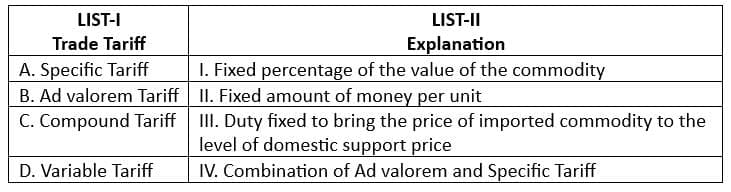
(a) A-I, B-II, C-III, D-IV
(b) A-II, B-I, C-IV, D-III
(c) A-III, B-IV, C-II, D-I
(d) A-IV, B-III, C-II, D-I
Ans: B
Key Points
- Specific Tariff (A-II):
- A specific tariffimposes a fixed monetary amount per unit of the commodity being imported.
- For example: $5 per kilogram of rice.
- A specific tariffimposes a fixed monetary amount per unit of the commodity being imported.
- Ad Valorem Tariff (B-I):
- An ad valorem tariffis calculated as a fixed percentage of the value of the imported goods.
- For example: A 10% tariff on the value of imported electronics.
- An ad valorem tariffis calculated as a fixed percentage of the value of the imported goods.
- Compound Tariff (C-IV):
- A compound tariffis a combination of both the specific and ad valorem tariffs.
- For example: A $3 per unit tariff plus 5% of the value of the product.
- A compound tariffis a combination of both the specific and ad valorem tariffs.
- Variable Tariff (D-III):
- A variable tariff adjusts the duty to bring the price of imported commodities up to the domestic support price.
- This type of tariff protects domestic producers by countering price fluctuations in the international market.
Additional Information
- Purpose of Tariffs:
- Tariffs are imposed to protect domestic industries from foreign competition.
- They also serve as a source of revenue for the government.
- Impact of Tariffs:
- Higher tariffs can increase the cost of imported goods, making them less competitive compared to domestic products.
- However, excessively high tariffs may lead to trade disputes or retaliatory tariffs from other countries.
- Examples of Tariff Usage:
- Specific Tariff: $1 per liter of imported wine.
- Ad Valorem Tariff: 20% on the value of imported cars.
- Compound Tariff: $2 per unit plus 10% of the product's value.
- Variable Tariff: Adjusted to maintain competitive pricing for domestic wheat producers.
Q42: Arm's length price as per section 92F is the price applied or proposed to be applied when:
(a) two unrelated persons enter into a transaction in uncontrolled conditions
(b) two related persons enter into a transaction in uncontrolled conditions
(c) two unrelated persons enter into a transaction in controlled conditions
(d) two related persons enter into a transaction in controlled conditions
Ans: A
Key Points
- Arm's Length Price
- The term Arm's Length Price is defined in Section 92F of the Income Tax Act, 1961.
- It refers to the price that would be charged when two unrelated parties transact in uncontrolled conditions.
- It ensures that the price of a transaction between related parties is the same as it would be if the parties were unrelated.
- Unrelated Persons
- Unrelated persons are parties who act independently and do not influence each other's financial or business decisions.
- Arm's Length Price assumes that such parties transact without any bias or external control.
- Uncontrolled Conditions
- Uncontrolled conditions are market-driven situations where transactions occur without any external influence, such as price manipulation or coercion.
- This ensures that the transaction price reflects a fair and competitive market value.
Additional Information
- Controlled vs. Uncontrolled Conditions
- Controlled conditions occur when related parties influence the terms of the transaction (e.g., price, quality, or quantity).
- Uncontrolled conditions ensure that transactions take place at a market-driven price without any undue influence.
- Related vs. Unrelated Persons
- Related persons include entities or individuals who have a close relationship, such as subsidiaries, associates, or family members.
- Unrelated persons are independent parties that do not have any special or close relationship.
- Objective of Arm's Length Price
- Arm's Length Price ensures fairness and prevents tax avoidance by related entities through transfer pricing.
- It is primarily used in international transactions and specified domestic transactions between related parties.
- Helps maintain compliance with global standards, such as the OECD guidelines for transfer pricing.
(a) A, B, C and D Only
(b) B, C and D Only
(c) A, B and C Only
(d) C, D and E Only
Ans: C
Key Points
- Demand/Market-Based Pricing
- Refers to pricing strategies that rely on customer demand, market trends, and the perceived value of a product.
- It involves adjusting prices based on factors such as market conditions and customer willingness to pay.
- Surge Pricing
- Dynamic pricing that increases prices during peak demand periods to maximize revenue.
- Commonly used in ride-sharing services, hospitality, and events.
- Premium Pricing
- Involves setting a high price to reflect the exclusive value or superior quality of a product.
- Targets customers willing to pay more for perceived luxury or uniqueness.
- 'What the Traffic Can Bear' Pricing
- Focuses on charging the maximum price customers are willing to pay without losing demand.
- Used in industries with fluctuating demand or limited competition.
Additional Information
- Discount Pricing
- Involves offering products at reduced prices to stimulate demand.
- While effective for clearing inventory, it does not fall under demand-based pricing as it focuses on cost reduction.
- Parity Pricing
- Pricing strategy based on matching competitors' prices rather than customer demand.
- Used to maintain market share but does not rely on market demand.
- Other Pricing Strategies
- Cost-plus pricing: Adds a markup to production costs.
- Psychological pricing: Focuses on perceived value (e.g., $9.99 instead of $10).
(a) A, B, C, D
(b) A, B, D, C
(c) C, B, A, D
(d) B, A, C, D
Ans: B
Key Points
- Mercantilism Theory
- This is the oldest theory of international trade, originating in the 16th-18th centuries.
- It emphasizes that a country's wealth is measured by its stock of precious metals (gold and silver).
- Promotes exports over imports to achieve a trade surplus.
- Comparative Advantage Theory
- Proposed by David Ricardo in 1817.
- It explains how countries benefit from trade by specializing in producing goods where they have a comparative advantage.
- Heckscher-Ohlin Theory
- Developed in the early 20th century by Eli Heckscher and Bertil Ohlin.
- This theory focuses on the factor endowments (land, labor, capital) of a country and how they determine trade patterns.
- Product Life Cycle Theory
- Proposed by Raymond Vernon in the 1960s.
- It describes the trade dynamics of products as they go through introduction, growth, maturity, and decline stages in their life cycle.
Additional Information
- Mercantilism Theory
- Encourages government intervention in the economy to promote exports and restrict imports.
- Was criticized for ignoring the benefits of free trade.
- Comparative Advantage Theory
- Advocates for free trade as it leads to an efficient allocation of resources globally.
- Assumes constant opportunity costs, which is a limitation in real-world scenarios.
- Heckscher-Ohlin Theory
- Explains why countries export goods that use their abundant and cheap factors of production.
- Fails to consider technological differences between countries.
- Product Life Cycle Theory
- Highlights the role of innovation and market demand in determining trade patterns.
- Limited applicability in modern economies due to the globalization of production.
Q45: Match the LIST-I with LIST-II
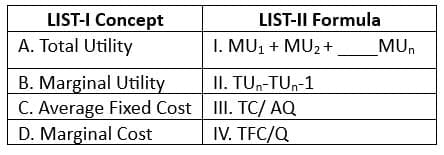
(a) A-IV, B-III, C-II, D-I
(b) A-II, B-I, C-III, D-IV
(c) A-I, B-II, C-IV, D-III
(d) A-III, B-II, C-I, D-IV
Ans: C
Key Points
- Total Utility (A-I)
- Total Utility is the sum of all Marginal Utilities derived from each unit of consumption.
- The formula is MU1 + MU2 + MU3 + ... + MUn.
- This concept helps in understanding the overall satisfaction gained from consuming multiple units.
- Marginal Utility (B-II)
- Marginal Utility refers to the additional utility gained from consuming one more unit of a good.
- The formula is TUn - TUn-1, where TUn is the total utility from the nth unit, and TUn-1 is the total utility from the previous unit.
- This concept explains the principle of diminishing marginal utility.
- Average Fixed Cost (C-IV)
- Average Fixed Cost is calculated by dividing the Total Fixed Cost by the quantity of output.
- The formula is TFC / Q, where TFC is the total fixed cost and Q is the quantity produced.
- This value decreases as production increases due to the spreading of fixed costs over more units.
- Marginal Cost (D-III)
- Marginal Cost refers to the additional cost incurred for producing one more unit of output.
- The formula is TC / AQ, where TC is the change in total cost and AQ is the change in quantity produced.
- This concept is crucial for decision-making in production and pricing strategies.
Additional Information
- Total Utility and Marginal Utility
- Total Utility increases as more units are consumed but at a decreasing rate due to the principle of diminishing marginal utility.
- Marginal Utility is critical in understanding consumer behavior and optimizing consumption.
- Cost Concepts
- Fixed Costs remain constant regardless of the level of production.
- Marginal Cost is key for determining the most cost-effective level of production.
- Average Fixed Cost decreases as production increases due to the spreading effect.
- Applications in Economics
- These concepts are used in pricing strategies, profit maximization, and resource allocation.
- Understanding these formulas helps in solving numerical problems in exams.
Q46: Match the LIST-I with LIST-II
 Choose the correct answer from the options given below:
(a) A-I, B-II, C-III, D-IV
(b) A-III, B-II, C-IV, D-I
(c) A-IV, B-III, C-I, D-II
(d) A-II, B-I, C-III, D-IV
Ans: D
Key Points
- Balance of Payment-Current Account (A-II):
- Relates to international transactions in goods and services.
- Includes components like export and import of goods (visible trade) and services (invisible trade).
- Balance of Payment-Capital Account (B-I):
- Records the inflow and outflow of capital between countries.
- Covers transactions like foreign investment, loans, and banking capital.
- Balance of Trade (C-III):
- Concerned with the import and export of goods only.
- Does not include services or capital transfers.
- Balancing Item (D-IV):
- Represents an entry for net errors and omissions.
- Helps ensure the Balance of Payments accounts are balanced.
Additional Information
- Balance of Payments (BOP):
- A comprehensive record of all economic transactions between residents of a country and the rest of the world during a specific period.
- Comprises two main accounts:
- Current Account: Tracks trade in goods, services, income, and current transfers.
- Capital Account: Tracks capital transfers and acquisition/disposal of non-produced, non-financial assets.
- Balance of Trade:
- A subset of the Current Account.
- Calculated as the difference between a country's exports and imports of goods.
- A positive balance indicates a trade surplus, while a negative balance indicates a trade deficit.
- Balancing Item:
- Accounts for statistical discrepancies in data collection.
- Ensures that the sum of the current and capital accounts equals zero (as per double-entry accounting).
(a) 10
(b) 20
(c) 30
(d) 50
Ans: B
Key Points
- Utility Patents in India
- The term of a utility patent in India is 20 years from the date of filing of the patent application.
- This term is consistent with international standards set under the Agreement on Trade-Related Aspects of Intellectual Property Rights (TRIPS).
- The 20-year term applies regardless of whether the application is filed with provisional or complete specifications.
- Legal Basis
- The term is governed by the Patents Act, 1970, specifically under Section 53.
- The act ensures protection of intellectual property rights for inventors during this period.
Additional Information
- Key Provisions of Patents Act, 1970
- The act defines patents as exclusive rights granted for an invention, which must be novel, non-obvious, and industrially applicable.
- It provides protection for inventions across diverse fields, including pharmaceuticals, technology, and manufacturing.
- Patent Renewal
- To maintain the validity of a patent, annual renewal fees must be paid starting from the 3rd year after filing.
- Failure to pay renewal fees results in the lapse of the patent.
- Patent Rights
- The patent holder is granted exclusive rights to prevent others from making, using, selling, or distributing the patented invention without authorization.
- These rights can be monetized through licensing or assignments.
(a) Customers
(b) Suppliers
(c) Technology
(d) Competitors
Ans: C
Key Points
- Micro environment
- Refers to the immediate external environment of a business that directly affects its operations.
- Includes entities such as customers, suppliers, competitors, and other stakeholders.
- Technologyis notpart of the micro environment.
- Technology falls under the macro environment, which encompasses broader external factors like economic, legal, social, and technological trends.
- Macro environment factors influence the industry and market as a whole, not just individual businesses.
Additional Information
- Elements of Micro Environment
- Customers: The individuals or businesses purchasing the products or services of a company.
- Suppliers: Entities that provide the raw materials, goods, or services necessary for production or operations.
- Competitors: Other businesses offering similar products or services in the market, influencing pricing and strategy.
- Intermediaries: Agents, distributors, and retailers who help deliver products to customers.
- Public: Groups or individuals that have an interest or influence on the business, such as media or advocacy groups.
- Elements of Macro Environment
- Technology: Innovations, trends, and advancements affecting industries globally.
- Economic Factors: Variables such as inflation, interest rates, and economic cycles.
- Political and Legal Factors: Laws, regulations, and government policies affecting business operations.
- Socio-cultural Factors: Social norms, cultural trends, and demographic shifts impacting market preferences.
(a) Labour
(b) Legal
(c) Land
(d) Latest
Ans: B
Key Points
- Legal
- In the PESTLE framework, the "L" stands for Legal, which refers to laws, regulations, and legal factors that influence an organization's environment.
- Legal factors include employment laws, consumer protection, trade regulations, and health and safety standards.
- These factors are critical for businesses to ensure compliance and avoid penalties or legal disputes.
- The "Legal" aspect is interconnected with other PESTLE factors like Political and Economic, as regulations often arise from government policies.
Additional Information
- PESTLE framework
- PESTLE stands for Political, Economic, Social, Technological, Legal, and Environmental factors.
- It is a tool used for understanding the external environment that affects an organization.
- Each factor highlights a specific aspect of the macro environment:
- Political: Government policies, stability, and regulations.
- Economic: Inflation, interest rates, and economic growth.
- Social: Cultural norms, demographics, and consumer behavior.
- Technological: Innovations, R&D, and technological adoption.
- Legal: Laws, regulations, and compliance requirements.
- Environmental: Sustainability, climate change, and ecological impact.
- Applications of PESTLE
- Used in strategic planning to analyze external influences.
- Helps organizations to identify opportunities and mitigate risks.
- Widely applied in industries like marketing, HR, and business development.
(a) NIL
(b) ₹50,000 or gross salary, whichever is lower
(c) ₹75,000 or gross salary, whichever is lower
(d) ₹40,000 or gross salary, whichever is lower
Ans: C
Key Points
- Standard Deduction for Alternative Tax Regime
- From Assessment Year 2025-26, a standard deduction has been introduced for salaried individuals opting for the alternative tax regime under Section 115BAC.
- The deduction is ₹75,000 or gross salary, whichever is lower.
- This provides relief to salaried taxpayers who choose the new tax regime, which previously did not allow many common deductions.
- Section 115BAC Overview
- Introduced in the Finance Act 2020, the section allows taxpayers to opt for a simplified tax regime with lower tax rates but fewer exemptions/deductions.
- Key exclusions include deductions like HRA, LTA, standard deduction (previously), and others.
- The addition of the standard deduction from AY 2025-26 aims to make the regime more attractive for salaried taxpayers.
Additional Information
- Comparison of Old vs. New Tax Regime
- Old Regime: Allows several exemptions and deductions, such as HRA, LTA, Section 80C investments, medical insurance premiums, etc.
- New Regime: Offers lower tax rates but restricts most exemptions and deductions. The addition of the standard deduction enhances its appeal.
- Taxpayers must evaluate their income structure and deductions to decide which regime is more beneficial.
- Standard Deduction in Income Tax
- The standard deduction is a flat deduction from salary income to reduce taxable income.
- Under the old regime, salaried individuals were eligible for a deduction of ₹50,000 from gross salary.
- From AY 2025-26, the new regime includes a standard deduction of ₹75,000 or gross salary, whichever is lower.
(a) A, B, C, E, D
(b) D, E, B, C, A
(c) E, D, C, B, A
(d) E, B, C, A, D
Ans: C
Key Points
- Idea Generation (E)
- This is the first step where creative ideas are brainstormed for a new product.
- Focus is on identifying unmet customer needs or market opportunities.
- Identifying Prospective Customers (D)
- Once ideas are generated, the next step is to determine the target audience.
- Understanding customer demographics and preferences helps refine product concepts.
- Concept Development and Testing (C)
- In this step, the product idea is further developed into a concept.
- Concept testing involves gathering customer feedback to ensure the idea resonates with the market.
- Feasibility Analysis (B)
- After testing the concept, a feasibility analysis is conducted to evaluate technical, financial, and operational viability.
- This ensures that the product is practical and sustainable in terms of resources and cost.
- Product Development (A)
- Finally, the product is developed, which includes designing, prototyping, and testing.
- This step transitions the idea into a tangible product ready for market launch.
Additional Information
- Importance of New Product Development
- Helps businesses stay competitive by introducing innovative products to the market.
- Ensures the company adapts to changing customer needs and trends.
- Key Challenges in New Product Development
- Balancing cost with quality and innovation.
- Ensuring effective market research to minimize risks.
- Managing time constraints to meet deadlines.
- Role of Feasibility Analysis
- Critical for avoiding financial losses due to impractical ideas.
- Helps in securing stakeholder approval for moving forward with development.
(a) 9.5%
(b) 10.8%
(c) 12.9%
(d) 14.5%
Ans: C
Key Points
- Overall Cost of Capitalis calculated using the formula:
- Overall Cost of Capital = Total Earnings / Total Capital
- Steps to solve:
- Debenture Interest:
- Debentures are ₹20,00,000 at 10% interest.
- Interest = ₹20,00,000 × 10% = ₹2,00,000.
- Net Income After Interest:
- EBIT (Earnings Before Interest and Tax) = ₹5,00,000.
- Net Income = EBIT - Debenture Interest = ₹5,00,000 - ₹2,00,000 = ₹3,00,000.
- Value of Equity:
- Value of Equity = Net Income / Equity Capitalisation Rate.
- Value of Equity = ₹3,00,000 / 16% = ₹18,75,000.
- Total Capital:
- Total Capital = Value of Debentures + Value of Equity.
- Total Capital = ₹20,00,000 + ₹18,75,000 = ₹38,75,000.
- Overall Cost of Capital:
- Overall Cost of Capital = EBIT / Total Capital.
- Overall Cost of Capital = ₹5,00,000 / ₹38,75,000 = 0.129 or 12.9%.
- Debenture Interest:
- Hence, the correct answer is Option 3: 0.129.
Additional Information
- EBIT(Earnings Before Interest and Tax):
- Represents the company's profitability before deducting interest and taxes.
- Used as a key input for calculating cost of capital.
- Equity Capitalisation Rate:
- Represents the rate at which investors expect returns on equity investments.
- Used to determine the value of equity by dividing net income by this rate.
- Debentures:
- Debentures are long-term debt instruments issued by companies to raise capital.
- They carry a fixed interest rate, which is a cost to the company.
- Overall Cost of Capital:
- Reflects the weighted cost of all sources of capital (debt and equity).
- It helps evaluate the efficiency of the company's capital structure.
(a) ₹9,65,000
(b) ₹8,85,000
(c) ₹10,75,000
(d) ₹9,95,000
Ans: B
Key Points
- Net Cash from Operating Activities
- To calculate Net Cash from Operating Activities, adjustments are made to the Net Profit Before Tax to account for non-cash items and changes in working capital.
- Non-cash items like Depreciation are added back to the profit because they do not involve actual cash outflow.
- Changes in working capital include adjustments for Decrease in Current Assets (added) and Decrease in Current Liabilities (subtracted).
- Tax Paid is subtracted because it represents actual cash outflow.
- Calculation:
- Net Profit Before Tax = ₹5,90,000
- Depreciation = ₹4,30,000
- Decrease in Current Assets = ₹30,000
- Decrease in Current Liabilities = ₹85,000
- Tax Paid = ₹80,000
- Net Cash from Operating Activities = ₹5,90,000 + ₹4,30,000 + ₹30,000 - ₹85,000 - ₹80,000 = ₹8,85,000
Additional Information
- Operating Activities
- Operating activities refer to the primary revenue-generating activities of a business, such as selling goods or providing services.
- The cash flow from operating activities is a key indicator of a company's ability to generate cash from its normal operations.
- Non-Cash Adjustments
- Non-cash items like Depreciation and Amortization are added back because they reduce accounting profit but do not involve cash outflow.
- These adjustments ensure the cash flow statement accurately reflects actual cash movements.
- Working Capital Adjustments
- Decrease in Current Assets (e.g., inventory or accounts receivable) increases cash flow because it implies cash inflow or reduced cash usage.
- Decrease in Current Liabilities (e.g., accounts payable) reduces cash flow because it implies a cash outflow to settle liabilities.
- Tax Paid
- Tax paid is subtracted because it represents an actual cash outflow.
- This adjustment ensures the operating cash flow reflects all cash movements related to taxes.
(a) A, B, C, D
(b) B, A, D, C
(c) D, B, A, C
(d) C, D, A, B
Ans: B
Key Points
- Chronological Order:
- The Great Depression was the earliest event (1929-1939). It began after the stock market crash of October 1929 and was a severe worldwide economic downturn.
- The Dot Com bubble burst occurred around 2000-2001, resulting from the rapid growth and subsequent crash of internet-based companies.
- The Global Financial Crisis occurred in 2008, triggered by the collapse of the housing market and financial institutions in the United States.
- The Covid Pandemic began in late 2019, causing global economic disruption due to health crises and lockdown measures.
- Correct Sequence: The correct chronological order of the events is B (Great Depression), A (Dot Com Bubble Burst), D (Global Financial Crisis), C (Covid Pandemic).
- Objective Approach: Understanding these events helps identify significant economic disruptions in history and their impact on global markets.
Additional Information
- Great Depression (1929-1939):
- Caused by factors such as overproduction, stock market speculation, and banking collapses.
- Led to widespread unemployment and poverty, shaping the modern economic policies.
- Dot Com Bubble Burst (2000-2001):
- Resulted from overvaluation of internet-related companies during the late 1990s.
- Triggered a loss of investor confidence and billions in financial losses.
- Global Financial Crisis (2008):
- Originated from high-risk mortgage lending and the collapse of financial institutions like Lehman Brothers.
- Marked by a global recession and implementation of bailout measures by governments.
- Covid Pandemic (2019-2023):
- Caused by the outbreak of the coronavirus (COVID-19), resulting in lockdowns and economic disruption.
- Highlighted the importance of global health systems and pandemic preparedness.
(a) A, B, and C Only
(b) B, C and D Only
(c) A and D Only
(d) B, C and E Only
Ans: D
Key Points
- Amalgamation in the nature of merger
- Amalgamation in the nature of merger involves the transfer of all assets and liabilities from the transferor company to the transferee company.
- Under this method, shareholders holding not less than 90% of the face value of the equity shares of the transferor company must become equity shareholders of the transferee company.
- Payment of purchase consideration cannot be made in cash. It should be made through the issue of equity shares of the transferee company.
- The journal entries for recording such mergers are passed using the pooling of interest method, as opposed to the purchase method.
- The business of the transferor company is intended to be continued by the transferee company after the merger.
- The statements B, C, and Eare incorrect as they deviate from the required conditions for amalgamation in the nature of merger:
- B: The correct threshold for equity shareholders is 90%, not 95%.
- C: Payment of consideration in cash is not allowed in a merger.
- E: The business of the transferor company must be continued, not discontinued.
Additional Information
- Pooling of Interest Method
- Used to account for amalgamation in the nature of merger.
- Under this method, the assets, liabilities, and reserves of the transferor company are recorded at their book values in the transferee company's books.
- No new goodwill or capital reserve is created due to the merger.
- The financial statements of both companies are combined as if they were a single entity from the beginning.
- Purchase Method
- Used to account for amalgamation in the nature of purchase.
- The assets and liabilities of the transferor company are recorded at their fair values in the transferee company's books.
- Goodwill or capital reserve may arise depending on the difference between the purchase consideration and the net assets acquired.
- Key Distinction Between Merger and Purchase
- In a merger, the identity of the transferor company is absorbed entirely into the transferee company, and the business is continued.
- In a purchase, the transferee company may or may not continue the business of the transferor company.
(a) 8.50%
(b) 10.53%
(c) 12.35%
(d) 15.25%
Ans: B
Key Points
- Cost of preference shares
- The formula to calculate the cost of preference shares (Kp) is:
Kp = (Preference Dividend) / (Net Proceeds from Issue) - Preference Dividend = Face Value × Rate of Dividend = ₹100 × 10% = ₹10
- Net Proceeds = Issue Price = ₹95
- Substitute the values into the formula:
Kp = ₹10 / ₹95 = 0.1053 (or 10.53%)
- The formula to calculate the cost of preference shares (Kp) is:
- Thus, the correct answer is 0.1053.
Additional Information
- Preference Shares
- Preference shareholders have a fixed rate of dividend and preferential rights over equity shareholders for dividend payment and repayment of capital.
- They do not have voting rights in most cases.
- Cost of Capital
- The cost of capital is the minimum return that a company must earn to satisfy its investors.
- It is calculated differently for equity, preference, and debt capital.
- Issue Price
- If shares are issued at a discount (e.g., ₹95 instead of ₹100), the net proceeds are lower, increasing the cost of capital.
- This concept is relevant in determining the realistic cost of funds raised through preference shares.
(a) 1992
(b) 1999
(c) 2003
(d) 2009
Ans: D
Key Points
- Investor Protection and Education Fund Regulations, 2009
- The Securities and Exchange Board of India (SEBI) introduced these regulations in 2009 to promote investor awareness and education.
- The purpose was to safeguard investor interests and ensure they are informed about their rights and responsibilities.
- The regulations also aimed at utilizing unclaimed dividends, application money, and other funds to support investor protection initiatives.
- SEBI's role
- SEBI ensures the implementation of these regulations to maintain the integrity of the securities market.
- The fund is used for activities such as investor education programs and resolving investor grievances.
Additional Information
- Investor Protection Initiatives
- SEBI conducts awareness campaigns to educate retail investors about financial literacy.
- Programs are designed to inform investors about market risks, investment products, and their rights under SEBI regulations.
- Key Features of the Regulations
- The fund includes amounts such as unclaimed dividends, unpaid redemption proceeds, and other leftover investor funds.
- SEBI uses these funds to create resources for grievance redressal, enhance investor education, and conduct training programs.
- Historical Context
- Before 2009, there was a lack of proper utilization of unclaimed funds for investor protection.
- The introduction of these regulations marked a significant step in improving investor confidence in the securities market.
Q58: The scheme of partial integration of tax or non-agricultural income with income derived from agricultural is applicable if an individual has:
(a) Non-Agricultural income of more than the exemption limit or agricultural income exceeding ₹5000
(b) Non-Agricultural income of more than the exemption limit or agricultural income exceeding ₹2500
(c) Non-Agricultural income of more than the exemption limit and agricultural income exceeding ₹2500
(d) Non-Agricultural income of more than the exemption limit and agricultural income exceeding ₹5000
Ans: D
Key Points
- Partial integration of income
- The scheme of partial integration is applicable only when an individual has both non-agricultural income exceeding the exemption limit and agricultural income exceeding ₹5000.
- This integration ensures that the taxation of non-agricultural income takes into account the impact of agricultural income, which is otherwise exempt from tax.
- Exemption limit
- The exemption limit refers to the income threshold up to which an individual is not required to pay any tax. For example, the exemption limit for individuals below 60 years is ₹2,50,000.
- Only if the non-agricultural income crosses this limit does the scheme of partial integration apply.
Additional Information
- Agricultural income
- Agricultural income refers to income derived from sources like farming, rent from agricultural land, or income from the sale of crops.
- In India, agricultural income is exempt from tax as per Section 10(1) of the Income Tax Act.
- How partial integration works
- If the scheme applies, the agricultural income is added to the non-agricultural income to compute the tax liability.
- However, the tax is computed only on non-agricultural income after considering the impact of the agricultural income on the applicable tax slab.
- Rationale
- The purpose of the scheme is to prevent taxpayers from exploiting the tax exemption on agricultural income by misclassifying taxable income as agricultural income.
- It ensures fairness in taxation and avoids undue tax advantages.
(a) A, B, C, D Only
(b) A, B, D and E Only
(c) B, C, D, and E Only
(d) A, B, C, E Only
Ans: C
Key Points
- Define the objectives of the project or task (B)
- Clearly defined objectives ensure that all team members understand the expected outcomes and work cohesively towards achieving them.
- It provides direction and helps in aligning efforts to meet project goals effectively.
- Clarify the roles, authority, and responsibilities of managers and team members (C)
- Defining roles and responsibilities avoids confusion and ensures accountability among team members.
- This is critical in a matrix structure where individuals report to multiple managers.
- Ensure that influence is based on knowledge, information, rather than on rank (D)
- In a matrix structure, decision-making based on expertise fosters better collaboration and innovation.
- It helps build trust and credibility among team members and leaders.
- Balance the power of functional and project managers (E)
- Maintaining a balance between the authority of functional and project managers avoids conflicts and ensures smooth workflow.
- This balance allows teams to leverage both technical expertise and project management skills effectively.
Additional Information
- Matrix Structure Overview
- A matrix structure is an organizational framework that combines functional and project-based structures.
- It allows employees to report to multiple managers, typically a functional manager and a project manager.
- The structure is beneficial in dynamic environments requiring flexibility and efficient resource allocation.
- Challenges in a Matrix Structure
- Potential for role ambiguity and conflicting priorities due to dual reporting lines.
- Increased coordination effort required among team members and managers.
- Guidelines for Effective Matrix Structure
- Define clear objectives and outcomes to ensure all stakeholders are aligned.
- Encourage open communication to resolve conflicts and foster collaboration.
- Provide training to managers and team members to adapt to the matrix environment effectively.
Q60: Match the LIST-I with LIST-II
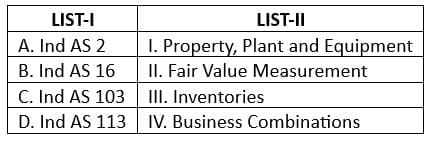 Choose the correct answer from the options given below:
(a) A-I, B-II, C-III, D-IV
(b) A-IV, B-III, C-II, D-I
(c) A-III, B-I, C-IV, D-II
(d) A-III, B-I, C-II, D-IV
Ans: C
Key Points
- Matching Ind AS Standards
- Ind AS 2 refers to Inventories, which deals with the accounting treatment for inventories including their valuation and recognition.
- Ind AS 16 pertains to Property, Plant, and Equipment, addressing the accounting for tangible fixed assets.
- Ind AS 103 is related to Business Combinations, covering accounting for mergers and acquisitions.
- Ind AS 113 deals with Fair Value Measurement, providing a framework for fair value determination.
- The correct matching is as follows:
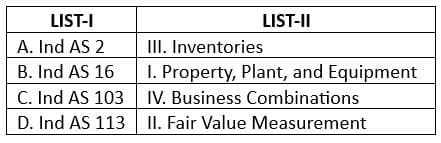
Additional Information
- Ind AS 2: Inventories
- Ind AS 2 defines inventories as assets held for sale in the ordinary course of business, in the process of production, or as materials consumed in production.
- It prescribes the cost formula and the methods for valuing inventories, such as FIFO and weighted average cost.
- Ind AS 16: Property, Plant, and Equipment
- This standard applies to tangible fixed assets used in production, supply of goods or services, and administrative purposes, with a useful life of more than one year.
- It includes provisions for depreciation, revaluation, and disposal of assets.
- Ind AS 103: Business Combinations
- Ind AS 103 provides guidance on accounting for business combinations, focusing on the acquisition method.
- It includes the recognition of goodwill or bargain purchase gain, measurement of non-controlling interest, and acquisition-related costs.
- Ind AS 113: Fair Value Measurement
- This standard establishes a single framework for fair value measurement under other Ind AS standards.
- It defines fair value as the price received to sell an asset or paid to transfer a liability in an orderly transaction between market participants at the measurement date.
- It specifies the valuation approaches: market approach, cost approach, and income approach.
(a) Behaviorally Anchored Rating Scale
(b) Critical Incident Method
(c) Paired Comparison Method
(d) Mixed Standard Scales
Ans: B
Key Points
- Critical Incident Method
- This method involves keeping a record of specific, uncommonly good or undesirable examples of an employee's behavior related to their work.
- The focus is on recording incidents that illustrate effective or ineffective performance.
- It provides objective data to review with the employee during pre-determined intervals, allowing for constructive feedback.
- The method emphasizes behavior, not traits or general impressions, ensuring a fair evaluation process.
Additional Information
- Behaviorally Anchored Rating Scale (BARS)
- This method uses specific behavior examples as anchors on a rating scale to evaluate performance.
- BARS combines both qualitative and quantitative data, making it highly reliable and valid for performance appraisals.
- Paired Comparison Method
- In this method, employees are compared pairwise with each other based on specific traits or performance criteria.
- It is suitable for making relative comparisons but may be less effective for providing individual feedback.
- Mixed Standard Scales
- This method involves evaluating employees against a set of statements describing high, medium, and low levels of performance.
- It ensures consistency in evaluation by avoiding rating errors like central tendency and halo effect.
(a) Brownfield investment
(b) Merger and Acquisition
(c) Strategic alliances
(d) Greenfield investment
Ans: D
Key Points
- Greenfield investment
- This type of Foreign Direct Investment (FDI) involves the creation of new assets and establishment of new production facilities in the host country.
- It is a method where a company starts its operations from the ground up, such as building factories, offices, or distribution hubs in the foreign country.
- This type of investment is common in industries like manufacturing, energy, and infrastructure.
- It is considered a long-term investment strategy and can significantly contribute to the host country's economy by creating jobs and boosting infrastructure.
Additional Information
- Types of FDI
- Greenfield investment
- Involves building new facilities from scratch in a foreign country.
- Provides more control to the investor over operations and policies.
- Encourages innovation and infrastructure development in the host country.
- Brownfield investment
- Involves acquiring or leasing existing facilities in a foreign country.
- Often used to expand operations quickly without starting from scratch.
- Common in industries like energy, telecommunications, and real estate.
- Merger and Acquisition
- Occurs when a company directly purchases or merges with an existing company in a foreign country.
- Offers immediate access to the market and established infrastructure.
- Strategic Alliances
- Involves partnerships between foreign and local companies to share resources, knowledge, and risks.
- Common in technology transfer and research-intensive industries.
- Greenfield investment
- Significance of Greenfield Investments
- Boosts the host country's economy through job creation and infrastructure development.
- Encourages the transfer of technology and managerial expertise.
- Promotes sustainable development by adhering to environmental and regulatory standards in the host country.
Q63: Match the LIST-I with LIST-II
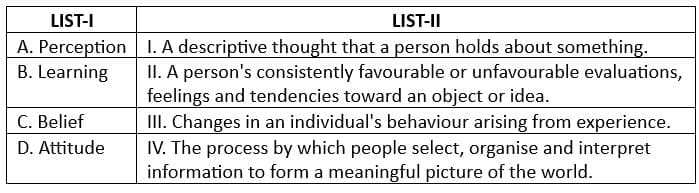
(a) A-I, B-II, C-III, D-IV
(b) A-III, B-IV, C-II, D-I
(c) A-IV, B-III, C-I, D-II
(d) A-II, B-III, C-I, D-IV
Ans: C
Key Points
- Perception (A-IV)
- Perception is the process by which individuals select, organize, and interpret information to form a meaningful picture of the world.
- It involves interpreting sensory input such as visual, auditory, or tactile stimuli.
- Learning (B-III)
- Learning refers to changes in an individual's behavior that arise from experience.
- It is an ongoing process influenced by past experiences and future expectations.
- Belief (C-I)
- A belief is a descriptive thought that a person holds about something.
- For example, a person may believe that a particular product is of high quality based on their personal experience or societal norms.
- Attitude (D-II)
- Attitude refers to an individual's consistently favorable or unfavorable evaluations, feelings, and tendencies toward an object or idea.
- It is a learned predisposition that affects decision-making and behavior.
Additional Information
- Perception
- Perception is influenced by factors such as culture, environment, and personal experiences.
- It can be subjective and differ from one person to another.
- Learning
- Learning theories such as classical conditioning, operant conditioning, and observational learning explain how individuals adapt their behavior.
- Reinforcement and punishment are key mechanisms in learning.
- Belief
- Beliefs are not always based on factual evidence and can be influenced by emotions or societal norms.
- They form the basis of opinions and judgments.
- Attitude
- Attitudes have three components: cognitive (thoughts), affective (feelings), and behavioral (actions).
- They are critical in understanding consumer behavior and decision-making processes.
(a) A and C Only
(b) A, B and C Only
(c) B, D and E Only
(d) A, C and E Only
Ans: A
Key Points
- Tax avoidance refers to the legitimate arrangement of financial affairs to minimize tax liability within the boundaries of the law.
- This aligns with statement A, which describes tax avoidance as a lawful practice for reducing taxes.
- Utilizing legal loop-holes is a key feature of tax avoidance.
- Statement C is correct, as tax avoidance involves exploiting legal provisions or gaps in tax laws to reduce tax liability.
- Statements B, D, and Eare incorrect because they describe characteristics of tax evasion, not tax avoidance:
- B: There is no malafide motive in tax avoidance because it is a legitimate practice.
- D: Avoidance occurs before a tax liability arises, not after.
- E: Tax avoidance is not the same as tax omission, which refers to failing to declare income.
Additional Information
- Tax avoidance vs. Tax evasion
- Tax avoidance is a legal practice where taxpayers use provisions of the law to minimize their tax liability.
- Tax evasion, on the other hand, is an illegal act where taxpayers deliberately misrepresent or hide information to reduce tax liability.
- Examples of tax evasion include under-reporting income, inflating expenses, or hiding assets.
- Significance of tax avoidance
- It allows individuals and businesses to optimize their financial planning.
- Governments often revise tax laws to close loopholes exploited for tax avoidance.
- Ethics in tax avoidance
- Although tax avoidance is legal, excessive reliance on loopholes may raise ethical concerns.
- Governments may view aggressive tax avoidance as contradictory to the spirit of tax laws.
Q65: Match the LIST-I with LIST-II
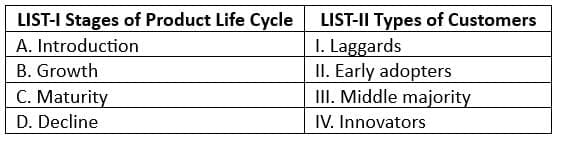
(a) A-I, B-II, C-III, D-IV
(b) A-II, B-III, C-I, D-IV
(c) A-IV, B-II, C-III, D-I
(d) A-III, B-II, C-IV, D-I
Ans: C
Key Points
- Stages of Product Life Cycle
- The Introduction stage is associated with Innovators, as they are the first to adopt new products.
- The Growth stage sees adoption by Early adopters, who are influential and help popularize the product.
- The Maturity stage involves the Middle majority, as the product gains widespread acceptance.
- The Decline stage is dominated by Laggards, who are the last to adopt the product.
- Matching LIST-I to LIST-II
- A-IV: Innovators are crucial during the Introduction stage.
- B-II: Early adopters facilitate product growth during the Growth stage.
- C-III: Middle majority drives sales during the Maturity stage.
- D-I: Laggards adopt products during the Decline stage.
Additional Information
- Innovators
- They are risk-takers and the first to try new products.
- Typically make up a small percentage of the population (~2.5%).
- Early adopters
- They are opinion leaders and influence the broader market.
- Comprise about 13.5% of the population.
- Middle majority
- Includes the early and late majority, who adopt products after observing their success.
- Represents a significant portion of the population (~68%).
- Laggards
- Resistant to change and adopt products only when necessary.
- Make up the remaining ~16% of the population.
- Product Life Cycle
- Includes four distinct stages: Introduction, Growth, Maturity, and Decline.
- Each stage corresponds to specific marketing strategies and customer behaviors.
(a) A, B, C and D Only
(b) B, C, D and E Only
(c) A, B, D and E Only
(d) B, D and E Only
Ans: C
Key Points
- Geographical Price Differentials
- These pricing strategies are designed to account for variations in costs or demand across different geographic locations.
- Examples include F.O.B Factory Pricing, Zone Pricing, Postage Stamp Pricing, and Basing Point Pricing.
- F.O.B Factory Pricing
- This stands for "Free On Board" pricing. Customers bear the shipping costs from the factory to their location.
- It is a common method to allocate transportation costs based on the buyer's location.
- Zone Pricing
- The company divides its market into geographic zones and sets a uniform price for each zone.
- Prices may vary between zones depending on transportation costs and other factors.
- Postage Stamp Pricing
- Also known as "Uniform Delivered Pricing," customers pay the same price regardless of their location within the market area.
- It is commonly used for nationwide marketing of products.
- Basing Point Pricing
- Prices are calculated based on the distance from a specific "basing point."
- This method simplifies pricing and ensures consistency in transportation cost calculations.
Additional Information
- Loss Leader Pricing
- This is not a geographical pricing strategy.
- It involves selling a product at a low price to attract customers who may then purchase other higher-priced products.
- It is commonly used in retail and promotional campaigns.
- Importance of Geographical Pricing
- Helps businesses cater to regional demand variations effectively.
- Ensures that transportation costs are accounted for fairly.
- Allows for competitive positioning in different markets.
(a) A, B, C, D, E
(b) C, B, D, A, E
(c) A, D, B, C, E
(d) E, D, C, B, A
Ans: C
Key Points
- Declaration of Solvency (A)
- The process begins with the declaration of solvency by the designated partners.
- This declaration confirms that the LLP is solvent and capable of paying off its debts in full within a specified period.
- Identification of an Insolvency Professional as Liquidator (D)
- A qualified Insolvency Professional is identified to act as the liquidator during the liquidation process.
- This professional oversees the process and ensures compliance with legal requirements.
- Designated Partners' Meeting (B)
- The designated partners convene a meeting to approve the resolution for voluntary liquidation.
- They also authorize the appointment of the insolvency professional as the liquidator.
- Partners' Meeting (C)
- A meeting of all partners is held to pass the resolution for voluntary liquidation.
- The resolution must be approved by at least three-fourths of the total partners.
- Filing of Resolutions with the Registrar and IBBI (E)
- The approved resolutions are filed with the Registrar of Companies (RoC) and the Insolvency and Bankruptcy Board of India (IBBI).
- This step ensures that the liquidation process is officially recorded and legally recognized.
Additional Information
- Voluntary Liquidation of LLP
- The voluntary liquidation process is undertaken when the partners of an LLP decide to wind up the business and settle its obligations.
- It applies only if the LLP is solvent and able to pay its debts.
- Role of Insolvency Professional
- The insolvency professional ensures compliance with the Insolvency and Bankruptcy Code (IBC), 2016.
- They prepare reports, manage the distribution of assets, and handle claims of creditors.
- Legal Compliance
- All resolutions and filings must comply with the provisions of the Limited Liability Partnership Act, 2008.
- Failure to file resolutions with the RoC and IBBI can invalidate the liquidation process.
Q68: Match the LIST-I with LIST-II
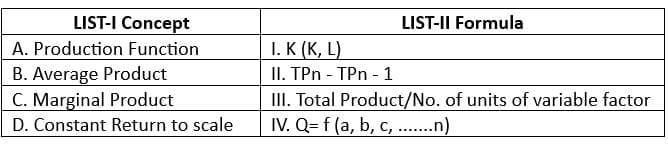 Choose the correct answer from the options given below:
(a) A-I, B-II, C-III, D-IV
(b) A-II, B-I, C-IV, D-III
(c) A-I, B-II, C-IV, D-III
(d) A-IV, B-III, C-II, D-I
Ans: D
Key Points
- Production Function (A-IV)
- A production function represents the relationship between inputs (like capital, labor) and the output produced.
- Its formula is expressed as Q = f(a, b, c, ....n), where Q is the output, and a, b, c, etc., are input variables.
- Average Product (B-III)
- The Average Product (AP) is calculated as the Total Product divided by the number of units of the variable factor.
- It measures the efficiency of each unit of the variable factor used in production.
- Marginal Product (C-II)
- The Marginal Product (MP) is the additional output produced by using an extra unit of input.
- Its formula is expressed as MP = Tn - Tn-1, where Tn is the total output at n units of input, and Tn-1 is the total output at n-1 units of input.
- Constant Return to Scale (D-I)
- Constant Return to Scale refers to a situation where increasing all inputs by a certain proportion leads to an equal proportion increase in output.
- Its representation is typically shown as K(K, L), where K and L are capital and labor inputs.
Additional Information
- Total Product
- Total Product (TP) refers to the total quantity of output produced by all units of a variable factor.
- It is the sum of all outputs produced at different levels of input.
- Returns to Scale
- Returns to scale are classified as:
- Increasing Returns to Scale: Output increases by a greater proportion than inputs.
- Constant Returns to Scale: Output increases in the same proportion as inputs.
- Decreasing Returns to Scale: Output increases by a lesser proportion than inputs.
- Returns to scale are classified as:
- Law of Diminishing Marginal Returns
- This law states that as more units of a variable factor are added to a fixed factor, the marginal product eventually decreases.
- It is a key concept in microeconomics and helps explain production efficiency.
(a) Management audit is a statutory requirement.
(b) Management audit is a comprehensive and critical review of all aspects of management process.
(c) Management audit covers wide area of management activities and may be for more than one financial year.
(d) The shareholders or board of directors may appoint the management auditor.
Ans: A
Key Points
- Incorrect nature of the statement:
- Management audit is not a statutory requirement, meaning it is not mandated by law.
- It is a voluntary process undertaken by organizations to evaluate the efficiency and effectiveness of their management practices.
- Statutory audits, such as financial audits, are legally required, whereas management audits are conducted as per the discretion of the organization.
- Purpose of management audit:
- It provides a critical evaluation of management policies, processes, and practices.
- The focus is on improving organizational efficiency and identifying areas for development.
Additional Information
- Scope of management audit:
- It covers all aspects of management, including planning, organizing, staffing, directing, and controlling.
- It is a comprehensive review and can span multiple financial years for assessing long-term trends.
- Appointment of management auditor:
- The management auditor is typically appointed by the shareholders or the board of directors of the organization.
- The appointment is made based on the organization's specific needs for performance evaluation.
- Key differences from statutory audit:
- A statutory audit focuses solely on financial compliance, while a management audit evaluates overall management practices.
- Statutory audits are mandatory by law, whereas management audits are voluntary.
(a) Cash
(b) Debertures
(c) Debtors
(d) Inventories
Ans: D
Key Points
- Non-Monetary Items
- Non-monetary items refer to those assets or liabilities whose value is not fixed in monetary terms.
- Examples include inventories, property, plant, and equipment, as their value can fluctuate based on market conditions.
- In the context of current purchasing power accounting, these items are adjusted for changes in the purchasing power of money.
- Inventories
- Inventories are classified as non-monetary items because their value is subject to market price changes.
- They are measured at cost or net realizable value, which is not fixed in monetary terms.
- Monetary Items vs. Non-Monetary Items
- Monetary items have a fixed nominal value, such as cash, debtors, and debentures.
- Non-monetary items, like inventories, do not have a fixed monetary value and are influenced by external factors such as inflation and market conditions.
Additional Information
- Monetary Items
- Monetary items include assets and liabilities that have a fixed value in terms of currency.
- Examples include:
- Cash: Always has a fixed nominal value.
- Debtors: Represent amounts receivable in fixed monetary terms.
- Debentures: Represent fixed obligations payable in monetary terms.
- These items are not affected by inflation adjustments in current purchasing power accounting.
- Current Purchasing Power (CPP) Accounting
- CPP accounting adjusts the financial statements for changes in the purchasing power of money due to inflation or deflation.
- Monetary items remain unadjusted, while non-monetary items are restated to reflect their current value in real terms.
- This method ensures that the financial statements provide a more accurate picture of an entity's financial position in times of changing inflation rates.
(a) Misrepresentation
(b) Undue influence
(c) Fraud
(d) Mistake
Ans: C
Key Points
- Fraud is a deliberate act of deception intended to secure an unfair or unlawful gain.
- The term active concealment of fact refers to hiding or suppressing a material fact that one is legally obligated to disclose.
- Under the Indian Contract Act, fraud includes acts committed with the intent to deceive another party.
- Examples include tampering with documents, hiding defects in products, or providing false information.
- Active concealment is considered fraudulent because it prevents the other party from making informed decisions.
Additional Information
- Misrepresentation
- Refers to the act of making an innocent or negligent false statement of fact.
- Unlike fraud, misrepresentation lacks the intent to deceive.
- It usually results in making the contract voidable at the discretion of the aggrieved party.
- Undue Influence
- Occurs when one party uses their position of power to dominate the will of another party.
- It involves exploiting a relationship of trust or dependency.
- Mistake
- A mistake refers to an erroneous belief about a fact or law.
- It can be classified into two types:
- Unilateral mistake
- Mutual mistake
- A mistake generally does not involve deliberate concealment or deception.
Q72: Match the LIST-I with LIST-II
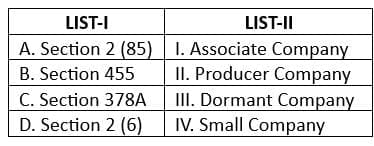
(a) A-I, B-II, C-III, D-IV
(b) A-I, B-III, C-II, D-IV
(c) A-II, B-III, C-I, D-IV
(d) A-IV, B-III, C-II, D-I
Ans: D
Key Points
- Section 2 (85): Small Company
- Defines a Small Company based on criteria like paid-up share capital and turnover, as specified under the Companies Act, 2013.
- Small companies enjoy certain exemptions and privileges under the Act.
- Section 455: Dormant Company
- Applicable to companies formed for future projects or holding assets without any significant accounting transactions.
- Such companies can apply for the status of a Dormant Company under this provision.
- Section 378A: Producer Company
- Introduced to govern Producer Companies, which consist of agriculturists or producers working together to achieve common goals.
- Focuses on activities such as processing, marketing, and exporting of agricultural produce.
- Section 2 (6): Associate Company
- Defines an Associate Company in which another company has significant influence, but not control.
- Significant influence refers to control of at least 20% of total voting power or participation in decision-making.
Additional Information
- Small Company:
- Exempted from certain provisions like preparing cash flow statements and holding four board meetings annually.
- Eligibility thresholds for turnover and paid-up share capital may change periodically as per government notifications.
- Dormant Company:
- Such companies are inactive but maintain their legal status to carry out future objectives.
- Need to file annual compliance documents, even if dormant.
- Producer Company:
- Governed under Chapter XXIA of the Companies Act, 2013.
- Promotes the economic interests of agricultural producers and rural entrepreneurs.
- Associate Company:
- Important for financial reporting and consolidation under accounting standards.
- Significant influence is determined by investment percentage or contractual arrangements.
Q73: What is the primary liability of the drawer of a bill of exchange or cheque?
(a) Liability to compensate the holder incase of dishonour.
(b) Liability to pay the amount at maturity.
(c) Liability to provide sufficient funds to the drawee.
(d) Liability to pay the holder without any condition.
Ans: A
Key Points
- Primary liability of the drawer:
- The drawer of a bill of exchange or cheque is liable to compensate the holder if the instrument is dishonoured.
- Dishonour occurs when the drawee (bank or individual) refuses to accept or pay the instrument.
- This liability arises under the Negotiable Instruments Act, ensuring protection for the holder of the instrument.
- Legal recourse for the holder:
- If dishonour occurs, the holder can initiate legal action against the drawer for compensation.
- The compensation typically includes the principal amount and any legal or incidental costs incurred by the holder.
Additional Information
- Key provisions of the Negotiable Instruments Act:
- Section 30: Specifies the liability of the drawer, stating that the drawer must compensate the holder if the instrument is dishonoured.
- Section 138: Deals with penalties for dishonour of cheques due to insufficient funds or other reasons.
- Other liabilities of the drawer:
- Liability to provide sufficient funds: The drawer must ensure that the drawee (bank) has adequate funds or authority to honour the payment.
- Liability to the payee: The drawer must ensure the instrument is correctly issued and delivered to avoid disputes or errors.
- Dishonour scenarios:
- Dishonour can occur due to insufficient funds, a stop payment order, or incorrect details on the instrument.
- Legal remedies and penalties are designed to protect the holder and maintain trust in negotiable instruments.
(a) A, B, C, D
(b) B, A, C, D
(c) C, D, A, B
(d) D, C, B, A
Ans: A
Key Points
- IFCI (Industrial Finance Corporation of India) was established in 1948, making it the first development financial institution in India.
- IDBI (Industrial Development Bank of India) was set up in 1964 to provide credit and other facilities for the development of industries.
- NABARD (National Bank for Agriculture and Rural Development) came into existence in 1982 to promote sustainable and equitable agriculture and rural development.
- SIDBI (Small Industries Development Bank of India) was established in 1990 to cater to the financial and developmental needs of micro, small, and medium enterprises.
- Thus, the correct chronological order (old to new) is A (IFCI), B (IDBI), C (NABARD), D (SIDBI).
Additional Information
- Development Financial Institutions (DFIs)
- DFIs are specialized institutions set up to provide long-term finance for the industrial and economic development of a country.
- They focus on sectors such as industry, agriculture, and small-scale enterprises that are often underserved by commercial banks.
- Role of DFIs in India
- Filling the credit gap in areas not adequately funded by private financial institutions.
- Promoting industrialization by supporting large infrastructure projects.
- Encouraging entrepreneurship and innovation through financial assistance.
- Key DFIs in India
- IFCI: The first DFI in India, initially focusing on providing long-term industrial finance.
- IDBI: Played a crucial role in planning, promoting, and developing industries.
- NABARD: Focused on agriculture, rural development, and microfinance.
- SIDBI: Concentrates on small-scale and medium enterprises to promote self-reliance and entrepreneurship.
Q75: Match the LIST-I with LIST-II
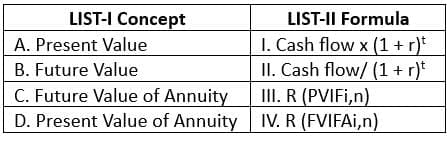 Choose the correct answer from the options given below:
(a) А-ІІ, В-І, С-IV, D-III
(b) A-I, B-II, C-IV, D-III
(c) A-III, B-IV, C-I, D-II
(d) A-I, B-III, C-II, D-IV
Ans: A
Key Points
- Matching LIST-I (Concept) with LIST-II (Formula):
- Present Value (A):
- The formula for Present Value (PV) is Cash Flow ÷ (1 + r)t.
- This formula determines the current worth of a future cash flow based on the discount rate (r) and time period (t).
- Hence, A matches with II.
- Future Value (B):
- The formula for Future Value (FV) is Cash Flow × (1 + r)t.
- This represents the value of an investment at a future date, considering the rate of return (r) and time period (t).
- Hence, B matches with I.
- Future Value of Annuity (C):
- The formula for Future Value of Annuity is R × FVIFAi,n.
- Here, R represents the periodic payment, and FVIFAi,n is the Future Value Interest Factor for Annuity.
- Hence, C matches with IV.
- Present Value of Annuity (D):
- The formula for Present Value of Annuity is R × PVIFAi,n.
- Here, R represents the periodic payment, and PVIFAi,n is the Present Value Interest Factor for Annuity.
- Hence, D matches with III.
- Present Value (A):
The correct matching is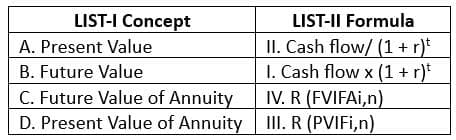
Additional Information
- Present Value (PV):
- The concept of Present Value is widely used in discounted cash flow analysis to evaluate investment opportunities.
- It helps in determining whether the current investment is worthwhile given the expected future returns.
- Future Value (FV):
- Future Value is crucial in compounding interest calculations, helping investors understand how much their money will grow over time.
- It is an essential concept in personal finance, retirement planning, and long-term investments.
- Future Value of Annuity (FVA):
- This concept applies to scenarios involving regular payments, such as monthly savings or installment plans.
- FVA is calculated using the formula: R × FVIFAi,n, where FVIFAi,n is determined from standard financial tables.
- Present Value of Annuity (PVA):
- PVA is used to evaluate the current worth of regular payments expected in the future, such as in loans or pensions.
- The formula: R × PVIFAi,n relies on PVIFAi,n values available in financial tables.
(a) A, B and C Only
(b) B, C and D Only
(c) A, C and E Only
(d) A, B and E Only
Ans: D
Key Points
- Statement A: If a company is an Indian company, it will automatically be considered as a domestic company.
- This statement is correct because under Indian tax law, all Indian companies are classified as domestic companies for taxation purposes.
- Statement B: Foreign company means a company which is not a domestic company.
- This statement is correct as per the definition in the Income Tax Act, where a foreign company is any company that is not incorporated in India and is not classified as a domestic company.
- Statement E: Foreign income is taxable in the hands of a company resident in India.
- This statement is correct because a resident company is taxed on its global income, including foreign income, under Indian tax laws.
Additional Information
- Statement C: The residential status of an Indian company can be non-resident in India.
- This statement is incorrect because an Indian company is always considered a resident in India under the Income Tax Act, irrespective of where its management or operations are conducted.
- Statement D: The residential status of a foreign company can never be resident in India.
- This statement is incorrect because a foreign company can be classified as a resident in India if its place of effective management (POEM) is in India during the relevant financial year.
- Definition of Domestic and Foreign Companies:
- A domestic company is one that is incorporated in India or declared as such under specific taxation provisions.
- A foreign company is one that is incorporated outside India and does not meet the criteria to qualify as a domestic company.
- Global Taxation for Resident Companies:
- Resident companies in India are subject to taxation on their global income, including income earned from foreign sources.
- Non-resident companies are taxed only on income earned or accrued within India.
(a) Profit Orientation
(b) Product Orientation
(c) Market Orientation
(d) Customer Orientation
Ans: D
Key Points
- Customer Orientation
- Levitt and Drucker emphasize the importance of focusing on the needs and preferences of the customer in marketing.
- Marketing is viewed as a process of understanding the customer and providing solutions that deliver value and satisfaction.
- Customer-centric approaches help businesses build long-term relationships and loyalty by addressing specific demands effectively.
- This orientation shifts the focus from simply selling products or services to creating a meaningful connection with the customer.
Additional Information
- Market Orientation vs. Customer Orientation
- Market Orientation focuses on understanding the broader market trends, competition, and external environment to align business strategies.
- Customer Orientation is narrower and specifically targets individual customer needs and preferences.
- While both orientations are important, Customer Orientation is critical for delivering personalized solutions and fostering brand loyalty.
- Product Orientation
- This approach prioritizes the quality and features of the product rather than the customer's needs.
- It assumes that a superior product will automatically attract customers, which may not always align with modern marketing principles.
- Profit Orientation
- Businesses primarily focused on profit orientation may neglect customer satisfaction, leading to short-term gains but long-term challenges.
- Levitt and Drucker argue that profits should be a result of satisfying the customer, rather than the sole focus.
Q78:
(a) D, B, A, C, E
(b) A, B, C, D, E
(c) B, D, C, E, A
(d) D, A, B, C, E
Ans: A
Key Points
- Maslow's Hierarchy of Needs
- This model is a psychological framework that categorizes human needs into five hierarchical levels.
- The arrangement is sequential, meaning that lower-level needs must generally be satisfied before higher-level needs can be addressed.
- The correct order in Maslow's hierarchy is as follows:
- Physiological Needs (D) - Basic survival needs like food, water, and shelter.
- Safety Needs (B) - Security, stability, and protection from harm.
- Social Needs (A) - Belonging, love, and interpersonal relationships.
- Esteem Needs (C) - Recognition, self-esteem, and respect from others.
- Self-Actualisation Needs (E) - Realizing one's full potential and pursuing personal growth.
Additional Information
- Details about the Five Levels
- Physiological Needs
- These are the most basic and essential needs, such as air, water, food, sleep, and clothing.
- Without fulfilling these needs, survival is at risk.
- Safety Needs
- These include physical safety, financial security, health, and protection from accidents and harm.
- Examples: Job security, insurance, and safe living conditions.
- These include physical safety, financial security, health, and protection from accidents and harm.
- Social Needs
- Humans have a need for belonging, love, and acceptance in relationships.
- Examples: Friendships, family bonds, and romantic relationships.
- Humans have a need for belonging, love, and acceptance in relationships.
- Esteem Needs
- These involve self-respect, achievement, and recognition by others.
- They are categorized into:
- Internal Esteem: Confidence, independence.
- External Esteem: Status, reputation.
- Self-Actualisation Needs
- This is the highest level, where individuals strive to achieve their full potential.
- Examples: Pursuing personal goals, creativity, and self-improvement.
- Physiological Needs
- Applications of Maslow's Hierarchy
- Used in psychology, education, and business to understand and motivate individuals.
- Helps identify priorities and address unmet needs effectively.
(a) A, C, D, B
(b) C, A, B, D
(c) C, A, D, B
(d) A, B, C, D
Ans: C
Key Points
- Correct Order for Asset Application in Partnership Firm Dissolution
- Step C: Paying the debts of the firm to third parties is the first priority, as the external liabilities must be cleared before internal obligations.
- Step A: Paying to each partner rateably what is due to them from the firm for advances (as distinguished from capital) comes next. These represent loans or temporary funding provided by partners.
- Step D: Settling the partners' capital accounts is the third step. This ensures that partners are reimbursed for their invested capital.
- Step B: Distributing any remaining residues among the partners in the proportion in which they were entitled to share profits is the final step in the process.
- This prioritization aligns with the legal requirements for the orderly settlement of obligations during the dissolution of a partnership firm.
Additional Information
- Legal Provisions:
- The order of application of assets is governed by Section 48 of the Indian Partnership Act, 1932.
- This ensures fair and equitable distribution of the firm's assets among creditors, partners, and other stakeholders.
- Explanation of Key Terms:
- Debts to third parties: These include liabilities to banks, suppliers, and other external creditors.
- Advances: Temporary loans or additional contributions made by partners, which are different from their fixed capital contributions.
- Capital: The amount invested by partners in the firm, which is reimbursed after settling external obligations.
- Residues: Any remaining assets distributed among partners as per the profit-sharing ratio.
- Practical Application:
- Correctly following this order protects the interests of creditors and ensures transparency and fairness during the dissolution process.
- Understanding the order is crucial for accountants, lawyers, and partners involved in a partnership firm.
(a) A, B, D Only
(b) A, C Only
(c) B, C, D Only
(d) A, B, C and D
Ans: A
Key Points
- World Trade Organization (WTO)
- WTO is an international organization established in 1995 to regulate and promote global trade.
- Key Objectives
- To set rules for international trade: WTO formulates agreements that provide a framework for international trade, ensuring predictability and stability.
- To resolve trade disputes: WTO has a dispute resolution mechanism to address disagreements between member countries regarding trade practices.
- To provide a forum for negotiating trade liberalisation: WTO facilitates discussions and negotiations to reduce trade barriers and enhance global trade flows.
- Exclusion of Incorrect Options
- Border disputes are not within the scope of the WTO. These are typically geopolitical issues handled by other international organizations or bilateral agreements.
Additional Information
- Functions of WTO
- Administers trade agreements such as the General Agreement on Tariffs and Trade (GATT).
- Monitors national trade policies to ensure adherence to global standards.
- Provides technical assistance and capacity-building programs for developing countries.
- Promotes transparency in trade practices through regular reviews.
- Benefits of WTO Membership
- Access to a larger global marketplace for goods and services.
- Legal framework to resolve trade disputes amicably.
- Opportunity to participate in trade negotiations that shape global trade policies.
- Key Agreements
- GATT (General Agreement on Tariffs and Trade) - Focuses on trade in goods.
- GATS (General Agreement on Trade in Services) - Deals with trade in services.
- TRIPS (Trade-Related Aspects of Intellectual Property Rights) - Addresses intellectual property issues in trade.
(a) 150 days
(b) 120 days
(c) 100 days
(d) 90 days
Ans: B
Key Points
- Working Capital Cycle
- The working capital cycle is the time taken by a company to convert its net current assets and current liabilities into cash.
- It includes raw material holding, production, finished goods holding, and credit terms with both suppliers and debtors.
- Calculation Breakdown
- Raw material holding period: 60 days
- Production process: 15 days
- Finished goods holding period: 30 days
- Debtors' credit period: 30 days
- Supplier credit period: Subtract 15 days
- Total working capital cycle = (60 + 15 + 30 + 30) - 15 = 120 days
- Correct Answer: Based on the calculation, the total working capital cycle is 120 days.
Additional Information
- Importance of Working Capital Cycle
- The working capital cycle helps businesses understand their liquidity and operational efficiency.
- Shorter cycles generally indicate better cash flow management and quicker turnover of assets.
- Components of Working Capital Cycle
- Raw Material Holding Period: Time for which raw materials are stored before production begins.
- Production Period: Time taken for raw materials to be converted into finished goods.
- Finished Goods Holding Period: Time for which finished goods are stored before being sold.
- Debtors' Credit Period: Time given to customers to pay for purchased goods.
- Supplier Credit Period: Time allowed by suppliers before payment is due; this reduces the cycle length.
- Objective Exam Tips
- Understand formula-based calculations for the working capital cycle.
- Pay attention to subtracting the supplier credit period from the overall cycle.
- Practice similar questions to improve speed and accuracy for exams.
(a) Monopoly
(b) Monopolistic Competition
(c) Oligopoly
(d) Perfect Competition
Ans: C
Key Points
- Oligopoly
- An oligopoly is a market structure where a small number of sellers dominate the market.
- These sellers offer competing products to a large number of buyers.
- The key feature of this structure is interdependence, where each seller's actions influence and are influenced by the actions of other sellers.
- Examples of oligopolistic industries include the automobile and airline industries.
Additional Information
- Market Structures
- Monopoly
- A market structure where there is only one seller and no competition.
- The seller has complete control over the price and supply of the product.
- Example: Utility companies like electricity providers in some regions.
- Monopolistic Competition
- A market structure where there are many sellers offering similar but differentiated products.
- Examples include restaurants, clothing brands, and cosmetic products.
- Perfect Competition
- A market structure where there are a large number of sellers and buyers, and all products are homogeneous.
- There is no control over price by individual sellers.
- Example: Agricultural markets like wheat or rice.
- Monopoly
- Key Characteristics of Oligopoly
- Few Sellers: The market is dominated by a small number of firms.
- Barriers to Entry: High entry costs or other obstacles prevent new competitors from entering easily.
- Non-Price Competition: Firms often compete on factors other than price, such as advertising, product differentiation, and customer service.
(a) A and D Only
(b) B, C and E Only
(c) A, B and C Only
(d) A, D and E Only
Ans: D
Key Points
- Property A: The coefficient of correlation and the two regression coefficients have the same signs
- The coefficient of correlation (denoted as r) and the regression coefficients (byx and bxy) are directly related.
- If r is positive, both regression coefficients are positive; if r is negative, both regression coefficients are negative.
- This ensures consistency in the direction of the relationship between variables.
- Property D: If one of the regression coefficients is greater than unity, the other must be less than unity
- The regression coefficients are calculated based on the standard deviations of the variables.
- If byx > 1, then bxy < 1, ensuring the product of the two regression coefficients equals the square of the correlation coefficient (r²).
- This property maintains the mathematical relationship between the coefficients and the correlation.
- Property E: The regression coefficients are independent of the change of origin but not of scale
- Regression coefficients remain unaffected by shifting the origin (e.g., adding or subtracting a constant).
- However, they are affected by changes in scale (e.g., multiplication or division by a constant).
- This distinction is important for understanding how data transformations impact regression analysis.
Additional Information
- Regression Coefficient Properties
- The regression coefficients byx and bxy are measures of the relationship between two variables, where one is dependent and the other is independent.
- They help predict the value of one variable based on the value of another.
- Correlation Coefficient and Regression Coefficients
- The correlation coefficient (r) represents the strength and direction of the linear relationship between two variables.
- The product of the two regression coefficients is equal to r², which represents the proportion of variance explained.
- Impact of Change in Origin and Scale
- A change in origin (shifting the data) does not affect the regression coefficients.
- A change in scale (rescaling the data) alters the regression coefficients proportionally.
(a) B, A, C, D, E
(b) A, B, C, E, D
(c) C, A, B, D, E
(d) D, E, B, A, C
Ans: C
Key Points
- Step 1 - Procure Digital Signature Certificate (C)
- A Digital Signature Certificate (DSC) is essential for signing electronic documents during the LLP incorporation process.
- DSC is required for filing forms with the Ministry of Corporate Affairs (MCA).
- Step 2 - Reserve LLP Name (A)
- The name of the LLP is reserved by filing the LLP Form 1 with the MCA.
- The name must comply with the naming guidelines provided under the LLP Act.
- Step 3 - Preparation of Documents for Incorporation of LLP (B)
- Documents such as the Incorporation Form, address proof, identity proof, and other supporting documents are prepared.
- Details of partners and their contributions are also included.
- Step 4 - LLP Incorporation and DIN Application (D)
- File the LLP Form 2 for incorporation along with the DIN Application for designated partners.
- Simultaneously, apply for PAN and TAN to comply with tax regulations.
- Step 5 - Drafting and Filling LLP Agreement (E)
- The LLP agreement governs the mutual rights and duties of the partners.
- It is filed through Form 3 within 30 days of incorporation.
Additional Information
- Limited Liability Partnership (LLP)
- An LLP is a corporate structure that combines the benefits of a partnership and a company.
- It provides limited liability protection to its partners, unlike traditional partnerships.
- Advantages of LLP
- Flexibility: Partners have the flexibility to manage the LLP as per mutual agreement.
- Separate Legal Entity: The LLP has its own legal identity, separate from its partners.
- Tax Benefits: LLPs are taxed differently from companies, offering potential savings.
- Key Forms for LLP Incorporation
- Form 1: Name Reservation.
- Form 2: LLP Incorporation.
- Form 3: LLP Agreement Filing.
(a) Test validity
(b) Criterion validity
(c) Content validity
(d) Construct validity
Ans: B
Key Points
- Criterion validity
- It refers to the extent to which the results of a selection procedure, such as a test, are statistically correlated with job performance or other relevant outcomes.
- It ensures that the selection tool is effective in predicting an individual's performance in a specific role or activity.
- For example, a test designed to predict sales performance will have high criterion validity if scores on the test strongly correlate with actual sales performance.
- It is widely used in employment testing, academic assessments, and other contexts where predictive accuracy is essential.
Additional Information
- Types of Validity
- Test validity
- It is a broad term that encompasses all types of validity, including criterion validity, content validity, and construct validity.
- It ensures that a test measures what it is intended to measure.
- Content validity
- Refers to how well a test represents the entire domain of the subject being measured.
- For example, a math test with questions from all relevant topics has high content validity.
- Construct validity
- Measures how well a test or tool assesses the theoretical construct it is designed to measure.
- For instance, a test for intelligence should align with established theories of intelligence.
- Test validity
- Importance of Criterion Validity
- Helps organizations make data-driven decisions in hiring, training, and performance evaluation.
- Improves the reliability of assessments and reduces the risk of biased decision-making.
- Widely applied in areas such as psychological testing, academic assessments, and job recruitment processes.
(a) A and B Only
(b) A, B and C Only
(c) B, C and D Only
(d) A, B, C and D
Ans: D
Key Points
- Price of the Commodity
- The price of a commodity directly influences its demand; generally, higher prices lead to lower demand (law of demand).
- Consumers evaluate the value they derive from a product relative to its cost.
- Income of the Consumer
- Consumer demand for goods is positively related to their income; higher income increases purchasing power.
- For normal goods, demand increases with income, while for inferior goods, demand may decrease as income rises.
- Taste and Preferences of Consumer
- Consumer preferences significantly affect demand; a shift in taste towards a commodity increases its demand.
- Factors like advertising, trends, and cultural influences impact consumer preferences.
- Size of Population
- A larger population typically leads to higher aggregate demand for goods and services.
- Population demographics, such as age distribution and urbanization, also play a role in determining demand patterns.
Additional Information
- Other Factors Influencing Demand
- Substitute Goods: Availability and pricing of substitutes can affect demand for the original product.
- Complementary Goods: Demand for one product can be influenced by the demand for complementary goods (e.g., cars and fuel).
- Future Expectations: Expectations about future price changes or income levels can affect current demand.
- Government Policies: Taxes, subsidies, and regulations can influence demand patterns for various goods.
- Elasticity of Demand
- Price Elasticity: Measures how sensitive demand is to changes in price.
- Income Elasticity: Reflects the change in demand based on variations in consumer income.
- Cross Elasticity: Indicates how demand for a product changes in response to the price of related goods.
Q87: Match the LIST-I with LIST-II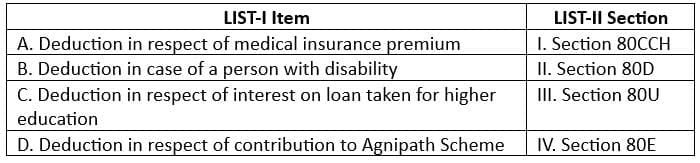
(a) A-IV, B-I, C-II, D-III
(b) A-III, B-IV, C-I, D-II
(c) A-II, B-III, C-IV, D-I
(d) A-I, B-II, C-III, D-IV
Ans: C
Key Points
- Deduction in respect of medical insurance premium (Section 80D)
- This section allows individuals to claim deductions for premiums paid towards health insurance for self, spouse, children, or parents.
- The maximum deduction varies based on age and whether the insured is a senior citizen.
- Deduction in case of a person with disability (Section 80U)
- This section is applicable to taxpayers who suffer from a disability, as defined under the Income Tax Act.
- Fixed deductions are provided based on the severity of the disability (normal disability vs. severe disability).
- Deduction in respect of interest on loan taken for higher education (Section 80E)
- This deduction is available to individuals for interest payments on loans taken for higher education.
- The deduction is available for a maximum of 8 years or until the loan is fully repaid, whichever is earlier.
- Deduction in respect of contribution to Agnipath Scheme (Section 80CCH)
- Introduced to provide tax benefits for contributions made to the Agnipath Scheme.
- The section specifies the eligibility and deduction limits for individuals contributing to this scheme.
Additional Information
- Section 80D
- This deduction can be claimed by individuals and Hindu Undivided Families (HUF).
- It also covers preventive health check-ups, subject to specified limits.
- Section 80U
- Disability must be certified by medical authorities as prescribed under the Income Tax rules.
- Applicable to conditions such as blindness, mental retardation, and locomotor disabilities.
- Section 80E
- The deduction is available to individuals who have taken loans for higher education for themselves, their spouse, children, or a student for whom they are the legal guardian.
- Higher education includes any course pursued after completing senior secondary education.
- Section 80CCH
- Introduced specifically to incentivize contributions to the Agnipath Scheme.
- Taxpayers must ensure compliance with the eligibility criteria under the scheme guidelines.
(a) t test
(b) z test
(c) Chi-Square test
(d) Mann-whitney test
Ans: A
Key Points
- Paired t-test
- The paired t-test is a statistical method used to compare the means of two related groups.
- It is specifically applied when the samples are dependent, such as measurements taken before and after an intervention on the same subjects.
- This test assumes that the data is normally distributed and the paired differences are continuous.
- It tests the null hypothesis that the mean difference between paired observations is zero.
- Statistical Application
- Used in scenarios like analyzing pre-test and post-test scores in educational research or measuring the effect of a treatment in clinical trials.
- Key formula: t = (Mean difference) / (Standard Error of Difference).
Additional Information
- Alternative Tests
- Z test
- Used for large samples (>30) and assumes the population standard deviation is known.
- Not suitable for paired samples, as it applies to independent samples and population proportions.
- Chi-Square test
- A non-parametric test used to analyze categorical data.
- Cannot be used for comparing means or paired samples.
- Mann-Whitney test
- A non-parametric test used for independent samples to compare medians.
- It is not appropriate for paired samples.
- Z test
- Assumptions of Paired t-test
- Data is continuous and measured on an interval or ratio scale.
- Paired differences are normally distributed.
- Observations within each pair are dependent, but pairs are independent.
(a) B, D, E, A, C
(b) A, C, E, B, D
(c) E, A, C, D, B
(d) E, C, A, B, D
Ans: D
Key Points
- E: Launch of S & P CNX Nifty
- The S & P CNX Nifty index was launched in 1996. It is a benchmark index of the National Stock Exchange (NSE).
- This was a significant milestone as it provided a standardized index for trading and gauging market performance.
- C: Commencement of Derivatives Trading in Index Futures
- Index futures trading began in 2000, marking the introduction of derivatives trading on NSE.
- It allowed investors to hedge risks and provided new opportunities for speculation and arbitrage.
- A: Commencement of Trading in Index Options
- Trading in index options commenced in 2001, further expanding derivatives market offerings.
- Index options gave traders a choice to bet on market movements with limited risk.
- B: Launch of Securities Lending and Borrowing Scheme
- The Securities Lending and Borrowing Scheme was introduced in 2008.
- This enabled investors to lend and borrow securities, providing liquidity and flexibility in the market.
- D: Launch of Mutual Fund Service System
- Mutual Fund Service System was launched in 2009, simplifying mutual fund transactions.
- This allowed investors to access mutual funds directly through NSE's infrastructure, boosting retail participation.
Additional Information
- Evolution of NSE
- NSE was established in 1992 to bring transparency and efficiency to the Indian stock market.
- It revolutionized trading by introducing screen-based trading and electronic settlement systems.
- Derivatives Market
- The launch of derivatives trading (futures and options) in the 2000s was a game-changer for the Indian financial markets.
- It allowed investors to manage risks and introduced sophisticated financial tools.
- Mutual Fund Services
- With the launch of the Mutual Fund Service System, NSE simplified mutual fund transactions, encouraging retail investor participation.
- This system was designed to provide a seamless and efficient process for buying and redeeming mutual fund units.
- Securities Lending and Borrowing
- This scheme boosted market liquidity and enabled investors to generate additional returns on idle securities.
- It played a crucial role in supporting short-selling and arbitrage opportunities in the market.
(a) 714 buckets
(b) 428 buckets
(c) 1000 buckets
(d) 1600 buckets
Ans: D
Key Points
- Break-even Analysis Formula
- To calculate the number of buckets required to achieve a specific profit, use the formula:
Sales Quantity = (Fixed Cost + Desired Profit) / (Selling Price - Variable Cost)
- To calculate the number of buckets required to achieve a specific profit, use the formula:
- Given Data
- Fixed Cost = ₹1,50,000
- Desired Profit = ₹90,000
- Selling Price per Bucket = ₹210
- Variable Cost per Bucket = ₹60
- Step-by-Step Calculation
- Contribution per Bucket = Selling Price - Variable Cost = ₹210 - ₹60 = ₹150
- Total Amount Needed = Fixed Cost + Desired Profit = ₹1,50,000 + ₹90,000 = ₹2,40,000
- Sales Quantity = Total Amount Needed / Contribution per Bucket = ₹2,40,000 / ₹150 = 1600 buckets
Additional Information
- Concept of Contribution Margin
- The contribution margin is the difference between the selling price per unit and the variable cost per unit.
- It represents the portion of sales revenue that contributes to covering the fixed costs and generating profit.
- Break-even Point
- The break-even point is the level of sales at which total revenue equals total costs (fixed and variable).
- At this point, the business makes neither a profit nor a loss.
- Profit Calculation
- Once the break-even point is surpassed, the contribution margin from additional units sold contributes to profit.
- Profit = (Sales Quantity × Contribution Margin) - Fixed Costs
(a) Encouraging empoyee to find new jobs
(b) Reducing training budgets
(c) Conducting skill gap analysis and creating career development plan
(d) Promoting only senior employee
Ans: C
Key Points
- Conducting skill gap analysis
- Identifies the disparity between current employee skills and the skills required for career progression.
- Helps in understanding the specific areas where employees need improvement or training.
- Provides objective data for creating actionable and tailored career development plans.
- Creating career development plans
- Ensures employees have a clear roadmap for growth within the organization.
- Promotes employee engagement by addressing dissatisfaction and aligning career goals with organizational objectives.
- Includes necessary training, mentorship, and certifications to help employees achieve their goals.
- Impact on employee morale
- Employees feel valued and supported, leading to increased satisfaction and productivity.
- Addresses concerns related to stagnation and lack of growth opportunities.
Additional Information
- Employee dissatisfaction
- Often stems from lack of clarity in career progression or perceived favoritism in promotions.
- Can lead to reduced morale, higher turnover rates, and lower productivity.
- Benefits of addressing skill gaps
- Improves the competency of the workforce, enhancing organizational performance.
- Provides employees with the tools they need to succeed, fostering loyalty and reducing attrition.
- Training and development
- Includes workshops, online courses, certifications, and mentorship programs tailored to employee needs.
- Should be aligned with both individual career aspirations and organizational goals.
(a) Making the resignation process more difficult
(b) Increasing workload
(c) Offering voluntary retirement
(d) Offering increments and career growth opportunities
Ans: D
Key Points
- Offering increments and career growth opportunities
- Financial benefits: Employees feel valued when they receive regular increments, making them more likely to stay with the organization.
- Career advancement: Opportunities for promotions and skill development encourage employees to envision a long-term future with the company.
- Increased job satisfaction: A focus on growth and rewards enhances employee morale and reduces dissatisfaction, a major driver of attrition.
- Retention strategy: Providing career growth aligns employees' goals with organizational objectives, fostering loyalty and reducing turnover rates.
- Employee engagement: Growth opportunities make employees more engaged, which positively impacts productivity and reduces the likelihood of resignation.
Additional Information
- Employee retention strategies
- Recognition and rewards: Regular acknowledgment of employee contributions fosters motivation and commitment.
- Work-life balance: Providing flexible work arrangements and addressing workload concerns helps employees maintain a healthy balance, reducing burnout and attrition.
- Employee training: Offering skill-building workshops and certifications enhances professional growth and satisfaction.
- Open communication channels: Transparent communication and feedback mechanisms improve trust and organizational culture.
- Common causes of attrition
- Lack of growth opportunities: Employees often leave organizations where they perceive limited career advancement.
- Poor compensation: Inadequate salaries or benefits can drive employees to seek better-paying jobs elsewhere.
- Work environment: Toxic or unsupportive work environments significantly contribute to attrition rates.
- Heavy workload: Overburdened employees may experience stress and burnout, leading to higher turnover.
(a) The number of training program conducted
(b) The positive feed back of customers
(c) The financial impact of HR initiatives on business growth
(d) The employees performance appraisal methods
Ans: C
Key Points
- The financial impact of HR initiatives on business growth
- Senior management prioritizes tangible outcomes that directly contribute to the organization's financial performance.
- By presenting data on how HR initiatives have led to measurable business growth, Priya can demonstrate the return on investment (ROI) of HR efforts.
- Examples include:
- Increased employee productivity leading to higher revenue.
- Cost savings due to reduced employee turnover.
- Improved organizational efficiency through training and development programs.
- Focusing on financial impact aligns HR initiatives with the company's strategic goals, making it easier to secure management buy-in.
Additional Information
- Other approaches and why they are less effective
- The number of training programs conducted
- This metric focuses on quantity, not the quality or impact of the training.
- Senior management is more concerned with how training translates to business results, not just the number of sessions.
- The positive feedback of customers
- While customer feedback is important, it is often indirectly related to HR initiatives.
- Without a clear link to financial outcomes, this point is less compelling for senior management.
- Employee performance appraisal methods
- Performance appraisal methods are process-oriented and do not explicitly highlight how HR impacts business growth.
- Focusing on outcomes rather than methods is more effective in convincing management.
- The number of training programs conducted
- Best practices for presenting HR initiatives
- Use data-driven insights to establish a clear connection between HR activities and business performance.
- Include case studies or examples that show successful HR contributions to financial growth.
- Highlight metrics such as:
- Employee retention rates and their cost savings.
- Increased sales or productivity linked to specific HR initiatives.
- Reduced absenteeism and its impact on operations.
(a) Employees social media engagements
(b) Attrition trends and exit interview feedback
(c) The number of training program
(d) The number of leaves taken by employees
Ans: B
Key Points
- Attrition trends
- Analyzing historical data on employee turnover helps in identifying patterns and trends over time.
- It provides insights into when and why employees are leaving, which can help in predicting future turnover.
- Exit interview feedback
- Exit interviews provide qualitative data on the reasons employees leave the organization.
- This data can highlight recurring issues such as dissatisfaction with management, lack of growth opportunities, or workplace culture challenges.
- Using these two data sources together allows Priya to develop predictive models to forecast labor turnover and implement strategies to improve employee retention.
Additional Information
- Importance of predictive analytics in HR
- Predictive analytics involves using historical data to forecast future events, such as employee turnover.
- It helps organizations proactively address issues, improving retention rates and reducing recruitment costs.
- Other key data points for HR analytics
- Employee engagement surveys: These can provide insights into overall employee satisfaction and potential risks of turnover.
- Performance data: Identifying correlations between performance and turnover can help target retention efforts.
- Demographics: Understanding turnover trends across age groups, departments, or job roles can improve targeted interventions.
- Limitations of social media and other options
- Social media engagements: While it reflects employee interests, it does not directly correlate with turnover.
- Number of training programs: Training alone does not indicate turnover risks unless paired with other data.
- Number of leaves: Excessive leaves may hint at dissatisfaction but are not a standalone predictor of turnover.
(a) Implementing intensive employee development program
(b) Hiring only external candidates for leadership role
(c) Implementing performance linked bonus
(d) Promoting employees on seniority basis
Ans: A
Key Points
- Implementing intensive employee development program
- This strategy focuses on training and upskilling employees to prepare them for future leadership roles.
- Development programs often include initiatives like mentorship, career coaching, and leadership workshops.
- It ensures that internal talent is groomed to take on higher responsibilities, fostering organizational continuity and retaining institutional knowledge.
- Such programs build a robust pipeline of competent leaders, reducing dependency on external hires.
- It enhances employee satisfaction and engagement by demonstrating the organization's commitment to their career growth.
Additional Information
- Other HR Strategies
- Hiring only external candidates for leadership roles
- This approach can bring fresh perspectives but may lead to a lack of internal motivation among employees.
- External hires may take time to adjust to the organization's culture and processes.
- Implementing performance-linked bonus
- While this improves employee productivity, it does not directly contribute to leadership development.
- This strategy primarily focuses on rewarding current performance rather than building future capabilities.
- Promoting employees on seniority basis
- This strategy may lead to promotions based on tenure rather than merit or leadership potential.
- It can result in inefficiencies if promoted employees lack the necessary skills for leadership roles.
- Hiring only external candidates for leadership roles
- Benefits of Leadership Development Programs
- Helps organizations adapt to market changes by building agile leaders.
- Improves succession planning by identifying high-potential candidates.
- Enhances organizational innovation by fostering creative problem-solving skills among future leaders.
Q96: A large real estate company in India is facing challenges in raising funds for expansion. Despite solid track record the company is struggling to attract investors due to increasing concern about liquidity in the financial market. The company has earlier relied on bank loans and debt instruments for financing but now looking for other funding option. The CFO of the company is evaluating different option such as corporate bonds, Private equity, public deposit and securitization to raise capital. He is also looking at the evolving role of financial institution such as investment banks, development banks and insurance companies in providing finance. However, he is concerned about the volatility of the stock market and the risk of inflation affecting company's future cashflow. To address these challenges, the company plan to consult with financial advisors and explore new avenues of funding, including green bonds and venture capital. The CFO must navigate the complex world of financial markets to ensure that the company secures the right funding at the right cost.
Which of the following is a primary function of financial markets in the economy?
(a) Facilitating buying and selling of financial instruments
(b) Offering financial advice to individual investors
(c) Providing loan without collateral
(d) Incresing revenues for the Government
Ans: A
Key Points
- Primary Function of Financial Markets
- Financial markets provide a platform for the buying and selling of financial instruments like stocks, bonds, derivatives, and more.
- This function enables the efficient allocation of resources by channeling funds from savers to entities in need of capital, such as businesses and governments.
- Liquidity Creation
- By facilitating transactions, financial markets ensure liquidity, allowing investors to buy or sell assets quickly without significant price changes.
- Importance for Economic Growth
- Efficient financial markets promote economic growth by enabling businesses to access funding for expansion and innovation.
Additional Information
- Other Functions of Financial Markets
- Price Discovery
- Financial markets help in the determination of prices of financial assets based on supply and demand dynamics.
- Risk Management
- Through instruments like derivatives, financial markets assist in hedging risks associated with price volatility.
- Price Discovery
- Key Differences from Non-Primary Functions
- While financial advice and loans are part of the broader financial ecosystem, they are not the primary functions of financial markets.
- Financial markets focus on facilitating transactions, not directly lending or advising individual investors.
Q97: A large real estate company in India is facing challenges in raising funds for expansion. Despite solid track record the company is struggling to attract investors due to increasing concern about liquidity in the financial market. The company has earlier relied on bank loans and debt instruments for financing but now looking for other funding option. The CFO of the company is evaluating different option such as corporate bonds, Private equity, public deposit and securitization to raise capital. He is also looking at the evolving role of financial institution such as investment banks, development banks and insurance companies in providing finance. However, he is concerned about the volatility of the stock market and the risk of inflation affecting company's future cashflow. To address these challenges, the company plan to consult with financial advisors and explore new avenues of funding, including green bonds and venture capital. The CFO must navigate the complex world of financial markets to ensure that the company secures the right funding at the right cost.
What is the main advantage of raising capital through venture capital?
(a) To avoid giving up ownership or control
(b) To access expertise and guidance from investors
(c) To get the fund for a very long term
(d) To get a low cost funding
Ans: B
Key Points
- Expertise and guidance
- Venture capitalists not only provide funding but also offer strategic mentorship to help businesses grow.
- This includes advice on business strategy, market positioning, and scaling operations.
- Network Access
- Venture capitalists bring access to a wide network of industry connections.
- These connections can help secure partnerships, acquire customers, and attract follow-on funding.
- Operational Support
- Many venture capital firms assist with recruitment of key personnel, such as senior management or technical experts.
- They may also provide support in setting up robust financial and operational systems.
Additional Information
- Venture Capital vs. Other Funding Sources
- Unlike bank loans, venture capital does not require repayment, making it less risky for startups.
- However, entrepreneurs typically have to give up a portion of their ownership in exchange for funding.
- Stages of Venture Capital Investment
- Venture capital funding is often provided in stages: seed funding, early-stage funding, and growth-stage funding.
- Each stage targets specific business milestones, such as product development, market entry, or scaling operations.
- Trade-offs of Venture Capital
- While venture capital offers growth opportunities, it often involves loss of control as investors may expect a say in major business decisions.
- Entrepreneurs must balance the benefits of funding and expertise with the potential dilution of ownership.
Q98: A large real estate company in India is facing challenges in raising funds for expansion. Despite solid track record the company is struggling to attract investors due to increasing concern about liquidity in the financial market. The company has earlier relied on bank loans and debt instruments for financing but now looking for other funding option. The CFO of the company is evaluating different option such as corporate bonds, Private equity, public deposit and securitization to raise capital. He is also looking at the evolving role of financial institution such as investment banks, development banks and insurance companies in providing finance. However, he is concerned about the volatility of the stock market and the risk of inflation affecting company's future cashflow. To address these challenges, the company plan to consult with financial advisors and explore new avenues of funding, including green bonds and venture capital. The CFO must navigate the complex world of financial markets to ensure that the company secures the right funding at the right cost.
What would be the main concern for the company if it has to issue green bonds for financing?
(a) High interest rate
(b) Less repayment period
(c) Limited investor demand due to niche market
(d) Goverment restriction
Ans: C
Key Points
- Limited investor demand
- Green bonds appeal primarily to investors with a focus on sustainability, creating a niche market.
- This niche nature can result in restricted demand, particularly compared to conventional bonds.
- Companies may face challenges in attracting a diverse investor base, impacting their ability to raise funds effectively.
- Investor preferences
- Investors may prioritize returns over environmental benefits, leading to lower participation in green bond markets.
- Awareness and interest in green bonds are still growing, which contributes to limited demand.
Additional Information
- Key features of green bonds
- Green bonds are designed to finance projects that provide environmental benefits, such as renewable energy, clean transportation, and waste management.
- They are subject to external certification to ensure compliance with sustainability goals.
- Challenges in issuing green bonds
- High costs: Companies may face additional expenses for certification and reporting requirements.
- Regulatory complexity: Ensuring compliance with government guidelines and international standards can be challenging.
- Market education: Companies must invest in educating investors about the benefits of green bonds to improve demand.
- Global trends
- Green bond issuance has been growing rapidly, driven by increasing awareness of climate change.
- Governments and international organizations are promoting green bonds through incentives and frameworks.
Q99: A large real estate company in India is facing challenges in raising funds for expansion. Despite solid track record the company is struggling to attract investors due to increasing concern about liquidity in the financial market. The company has earlier relied on bank loans and debt instruments for financing but now looking for other funding option. The CFO of the company is evaluating different option such as corporate bonds, Private equity, public deposit and securitization to raise capital. He is also looking at the evolving role of financial institution such as investment banks, development banks and insurance companies in providing finance. However, he is concerned about the volatility of the stock market and the risk of inflation affecting company's future cashflow. To address these challenges, the company plan to consult with financial advisors and explore new avenues of funding, including green bonds and venture capital. The CFO must navigate the complex world of financial markets to ensure that the company secures the right funding at the right cost.
In a volatile stock market, how the company can reduce financing risk when raising funds through equity?
(a) Issue share only when market is at peak
(b) Raise funds through long term bonds only
(c) Reduce dividend payout to increase internal funds
(d) Diversify source of funds by combining debt and equity financing
Ans: D
Key Points
- Diversify source of funds
- Combining debt and equity financing reduces the dependency on a single funding source.
- It balances the risk-return tradeoff by maintaining an optimal capital structure.
- This approach is particularly useful in a volatile stock market, where equity prices fluctuate unpredictably.
- Minimizes financing risk
- By using multiple funding sources, companies can ensure stability in raising necessary funds even during market downturns.
- Diversification allows the company to leverage debt when equity markets are unfavorable and vice versa.
- Flexibility in financial planning
- This approach offers greater flexibility for the company to adapt to market conditions and financial needs.
- It ensures that the company can avoid over-reliance on any one source of capital.
Additional Information
- Equity financing
- Involves raising funds by issuing shares to investors, which does not require repayment.
- However, it may lead to dilution of ownership and is dependent on market conditions.
- In a volatile market, equity financing becomes less predictable due to fluctuating share prices.
- Debt financing
- Raising funds through loans or bonds that need to be repaid with interest.
- Provides a predictable cost of financing but increases financial risk due to fixed obligations.
- Long-term debt is often used to reduce the impact of short-term market fluctuations.
- Optimal capital structure
- Refers to the mix of debt and equity that minimizes the overall cost of capital while maximizing shareholder value.
- Diversifying financing sources is a key strategy to achieve an optimal capital structure in uncertain markets.
Q100: A large real estate company in India is facing challenges in raising funds for expansion. Despite solid track record the company is struggling to attract investors due to increasing concern about liquidity in the financial market. The company has earlier relied on bank loans and debt instruments for financing but now looking for other funding option. The CFO of the company is evaluating different option such as corporate bonds, Private equity, public deposit and securitization to raise capital. He is also looking at the evolving role of financial institution such as investment banks, development banks and insurance companies in providing finance. However, he is concerned about the volatility of the stock market and the risk of inflation affecting company's future cashflow. To address these challenges, the company plan to consult with financial advisors and explore new avenues of funding, including green bonds and venture capital. The CFO must navigate the complex world of financial markets to ensure that the company secures the right funding at the right cost.
The company is considering corporate bonds as a funding option. Which factor is most likely to affect the interest rate of bond?
(a) The number of projects completed by the company
(b) The interest rate on Government securities
(c) The credit rating of the bond
(d) The level of Foreign Direct Investment
Ans: C
Key Points
- The credit rating of the bond
- A bond's credit rating reflects the issuer's ability to repay the debt and meet interest payments.
- Higher ratings (e.g., AAA) indicate lower risk, leading to lower interest rates.
- Lower ratings (e.g., BB or below) suggest higher risk, requiring higher interest rates to attract investors.
- Credit ratings are determined by agencies such as Moody's, S&P, and Fitch.
- Investors use these ratings to assess the bond's risk profile and potential returns.
Additional Information
- Interest rate on government securities
- Government securities often serve as a benchmark for bond interest rates, but they primarily reflect risk-free rates.
- Corporate bonds offer higher rates than government securities due to their default risk.
- Foreign Direct Investment (FDI) levels
- FDI levels may influence a company's financial stability indirectly but are not a direct determinant of bond interest rates.
- Number of projects completed by the company
- While this demonstrates operational success, it does not directly impact the bond's credit rating or interest rate.
FAQs on UGC NET Paper 2: Commerce 27th June 2025 Shift 1
| 1. What are the main topics covered in UGC NET Commerce Paper 2 for June 2025? |  |
| 2. How should I prepare for the multiple-choice questions in UGC NET Commerce Paper 2 shift 1? | |
| 3. What's the difference between financial accounting and management accounting questions asked in UGC NET Commerce? | |
| 4. How can I avoid common mistakes while answering company law and corporate governance questions? | |
| 5. What audit concepts should I focus on for maximum marks in UGC NET Paper 2? | |