UGC NET Paper 2: Sociology 29th June 2025 Shift 1

Q1: Where people are in a long-term partner relationship and they and others recognise them as a couple but
They remain isolated most of the time, referred to as ________.
(a) intimate and family relationships
(b) Affinities and relationships
(c) Cohabitation
(d) Mixed-race family relationships
Ans: C
- Cohabitation
- Refers to a living arrangement where a couple is in a long-term relationship and shares a household without being legally married.
- In many cases, the relationship is recognized socially or among peers as a partnership.
- Despite living together, cohabiting couples may experience isolation from broader social networks due to various factors such as personal preferences or societal perceptions.
- It is distinct from other forms of relationships, such as marriage, which involve legal or religious recognition.
Additional Information
- Intimate and family relationships
- Focuses on emotional and physical closeness, often involving family bonds or legal ties like marriage.
- Unlike cohabitation, intimate relationships often do not emphasize shared living arrangements unless they are formalized through marriage.
- Affinities and relationships
- Refers to connections based on shared interests, values, or emotional bonds but does not necessarily involve living together.
- It is broader and less specific compared to cohabitation.
- Mixed-race family relationships
- Indicates families or partnerships involving individuals from different racial or ethnic backgrounds.
- This term is unrelated to the concept of cohabitation, which is based on living arrangements rather than race or ethnicity.
Q2: 'Grounded Theory' in social research was first developed by the following.
(a) Denzin and Lincoln
(b) Clifford Geertz and Marcus G.E
(c) Barney Glaser and Anselm Strauss
(d) Fielding N.G and Lee R.N
Ans: C
- Grounded Theory
- Grounded theory is a qualitative research methodology that aims to develop theories based on data systematically collected and analyzed.
- This methodology was first introduced by Barney Glaser and Anselm Strauss in their seminal 1967 book titled "The Discovery of Grounded Theory."
- It emphasizes the generation of theory from data rather than relying on pre-existing theoretical frameworks.
- The approach is widely used in social sciences, healthcare research, and other fields where exploratory analysis is required.
Q3: Following are the major public programmes/schemes for farmers introduced by the Government of India.
Arrange them sequentially from the earliest to the latest.
A. Pradhanmantri Matsya Sampada Yojana (Fisheries)
B. P.M Kisan Yojana
C. Soil Health Card Scheme
D. Agricultural Credit (Kisan Credit Card)
E. Paramparagat Krishi Yojana (Promotion of Organic Farming)
Choose the correct answer from the options given below:
(a) A, E, C, B, D
(b) C, A, D, B, E
(c) D, C, A, B, E
(d) D, C, E, B, A
Ans: D
- D. Agricultural Credit (Kisan Credit Card)
- Introduced in 1998, this scheme aimed at providing farmers with timely access to credit.
- It helps farmers meet their short-term credit requirements for cultivation and allied activities.
- C. Soil Health Card Scheme
- Launched in 2015 to promote soil testing and provide farmers with information on soil health.
- The scheme helps farmers adopt better practices for sustainable farming.
- E. Paramparagat Krishi Vikas Yojana (Promotion of Organic Farming)
- Initiated in 2015, this program focuses on promoting organic farming and reducing dependency on chemical fertilizers.
- Encourages the adoption of sustainable agricultural practices.
- B. P.M Kisan Yojana
- Launched in 2019, the scheme provides direct income support to farmers by depositing ₹6,000 annually into their accounts.
- It aims to support small and marginal farmers financially.
- A. Pradhanmantri Matsya Sampada Yojana
- Introduced in 2020, this scheme focuses on the development of the fisheries sector.
- Its objectives include enhancing fish production, creating employment opportunities, and improving infrastructure in fisheries.
Q4: Identify three basic sources of Power within any political system.
A. Prestige
B. Class
C. Force
D. Influence
Ε. Authority
Choose the most appropriate answer from the options given below:
(a) A, B, D, Only
(b) B, C, E Only
(c) C, D, E Only
(d) A, C, E Only
Ans: C
- Force
- Represents the use of coercion or physical power to enforce decisions and policies.
- It is a fundamental source of power in any political system, especially in authoritarian regimes.
- Examples include military power, police enforcement, and legal penalties.
- Influence
- Refers to the ability to shape or sway the decisions and actions of others without direct coercion.
- Influence can stem from factors such as charisma, public opinion, or lobbying efforts.
- It is a critical element in democratic systems where persuasion and negotiation play a key role.
- Authority
- Represents the legitimate power vested in individuals or institutions, such as governments or leaders.
- Authority is recognized by society and is often formalized through laws, constitutions, or traditions.
- It is a stable and institutionalized source of power in both democratic and non-democratic systems.
Q5: Among the following tribes, which one practiced fraternal polyandry?
(a) Irula
(b) Bhil
(c) Santhal
(d) Toda
Ans: D
- Fraternal polyandry
- Fraternal polyandry refers to the marriage practice where a woman marries multiple brothers within a family.
- This form of polyandry is often found in societies with scarce resources, allowing families to remain united and share property.
- Toda tribe
- The Toda tribe of the Nilgiri Hills in Tamil Nadu is known for practicing fraternal polyandry.
- This practice helps in maintaining family unity and ensuring equitable distribution of land and resources among siblings.
- It is a unique cultural feature of the Toda tribe, setting them apart from many other tribal groups in India.
Q6: According to whom, capitalism extracts not only physical labour but also emotional labour, and this is particularly the case in the hospitality sector.
(a) judith butler
(b) Betty Friedan
(c) Arlie Hochschild
(d) Anne Oakley
Ans: C
- Arlie Hochschild
- Arlie Hochschild is a sociologist known for her groundbreaking work on emotional labour.
- In her book The Managed Heart, Hochschild introduced the concept of emotional labour, referring to the effort workers put into managing their emotions to meet organizational expectations.
- Capitalism, especially in sectors like hospitality, often demands both physical and emotional labour from workers.
- Hochschild's work highlights how employees in the hospitality sector must continuously display positive emotions (e.g., friendliness, warmth) despite their actual feelings, which can lead to emotional exhaustion.
Q7: When a subculture explicitly and deliberately opposes certain aspects of the larger culture, it is known as _____.
(a) Counterculture
(b) Assimilation
(c) Cultural conflict
(d) Cultural impact
Ans: A
- Counterculture refers to a subculture that actively opposes specific norms, values, or practices of the dominant culture.
- Such subcultures often promote alternative lifestyles or ideologies that challenge the mainstream cultural expectations.
- Examples include movements like the hippie movement in the 1960s or punk subcultures that rebel against societal norms.
- The key distinction lies in the deliberate opposition to established cultural practices, unlike other forms of cultural variation.
- Countercultures often emerge during periods of social change or dissatisfaction with existing systems.
Q8: Arrange the development of normative theories of media in chronological order.
A. Social Responsibility Theory
B. Liberal Theory
C. Authoritarian Theory
D. Soviet Communist Theory
E. Development Media Theory
Choose the correct answer from the options given below :
(a) E, A, B, C, D
(b) C, A, B, D, E
(c) B, A, C, E, D
(d) C, B, A, D, E
Ans: D
- Normative Theories of Media explain how media should ideally operate in a society based on its social, cultural, and political context.
- The chronological development of these theories is as follows:
- Authoritarian Theory (C):
- Developed in the 16th and 17th centuries.
- Emphasizes strict control of media by the state to maintain authority.
- Rooted in monarchy and feudal systems.
- Liberal Theory (B):
- Emerged in the 18th century during the Enlightenment period.
- Advocates for a free press to act as a watchdog and provide unbiased information.
- Associated with democratic ideals.
- Social Responsibility Theory (A):
- Introduced in the mid-20th century.
- Focuses on ethical responsibilities of the media to serve the public interest.
- Developed as a response to the limitations of the Liberal Theory.
- Soviet Communist Theory (D):
- Originated in the early 20th century during the rise of communism in the USSR.
- Media is owned and controlled by the state to propagate socialist ideologies.
- Development Media Theory (E):
- Introduced in the late 20th century.
- Focuses on using media for national development, particularly in developing countries.
- Authoritarian Theory (C):
- Thus, the correct chronological order is: C (Authoritarian Theory), B (Liberal Theory), A (Social Responsibility Theory), D (Soviet Communist Theory), E (Development Media Theory).
Q9: The book 'Cultural Change in India: Identity and Globalization' is authored by _________.
(a) Arjun Appadurai
(b) Yogendra Singh
(c) Dipankar Gupta
(d) Satish Deshpande
Ans: B
- Yogendra Singh
- Yogendra Singh, a renowned Indian sociologist, authored the book "Cultural Change in India: Identity and Globalization".
- The book provides an in-depth analysis of the impact of globalization on Indian society and its cultural transformation.
- It examines how traditional identities in India are being redefined in the context of modernization and global influences.
- The work is widely referenced in sociology and cultural studies, making it a significant contribution to academic literature.
Additional Information
- Yogendra Singh's Contributions
- Yogendra Singh is a pioneer in the field of sociology in India, with a focus on social change and development.
- His other notable works include "Modernization of Indian Tradition" and "Social Stratification and Change in India".
- He has significantly contributed to the study of the interplay between tradition and modernity in Indian society.
- Globalization and Cultural Change
- Globalization has resulted in the blending of local and global cultures, leading to the emergence of new identities.
- Key sociological themes include the impact of technology, media, and economic reforms on cultural values and practices.
- Understanding the dynamics of globalization is critical for students of sociology, anthropology, and cultural studies.
- Other Authors Mentioned
- Arjun Appadurai: Known for his work on globalization and modernity, particularly the concept of "scapes" in global cultural flows.
- Dipankar Gupta: Focuses on modernity and social stratification in India.
- Satish Deshpande: Renowned for his studies on caste, inequality, and modernity in India.
Q10: Chronologically arrange the elements or building blocks of Social Theory:
A. Statements
B. Formats
C. Concepts
D. Variables
Choose the correct answer from the options given below:
(a) A, B, C, D
(b) B, A, D, C
(c) C, D, A, B
(d) C, D, B, A
Ans: C
- Chronological arrangement of elements in Social Theory
- Concepts are the fundamental building blocks of social theory, representing abstract ideas or phenomena that provide the basis for understanding social reality.
- Variables are measurable attributes or properties derived from concepts, allowing researchers to establish relationships and patterns.
- Statements are assertions or hypotheses that connect variables, explaining relationships or causal mechanisms between them.
- Formats refer to the structural organization or representation of statements, ensuring clarity and coherence in presenting social theory.
- This sequence reflects the logical progression from abstract ideas (Concepts) to measurable components (Variables), followed by theoretical explanation (Statements) and structured representation (Formats).
Q11: Match List-I with List-II. Choose the correct answer from the options given below:
(a) A-III, B-II, C-I, D-IV
(b) A-II, B-IV, C-I, D-III
(c) A-III, B-IV, C-II, D-I
(d) A-II, B-III, C-IV, D-I
Ans: D
- Jurgen Habermasauthored "The Philosophical Discourse of Modernity"(A-II).
- This book examines critical theories of modernity, focusing on rationality and its limitations.
- Habermas critiques thinkers like Nietzsche, Foucault, and Derrida, offering his own perspective on communicative rationality.
- Stuart Halland others contributed to "Formations of Modernity"(B-III).
- It explores cultural and historical dimensions of modernity, emphasizing how it shapes identities and social structures.
- The work is part of the Open University series, making it accessible for academic and public audiences.
- Anthony Giddensauthored "The Consequences of Modernity"(C-IV).
- This book discusses the transformations brought by modernity, including globalization, risk society, and reflexivity.
- Giddens argues that modernity is characterized by increased trust in abstract systems.
- Arjun Appaduraiauthored "Modernity at Large: Cultural Dimensions of Globalization"(D-I).
- Appadurai examines globalization's impact on cultural practices, emphasizing concepts like "scapes" (ethnoscapes, mediascapes, etc.).
- He focuses on how global processes reshape local identities and cultural forms.
Q12: Who introduced the notion 'system levels' and the concept of 'different and multiple system' in functional analysis?
(a) Talcott Parsons
(b) Robert Merton
(c) Bronislaw Malinowski
(d) Marion. J. Levy
Ans: C
- Bronislaw Malinowski
- Malinowski was a pioneering anthropologist who introduced the concept of functional analysis in social science.
- He emphasized the importance of understanding society as a system with interdependent levels and multiple systems functioning together.
- The concept of "system levels" refers to the idea that societal institutions are interconnected and operate at various levels to maintain societal stability.
- In functional analysis, Malinowski focused on how cultural practices and institutions meet the basic needs of individuals and contribute to the functioning of society.
Q13: Match the typology of movements given in List-I with sociologists in List-II. Choose the correct answer from the options given below:
(a) A-II, B-III, C-I, D-IV
(b) A-III, B-I, C-IV, D-II
(c) A-I, B-II, C-III, D-IV
(d) A-IV, B-II, C-I, D-III
Ans: B
- Typology of Movements
- The classification of social movements helps to understand their nature, objectives, and impact.
- Each sociologist has contributed uniquely to the study of movement typologies:
- Explanation of Matching
- A-III: Charismatic, ideological, and organizational movements are associated with T.K. Oommen.
- B-I: Accumulative, alternative, and transformative movements are classified by Partha Mukherji.
- C-IV: Revolt, rebellion, reform, and revolution are studied by Ghanshyam Shah.
- D-II: Reformist, transformatory, and revolutionary movements are categorized by MSA Rao.
- Correct Mapping: A-III, B-I, C-IV, D-II aligns with Option 2.
Q14: Arrange the following writings of Pierre Bourdieu in a chronological order.
A. An Invitation to Reflexive Sociology
B. The Logic of Practice
C. Distinction: A Social Critique of the Judgement of Taste
D. Masculine Domination
Ε. Language and Symbolic Power
Choose the correct answer from the options given below:
(a) B, C, A, E, D
(b) C, E, B, A, D
(c) B, A, D, E, C
(d) C, B, D, A, E
Ans: B
Sol: The correct answer is - C, E, B, A, D
- Distinction: A Social Critique of the Judgement of Taste (C) was published in 1979, making it the earliest work in the given list.
- Language and Symbolic Power (E) was published in 1982, following "Distinction".
- The Logic of Practice (B) came next, published in 1990.
- An Invitation to Reflexive Sociology (A) was published later in 1992.
- Masculine Domination (D) was the most recent, published in 1998.
Q15: Radcliffe Brown conducted his fieldwork in the following geographical locations.
A. Andaman and Nicobar Islands
B. Indonesia
C. Australia
D. Mexico
E. Malaysia
Choose the correct answer from the options given below:
(a) Only B, C and D
(b) Only A and C
(c) Only B and E
(d) Only C, D and E
Ans: B
- Radcliffe-Brown's fieldwork
- Radcliffe-Brown conducted extensive fieldwork in the Andaman and Nicobar Islands and Australia.
- His fieldwork in the Andaman and Nicobar Islands led to the publication of the seminal work, "The Andaman Islanders," which focused on kinship and social structure.
- In Australia, he studied the indigenous communities, focusing on their social organization and rituals.
- Incorrect Options
- Radcliffe-Brown did not conduct fieldwork in Indonesia, Mexico, or Malaysia.
- These regions are unrelated to his anthropological studies.
- Correct Combination
- The correct combination of geographical locations where Radcliffe-Brown conducted fieldwork is Andaman and Nicobar Islands and Australia.
Q16: Match List-I with List-II.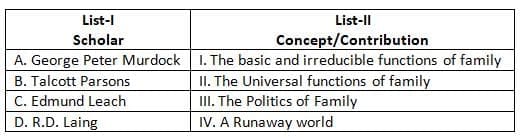 Choose the correct answer from the options given below:
(a) A-I, B-II, C-IV, D-III
(b) A-III, B-II, C-I, D-IV
(c) A-II, B-I, C-IV, D-III
(d) A-II, B-III, C-IV, D-I
Ans: C
- George Peter Murdock (A-II)
- He proposed that family performs universal functions such as reproduction, economic cooperation, sexual regulation, and socialization.
- His work emphasizes the universality of family structures across cultures.
- Talcott Parsons (B-I)
- Parsons identified two basic and irreducible functions of family: primary socialization of children and the stabilization of adult personalities.
- He viewed family as a key institution for maintaining social order and stability.
- Edmund Leach (C-IV)
- Leach's work on families highlighted the idea of a "runaway world," focusing on the rapidly changing dynamics of family structures and their social implications.
- He explored the interplay between family roles and broader societal changes.
- R.D. Laing (D-III)
- Laing studied the politics of family, emphasizing how family relationships and dynamics can shape individual psychology and contribute to social control.
- His work delves into the psychological impact of family systems on identity and mental health.
Q17: New Religious Movements (NRMs) are indebted for their growth.
(a) The revival of mainstream religions
(b) of rising economic inequalities
(c) The growing secularisation
(d) increasing information and knowledge
Ans: C
- The growing secularisation
- Secularisation refers to the process where religion loses its authority and influence over societal institutions and individuals.
- As society becomes more secular, people often seek spiritual alternatives, leading to the rise of New Religious Movements (NRMs).
- NRMs offer a fresh perspective on spirituality, often focusing on individual experiences rather than institutionalised practices.
- This trend is particularly prominent in modern, urbanised societies where traditional religious practices may seem less relevant to contemporary lifestyles.
Q18: Which Indian Sociologist critiqued the Eurocentric form of sociology and argued for indigenous sociology and based his arguments on universal humanism?
(a) A.R. Desai
(b) R. K. Mukerjee
(c) D.P Mukerji
(d) D.N Majumdar
Ans: B
- R. K. Mukerjee
- R. K. Mukerjee was a prominent Indian sociologist who critiqued the Eurocentric approach in sociology.
- He emphasized the need for an indigenous sociology that reflects the unique social, cultural, and historical contexts of India, rather than adopting Western paradigms blindly.
- His arguments were grounded in universal humanism, where the focus was on the interconnectedness of human societies and the common principles guiding them.
- He believed that sociology should not only study the structures but also the values and moral principles that guide social processes in Indian society.
Q19: "Match List-I with List-II.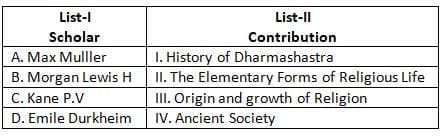 Choose the correct answer from the options given below:
(a) A-II, B-III, C-IV, D-I
(b) A-III, B-IV, C-I, D-II
(c) A-III, B-IV, C-II, D-I
(d) A-IV, B-II, C-I, D-III
Ans: B
- Max Muller
- Max Muller's contribution is associated with the Origin and Growth of Religion.
- He was a pioneer in the study of comparative religion and focused on the development of religious ideas through history.
- Morgan Lewis H
- Morgan Lewis H is known for his work Ancient Society, which explores human social evolution.
- His theories contributed significantly to anthropology and the understanding of societal development.
- Kane P.V
- Kane P.V authored the History of Dharmashastra, a monumental work on ancient Indian legal and ethical texts.
- This work is a critical resource for understanding the evolution of Indian legal systems and cultural practices.
- Emile Durkheim
- Emile Durkheim's contribution is the Elementary Forms of Religious Life, which examines the sociological aspects of religion.
- He analyzed the role of religion in maintaining social cohesion and its impact on collective consciousness.
Q20: The theory of knowledge with regard to its method and validity, and the distinction between justified belief and opinion in known as
(a) Methodology
(b) Epistemology
(c) Ethnomethodology
(d) Empiricism
Ans: B
- Epistemology
- Epistemology is the branch of philosophy that studies the nature, origin, and scope of knowledge.
- It explores the distinction between justified belief and opinion, aiming to determine what constitutes true knowledge.
- Key topics in epistemology include:
- Methods of acquiring knowledge.
- Validity and reliability of knowledge.
- Understanding the limits of human cognition.
- It is a foundational discipline in philosophy, influencing fields such as ethics, science, and education.
Additional Information
- Methodology
- Focuses on the systematic procedures used in research or analysis.
- It is not directly concerned with the philosophical understanding of knowledge but rather the process of investigation.
- Ethnomethodology
- A sociological approach that studies how people produce and maintain a shared sense of reality.
- It is more relevant to social sciences than philosophy.
- Empiricism
- Empiricism emphasizes that knowledge comes primarily from sensory experience.
- It is a theory of knowledge but does not encompass the broader philosophical inquiries found in epistemology.
Q21: Who proposed the term 'role handicap' in sociology?
(a) Talcott Parsons
(b) H.D. Kirk
(c) T.R. Sarbin
(d) T.M. Newcomb
Ans: B
- Role Handicap
- The term Role Handicap was proposed by H.D. Kirk.
- Role Handicap refers to the challenges or disadvantages faced by individuals when performing specific roles in society due to various factors such as physical, social, or cultural barriers.
- It is particularly relevant in sociology and disability studies as it highlights how societal expectations can impact an individual's ability to fulfill certain roles.
- H.D. Kirk's work emphasized the importance of understanding these barriers in order to foster inclusion and reduce discrimination.
Additional Information
- Role Theory
- Role theory is a sociological concept that examines how individuals behave in accordance with the expectations of their social roles.
- It is closely tied to concepts such as role conflict, role strain, and role identification.
- Scholars such as Talcott Parsons and T.R. Sarbin have contributed significantly to the development of role theory.
- Disability Studies and Sociology
- Disability studies focus on the social, cultural, and political dimensions of disability and how societal structures impact individuals with disabilities.
- Concepts like role handicap are essential for understanding how societal norms can exacerbate challenges for individuals with disabilities.
- Efforts to reduce role handicap include policy changes, awareness campaigns, and inclusive practices.
Q22: Which of the following is not related to Anthony Gidden's 'Theory of Modernity'?
(a) Distanciation
(b) Colonization of Life world
(c) Disembedding
(d) Reflexivity
Ans: B
- Colonization of Life world
- This concept is primarily associated with Jürgen Habermas, not Anthony Giddens.
- Habermas discusses the idea of the "life world" being overtaken by systemic forces like bureaucracy and economy, leading to a loss of autonomy and meaning in everyday life.
- In contrast, Giddens' "Theory of Modernity" focuses on other key concepts such as distanciation, disembedding, and reflexivity.
- Thus, the "Colonization of Life world" is not related to Giddens' framework.
Q23: The following media-audience study models emerged overtime. Find the correct chronological sequence
from the earliest to the latest.
A. Interpretative model
B. Gratification model
C. Hyper reality model
D. Hypodermic model
Choose the correct answer from the options given below:
(a) B, A, C, D
(b) A, C, B, D
(c) D, A, B, C
(d) D, B, A, C
Ans: D
- Chronological order of media-audience study models:
- Hypodermic model (D):
- Developed during the early 20th century, this model assumes media messages have a direct, immediate, and powerful effect on a passive audience.
- It is also known as the "magic bullet theory" and reflects a simplistic view of media influence.
- Gratification model (B):
- Emerging in the mid-20th century, this model focuses on the audience's active role in selecting and interpreting media to fulfill their needs (e.g., entertainment, knowledge).
- It emphasizes a more interactive and participatory relationship between media and its audience.
- Interpretative model (A):
- Introduced in the latter half of the 20th century, this model highlights how audiences actively construct meaning from media content based on their cultural and social contexts.
- Hyper reality model (C):
- Developed in the late 20th to early 21st century, this model addresses the blending of reality and media representations, creating a "hyper-reality."
- It is heavily influenced by postmodern theories and theorists such as Jean Baudrillard.
- Hypodermic model (D):
- The sequence D → B → A → C reflects the progression from simplistic, direct media effects to complex, interpretative, and postmodern approaches.
Q24: Who among the following edited the monthly periodical titled 'The Indian Sociologist'?
(a) G.S. Ghurye
(b) Irrawaddy River
(c) D.P. Mukherjee
(d) Shyamaji Krishnavarma
Ans: D
- Shyamaji Krishnavarma
- He was a prominent Indian nationalist and a key figure in the Indian independence movement.
- He edited and published the monthly periodical 'The Indian Sociologist', which served as a platform to promote ideas of freedom and self-rule.
- The periodical was published in London and became a voice for revolutionary activities against British colonial rule in India.
- It was banned by British authorities for its radical content and role in inspiring revolutionary sentiments among Indians.
Additional Information
- Shyamaji Krishnavarma's Contributions
- He founded the Indian Home Rule Society in 1905, with the aim of advocating for India's independence from British rule.
- He also established India House in London, which served as a hub for Indian students and revolutionaries.
- His efforts inspired other prominent leaders, such as Vinayak Damodar Savarkar and Madame Bhikaji Cama.
- 'The Indian Sociologist'
- This periodical was primarily aimed at raising awareness about the socio-political conditions in colonial India.
- It served as a tool to criticize British policies and promote the cause of Indian nationalism.
- Its content often highlighted the need for armed resistance and self-determination.
- Impact of Indian Revolutionaries Abroad
- Revolutionaries like Shyamaji Krishnavarma played a crucial role in garnering international support for India's independence.
- Their activities abroad created pressure on the British government and inspired revolutionary movements within India.
- Their work laid the foundation for future leaders and movements in the Indian freedom struggle.
Q25: Match List-I with List-II.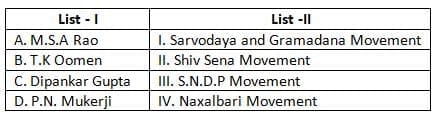
Choose the correct answer from the options given below:
(a) A-III, B-I, C-II, D-IV
(b) A-II, B-IV, C-I, D-III
(c) A-IV, B-II, C-III, D-I
(d) A-I, B-III, C-IV, D-II
Ans: A
- A. M.S.A Rao - S.N.D.P Movement
- M.S.A Rao extensively studied and documented the S.N.D.P (Sree Narayana Dharma Paripalana) Movement, which aimed at social reform among the Ezhava community in Kerala.
- The movement emphasized social equality, education, and economic upliftment.
- B. T.K Oomen - Sarvodaya and Gramadana Movement
- T.K Oomen is known for his work on the Sarvodaya and Gramadana movements, which were inspired by Gandhian principles for rural reconstruction and community development.
- The movements aimed at promoting self-reliant villages through voluntary land donations and equitable resource distribution.
- C. Dipankar Gupta - Shiv Sena Movement
- Dipankar Gupta has critically analyzed the Shiv Sena Movement, which is a regional political movement in Maharashtra.
- The movement is known for its emphasis on Marathi identity and its influence on Mumbai's socio-political landscape.
- D. P.N. Mukerji - Naxalbari Movement
- P.N. Mukerji is associated with studies on the Naxalbari Movement, which originated as a peasant uprising in West Bengal in 1967.
- The movement focused on land redistribution and highlighted issues of class struggle and exploitation of the rural poor.
Q26: Max Weber used the term 'Class' to refer to a group of people who have similar level of _______.
A. Education
B. Income
C. Status
D. Technical skill
E. Wealth
Choose the most appropriate answer from the options given below:
(a) B, C and D Only
(b) B, C and E Only
(c) A, B and C Only
(d) C, D and E Only
Ans: B
- Max Weber's concept of 'Class'
- Max Weber defined 'class' as a group of individuals who share a similar position in the market economy.
- He emphasized that class is determined by one's economic resources, including income and wealth.
- The concept also includes the notion of 'status', which reflects social prestige and influence.
- Explanation of the correct answer
- The correct answer includes:
- B: Income - A critical determinant of class in Weber's analysis.
- C: Status - Indicates the social standing or prestige associated with a class.
- E: Wealth - Refers to accumulated economic resources that impact one's class position.
- Options A (Education) and D (Technical Skill) are not part of Weber's definition of 'class'. While they may influence one's class indirectly, they are not direct factors in Weber's framework.
- The correct answer includes:
Q27: Identify the purpose of social stratification through the lens of different perspectives.
A. Facilitate recruitment to social positions (functional)
B. Facilitate exploitation (conflict)
C. Influence the life styles of people (interactionist)
D. Survival of the fittest (evolutionary)
E. Social satisfaction (general)
Choose the correct answer from the options given below:
(a) Only A, B, C
(b) Only A, B, C, D
(c) Only A, C, D, E
(d) Only B. C. D.
Ans: A
- Purpose of social stratification
- Functional perspective highlights that social stratification facilitates the recruitment and allocation of individuals to various social positions, ensuring efficiency and stability in society.
- Conflict perspective emphasizes that stratification enables exploitation, as dominant groups maintain control over resources and subordinate groups.
- Interactionist perspective focuses on how stratification influences the lifestyles, interactions, and identity formation of individuals within society.
- The correct answer excludes Option D (Evolutionary: Survival of the fittest) and Option E (General: Social satisfaction) as they are not directly aligned with the theoretical perspectives mentioned.
Q28: Match List-I with List-II.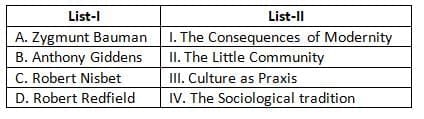 Choose the correct answer from the options given below:
(a) A-III, B-I, C-IV, D-II
(b) A-IV, B-I, C-III, D-II
(c) A-IV, B-III, C-II, D-I
(d) A-II, B-I, C-IV, D-III
Ans: A
- Zygmunt Bauman - Culture as Praxis (A-III):
- Zygmunt Bauman was a sociologist whose work focused on modernity, postmodernity, and culture. His book "Culture as Praxis" explores the relationship between culture and human practice in shaping societal life.
- Anthony Giddens - The Consequences of Modernity (B-I):
- Anthony Giddens is a prominent sociologist known for his work on modernity and globalization. His book "The Consequences of Modernity" examines the implications of modernity on social and personal life.
- Robert Nisbet - The Sociological Tradition (C-IV):
- Robert Nisbet was a historian and sociologist who wrote "The Sociological Tradition," emphasizing the development of sociology as a discipline and its classical roots.
- Robert Redfield - The Little Community (D-II):
- Robert Redfield was an anthropologist and sociologist. His book "The Little Community" focuses on small, traditional communities and their social structures.
Q29: Which of the following statements from below are characteristic of 'Fordism.'
A. The adoption of standardized work routines.
B. The resulting rise of the mass worker and bureaucratized unions.
C. Decentralized collective bargaining replaces centralized negotiations.
D. The use of inflexible technologies such as the assembly line.
E. The workers become more differentiated as people and require more differentiated commodities, lifestyles, and cultural outlets.
Choose the correct answer from the options given below:
(a) A, B and C Only
(b) A, B and D Only
(c) A, C and D Only
(d) A, B and E Only
Ans: B
- Fordism refers to a system of industrial production pioneered by Henry Ford, characterized by:
- Standardized work routines (Option A): Fordism emphasized the use of repetitive and standardized tasks to improve efficiency and productivity.
- Mass worker and bureaucratized unions (Option B): This system created conditions for the rise of mass workers with limited skill specialization, leading to the formation of bureaucratized unions.
- Inflexible technologies (Option D): The introduction of assembly lines is a hallmark of Fordism, allowing for mass production but reducing flexibility in manufacturing.
- Options C and E are incorrect because:
- Decentralized collective bargaining (Option C) is not a characteristic of Fordism; centralized negotiations were more common.
- Workers becoming differentiated (Option E) aligns more with post-Fordism, which emerged as a response to Fordism's limitations.
Q30: Some of the selected research works of A.R Desai is presented below. Arrange them in a chronological sequence from prior to latter.
A. Rural Sociology in India
B. State and Society in India
C. A Profile of Indian Slums
D. Social Background of Indian Nationalism
Choose the correct answer from the options given below:
(a) A, C, D, B
(b) A, D, C, B
(c) C, D, A, B
(d) D, A, B, C
Ans: B
- A.R. Desai was a prominent Indian sociologist known for his significant contributions to the study of Indian society and its historical transformations.
- The chronological sequence of his research works is as follows:
- Rural Sociology in India (1953): This work focuses on rural life and the socio-economic structures in Indian villages.
- Social Background of Indian Nationalism (1959): A seminal work examining the socio-economic factors that shaped Indian nationalism.
- A Profile of Indian Slums (1970): This study provides insights into the living conditions and socio-economic challenges of slum dwellers in India.
- State and Society in India (1975): An analysis of the relationship between the Indian state and society in the context of development and change.
- The correct sequence aligns with the chronological publication of these works, starting with Rural Sociology and ending with State and Society.
Q31: Who among the following differentiated between culture and civilization?
(a) Alfred Weber
(b) Emile Durkheim
(c) Marcel Moss
(d) Claude-Lévi Strauss
Ans: A
- Alfred Weber
- Alfred Weber was a German sociologist and economist known for his contributions to cultural theory.
- He made a clear distinction between culture and civilization, arguing that culture relates to the spiritual and intellectual aspects of human life, while civilization pertains to the material and technological progress.
- This differentiation highlights how human societies develop in two distinct dimensions:
- Culture: Concerned with values, traditions, and artistic expression.
- Civilization: Focused on technological advancements and organizational systems.
- His work is foundational in understanding the interplay between cultural and material development in sociology.
Q32: According to Pierre Bourdieu in his "Forms of Capital" cultural capital is manifested in and through these forms and states. These are ______.
A Institutionalised
B. Embodied
C. Symbolised
D. Objectified
E. Network
Choose the most appropriate answer from the options given below:
(a) A, B and D Only
(b) A, C and D Only
(c) B, C and E Only
(d) C, D and E Only
Ans: A
- Forms of Cultural Capital
- According to Pierre Bourdieu, cultural capital exists in three forms: institutionalized, embodied, and objectified.
- Institutionalized: This refers to recognition in the form of academic qualifications or credentials that institutionalize cultural capital.
- Embodied: Cultural capital in its embodied state exists in the form of knowledge, skills, and dispositions that an individual acquires over time.
- Objectified: Tangible objects, such as works of art, books, or instruments, represent cultural capital in its objectified state.
- Incorrect Options
- Symbolised and Network are not recognized as forms of cultural capital in Bourdieu's framework.
Q33: What is the term for 'the knowledge that human beings acquire from sensory experiences'?
Note: This question was dropped by NTA due to some error. We have modified the options to make it error free.
(a) Ontology
(b) Empiricism
(c) Rationalism
(d) Both 2 and 3
Ans: D
- Empiricism
- Holds that knowledge arises from sensory experience-observation, perception, and experimentation.
- Corresponds to a posteriori knowledge (dependent on experience).
- Classically associated with Locke, Berkeley, and Hume.
- Rationalism
- Asserts that reason and innate ideas are central sources of knowledge (especially in mathematics and logic).
- Corresponds to a priori knowledge (independent of experience).
- Key figures include Descartes, Spinoza, and Leibniz.
Q34: Testing a hypothesis mainly involves _______ :
A. Formulate your hypothesis
B. Collect the required data
C. Analyse the data to draw a conclusion about the hypothesis
D. Test the first alternative hypothesis
E. Test the null hypothesis
Choose the correct answer from the options given below :
(a) Only A, B, C, D
(b) Only B, C, D, E
(c) Only A, B, C
(d) Only C, D, E
Ans: C
- Formulate your hypothesis (A)
- Developing a clear and testable hypothesis is the first step in any hypothesis testing process.
- This hypothesis must be specific and based on prior knowledge or research.
- Collect the required data (B)
- The next step involves gathering data that is relevant to the hypothesis.
- Data collection methods depend on the type of study (e.g., experiments, surveys, or observations).
- Analyze the data to draw a conclusion (C)
- Once data is collected, it must be analyzed to determine whether it supports or rejects the hypothesis.
- This involves statistical techniques to ensure the results are objective and reliable.
Q35: Who among the following was the doctoral student of G.S. Ghurye?
A. A.K. Saran
B. A.R. Desai
C. T.N. Madan
D. M.N. Srinivas
E. D.N. Majumdar
Select the correct answer from the options given below :
(a) Only A, B and E
(b) Only B, C and E
(c) Only D and E
(d) Only B and D
Ans: D
- A.R. Desai and M.N. Srinivas were notable doctoral students of G.S. Ghurye, a prominent Indian sociologist and anthropologist.
- A.R. Desai is recognized for his contributions to Marxist sociology and his analysis of Indian society through a class perspective.
- M.N. Srinivas is famous for his concept of "Sanskritization" and his pioneering ethnographic studies on caste and society in India.
- Both scholars were deeply influenced by Ghurye's mentorship, which shaped their research methodologies and academic pursuits.
Q36: The numerical value that is assigned to a response at the time of analysing the data is called as.
(a) Code
(b) Coding
(c) Variable
(d) Case View
Ans: A
- Code
- The term Code refers to the numerical value or symbol that is assigned to a response for the purpose of data analysis.
- It is a crucial step in data processing, simplifying the organization and interpretation of responses.
- Coding involves assigning these codes, but the actual numerical value is referred to as the Code.
- For example, in a survey, if "Yes" is assigned the value 1 and "No" is assigned the value 2, then 1 and 2 are the Codes.
Additional Information
- Coding
- Coding refers to the process of assigning codes (numerical values or symbols) to qualitative or quantitative data.
- It helps in converting raw data into a structured format for statistical analysis.
- Coding is particularly useful in surveys, interviews, and other forms of primary data collection.
- Variable
- A Variable represents a characteristic or attribute that can take on different values. For example, age, gender, income, etc.
- Variables are often measured and analyzed using codes but are distinct from the actual codes themselves.
- Case View
- Case View is a term commonly used in software like SPSS or similar tools, where each row represents an individual case or respondent.
- It is a way of organizing data but does not directly refer to the numerical values assigned to responses.
Q37: Which of the following statements are associated with McLuhan's understanding of media?
A.Printed page demands complete participation, unlike telephone
B. Print is the technology of individualism
C. Cinema is cold medium
D. Television is cold medium
E. Medium is the Message
Choose the most appropriate answer from the options given below:
(a) B, D, E Only
(b) A, D, E Only
(c) B, C, D Only
(d) C, D, E Only
Ans: A
- Marshall McLuhan's Understanding of Media:
- McLuhan is well-known for his concept that the "Medium is the Message."
- He distinguished between "hot" and "cold" media, where:
- Television is a cold medium because it requires high audience participation and interpretation.
- Print is the technology of individualism, emphasizing independent thought and engagement.
- The correct answer includes:
- B: Print is the technology of individualism
- D: Television is cold medium
- E: Medium is the Message
Q38: The process of reversible dispute resolution mainly involves the following :
A. Arbitration
B. Conviction
C. Conciliation
D. Consolation
E. Mediation
Choose the correct answer from the options given below :
(a) Only A, B, E
(b) Only C, D, E
(c) Only B. C. E.
(d) Only A, C, E
Ans: D
- Arbitration
- A formal dispute resolution method in which a neutral third party, known as an arbitrator, is appointed to make a binding decision.
- It is often used in commercial disputes and provides a legally enforceable outcome.
- Key Advantage: Arbitration is a reversible dispute resolution process as parties can agree on its terms before enforcing the decision.
- Conciliation
- A voluntary process where a third party, known as a conciliator, helps disputing parties reach a mutually acceptable agreement.
- It is less formal than arbitration and allows for more flexibility in negotiations.
- Key Advantage: Conciliation emphasizes mutual understanding and preserves relationships between the parties.
- Mediation
- A process where a neutral third party, called the mediator, facilitates communication between disputing parties to help them reach a resolution.
- Key Feature: Mediation is non-binding unless both parties agree to the terms.
- Mediation is widely used in civil disputes, family law cases, and workplace conflicts.
- Incorrect Options:
- Conviction refers to a legal judgment in criminal cases, which does not fall under reversible dispute resolution methods.
- Consolation involves comforting someone emotionally, which is unrelated to dispute resolution processes.
Q39: A vast urban region containing number of cities and their surrounding suburbs is best defined as.
(a) Megacity
(b) Megaregion
(c) Urban Corridor
(d) Megalopolis
Ans: D
- Megalopolis
- A megalopolis refers to a large, continuous urban region that encompasses multiple cities and their surrounding suburbs.
- It is characterized by extensive urbanization where individual cities and towns are interconnected economically, socially, and geographically.
- Examples include the BosWash corridor in the United States, which stretches from Boston to Washington, D.C.
- The term was first popularized by the geographer Jean Gottmann in his study of urbanization in the northeastern United States.
- A megalopolis is distinct from smaller urban areas like a megacity, which refers to an individual large city rather than a regional conglomeration.
Q40: Which of the following is true about Levi-Strauss 'Theory of Exchange'?
A. Exchange must be viewed in terms of its functions for integrating the larger social structure
B. Levi-Strauss rejects the psychological interpretations of exchange
C. He endorsed utilitarian assumption that first principles of exchange are economic in nature
D. Exchange cannot be understood solely in terms of individual motives
E. Exchange relations involve costs for individuals which are attributed to society
Choose the correct answer from the options given below:
(a) A, B, C, D Only
(b) A, B, D, E Only
(c) A, C, D, E Only
(d) B, C, D, E Only
Ans: B
- Levi-Strauss' Theory of Exchange
- Levi-Strauss emphasized that exchange plays a critical role in integrating the larger social structure, fostering social cohesion and interconnection.
- He rejected psychological interpretations of exchange, focusing instead on structural and cultural dynamics.
- Levi-Strauss argued that exchange cannot be understood solely in terms of individual motives, as it operates within broader societal frameworks and structures.
- Exchange relations often involve costs for individuals, which are attributed to the functioning of society as a whole.
Q41: Match List-l with List-II.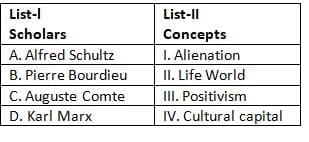 Choose the correct answer from the options given below:
(a) A-II, B-IV, C-III, D-I
(b) A-I, B-III, C-II, D-IV
(c) A-II, B-III, C-IV, D-I
(d) A-II, B-I, C-IV, D-III
Ans: A
- Alfred Schultz - Life World (II)
- Schultz introduced the concept of Life World, which refers to the everyday reality that individuals experience subjectively.
- This idea is central to phenomenology and emphasizes how people perceive and interpret their world through lived experiences.
- Pierre Bourdieu - Cultural Capital (IV)
- Bourdieu's concept of Cultural Capital focuses on non-economic resources (e.g., education, skills, cultural knowledge) that influence social mobility.
- It is a key element in understanding how power and privilege are maintained in society.
- Auguste Comte - Positivism (III)
- Comte is considered the father of Positivism, which emphasizes scientific methods and empirical data in studying society.
- He proposed that society evolves through three stages: theological, metaphysical, and scientific (positive).
- Karl Marx - Alienation (I)
- Marx introduced the concept of Alienation, describing how workers become disconnected from the products of their labor under capitalism.
- It highlights the exploitation and loss of autonomy experienced by the working class in capitalist societies.
Q42: The theoretical paradigm of functionalism anchored the idea that the maintenance of social cohesion, order and stability depends on the following:
(a) Ideological inclination
(b) Moral consensus
(c) Legal consultation
(d) Democratic conduct
Ans: B
- Moral Consensus
- The functionalist paradigm emphasizes that social cohesion, order, and stability are maintained when members of a society share common moral values.
- Such consensus ensures that individuals work towards collective goals, reducing conflicts and fostering unity.
- It is based on the idea that shared norms and values act as the "glue" that holds society together, as theorized by Emile Durkheim.
- The absence of moral consensus can lead to a state of anomie (normlessness), which disrupts societal stability.
Additional Information
- Functionalism
- Functionalism is a theoretical framework in sociology that views society as a complex system with interdependent parts working together to maintain stability.
- Key proponents of this theory include Emile Durkheim, Talcott Parsons, and Robert K. Merton.
- Each part of society (e.g., family, education, religion) has specific functions that contribute to the overall functioning of the social system.
- Other Related Concepts
- Ideological Inclination: Refers to the alignment of beliefs and ideas within a society, but it is not central to functionalist theory as moral consensus is.
- Legal Consultation: While laws help maintain order, functionalism prioritizes shared moral values over legal frameworks.
- Democratic Conduct: Democratic practices promote participation, but they do not inherently ensure moral consensus, which is the foundation of functionalist thought.
Q43: The concept of 'undistorted communication' is related to:
(a) Manuel Cassells
(b) Pierre Bodeau
(c) Jurgen Habermas
(d) Karl Mannheim
Ans: C
- Jurgen Habermas is a renowned philosopher and sociologist, particularly known for his contributions to the theory of communicative action.
- The concept of undistorted communication is central to his work, emphasizing rational dialogue free from coercion and distortion.
- Habermas argued that communication should be guided by principles of truth, sincerity, and appropriateness.
- He developed this idea as part of his broader framework of discourse ethics, which aims to achieve mutual understanding through dialogue.
- This concept is closely tied to Habermas's theory of the public sphere, where individuals engage in rational-critical debate.
- Understanding undistorted communication is vital for topics related to democracy, social integration, and conflict resolution.
Q44: Theoretical sampling is used when.
A. Extension of the basic population is not known in advance
B. Features of the basic population are not known in advance
C. Sample Size is not defined in advance
D. Repeated drawing of sampling elements with criteria to be defined again in each step
E. Sampling is finished when the whole sample has been studied
Choose the correct answer from the options given below:
(a) A, B, C, D Only
(b) B, C, D, E Only
(c) A, C, D, E Only
(d) A, B, D, E Only
Ans: A
- Theoretical sampling
- Theoretical sampling is a method used in qualitative research, especially in grounded theory, where data collection is guided by emerging concepts during the research process.
- The following characteristics make it unique:
- Option A: The extension of the basic population is not known in advance, as the researcher adapts the sampling process based on the emerging data.
- Option B: The features of the basic population are also not predetermined, as the study evolves dynamically.
- Option C: The sample size is not defined at the beginning; instead, it evolves as the researcher continues to gather and analyze data.
- Option D: Sampling involves repeatedly drawing elements based on criteria that are redefined at each step as the study progresses.
- Option E is incorrect because sampling in theoretical sampling is not finished when the whole sample has been studied. Instead, it concludes when theoretical saturation is reached, meaning no new data or insights emerge from additional sampling.
Q45: David Held and his colleagues divided the arguments on globalisation into which three broad branches?
A. Hypoglobalisers
B. Hyperglobalisers
C. Sceptics
D. Hybridglobalisers
E. Transformationalists
Select the correct answer from the options given below:
(a) Only A, B, E
(b) Only B. C. E.
(c) Only A, B, C
(d) Only B, D, E
Ans: B
- David Held and his colleagues categorized the arguments on globalization into three branches:
- Hyperglobalisers: They argue that globalization is a transformative force reshaping the world, leading to a borderless economy.
- Sceptics: They believe globalization is exaggerated, emphasizing that the nation-state remains the central actor in global affairs.
- Transformationalists: They take a middle-ground approach, suggesting globalization is causing significant changes but not eliminating the importance of the nation-state.
- The categorization focuses on how globalization impacts economics, politics, and culture.
- Options B (Hyperglobalisers), C (Sceptics), and E (Transformationalists) are the correct branches as per this framework.
Q46: An Experimental method introduced by Harold Garfinkel in Ethnomethodology that disrupts routine everyday life and questions the normative order is called as ___.
(a) Externalizing
(b) Masking
(c) Breaching
(d) Staging
Ans: C
- Breaching
- In Ethnomethodology, Harold Garfinkel introduced the concept of breaching experiments to disrupt routine, everyday activities.
- These experiments involve breaking social norms or routines to observe how individuals restore the normative order.
- The goal of breaching is to make the invisible rules of social interaction visible by highlighting how people react when these rules are violated.
- Examples of breaching include behaving in unexpected ways, such as standing too close to someone in an elevator or facing the wrong way during a conversation.
Q47: The ways in which divisions of class, gender and ethnicity combine to produce complex forms of social inequality is best defined by the term:
(a) Social Exclusion
(b) Intensive inequality
(c) Interdivision
(d) Intersectionality
Ans: D
- Intersectionality
- Intersectionality is a sociological framework that examines how different social categories such as class, gender, and ethnicity interact to create complex forms of social inequality.
- It highlights that individuals often face overlapping systems of discrimination or privilege due to their multiple social identities.
- The term was popularized by Kimberlé Crenshaw, a legal scholar, to analyze how systemic oppression works across interconnected social structures.
- For example:
- A woman may face gender discrimination, but if she is also from a racial minority, her experiences of discrimination may be compounded by race.
- Similarly, a working-class individual may encounter economic inequality, but their experiences may vary depending on their gender or ethnicity.
- This concept is widely used in fields like sociology, law, and feminist studies to understand social injustice in a nuanced way.
Q48: Match the concepts given in List-l with the names of sociologists given in List-II. 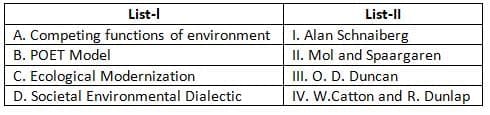 Choose the correct answer from the options given below:
(a) A-III, B-II, C-I, D-IV
(b) A-II, B-IV, C-III, D-I
(c) A-IV, B-III, C-II, D-I
(d) A-III, B-I, C-II, D-IV
Ans: C
- Competing functions of environment (A-IV)
- Associated with W. Catton and R. Dunlap, who emphasized the environmental constraints and competing demands placed by human society on natural resources.
- This concept explores how societal practices often lead to overuse or depletion of environmental resources.
- POET Model (B-III)
- Developed by O. D. Duncan, this model analyzes the interplay between Population, Organization, Environment, and Technology.
- It provides a framework for understanding how these factors influence social and environmental systems.
- Ecological Modernization (C-II)
- Proposed by Mol and Spaargaren, this theory focuses on the potential for societal modernization to lead to better environmental outcomes.
- It emphasizes technological innovation, structural change, and policy reforms to address environmental issues.
- Societal Environmental Dialectic (D-I)
- Introduced by Alan Schnaiberg, this concept examines the contradictory relationship between society and the environment.
- It highlights the tension between economic growth and environmental degradation.
Q49: Women in Development (WID) is associated with which of the following theoretical approaches?
(a) Post-feminism
(b) Feminist Political Ecology
(c) Liberal Modernization Theory
(d) Radical Feminism
Ans: C
- Liberal Modernization Theory
- The Women in Development (WID) approach emerged during the 1970s, focusing on integrating women into the development process.
- It is rooted in the Liberal Modernization Theory, which emphasizes progress and modernization through economic growth and social reforms.
- WID highlights the need to address gender disparities by ensuring women have access to resources, education, and employment opportunities.
- It operates within the framework of liberal feminism, advocating for equality through policy reforms and institutional changes rather than radical societal shifts.
- The approach aligns with the belief that economic development can lead to greater gender equality over time.
Additional Information
- Comparison with Other Theoretical Approaches
- Post-feminism:This approach focuses on the idea that feminism has achieved its goals, emphasizing individual empowerment rather than collective action. It is not directly tied to the WID framework.
- Feminist Political Ecology:This approach examines the intersection of gender, environment, and power, emphasizing how ecological issues impact women disproportionately. It differs from WID's focus on economic integration.
- Radical Feminism: Radical feminism critiques patriarchal structures and advocates for revolutionary changes to societal systems. This is distinct from WID's reformist and modernization-oriented perspective.
- Evolution of Gender and Development Approaches
- After WID, new frameworks like Gender and Development (GAD) emerged, which focused on addressing systemic gender inequalities and power relations.
- Subsequent approaches, such as Women, Environment, and Development (WED), expanded the focus to include ecological and sustainability issues.
- Criticism of the WID Approach
- Critics argue that WID oversimplifies the challenges faced by women, treating them as a homogenous group without considering cultural, social, and regional differences.
- It has also been critiqued for its reliance on modernization paradigms, which may perpetuate inequalities rather than addressing their root causes.
Q50: Which of the following concept is not associated with Ethnomethodology?
(a) Indexicality of Meaning
(b) Reflexive Actions
(c) Reciprocity of Perspectives
(d) Biase Attitude
Ans: D
- Biased Attitude
- Ethnomethodology focuses on understanding the methods and practices people use to make sense of their everyday social interactions.
- The concept of a biased attitude is not part of Ethnomethodology as it does not align with its goal of studying the underlying mechanisms of social order.
- Instead, Ethnomethodology emphasizes concepts like indexicality, reflexivity, and reciprocity of perspectives, which are central to understanding how individuals navigate and interpret social contexts.
- Therefore, Biased Attitude is unrelated to this sociological framework and is the correct choice for this question.
Q51: Which of the following are true about the role of theory in research?
A. It provides orientation to research.
B. Theory does not summarize what is already known about the object of study.
C. Theory points out gaps in knowledge.
D. Theory predicts facts.
E. Theory conceptualizes and classifies data.
Choose the correct answer from the options given below:
(a) Only A, B, D, E
(b) Only A, C, D, E
(c) Only B, C, D, E
(d) Only A, B, C, E
Ans: B
- Theory provides orientation to research (A):
- Theory serves as a framework for conducting research by providing a conceptual roadmap.
- It helps researchers align their hypotheses, methods, and interpretations with the existing body of knowledge.
- Theory points out gaps in knowledge (C):
- By summarizing existing knowledge, theory highlights areas where further investigation is needed.
- This ensures that research efforts contribute to the development of the field.
- Theory predicts facts (D):
- Theories are used to make testable predictions based on observed patterns and relationships.
- For example, in scientific disciplines, theories like Newton's laws predict physical phenomena under certain conditions.
- Theory conceptualizes and classifies data (E):
- Theory provides a conceptual structure for organizing and interpreting data.
- This helps in identifying categories, patterns, and relationships within the data.
Q52: In 19th Century Bombay, the elite English educated literati inaugurated the following civil society institutions.
Arrange them chronologically from prior to latter.
A. Geographical Society of Bombay
B. Anthropological Society of Bombay
C. Bombay Branch of the Royal Asiatic Society of Great Britain and Ireland
D. Literary Society of Bombay
Choose the correct answer from the options given below:
(a) D, C, B, A
(b) C, A, D, B
(c) D, C, A, B
(d) B, A, C, D
Ans: C
- Literary Society of Bombay (D)
- Established in 1804, it was one of the earliest civil society institutions in Bombay.
- Focused on promoting literary, scientific, and intellectual pursuits among the elite.
- Bombay Branch of the Royal Asiatic Society of Great Britain and Ireland (C)
- Founded in 1827, it succeeded the Literary Society of Bombay.
- Aimed to advance knowledge about Asian culture, history, and archaeology.
- Geographical Society of Bombay (A)
- Established in 1873, focused on geographical studies and exploration.
- Encouraged research and documentation of the Indian subcontinent's geography.
- Anthropological Society of Bombay (B)
- Founded in 1886, promoted the study of anthropology and human societies.
- Contributed to understanding the diversity of Indian communities and cultures.
Q53: 'Suppose a clerk tries to appear busier than he or she actually is when a supervisor happens to be watching'.
Erving Goffman would study that behaviour from what approach?
(a) Psychological
(b) Interactionist
(c) Functionalist
(d) Conflict
Ans: B
- Interactionist Approach
- Focuses on the analysis of face-to-face interactions and the ways individuals manage their impressions.
- Erving Goffman developed the concept of dramaturgy, which studies how individuals present themselves in social settings, much like actors on a stage.
- The clerk's behavior of appearing busier is an example of impression management, where people try to control how others perceive them.
- Interactionists emphasize the importance of symbols, gestures, and context in shaping human behavior.
Additional Information
- Erving Goffman's Dramaturgical Analysis
- Goffman compared social interactions to a theatrical performance, where individuals are both actors and audience members.
- The concept of front stage refers to the behavior individuals display in public settings to maintain desired impressions.
- The concept of back stage refers to private areas where individuals can relax and be themselves without worrying about impressions.
- Key Terms in Interactionism
- Impression Management: The process by which individuals attempt to influence how others perceive them.
- Symbolic Interactionism: A broader framework that examines how individuals create and interpret symbols in social interactions.
- Role Performance: How individuals fulfill the expectations associated with their social roles.
- Contrast with Other Approaches
- Functionalist: Focuses on societal stability and the roles institutions play, not individual behavior in micro-level interactions.
- Conflict: Examines power struggles and inequality, rather than symbolic interactions.
- Psychological: Focuses on individual mental processes, which is distinct from studying social interactions.
Q54: Match List-I with List-II: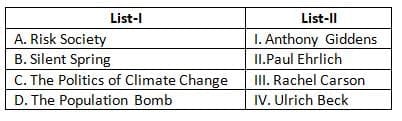 Choose the correct answer from the options given below :
(a) AI, B-II, C-IV, D-III
(b) A-IV, BI, C-III, D-II
(c) AI, B-III, C-II, D-IV
(d) A-IV, B-III, CI, D-II.
Ans: D
- Match List-I with List-II:
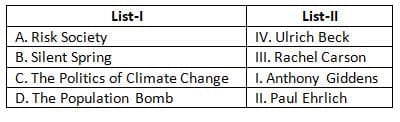
- Risk Society is authored by Ulrich Beck. It discusses the shift in modern society from traditional industrial risks to global risks such as environmental and technological hazards.
- Silent Spring is written by Rachel Carson. This seminal book highlights the harmful effects of pesticides on the environment, particularly on birds, and is credited with sparking the environmental movement.
- The Politics of Climate Change is authored by Anthony Giddens. It explores the political and social dimensions of climate change, emphasizing the need for global responses.
- The Population Bomb is written by Paul Ehrlich. It raises concerns about overpopulation and its potential consequences for resource depletion and environmental degradation.
- The correct mapping for the question is:
Q55: Following are the political and economic events that have happened in the political history of India. Arrange them in chronological order from first to last:
A. Green Revolution
B. Nationalization of Banks
C. General Agreement on Trade and Tariffs
D. Community Development Programme
E. National Emergency
Choose the correct answer from the options given below:
(a) B, A, C, D, E
(b) A, C, E, D, B
(c) D, A, B, E, C
(d) D, B, A, C, E
Ans: C
- Community Development Programme
- Launched in 1952, it was one of the first organized efforts by the government to develop rural India.
- Aimed at improving agriculture, irrigation, and basic services in rural areas.
- Green Revolution
- Introduced in 1960s, it focused on increasing agricultural productivity through high-yield variety seeds, fertilizers, and irrigation.
- Marked a significant shift in India's food production capacity.
- Nationalization of Banks
- Occurred in 1969, under Prime Minister Indira Gandhi.
- 14 major private banks were nationalized to ensure better credit access for rural and underprivileged sections of society.
- National Emergency
- Declared in 1975, lasting until 1977, this period saw suspension of civil liberties and increased centralization of power.
- Imposed under Article 352 of the Indian Constitution by Prime Minister Indira Gandhi.
- General Agreement on Trade and Tariffs (GATT)
- India became a founding member of the GATT in 1947, which later evolved into the World Trade Organization (WTO) in 1995.
- GATT aimed at reducing tariffs and promoting free trade globally.
Q56: Match List-I with List-II.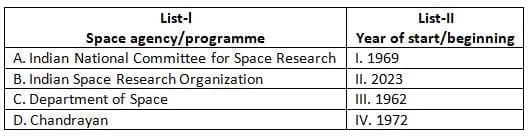 Choose the correct answer from the options given below:
(a) A-II, B-III, C-I, D-IV
(b) A-III, B-II, C-IV, D-I
(c) A-III, B-I, C-IV, D-II
(d) A-IV, B-I, C-II, D-III
Ans: C
- Indian National Committee for Space Research (INCOSPAR)
- INCOSPAR was established in 1962 under the Department of Atomic Energy (DAE).
- It marked the beginning of organized space exploration efforts in India.
- Indian Space Research Organization (ISRO)
- ISRO was formed in 1969, replacing INCOSPAR to focus more intensively on space technology development.
- Under the leadership of Dr. Vikram Sarabhai, ISRO was structured to carry out advanced research and satellite development.
- Department of Space
- The Department of Space was established in 1972 to oversee space programs and policies in India.
- It operates directly under the Prime Minister's Office, ensuring high-level strategic planning.
- Chandrayaan Program
- India's Chandrayaan program began in 2008 with Chandrayaan-1, but the latest mission, Chandrayaan-3, was launched in 2023.
- The program is aimed at lunar exploration and studying the Moon's surface and atmosphere.
Additional Information
- ISRO's Achievements
- ISRO has successfully launched various missions, including PSLV, GSLV, and interplanetary exploration programs like Mars Orbiter Mission (Mangalyaan).
- It has developed indigenous satellite navigation systems like NavIC and remote sensing satellites.
- Chandrayaan Program Specifics
- Chandrayaan-1 discovered water molecules on the Moon's surface.
- Chandrayaan-3 aims for a soft landing near the lunar south pole, advancing India's space exploration capabilities.
- Global Context
- India's space program is recognized globally for cost-effective and innovative solutions.
- ISRO collaborates with international agencies like NASA, ESA, and Roscosmos.
Q57: In which of his works has Emile Durkheim advocated a form of 'Guild Socialism'?
(a) The Division of Labour in Society
(b) Professional Ethics and Civic Morals
(c) The Rules of Sociological Method
(d) Elementary Forms of Religious Life
Ans: B
- Emile Durkheim
- Durkheim was one of the founding figures of sociology and focused on understanding social structures and cohesion.
- Advocacy of Guild Socialism
- In his work Professional Ethics and Civic Morals, Durkheim emphasized the importance of professional groups or "corporations" for social regulation and solidarity.
- He proposed that such groups, akin to guilds, could mediate between the state and the individual, ensuring a balanced and cohesive society.
- Professional Ethics and Civic Morals
- This work highlights Durkheim's view on moral regulation through professional groups.
- It reflects his belief in establishing a social framework that integrates both individual liberties and collective responsibility.
Q58: Arrange the peasant movements during colonial India in chronological order :
A. Bardoli Satyagraha
B. Indigo growers movement
C. Santhal Rebellion
D. Moplah Rebellion
E. Champaran Movement
Choose the correct answer from the options given below :
(a) C, B, E, D, A
(b) E, B, C, A, D
(c) B, C, D, E, A
(d) A, C, B, E, D
Ans: A
- Santhal Rebellion (C)
- The Santhal Rebellion occurred in 1855-56 in the Rajmahal Hills against oppressive zamindars and colonial authorities.
- This was one of the earliest tribal uprisings during British rule in India.
- Indigo Growers Movement (B)
- Also known as the Indigo Rebellion, it happened in 1859-60 in Bengal.
- The movement was against the forced cultivation of indigo imposed by British planters.
- Champaran Movement (E)
- Led by Mahatma Gandhi in 1917, this was the first Satyagraha in India.
- The movement protested the exploitation of farmers through the tinkathia system in Bihar.
- Moplah Rebellion (D)
- The Moplah (or Mapillah) Rebellion occurred in 1921 in Malabar, Kerala.
- It was an uprising of Muslim peasants against oppressive landlords and colonial rule.
- Bardoli Satyagraha (A)
- Led by Sardar Vallabhbhai Patel in 1928, this movement protested a hike in land revenue in Bardoli, Gujarat.
- The success earned Patel the title of Sardar.
Additional Information
- Peasant Movements during Colonial India
- Peasant movements were driven by exploitation under British policies, such as high revenue demands, the zamindari system, and forced cultivation of cash crops.
- These movements often combined economic grievances with demands for political rights.
- Key Features of Peasant Movements
- Leaders like Gandhi introduced non-violent methods such as Satyagraha to the movements.
- Some uprisings, such as the Santhal Rebellion, took on a violent character due to the intensity of oppression.
- Impact of These Movements
- They highlighted the plight of Indian peasants at the national and international levels.
- They played a vital role in the Indian independence movement by uniting the masses against colonial rule.
Q59: Who classified social structure as 'actual structure' and 'general structure'?
(a) Emile Durkheim
(b) Claude-Levi Strauss
(c) Radcliffe Brown
(d) S. F. Nadel
Ans: C
- Radcliffe Brown
- Radcliffe Brown, a prominent social anthropologist, is known for his contributions to the study of social structures.
- He classified social structures into two categories:
- 'Actual structure' refers to the observable relationships among individuals in a society, emphasizing real-life interactions.
- 'General structure' deals with the abstract, conceptual framework of social relationships and patterns as they exist across societies.
- Radcliffe Brown advocated for the use of structural-functional analysis in anthropology, highlighting the interconnections between social structures and their functions within a society.
Q60: In statistical understanding, to select an unbiased sample we need to ensure that the probability of selection of each unit is ___________ and _________.
(a) equal and independent
(b) Guaranteed and objective
(c) Equal and reliable
(d) Rational and equal
Ans: A
- Unbiased Sample
- To ensure a sample is unbiased, each unit in the population must have an equal probability of being selected.
- Each selection must be made independently, meaning the choice of one unit does not affect the selection of another.
- Equal Probability
- Ensures that no unit is given a higher or lower chance of being selected, preventing skewed results.
- Independence
- Guarantees that the selection of one unit does not influence the selection of others, maintaining the integrity of the sampling process.
Additional Information
- Simple Random Sampling
- A common method to achieve an unbiased sample where each unit has an equal and independent chance of being selected.
- Often implemented using tools like random number generators or lottery methods.
- Systematic Sampling
- Although systematic sampling selects units at regular intervals, it may introduce bias if the population has a hidden pattern.
- For true randomness, systematic sampling is not equivalent to ensuring independence.
- Impact of Bias
- Biased samples can lead to results that do not accurately represent the population, impacting decision-making and research outcomes.
- Avoiding bias is critical in fields like market research, public health studies, and political polling.
Q61: What is the term which defines the idea 'that people will want to engage with people who like similar things as they do."
(a) People you may know
(b) Homophily
(c) Online community
(d) Technological determinism
Ans: B
- Homophily
- The term Homophily refers to the concept that people tend to form connections with others who share similar interests, values, or characteristics.
- It is derived from the Greek words "homo" (same) and "philia" (love or affinity), indicating the preference for similarity in relationships.
- This concept is widely used in sociology, communication studies, and social network analysis to explain how social groups and communities are formed.
- Homophily plays a significant role in shaping online communities, influencing friendships, and even determining patterns of information sharing.
Q62: Provide chronological sequence of the constitutional amendments.
A. Right to Education
B. Ten percent reservation to Economically Weaker Section (EWS)
C. Constitutional status to Panchyati Raj Institutions
D. Constitutional status to the National Commission for Backward Classes
E. Bifurcation of the National Commission for Scheduled Castes and Scheduled Tribes.
Choose the correct answer from the options given below:
(a) A, B, C, D, E
(b) B, C, E, D, A
(c) C, A, B, D, E
(d) C, A, E, D, B
Ans: D
- Chronological Sequence of Constitutional Amendments:
- C: Constitutional status to Panchayati Raj Institutions - The 73rd Constitutional Amendment Act, 1992, granted constitutional status to Panchayati Raj Institutions, effective from April 24, 1993.
- A: Right to Education - The 86th Constitutional Amendment Act, 2002, inserted Article 21A, making education a fundamental right for children aged 6-14 years.
- E: Bifurcation of the National Commission for Scheduled Castes and Scheduled Tribes - The 89th Constitutional Amendment Act, 2003, created separate commissions for Scheduled Castes and Scheduled Tribes by amending Article 338 and inserting Article 338A.
- D: Constitutional status to the National Commission for Backward Classes - The 102nd Constitutional Amendment Act, 2018, granted constitutional status to the National Commission for Backward Classes (NCBC).
- B: Ten percent reservation to Economically Weaker Section (EWS) - The 103rd Constitutional Amendment Act, 2019, introduced 10% reservation for EWS in education and public employment.
- The sequence C, A, E, D, B matches the chronological order of these amendments.
Q63: Which type of research, studies the socio-economic characteristics of residents of a community?
(a) Exploratory Research
(b) Descriptive Research
(c) Correlational Research
(d) Experimental Research
Ans: B
- Descriptive Research
- This type of research is focused on providing a detailed, accurate, and systematic description of a population, situation, or phenomenon.
- It investigates the socio-economic characteristics of residents of a community, such as their age, education, income, occupation, and living conditions.
- The primary goal is to collect factual data that helps in understanding the current status of the subject being studied.
- For example, in a study of a community, descriptive research can provide insights into patterns of employment, housing, and healthcare access.
- Methods commonly used include surveys, census, and demographic studies.
Additional Information
- Exploratory Research
- Primarily conducted to explore a problem that has not been clearly defined yet.
- Focuses on generating new ideas and hypotheses rather than providing detailed data.
- Often serves as a precursor to more detailed research, such as descriptive or experimental research.
- Correlational Research
- Examines the relationship between two or more variables to determine if they are associated.
- It does not imply causation but helps identify patterns of association.
- For example, studying the correlation between education level and income.
- Experimental Research
- Focuses on identifying causal relationships by manipulating one or more variables while controlling others.
- Used in controlled settings, such as laboratories, to test hypotheses.
- For example, studying the effects of a new teaching method on student performance.
Q64: Who argued that the household division of labour existed before the advent of industrial capitalism but capitalism also reinforced the public-private division of labour which became prominent during this phase.
(a) Antonio gramsci
(b) Frederick Engels
(c) Emile Durkheim
(d) Max Weber
Ans: B
- Frederick Engels
- Engels argued that the division of labour within households predates industrial capitalism.
- He linked the rise of capitalism to the reinforcement of the public-private division of labour, where men dominated the public sphere (work and politics), and women were relegated to the private sphere (home and caregiving).
- In his work "The Origin of the Family, Private Property and the State", Engels highlighted how capitalism magnified gender inequalities by making women's domestic labour invisible and economically undervalued.
- Engels' analysis provides a foundation for understanding the historical roots of gender roles and the socio-economic systems that perpetuate them.
Additional Information
- Antonio Gramsci
- Gramsci focused on cultural hegemony, explaining how societal norms and values maintain power structures, but did not specifically analyze household labour division.
- Emile Durkheim
- Durkheim studied social solidarity and division of labour in broader terms, emphasizing the transition from mechanical to organic solidarity, rather than household labour specifics.
- Max Weber
- Weber focused on rationalization and bureaucracy in modern societies, but his work did not delve deeply into the division of household labour.
Q65: Which of the following is not a type of triangulation in social research?
(a) Data triangulation
(b) Investigator triangulation
(c) Sampling triangulation
(d) Methodological triangulation
Ans: C
- Sampling triangulation
- It is not considered a formal type of triangulation in social research.
- Triangulation in research typically refers to using multiple approaches to validate findings, but sampling triangulation is not recognized as a standard method.
- Common types of triangulation include data triangulation, investigator triangulation, and methodological triangulation.
- Sampling in research focuses on selecting participants or units for study, whereas triangulation is concerned with validating findings through diverse perspectives or approaches.
Q66: Indentured workers from colonial India were relocated to the following colonies around the world to work on plantations.
A. Surinam
B. Colombia
C. Fiji
D. Mauritius
E. New Guinea
Select the correct answer from the options given below:
(a) Only A, B and E
(b) Only A, C and D
(c) Only A, D and E
(d) Only A, B and C
Ans: B
- Indentured workers from colonial India
- Indentured laborers were recruited from colonial India to work in overseas colonies during the 19th and early 20th centuries.
- They were employed primarily in plantation economies, where crops like sugar, tea, and rubber were cultivated.
- Correct colonies
- Surinam: Located in South America, Surinam was a Dutch colony where indentured Indian workers were employed on plantations.
- Fiji: Indian indentured laborers were transported to Fiji to work on sugar plantations, forming a significant part of Fiji's population today.
- Mauritius: Indian indentured workers contributed significantly to the plantation economy of Mauritius and formed a major part of the population.
- Incorrect colonies
- Colombia: Indian indentured workers were not sent to Colombia. It was not a destination for this labor system.
- New Guinea: Similarly, New Guinea was not a colony where Indian indentured laborers were employed.
Q67: Who among the following social scientists developed his theory on the idea of networks and flows?
(a) Frank webster
(b) Pierre Boiu Explained
(c) Manuel castells
(d) Clifford geirge
Ans: C
- Manuel Castells
- Manuel Castells is a renowned Spanish sociologist and professor specializing in sociology and communication.
- He developed the theory of networks and flows, which focuses on the interconnectedness of modern society through global networks.
- His seminal work, "The Network Society", explores how technological advancements, particularly in communication systems, have transformed social, economic, and political structures.
- Castells emphasized the role of information flows in shaping the dynamics of power, production, and consumption in contemporary society.
- This theory is widely applied in fields such as urban studies, globalization, and media.
Q68: Match the concepts given in List-l with sociologists given in List-II.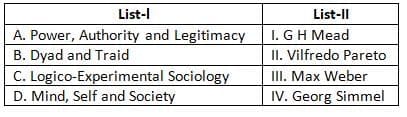 Choose the correct answer from the options given below:
(a) A-IV, B-III, C-I, D-II
(b) A-II, B-I, C-IV, D-III
(c) A-III, B-IV, C-II, D-I
(d) A-II, B-IV, C-III, D-I
Ans: C
- Power, Authority, and Legitimacy - Max Weber
- Max Weber introduced the concepts of power, authority, and legitimacy in his sociological works.
- He categorized authority into three types:
- Traditional
- Charismatic
- Legal-rational
- This framework is central to understanding political sociology and organizational structures.
- Dyad and Triad - Georg Simmel
- Georg Simmel analyzed social interactions in small groups and introduced the concepts of dyad (groups of two) and triad (groups of three).
- A dyad is highly fragile due to its dependence on both members, while a triad introduces complexity due to the addition of a third party.
- Logico-Experimental Sociology - Vilfredo Pareto
- Vilfredo Pareto emphasized the use of logical reasoning and experimental methods in sociology.
- His work laid the foundation for the application of scientific methodologies to social phenomena.
- Mind, Self, and Society - G.H. Mead
- G.H. Mead's work focuses on the development of the self through social interaction.
- He introduced the concept of the generalized other and emphasized the role of symbols in communication and socialization.
Q69: Arrange the following works of Jurgen Habermas in chronological order.
A. Legitimation Crisis
B. Knowledge and Interest
C. Theory of Communicative Action
D. Communication and Evolution of Society
Choose the correct answer from the options given below:
(a) B, C, D, A
(b) D, A, B, C
(c) B, A, D, C
(d) C, D, A, B
Ans: C
- Chronological Order of Works
- Knowledge and Interest (1971): This book outlines Habermas's theory of knowledge-constitutive interests, explaining the relationship between human cognition and societal practices.
- Legitimation Crisis (1973): A seminal work discussing the challenges of political and economic legitimacy in late-capitalist societies.
- Communication and Evolution of Society (1979): This work explores the role of language and communication in societal evolution.
- Theory of Communicative Action (1981): A comprehensive two-volume work presenting Habermas's framework for social theory based on communicative rationality.
- Option 3 is correct because it arranges the works in their actual chronological sequence: B (1971), A (1973), D (1979), C (1981).
Q70: Ivan Illich argued that modern medical practices have caused more harm than good due to pharmacogenesis. He conceptualised three following types of pharmacogenesis.
A. Clinical pharmacogenesis
B. Cultural pharmacogenesis
C. Medico-legal pharmacogenesis
D. Social pharmacogenesis
E. Metaphysical pharmacogenesis
Choose the correct answer from the options given below:
(a) Only A, B and C
(b) Only A, C and D
(c) Only A, B and D
(d) Only A, C and E
Ans: C
- Ivan Illich's concept of pharmacogenesis
- Pharmacogenesis refers to the idea that modern medical practices and interventions can sometimes create more harm than good.
- It is part of Illich's broader critique of institutionalized medicine, as outlined in his book "Medical Nemesis".
- Types of pharmacogenesis in Illich's framework
- Clinical pharmacogenesis: Refers to harm caused by medical treatments, such as adverse drug effects or medical errors.
- Cultural pharmacogenesis: Describes how medicalization changes societal norms and expectations, often leading to dependency on medical solutions for non-medical problems.
- Social pharmacogenesis: Focuses on the societal consequences of medical interventions, such as inequalities in access to healthcare or over-reliance on medical systems.
- Elimination of incorrect options
- Option C: Medico-legal pharmacogenesis is not a type of pharmacogenesis defined by Illich.
- Option E: Metaphysical pharmacogenesis is also not part of Illich's conceptual framework.
Q71: Match List-I with List-II.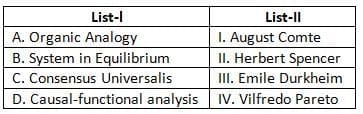 Choose the correct answer from the options given below:
(a) A-IV, B-III, C-II, D-I
(b) A-III, B-I, C-II, D-IV
(c) A-I, B-III, C-II, D-IV
(d) A-II, B-IV, C-I, D-III
Ans: D
- Organic Analogy
- Organic analogy is a concept introduced by Herbert Spencer, comparing society to a living organism.
- He explained how social institutions function in coordination, similar to organs in a body.
- System in Equilibrium
- This concept is attributed to Vilfredo Pareto, who viewed society as a system striving for equilibrium.
- It emphasizes the balance and adjustment of social forces within a society.
- Consensus Universalis
- August Comte introduced this idea, emphasizing the universal consensus required for social order and stability.
- It highlights the importance of shared beliefs and values in maintaining societal harmony.
- Causal-functional analysis
- Emile Durkheim utilized causal-functional analysis to study social phenomena and their functions within society.
- He focused on the relationship between causes and effects of societal structures and their roles in maintaining social equilibrium.
Q72: The term 'Marxology' was coined by
(a) R. K. Mukherjee
(b) D.N. Majumdar
(c) A. R. Desai
(d) D.P. Mukerji
Ans: D
- Marxology
- The term Marxology was coined by D.P. Mukerji, a prominent Indian sociologist and scholar.
- Marxology involves the study and interpretation of Karl Marx's ideas, theories, and their application to various socio-economic and political contexts.
- D.P. Mukerji's contributions helped shape the understanding of Marxist perspectives in Indian sociology.
- He emphasized the importance of analyzing Indian society through the lens of Marxist theory while considering its unique cultural and historical aspects.
Q73: Alfred Schutz' contribution to sociological theorizing resides in his ability to blend.
(a) Husserl's phenomenology with dialectical materialism
(b) Mead's interactionism with Weber's Verstehen
(c) Husserl's phenomenology with Weber's action theory
(d) Husserl's phenomenology with Durkheim's Sociologism
Ans: C
- Alfred Schutz was a prominent sociologist known for combining philosophical ideas with sociological theories.
- His work primarily focused on integrating Husserl's phenomenology and Weber's action theory:
- Husserl's phenomenology emphasizes the study of conscious experiences and the meanings individuals attribute to their lived experiences.
- Weber's action theory focuses on understanding social actions by interpreting the subjective meanings individuals attach to their actions.
- Schutz demonstrated that by blending these approaches, sociologists could better understand the subjective meanings that guide human actions in social contexts.
- His contributions are foundational in the development of the sociological phenomenology tradition, which examines everyday social interactions and the construction of shared meanings.
Q74: Match List-I with List-II: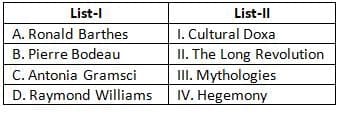 Choose the correct answer from the options given below:
(a) A-II, B-I, C-III, D-IV
(b) A-IV, B-III, C-I, D-II
(c) A-III, B-IV, C-I, D-II
(d) A-III, B-I, C-IV, D-II
Ans: D
- Ronald Barthes - Mythologies (A-III)
- Ronald Barthes is a key figure in semiotics and cultural studies.
- His work Mythologies explores how cultural phenomena are shaped into "myths" and how these myths convey ideological meaning.
- Pierre Bourdieu - Cultural Doxa (B-I)
- Pierre Bourdieu introduced the concept of Cultural Doxa, which refers to the unquestioned beliefs and assumptions that dominate a society's culture.
- Doxa is central to understanding how power structures are maintained through cultural practices.
- Antonio Gramsci - Hegemony (C-IV)
- Antonio Gramsci is renowned for his theory of Hegemony, which explains how ruling classes maintain dominance through cultural and ideological consensus rather than coercion.
- Hegemony involves the subtle control of societal norms and values to reinforce power structures.
- Raymond Williams - The Long Revolution (D-II)
- Raymond Williams' seminal work The Long Revolution examines cultural change over time and its interplay with societal transformations.
- He emphasizes the role of culture in shaping collective consciousness and societal progress.
Q75: Who defined religion as 'a unified system of beliefs and practices with reference to sacred things'?
(a) Karl Marx
(b) Max Weber
(c) Emile Durkheim
(d) Georg Simmel
Ans: C
- Emile Durkheim defined religion as "a unified system of beliefs and practices with reference to sacred things."
- Durkheim emphasized the idea of the sacred versus the profane. Sacred things are set apart and forbidden, invoking reverence and awe.
- He argued that religion serves as a social institution, fostering social cohesion and a collective consciousness.
- His definition is foundational in sociology and remains widely cited in the study of religion.
- Durkheim's work primarily focuses on the social functions of religion, rather than its theological aspects.
Additional Information
- Émile Durkheim and his contribution to sociology:
- Durkheim is considered one of the founding fathers of sociology.
- His major works include "The Elementary Forms of Religious Life", which explores the origins and functions of religion.
- He introduced the concept of collective effervescence, where communal religious experiences create a sense of unity.
- Comparison with other thinkers:
- Karl Marx: Viewed religion as an instrument of oppression, famously describing it as "the opium of the people."
- Max Weber: Focused on the relationship between religion and economic behavior, especially in "The Protestant Ethic and the Spirit of Capitalism."
- Georg Simmel: Examined religion in the context of individualism and social interaction.
- Durkheim's concept of the social function of religion remains a cornerstone in understanding its role in maintaining societal order.
Q76: According to Trochim and Donnelly, what is the chronological order of alternative criteria for assessing qualitative research?
A. Confirmability
B. Reliability
C. Dependability
D. Transferability
Choose the correct answer from the options given below:
(a) A, B, C, D
(b) B, A, D, C
(c) B, A, C, D
(d) B, D, C, A
Ans: D
- Trochim and Donnelly's criteria for assessing qualitative research
- The chronological order of alternative criteria is Reliability, Transferability, Dependability, and Confirmability.
- This sequence aligns with the evolution of qualitative research methodologies to ensure rigor and trustworthiness.
- Reliability refers to the consistency of research findings.
- Transferability assesses whether findings can be applied in other contexts.
- Dependability emphasizes the stability of data over time.
- Confirmability ensures that the findings are shaped by the participants and not researcher bias.
Q77: Which of the following marriage practices are preferred to ensure and protect family property and inheritance rights.
A. Levirate practice
B. Couvade practice
C. Fraternal Polygynandry
D. Sororal practice
E. Potlatch practice
Choose the correct answer from the options given below:
(a) A, C and D
(b) A, B and E
(c) A, B and D
(d) A, B and C
Ans: A
- Levirate practice
- The Levirate practice involves a widow marrying her deceased husband's brother. This ensures that property and inheritance rights remain within the same family.
- It helps protect the family's wealth and maintains continuity in the lineage.
- Fraternal Polygynandry
- This practice involves multiple brothers marrying a single wife, ensuring that family property remains undivided among the siblings.
- It is commonly observed in societies where the division of land or resources could threaten the family's economic stability.
- Sororal practice
- This involves a man marrying sisters, which strengthens alliances between families and ensures better inheritance management.
- It reduces conflicts over property by consolidating familial ties.
Q78: Malinowski in 'Scientific Theory of Culture and Other Essays' lists which of the following as basic needs?
A. Metabolism
B. Physical pleasure
C. Hygiene
D. Movement
E. Shelter
Choose the correct answer from the options given below:
(a) Only A, B, E
(b) Only B. C. D.
(c) Only A, B, C
(d) Only B. C. E.
Ans: C
- Basic needs listed by Malinowski
- According to Bronisław Malinowski in his work 'Scientific Theory of Culture and Other Essays', he identifies certain basic needs that are fundamental for human survival and societal functioning.
- These needs include:
- Metabolism (A): Refers to the biological need for food to sustain life processes.
- Physical pleasure (B): Encompasses the need for comfort and satisfaction derived from fulfilling physical and emotional desires.
- Hygiene (C): Highlights the necessity of cleanliness for maintaining health and preventing diseases.
- These three components are considered foundational for individual and collective well-being.
- Incorrect options
- Movement (D): While important, it is not explicitly listed by Malinowski as a basic need in the referenced work.
- Shelter (E): Though essential for survival, it is categorized differently in Malinowski's framework and not listed among the basic needs in this context.
Q79: The discovery that chlorofurocarbons (CFCs) can destroy ozone particles and threaten the Earth's protective ozone layer was published:
(a) By Schnellberg and Guld
(b) By Rachel Carson
(c) By Donella H. Meadows
(d) By Sherwood Rowland and Mario Molina
Ans: D
- Sherwood Rowland and Mario Molina
- In the year 1974, Sherwood Rowland and Mario Molina published groundbreaking research on the environmental impact of chlorofluorocarbons (CFCs).
- Their study revealed that CFCs release chlorine atoms when broken down by ultraviolet (UV) radiation in the atmosphere.
- These chlorine atoms catalytically destroy ozone molecules, significantly depleting the Earth's protective ozone layer.
- Rowland and Molina's work was instrumental in raising global awareness about the dangers posed by CFCs and led to international regulatory actions, including the Montreal Protocol in 1987.
Q80: Which of the following is true about Ulrich Beck's theory of risk?
A. Beck openly criticizes modernity and its attendant risks.
B. Beck's thesis argues that Western countries have moved beyond industrial or class society.
C. He argues that hunger is classist, misery is democratic.
D. Beck concludes that modernity has no capacity to solve the problems it creates.
E. According to Beck, risk is largely invisible to ordinary people.
Choose the correct answer from the options given below:
Note: This question was dropped by NTA due to some error. We have modified it to make it error free.
(a) Only A, B, C, D
(b) Only A, C, D, E
(c) Only A, B, C, E
(d) Only A, B, D, E
Ans: C
- Correct statements about Beck's Risk Society theory:
- A. Beck openly criticizes modernity and its attendant risks: Beck argues that modernity generates new global risks like environmental disasters and nuclear threats.
- B. Beck's thesis argues that Western countries have moved beyond industrial or class society: He states that societies are transitioning to a risk society where risks, not classes, dominate.
- C. He argues that hunger is classist, misery is democratic: Beck famously wrote: "Hunger is hierarchical, smog is democratic," meaning risks cut across classes.
- E. According to Beck, risk is largely invisible to ordinary people: Many risks like radiation, toxins, and chemical pollution are imperceptible without scientific knowledge.
- D is incorrect:
- Beck does NOT claim that modernity has zero capacity to solve problems; rather, he argues that modernity tries to manage risks through reflexive modernization, but solutions often create new risks.
Q81: What do you call a worker whose job involves encouraging others to consume goods, services and cultural products?
(a) Cultural regeneration karma
(b) Gig workers
(c) Cultural mediator
(d) Manager
Ans: C
- Cultural mediator
- A Cultural mediator is a professional who facilitates interactions between individuals or groups, aiming to promote the consumption of goods, services, and cultural products.
- The role involves creating a bridge between producers and consumers by enhancing cultural understanding and appreciation.
- Cultural mediators are often employed in industries like tourism, art, and media to promote cultural experiences.
- They help in contextualizing cultural elements to ensure they are accessible and appealing to a target audience.
- This role is distinct from other professions, as it focuses heavily on cultural education and engagement.
Q82: Arrange the following in a chronological order.
A. Kyoto Protocol
B. Copenhagen Summit
C. Earth Summit at Rio
D. United Nations Environment Programme
Choose the correct answer from the options given below:
(a) D, A, C, B
(b) C, D, A, B
(c) D, C, A, B
(d) C, A, D, B
Ans: C
- Chronological order of events
- United Nations Environment Programme (UNEP) was established in 1972 to coordinate global environmental efforts.
- Earth Summit at Rio, also known as the Rio Summit, was held in 1992 and focused on sustainable development.
- Kyoto Protocol, an international treaty to reduce greenhouse gas emissions, was adopted in 1997.
- Copenhagen Summit, officially known as the 2009 United Nations Climate Change Conference, aimed at a global climate agreement but faced challenges in achieving binding commitments.
- The correct chronological sequence is therefore D, C, A, B, as outlined in the question.
Q83: Match List-l with List-II.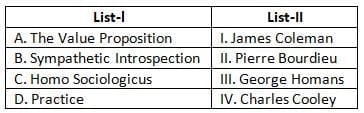 Choose the correct answer from the options given below:
(a) A-IV, B-I, C-II, D-III
(b) A-II, B-III, C-IV, D-I
(c) A-III, B-IV, C-I, D-II
(d) A-I, B-II, C-IV, D-III
Ans: C
- A. The Value Proposition - George Homans (III)
- The "Value Proposition" is associated with George Homans, a key theorist in exchange theory.
- It emphasizes the idea that individuals weigh the value of rewards relative to costs in social interactions.
- This concept is foundational to understanding rational decision-making in sociology.
- B. Sympathetic Introspection - Charles Cooley (IV)
- This concept is linked to Charles Cooley, an early American sociologist.
- "Sympathetic introspection" refers to understanding others by putting oneself in their position, emphasizing empathy in social research.
- It is a key principle in Cooley's work on the "looking-glass self."
- C. Homo Sociologicus - James Coleman (I)
- The term "Homo Sociologicus" is associated with James Coleman, a prominent sociologist.
- It describes the idea of individuals as social beings who act according to norms, roles, and expectations.
- This concept highlights the interplay between individual agency and social structure.
- D. Practice - Pierre Bourdieu (II)
- The concept of "Practice" is central to the work of Pierre Bourdieu.
- Bourdieu's theory focuses on habitus, field, and capital, explaining how individuals navigate social structures through practices.
- "Practice" bridges the gap between structure and agency in Bourdieu's framework.
Q84: Match List-I with List-II.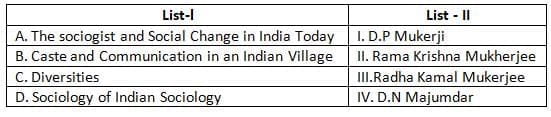 Choose the correct answer from the options given below:
(a) A-I, B-II, C-III, D-IV
(b) A-II, B-I, C-IV, D-III
(c) A-III, B-IV, C-I, D-II
(d) A-IV, B-III, C-II, D-I
Ans: C
- Matching List-I with List-II:
- A. The Sociologist and Social Change in India Today is attributed to Radha Kamal Mukerjee, a pioneer in Indian sociology known for his contributions to social change and cultural studies.
- B. Caste and Communication in an Indian Village is authored by D.N. Majumdar, who extensively studied caste dynamics and communication within rural Indian settings.
- C. Diversities is the work of D.P. Mukerji, emphasizing the pluralistic and diverse nature of Indian society.
- D. Sociology of Indian Sociology is by Rama Krishna Mukherjee, who critically analyzed the evolution of sociology in India.
- The correct pairing is based on established scholarly contributions and their alignment with specific topics in Indian sociology.
- Understanding the association between authors and their works is essential for sociological studies and competitive exams.
Q85: Habermas's 'legitimacy crisis' argues that:
(a) The state progressively withdraws from the economy.
(b) The State wants to transfer political issues into 'technical problems'.
(c) The state wants to 'technologise' political issues.
(d) The state shows its true form of 'technological consciousness'.
Ans: B
- 'Legitimacy crisis' refers to a situation where the state struggles to justify its authority or maintain public trust due to systemic issues.
- Habermas argues that the state increasingly attempts to transform political issues into 'technical problems', which can be addressed using administrative or technical solutions rather than democratic or political debate.
- This approach reflects the state's effort to avoid direct engagement with contentious political debates and instead focus on technocratic solutions.
- By reframing political issues as technical problems, the state seeks to maintain its legitimacy by portraying itself as efficient and solution-oriented rather than politically divisive.
- This concept is central to Habermas's critique of modern governance and its reliance on technological consciousness over participatory democracy.
Q86: The study of signs and symbols is called as:
(a) Hermeneutics
(b) Semiotics
(c) Epistemic
(d) Semantics
Ans: B
- Semiotics
- Semiotics is the study of signs and symbols and how they are used to convey meaning.
- It examines the relationship between signs (e.g., words, images, gestures) and what they represent or signify.
- The field is essential in understanding communication processes in various contexts such as language, media, and culture.
- The term is derived from the Greek word "semeion" meaning "sign."
- It is a foundational concept in disciplines such as linguistics, anthropology, sociology, and media studies.
Additional Information
- Hermeneutics
- Hermeneutics is the study of interpretation, particularly in relation to texts, language, and symbolic expressions.
- It is often used in fields like theology, philosophy, and literary theory.
- While it may overlap with semiotics, its focus is primarily on interpretation, not the study of signs and symbols themselves.
- Epistemic
- The term "epistemic" relates to knowledge or the study of the nature and scope of knowledge (epistemology).
- It is a philosophical concept and does not pertain specifically to the study of signs or symbols.
- Semantics
- Semantics is the study of meaning in language, focusing on how words, phrases, and sentences convey meaning.
- While related to semiotics, it is more narrowly focused on language rather than signs and symbols in a broader sense.
Q87: The term 'Symbolic Interactionism' was first introduced by whom amongst the following?
(a) George Herbert Mead
(b) Herbert Blumer
(c) Charles Horton Cooley
(d) Edmund Husserl
Ans: B
- Herbert Blumer
- The term Symbolic Interactionism was first coined by Herbert Blumer, an American sociologist.
- Blumer introduced the concept to describe a theoretical framework emphasizing the importance of symbols and meaning in human interaction.
- His work is heavily influenced by the teachings of George Herbert Mead, another prominent sociologist, but Blumer was the one who formalized the term.
- Symbolic Interactionism focuses on how individuals create and interpret social reality through interactions and shared symbols.
Q88: According to Ferdinand de Saussure, what are the two defining characteristics of a linguistic sign?
A. Arbitrariness
B. Difference
C. Indicative
D. Linearity
E. Indicated
Choose the correct answer from the options given below:
(a) Only A and B
(b) Only A and D
(c) Only C and E
(d) Only B and D
Ans: B
- Arbitrariness
- According to Ferdinand de Saussure, the relationship between the signifier (sound/image) and the signified (concept) is arbitrary, meaning there is no inherent or natural connection.
- This arbitrariness is a fundamental principle of linguistic signs as described in Saussure's theory.
- Linearity
- Saussure emphasized that linguistic signs are linear in nature. This means that they unfold in a sequence over time (spoken) or occupy a linear space (written).
- The linearity of the signifier highlights the importance of order and temporal/spatial arrangement in communication.
Q89: Arrange the phases of development of 'Self' in a chronologial order.
A. Engaging in Games
B. Recognizing the generalized others
C. Engaging in Imitation
D. Engaging in Play
Choose the correct answer from the options given below:
(a) D, C, B, A
(b) C, D, A, B
(c) A, B, C, D
(d) B, A, C, D
Ans: B
- Phases of development of 'Self'
- The concept of 'Self' development was introduced by sociologist George Herbert Mead.
- The development occurs in specific phases, which must be understood in a chronological sequence.
- Explanation of the correct sequence
- Phase 1: Engaging in Imitation (C)
- Occurs during infancy.
- The child mimics or imitates the behavior of others without understanding the meaning.
- Phase 2: Engaging in Play (D)
- Occurs in early childhood.
- The child takes on roles, such as pretending to be a teacher or parent, and begins to understand specific roles in society.
- Phase 3: Engaging in Games (A)
- Occurs later in childhood.
- The child engages in structured activities and games, learning rules and cooperation.
- Phase 4: Recognizing the Generalized Others (B)
- Occurs during adolescence and beyond.
- The individual understands societal expectations and develops a sense of 'Self' in relation to the broader society.
- Phase 1: Engaging in Imitation (C)
Q90: Arrange the environmental movements of India in chronological order.
A. Silent Valley Movement
B. Chipko Movement
C. Narmada Bachav Andolan
D. Appiko Movement
Ε. Chilka Bachav Andolan
Choose the correct answer from the options given below:
(a) A, C, D, E, B
(b) B, D, C, E, A
(c) E, C, A, D, B
(d) B, A, D, C, E
Ans: D
- Chronological Order
- The Chipko Movement (1973) was one of the earliest environmental movements in India, initiated to protect forests in Uttarakhand.
- The Silent Valley Movement (1978) was launched to save the Silent Valley forest in Kerala from a hydroelectric project.
- The Appiko Movement (1983), inspired by the Chipko Movement, aimed to protect forests in the Western Ghats, Karnataka.
- The Narmada Bachav Andolan (1985) opposed the construction of dams on the Narmada river, focusing on displacement and environmental destruction.
- The Chilka Bachav Andolan (1991) revolved around protecting the Chilika Lake ecosystem in Odisha from harmful aquaculture practices.
- Environmental Movements
- These movements reflect grassroots activism to protect natural resources and prevent environmental degradation.
- Each movement addressed specific ecological challenges, often involving local communities.
Q91: Read the following paragraph and answer the questions.
"Modernity is a culture of risk. By this I do not mean that social life is riskier now than it was before; for most people it is not. Indeed, the concept of risk becomes central to how ordinary actors and technocrats organize the social world. Modernity removes risk from certain areas and practices of life altogether, yet at the same time introduces risk parameters on a scale largely or entirely unknown in earlier periods. Modernity is a runaway engine of enormous power that we humans can collectively steer to a point but which threatens to get out of our control and blow itself to pieces. This juggernaut crushes those who resist it and while it appears to be on a steady course at times, there are times when it veers precariously in directions we cannot foresee. The ride is by no means entirely unpleasant or unprofitable; it is often exhilarating and full of hopeful anticipation. But as long as the institutions of modernity persist, we will never be able to fully control the course or speed of this journey; in turn, we will never be able to feel completely secure because the spheres it covers are fraught with risks of enormous consequences."
Modernity is called:
(a) Eternal
(b) Juggernaut (Heavy Vehicle)
(c) Statical
(d) A journey to certainty
Ans: B
- The passage explicitly says: "Modernity is a runaway engine of enormous power... This juggernaut...".
- "Juggernaut" is used as the central metaphor to capture power, momentum, and partial uncontrollability.
- Nothing in the passage calls modernity "eternal," "statical," or "a journey to certainty."
Q92: Read the following paragraph and answer the questions.
"Modernity is a culture of risk. By this I do not mean that social life is riskier now than it was before; for most people it is not. Indeed, the concept of risk becomes central to how ordinary actors and technocrats organize the social world. Modernity removes risk from certain areas and practices of life altogether, yet at the same time introduces risk parameters on a scale largely or entirely unknown in earlier periods. Modernity is a runaway engine of enormous power that we humans can collectively steer to a point but which threatens to get out of our control and blow itself to pieces. This juggernaut crushes those who resist it and while it appears to be on a steady course at times, there are times when it veers precariously in directions we cannot foresee. The ride is by no means entirely unpleasant or unprofitable; it is often exhilarating and full of hopeful anticipation. But as long as the institutions of modernity persist, we will never be able to fully control the course or speed of this journey; in turn, we will never be able to feel completely secure because the spheres it covers are fraught with risks of enormous consequences."
The journey of modernity is:
(a) Totally joyful
(b) Totally joyless
(c) This is not beneficial or disadvantageous in any way
(d) Statical
Ans: C
- The passage repeatedly stresses threats and lack of control: modernity is described as a "runaway engine" that "threatens to get out of our control." This foregrounds negative consequences.
- It emphasises persistent insecurity: "we will never be able to feel completely secure," which frames the experience of modernity in terms of danger and anxiety rather than progress alone.
- Although some exhilaration is acknowledged, the dominant imagery (juggernaut, crushed resistance, unpredictable veering) highlights harm, risk, and loss-supporting a negative characterization.
Q93: Read the following paragraph and answer the questions.
"Modernity is a culture of risk. By this I do not mean that social life is riskier now than it was before; for most people it is not. Indeed, the concept of risk becomes central to how ordinary actors and technocrats organize the social world. Modernity removes risk from certain areas and practices of life altogether, yet at the same time introduces risk parameters on a scale largely or entirely unknown in earlier periods. Modernity is a runaway engine of enormous power that we humans can collectively steer to a point but which threatens to get out of our control and blow itself to pieces. This juggernaut crushes those who resist it and while it appears to be on a steady course at times, there are times when it veers precariously in directions we cannot foresee. The ride is by no means entirely unpleasant or unprofitable; it is often exhilarating and full of hopeful anticipation. But as long as the institutions of modernity persist, we will never be able to fully control the course or speed of this journey; in turn, we will never be able to feel completely secure because the spheres it covers are fraught with risks of enormous consequences."
For the writer modernity is:
(a) Culture of risk
(b) Statical
(c) Negative
(d) Circular
Ans: A
- The passage opens with: "Modernity is a culture of risk."
- It emphasizes risk becoming central to how actors and technocrats organize social life.
- Other options (statical, negative, circular) are not supported by the text.
Q94: Read the following paragraph and answer the questions.
"Modernity is a culture of risk. By this I do not mean that social life is riskier now than it was before; for most people it is not. Indeed, the concept of risk becomes central to how ordinary actors and technocrats organize the social world. Modernity removes risk from certain areas and practices of life altogether, yet at the same time introduces risk parameters on a scale largely or entirely unknown in earlier periods. Modernity is a runaway engine of enormous power that we humans can collectively steer to a point but which threatens to get out of our control and blow itself to pieces. This juggernaut crushes those who resist it and while it appears to be on a steady course at times, there are times when it veers precariously in directions we cannot foresee. The ride is by no means entirely unpleasant or unprofitable; it is often exhilarating and full of hopeful anticipation. But as long as the institutions of modernity persist, we will never be able to fully control the course or speed of this journey; in turn, we will never be able to feel completely secure because the spheres it covers are fraught with risks of enormous consequences."
What has become essential for organizing the social world of laypeople and experts?
(a) Technology
(b) Expertise
(c) Consideration of risk
(d) Benefit
Ans: C
- "The concept of risk becomes central to how ordinary actors and technocrats organize the social world."
- Hence, consideration of risk is essential for organization.
- Technology, expertise, or benefit may feature, but the passage singles out risk as central.
Q95: Read the following paragraph and answer the questions.
"Modernity is a culture of risk. By this I do not mean that social life is riskier now than it was before; for most people it is not. Indeed, the concept of risk becomes central to how ordinary actors and technocrats organize the social world. Modernity removes risk from certain areas and practices of life altogether, yet at the same time introduces risk parameters on a scale largely or entirely unknown in earlier periods. Modernity is a runaway engine of enormous power that we humans can collectively steer to a point but which threatens to get out of our control and blow itself to pieces. This juggernaut crushes those who resist it and while it appears to be on a steady course at times, there are times when it veers precariously in directions we cannot foresee. The ride is by no means entirely unpleasant or unprofitable; it is often exhilarating and full of hopeful anticipation. But as long as the institutions of modernity persist, we will never be able to fully control the course or speed of this journey; in turn, we will never be able to feel completely secure because the spheres it covers are fraught with risks of enormous consequences."
Modernity is uncertain because it:
A. completely reduces risk from certain areas and practices of life, yet introduces risk at a much larger scale.
B. It was completely unknown in earlier times.
C. Modernity is a runaway engine of enormous power which we can steer to a certain extent but which is in danger of going out of our control.
D. This ride/journey is not entirely pleasant or profitable.
E. But, as long as the institutions of modernity persist, we can hardly control the path or speed of this journey.
Choose the correct answer from the options given below:
(a) Only A, C, D, E
(b) Only A, B, C, D
|(c) Only A, B, D, E
(d) Only B, C, D, E
Ans: B
- Statement A: The text clearly mentions that modernity "removes risk from certain areas and practices of life altogether, yet at the same time introduces risk parameters on a scale largely or entirely unknown in earlier periods." (Correct)
- Statement B: It affirms that these risks were "largely or entirely unknown in earlier periods." (Correct)
- Statement C: Modernity is described as a "runaway engine of enormous power which we can steer to a point but which threatens to get out of our control." (Correct)
- Statement D: The passage acknowledges that "The ride is by no means entirely unpleasant or unprofitable," meaning it is partly unpleasant or risky-this reflects uncertainty. (Correct)
Q96: Read the following passage and answer the questions:
"One day in 1867, a young man from the village of Lapcourt... obtained a few caresses from a little girl, just as he had done before and seen done by the village urchins around him... So he was pointed out by the girl's family to the mayor of the village, reported by the mayor to the gendarmes, led by the gendarmes to the judge, who indicted him and turned him over first to a doctor, then to two other experts who not only wrote their report but also had it published. What is the significant thing about this story? The pettiness of it all; the fact that this everyday occurrence in the life of village sexuality, these inconsequential bucolic pleasures, could become, from a certain time, the object not only of a collective intolerance but of a judicial action, a medical intervention, a careful clinical examination, and an entire theoretical elaboration. The thing to note is that they went so far as to measure the brainpan, study facial bone structure, and inspect for possible signs of degenerescence the anatomy of this personage who up to that moment had been an integral part of village life; that they made him talk; that they questioned him concerning his thoughts, inclinations, habits, sensations, and opinions. And then, acquitting him of any crime, they decided finally to make him into a pure object of medicine and knowledge an object to be shut away till the end of his life in the hospital at Maréville, but also one to be made known to the world of learning through a detailed analysis."
The passage suggests that modernity is represented by certain features laid out below.
A. Control of Sexuality
B. Science and Technology
C. Self-Policing
D. Self-Confessions
Chose the correct Answer from the options given below:
(a) A, B and C
(b) B, C and D
(c) A, C and D
(d) A, B and D
Ans: C
- The episode turns an "everyday occurrence in the life of village sexuality" into an object of scrutiny - signalling Control of Sexuality (A).
- "They made him talk; they questioned him concerning his thoughts, inclinations, habits" - this confessional probing produces a subject who examines and regulates himself, indicating Self-Policing (C).
- The explicit demand to speak one's inner life ("made him talk... questioned him") is a classic mechanism of Self-Confession (D) in modern disciplinary regimes.
Q97: Read the following passage and answer the questions:
"One day in 1867, a young man from the village of Lapcourt... obtained a few caresses from a little girl, just as he had done before and seen done by the village urchins around him... So he was pointed out by the girl's family to the mayor of the village, reported by the mayor to the gendarmes, led by the gendarmes to the judge, who indicted him and turned him over first to a doctor, then to two other experts who not only wrote their report but also had it published. What is the significant thing about this story? The pettiness of it all; the fact that this everyday occurrence in the life of village sexuality, these inconsequential bucolic pleasures, could become, from a certain time, the object not only of a collective intolerance but of a judicial action, a medical intervention, a careful clinical examination, and an entire theoretical elaboration. The thing to note is that they went so far as to measure the brainpan, study facial bone structure, and inspect for possible signs of degenerescence the anatomy of this personage who up to that moment had been an integral part of village life; that they made him talk; that they questioned him concerning his thoughts, inclinations, habits, sensations, and opinions. And then, acquitting him of any crime, they decided finally to make him into a pure object of medicine and knowledge an object to be shut away till the end of his life in the hospital at Maréville, but also one to be made known to the world of learning through a detailed analysis."
This paragraph explores the theoretical conceptualization of the following scholar.
(a) Anthony Giddens
(b) Zygmunt Bauman
(c) Michel Foucault
(d) Pierre Bourdieu
Ans: C
- The passage shows how a minor act becomes the target of judicial action, medical intervention, and clinical examination-central to Foucault's analysis of modern power.
- Turning the person into an "object of medicine and knowledge" captures the power/knowledge nexus and medicalization themes in Foucault.
- The emphasis on confession, expert reports, and institutional control echoes Discipline & Punish and History of Sexuality.
Q98: Read the following passage and answer the questions:
"One day in 1867, a young man from the village of Lapcourt... obtained a few caresses from a little girl, just as he had done before and seen done by the village urchins around him... So he was pointed out by the girl's family to the mayor of the village, reported by the mayor to the gendarmes, led by the gendarmes to the judge, who indicted him and turned him over first to a doctor, then to two other experts who not only wrote their report but also had it published. What is the significant thing about this story? The pettiness of it all; the fact that this everyday occurrence in the life of village sexuality, these inconsequential bucolic pleasures, could become, from a certain time, the object not only of a collective intolerance but of a judicial action, a medical intervention, a careful clinical examination, and an entire theoretical elaboration. The thing to note is that they went so far as to measure the brainpan, study facial bone structure, and inspect for possible signs of degenerescence the anatomy of this personage who up to that moment had been an integral part of village life; that they made him talk; that they questioned him concerning his thoughts, inclinations, habits, sensations, and opinions. And then, acquitting him of any crime, they decided finally to make him into a pure object of medicine and knowledge an object to be shut away till the end of his life in the hospital at Maréville, but also one to be made known to the world of learning through a detailed analysis."
What implication does the scholar want to indicate through this passage:
A. Absoluteness of truth
B. Public gaze
C. Normal and abnormal
D. Rule of truth
Choose the correct answer from the options given below:
(a) Only A, B and C
(b) Only A, B and D
(c) Only B, C and D
(d) Only C, B and D
Ans: C
- Being "made known to the world of learning" and subjected to public procedures reflects the Public gaze (B).
- Experts classify conduct via "careful clinical examination," marking distinctions of Normal and abnormal (C).
- "Pure object of medicine and knowledge" shows how institutions produce binding truths-Foucault's Rule of truth (D).
- No claim of fixed, eternal truth is made; rather truth is institutionally produced, so Absoluteness of truth (A) is not implied.
Q99: Read the following passage and answer the questions:
"One day in 1867, a young man from the village of Lapcourt... obtained a few caresses from a little girl, just as he had done before and seen done by the village urchins around him... So he was pointed out by the girl's family to the mayor of the village, reported by the mayor to the gendarmes, led by the gendarmes to the judge, who indicted him and turned him over first to a doctor, then to two other experts who not only wrote their report but also had it published. What is the significant thing about this story? The pettiness of it all; the fact that this everyday occurrence in the life of village sexuality, these inconsequential bucolic pleasures, could become, from a certain time, the object not only of a collective intolerance but of a judicial action, a medical intervention, a careful clinical examination, and an entire theoretical elaboration. The thing to note is that they went so far as to measure the brainpan, study facial bone structure, and inspect for possible signs of degenerescence the anatomy of this personage who up to that moment had been an integral part of village life; that they made him talk; that they questioned him concerning his thoughts, inclinations, habits, sensations, and opinions. And then, acquitting him of any crime, they decided finally to make him into a pure object of medicine and knowledge an object to be shut away till the end of his life in the hospital at Maréville, but also one to be made known to the world of learning through a detailed analysis."
What does 'And then, acquitting him of any crime, they decided finally to make him into a pure object of medicine and knowledge' this statement in the paragraph refers to:
A. Objectification of the body.
B. Medicalization of the body.
C. Politicization of the body.
D. De-objectifying the body.
Chose the correct Answer from the options given below:
(a) A, B and C
(b) A, C and D
(c) A, B and D
(d) A and B only
Ans: A
- "Make him into a pure object of medicine and knowledge" explicitly signals Objectification of the body (A).
- Submission to doctors and experts, clinical measurements of skull and anatomy show Medicalization of the body (B).
- The chain of mayor → gendarmes → judge → experts → confinement indicates institutional power over bodies, i.e., Politicization of the body (C).
- De-objectifying (D) is the opposite of what occurs; hence it is not included.
Q100: Read the following passage and answer the questions:
"One day in 1867, a young man from the village of Lapcourt... obtained a few caresses from a little girl, just as he had done before and seen done by the village urchins around him... So he was pointed out by the girl's family to the mayor of the village, reported by the mayor to the gendarmes, led by the gendarmes to the judge, who indicted him and turned him over first to a doctor, then to two other experts who not only wrote their report but also had it published. What is the significant thing about this story? The pettiness of it all; the fact that this everyday occurrence in the life of village sexuality, these inconsequential bucolic pleasures, could become, from a certain time, the object not only of a collective intolerance but of a judicial action, a medical intervention, a careful clinical examination, and an entire theoretical elaboration. The thing to note is that they went so far as to measure the brainpan, study facial bone structure, and inspect for possible signs of degenerescence the anatomy of this personage who up to that moment had been an integral part of village life; that they made him talk; that they questioned him concerning his thoughts, inclinations, habits, sensations, and opinions. And then, acquitting him of any crime, they decided finally to make him into a pure object of medicine and knowledge an object to be shut away till the end of his life in the hospital at Maréville, but also one to be made known to the world of learning through a detailed analysis."
According to the scholar, this incident shows that the society was more focused on which of the following aspects.
A. Bio-politics
B. Knowledge and power
C. Bureaucracy
D. Sexuality
Choose the correct answer from the options given below:
(a) Only A, B and C
(b) Only A, C and D
(c) Only B, C and D
(d) Only A, B and D
Ans: D
- Confinement "till the end of his life" and regulation of bodies through institutions exemplify Bio-politics (A).
- Expert examination producing reports manifests the Knowledge & Power (B) dynamic.
- The incident springs from and targets Sexuality (D), turning it into a site of truth-production and control.
- While officials appear, bureaucratic procedure is not the central analytic focus; hence Bureaucracy (C) is excluded.
FAQs on UGC NET Paper 2: Sociology 29th June 2025 Shift 1
| 1. What is the syllabus for UGC NET Paper 2 in Sociology? |  |
| 2. How is the UGC NET Paper 2 in Sociology structured? | |
| 3. What are some important topics to focus on for UGC NET Sociology preparation? | |
| 4. How can candidates effectively prepare for UGC NET Paper 2 in Sociology? | |
| 5. Are there any recommended books for UGC NET Sociology preparation? | |