Overview of Industrial Relations

Understanding Industrial Relations (IR)
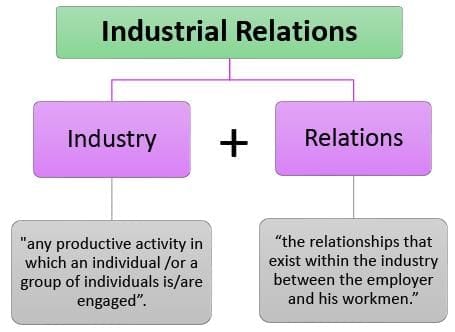
- Industrial relations pertain to the relationships between employees and employers within organisations. It encompasses any productive activities undertaken by individuals or groups. These relations are fundamental to the interaction between employers and their workers.
- Relationships, both inside and outside the workplace, typically involve:
- Interactions among individual workers.
- Connections between workers and their employers.
- Relations among employers.
- Links between employers and workers with organisations that advocate for their interests.
- Relations among these advocacy organisations at various levels.
- The primary parties in an industrial relations system usually include:
- Employees.
- Employers.
- Employers' associations.
- Government.
- Trade unions.
- Courts and tribunals.
- Industrial Relationsalso involves the methods through which these relationships are articulated, such as:
- Collective bargaining, where employers and trade unions negotiate terms of employment.
- Workers' participation in decision-making processes within the organisation.
- Grievance and dispute resolution mechanisms to address conflicts.
- Furthermore, Industrial Relations encompasses the management of conflicts that may arise between employers, workers, and trade unions.
Characteristics of Industrial Relations
- Presence of Two Parties: Industrial Relations emerge from the employment relationship within an industrial setting, involving two primary parties: labour and management. The industry provides the context for these relations.
- Cooperation and Conflict: Industrial Relations encompass both cooperative and conflictual aspects. This dual nature is fundamental to their dynamics. The focus is on the attitudes, relationships, practices, and procedures developed by the parties to manage or mitigate conflicts.
- Macro Factors: Labour and management operate within a broader system, and Industrial Relations consider external factors such as workplace technology, the socio-economic and political environment, national labour policies, and the perspectives of trade unions, workers, and employers.
- Conditions and Terms of Employment: Industrial Relations examine the conditions that foster cooperation between labour and management, along with the necessary practices and procedures to achieve this cooperation.
- Legislation: The field studies laws, regulations, agreements, court awards, customs, traditions, and the governmental policy framework aimed at promoting cooperation between labour and management. It also analyses the patterns of intervention by the executive and judiciary in regulating labour-management relations.
Factors Affecting Industrial Relations
Industrial Relations is a broad concept that draws from various fields such as social sciences, humanities, behavioral sciences, and law. It encompasses all factors that influence how people behave at work. Here are some key factors that influence Industrial Relations:
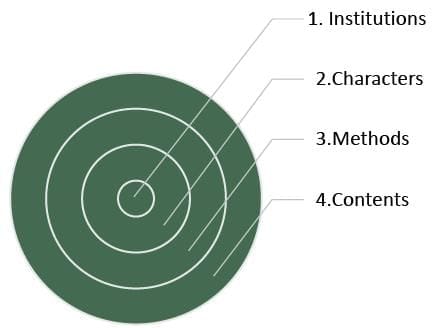
1. Institutions
- Institutions include government bodies, employers, trade unions, union federations, and associations. These organizations, along with labor courts and tribunals, have a direct or indirect impact on industrial relations systems.
2. Characters
- This factor studies the roles of workers' unions, employers' federations, and officials such as managers, mediators, conciliators, arbitrators, and judges of labor courts and tribunals.
3. Methods
- Methods focus on collective bargaining, workers' participation in industrial relations schemes, disciplinary procedures, grievance redressal mechanisms, dispute settlement processes, and union reorganization.
- It also includes organizing protests and revising existing rules, regulations, policies, and procedures through hearings in labor courts and tribunals.
4. Contents
- Contents encompass matters related to employment conditions such as pay, hours of work, leave with wages, health and safety, disciplinary actions, layoffs, dismissals, and retirements.
- It also includes laws and regulations governing labor welfare, social security, industrial relations, and issues related to workers' participation in management and collective bargaining.
Need/ Importance of Industrial Relations
Industrial relations play a vital role in ensuring the smooth functioning and growth of modern industries. The relationship between workers and employers is crucial for industrial progress, making it necessary to foster and maintain positive interactions between labour and management. A harmonious relationship is essential for both parties to safeguard their interests in the production process.
To achieve this, organizations must focus on preventing disputes or resolving them swiftly to maintain industrial peace and enhance productivity. The following points highlight the significance of industrial relations:
- Uninterrupted production
- Reduction in Industrial Disputes
- High morale
- Mental Revolution
- Reduced Wastage
1) Uninterrupted production : The primary benefit of industrial relations is the assurance of continuous production. This leads to stable employment for everyone, from managers to workers, and ensures the optimal utilization of resources, resulting in maximum production and consistent income for all. Smooth operations are essential not only for the industry itself but also for other industries reliant on its products, for exporters when goods are destined for export, and for consumers when products are intended for mass consumption.
2) Reduction in Industrial Disputes : Positive industrial relations contribute to minimizing disputes. Disagreements often arise from unmet human needs or desires, which can be addressed through effective industrial relations. Issues such as strikes, lockouts, slowdowns, and grievances may emerge even in peaceful contexts due to unresolved matters. Strong industrial relations promote cooperation and enhance production levels.
3) High morale : Strong industrial relations elevate employee morale. When workers feel that both employers and employees share a common interest in increasing production, they are more motivated. Each worker perceives themselves as a co-owner of the industry's success. Employers should acknowledge that the benefits of the industry should be fairly shared with workers. This unity of purpose, achieved through industrial peace, enhances workers' societal status and fulfills their sense of self-worth, positively impacting production as collaborative efforts yield significant results.
4) Mental Revolution : The primary objective of industrial relations is to bring about a significant shift in the mindset of both workers and employers. Industrial peace relies on both parties viewing themselves as partners. Workers should recognize their role in this partnership, while employers must acknowledge their authority. This mutual respect will naturally enhance production as both sides understand and appreciate each other's needs.
5) Reduced Wastage : Effective industrial relations are built on cooperation and mutual appreciation. This collaboration not only boosts production but also minimizes waste of manpower, materials, and machinery, leading to more efficient operations.
Goals of Industrial Relations
- To safeguard the interests of both labor and management by fostering a high level of mutual understanding and goodwill among all parties involved in the production process.
- To avert industrial conflicts and promote harmonious relations, which are essential for worker productivity and the industrial progress of a nation.
- To enhance productivity during times of full employment by reducing high turnover rates and frequent absenteeism.
- To minimize strikes, lockouts, and protests by providing fair wages, improved living standards, and safer working conditions.
- To improve the economic conditions of workers within the existing framework of industrial management and political governance.
- To establish state control over industrial activities to regulate production and promote harmonious industrial relations.
Effects of Poor Industrial Relations
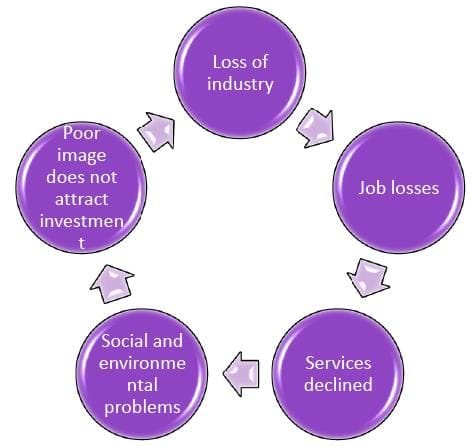
Poor industrial relations can have severe negative impacts on a country's economic life. Here are some of the detrimental effects of poor industrial relations:
1. Multiplier Effects:
- Modern industry and the economy are interconnected.
- Even if the direct loss from industrial conflict in one plant appears small, the overall loss due to its multiplier effect on the economy is significant.
- The multiplier effect occurs when one group's actions influence others, leading to multiple strikes.
- Consequences of this effect include loss of industry, job losses, decreased services, social and environmental issues, and a negative image that deters potential investment.
2. Fall in Normal Tempo:
- Poor industrial relations adversely affect the normal pace of work, resulting in performance levels below optimal.
- This decline leads to increased costs, higher absenteeism, and greater staff turnover.
- Discipline within the workplace deteriorates, impacting both the quality and quantity of production.
3. Frustration and Social Cost:
- Employees come to work not only for a salary but also to meet their social and personal needs.
- When these needs are not met, it leads to frustration.
- Poor industrial relations play a significant role in employee dissatisfaction, reducing harmony and increasing social tension.
4. Resistance to Change:
- A dynamic industrial environment requires constant changes, including improvements in methods, cost savings, and new product development.
- Each of these tasks involves a series of changes that are often strongly resisted during industrial conflicts.
FAQs on Overview of Industrial Relations
| 1. What is the meaning of Industrial Relations (IR)? |  |
| 2. What are the key features of Industrial Relations? | |
| 3. What factors influence Industrial Relations? | |
| 4. What are the objectives of Industrial Relations? | |
| 5. What are the effects of poor Industrial Relations? | |




