UPSC Exam > UPSC Notes > Current Affairs & Hindu Analysis: Daily, Weekly & Monthly > Understanding Creative Destruction
Understanding Creative Destruction

Summarized Discussion on Creative Destruction and the 2025 Nobel Prize in Economics
This summary condenses a discussion on Creative Destruction, its recognition in the 2025 Nobel Prize in Economics, and its relevance to India's economic and cultural context, featuring insights from Professor Vimal Kumar (IIT Kanpur) and Professor Chan Singh (CEO, Egrow Foundation). The discussion draws parallels with Indian mythology, highlights India's progress, and addresses challenges in managing technological transitions.
Introduction to Creative Destruction and the 2025 Nobel Prize
- Creative Destruction, a concept by Joseph Schumpeter (1942), describes how new innovations replace outdated technologies and industries, driving economic progress from the Industrial Revolution to the digital era.
- It fosters economic renewal and stability through a cycle of innovation and obsolescence.
- The 2025 Nobel Prize in Economicswas awarded to:
- Joel Mokyr (Northwestern University): For identifying prerequisites for technological progress and economic growth.
- Philippe Aghion (College de France, LSE) and Peter Howitt (Brown University): For theories on sustained growth through creative destruction, emphasizing competition as a driver of innovation.
- Experts: Professor Vimal Kumar and Professor Chan Singh provide insights into the concept's application in India.
Creative Destruction and Indian Mythology (Professor Kumar)
- Core Processes:
- Innovation: Creation of new technologies, products, or ideas.
- Obsolescence: Replacement of outdated systems, rendering them redundant.
- This cycle drives productivity but creates friction between old and new systems, requiring careful management to balance stability and change.
- Mythological Parallel:
- Professor Kumar compares creative destruction to Lord Shiva's cosmic role in Hindu mythology as the destroyer who enables new creation.
- The "halahala" (poison) from the cosmic churning symbolizes the friction and challenges during economic transitions.
- Shiva's role is not reckless destruction but a mindful transition, deciding what must be eliminated for progress.
- In a resource-constrained world, creative destruction ensures renewal by replacing old systems with innovative ones, avoiding stagnation.
Indian Cultural Context and Historical Perspective (Professor Singh)
- Indian Philosophy Alignment:
- The concept of reincarnation and continuous growth in Indian philosophy mirrors creative destruction, where individuals and economies evolve by shedding outdated practices.
- Examples include technological shifts from large computers and Walkmans to smartphones, illustrating constant renewal.
- Schumpeter's Pessimism vs. Modern Optimism:
- Schumpeter feared that creative destruction might destabilize capitalism.
- Aghion's work counters this, showing that competition fuels continuous innovation, ensuring economic survival and growth.
- Indian culture's cyclical view of growth, destruction, and rebirth enriches the understanding of economic transformation.
- Key Insight: Effective institutional and cultural frameworks are essential to manage the disruptions caused by creative destruction.
Creative Destruction in Contemporary India (Professor Kumar)
- Examples of Creative Destruction in India:
- E-commerce vs. Kirana Stores: Competition between online platforms and traditional retail, raising fair trade concerns.
- Internal Combustion Engines (ICE) to Electric Vehicles (EVs): Policy challenges include GST, infrastructure development, and job displacement for drivers.
- Coal to Renewable Energy: Environmental policies disrupt coal-based industries, impacting jobs.
- Challenges:
- Social and economic friction arises as new technologies displace workers (e.g., drivers, coal workers).
- Regulatory frameworksmust adapt to ensure:
- Fair competition between old and new industries.
- Inclusion of vulnerable groups affected by transitions.
- Support for innovation without excessive disruption.
- Risk: Without effective management, creative destruction could lead to governance bottlenecks and social unrest.
India's Progress in Managing Creative Destruction (Professor Singh)
- Government Initiatives:
- Startup India and Standup India: Promote entrepreneurship and innovation.
- Fintech and Financial Inclusion: Enabled by the JAM Trinity (Jan Dhan, Aadhaar, Mobile), revolutionizing digital banking.
- STEM Education and R&D: Significant investments foster a culture of innovation.
- Alignment with Nobel Research:
- India's policies make innovation endogenous (integral to the economic system).
- Competition and technological progress are leveraged for sustained growth.
- Metaphor: Professor Singh compares economic renewal to a rose garden, where new buds replace wilting flowers, reflecting natural cycles of growth and obsolescence.
- Digital Transformation: India embraces technology in banking, railways, and other sectors, replacing traditional methods with efficient solutions, though job losses and adaptation challenges persist.
Managing the "Poison" of Creative Destruction (Professor Kumar)
- Institutional Safety Nets:
- Food security for 80 crore people.
- Housing schemes for urban and rural populations.
- Affordable medical insurance to protect vulnerable groups.
- Promotion of yogic exercises for health and well-being.
- Transition Policies:
- Skilling programs must accelerate to prepare youth for rapidly evolving technologies, especially AI.
- Infrastructure investment is critical; India's projected $18-19 billion AI investment by 2030 is modest compared to the global $1.8 trillion.
- Risk: Without rapid upskilling and infrastructure development, India risks losing its demographic dividend and facing social disruption.
- Key Insight: Embracing Shiva's destruction without fear requires managing the "poison" (friction) to ensure smooth transitions and avoid chaos.
India's Path Forward and Vision 2047
- Digital-Led Industrial Revolution:
- India hosts one of the world's largest startup ecosystems and a vibrant innovation-driven economy.
- Vision 2047:
- Aims for a developed India through sustainable and equitable growth.
- Balances innovation with social protection and environmental stewardship.
- Shiva's Cosmic Dance: Represents India's dynamic growth model, balancing creation and destruction purposefully.
- Challenges:
- Sustaining growth momentum while ensuring inclusion and equity.
- Addressing governance bottlenecks and social challenges from rapid technological change.
- Call to Action: Encourages ongoing discussions on innovation, growth, and inclusion.
Summary Table: Key Concepts and Indian Context
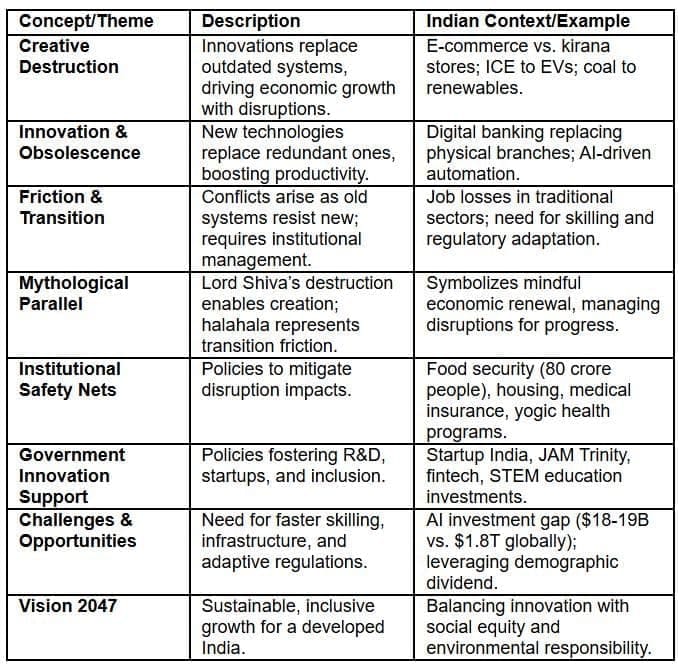
Key Insights
- Creative destruction is vital for economic growth but requires careful management to minimize social and economic disruptions.
- The Shiva metaphor contextualizes creative destruction in Indian philosophy, emphasizing mindful transitions.
- India's digital transformation, startup ecosystem, and policies like JAM Trinity align with global innovation trends but face challenges in skilling and infrastructure.
- Institutional safety nets (food, housing, health) are critical to support vulnerable populations during transitions.
- Vision 2047 focuses on sustainable, equitable growth, balancing innovation with social and environmental priorities.
- Competition and cultural frameworks, as highlighted by Nobel laureates, drive innovation and sustained growth.
Keywords
Creative destruction, Joseph Schumpeter, innovation, obsolescence, economic growth, technological progress, Lord Shiva, halahala, Indian mythology, digital transformation, startups, financial inclusion, skilling, infrastructure, AI, sustainability, inclusion, transition policies, Nobel Prize 2025, Vision 2047.
The document Understanding Creative Destruction is a part of the UPSC Course Current Affairs & Hindu Analysis: Daily, Weekly & Monthly.
All you need of UPSC at this link: UPSC
FAQs on Understanding Creative Destruction
| 1. What is the concept of creative destruction and how does it relate to economic growth? |  |
Ans. Creative destruction is a term coined by economist Joseph Schumpeter, referring to the process by which new innovations replace outdated technologies or industries. This cycle of innovation is essential for economic growth as it allows for the reallocation of resources to more productive uses, ultimately leading to increased efficiency and new job creation. In the context of an economy, creative destruction can stimulate competition and drive technological advancements, contributing to overall development.
| 2. How does creative destruction manifest in the Indian economy? | |
Ans. In India, creative destruction can be observed through the rapid growth of the technology sector, which has led to the decline of traditional industries. For instance, the rise of e-commerce platforms has disrupted brick-and-mortar retail stores. Additionally, innovations in sectors like fintech and agritech have transformed traditional practices, enhancing productivity and accessibility while phasing out outdated models. This phenomenon highlights the dynamic nature of the Indian economy and its capacity for adaptation and growth.
| 3. What are the implications of creative destruction for employment in India? | |
Ans. While creative destruction can lead to job losses in declining industries, it often creates new employment opportunities in emerging sectors. For example, the growth of the digital economy has resulted in a demand for skilled workers in IT, data analytics, and digital marketing. However, this transition may require workforce reskilling and upskilling initiatives to help displaced workers adapt to new job markets. Thus, the long-term impact on employment is a mix of challenges and opportunities.
| 4. How can policymakers support creative destruction in the economy? | |
Ans. Policymakers can foster an environment conducive to creative destruction by investing in education and skill development, promoting research and innovation, and creating a regulatory framework that encourages entrepreneurship. Additionally, providing financial support for startups and facilitating access to technology can help nurture new businesses that drive economic growth. Supportive policies can mitigate the negative impacts on workers and industries that are phased out.
| 5. What role does creative destruction play in sustainability and environmental considerations? | |
Ans. Creative destruction can have significant implications for sustainability, as innovative technologies often lead to more efficient resource use and reduced environmental impact. For instance, the shift from fossil fuels to renewable energy sources exemplifies creative destruction in action. In India, promoting sustainable practices through innovative solutions can drive economic growth while addressing environmental challenges. However, it is crucial to manage this transition carefully to ensure that it benefits all stakeholders involved.
About this Document

4.65/5 Rating

Apr 18, 2026 Last updated
Related Exams
Document Description: Understanding Creative Destruction for UPSC 2026 is part of Current Affairs & Hindu Analysis: Daily, Weekly & Monthly preparation. The notes and questions for Understanding Creative Destruction have been prepared according to the UPSC exam syllabus. Information about Understanding Creative Destruction covers topics like and Understanding Creative Destruction Example, for UPSC 2026 Exam. Find important definitions, questions, notes, meanings, examples, exercises and tests below for Understanding Creative Destruction.
Introduction of Understanding Creative Destruction in English is available as part of our Current Affairs & Hindu Analysis: Daily, Weekly & Monthly for UPSC & Understanding Creative Destruction in Hindi for Current Affairs & Hindu Analysis: Daily, Weekly & Monthly course. Download more important topics related with notes, lectures and mock test series for UPSC Exam by signing up for free. UPSC: Understanding Creative Destruction
Description
Understanding Creative Destruction of Current Affairs & Hindu Analysis covers all the important topics, helping you prepare for the UPSC exam on EduRev. Start for free!
Information about Understanding Creative Destruction
In this doc you can find the meaning of Understanding Creative Destruction defined & explained in the simplest way possible. Besides explaining types of Understanding Creative Destruction theory, EduRev gives you an ample number of questions to practice Understanding Creative Destruction tests, examples and also practice UPSC tests



Related Searches
Objective type Questions, Semester Notes, Sample Paper, Extra Questions, Exam, video lectures, Previous Year Questions with Solutions, Understanding Creative Destruction, Free, Summary, Understanding Creative Destruction, study material, Important questions, ppt, Viva Questions, pdf , Understanding Creative Destruction, shortcuts and tricks, MCQs, past year papers, practice quizzes, mock tests for examination;