Chapter Notes: Industries & Tourism Industry


Introduction
The chapter "Industries & Tourism Industry" provides comprehensive insights into India's industrial development and tourism sector. Industries play a crucial role in transforming raw materials into finished goods, generating employment, and contributing to overall economic growth. Understanding this chapter requires a mix of conceptual clarity and factual knowledge about industrial types, location factors, regional distribution, and major industries. The chapter also examines historical influences, particularly British colonization, which shaped India's industrial landscape. Through a detailed study of agro-based, mineral-based, heavy, light, and labor-intensive industries, along with regional industrial clusters, readers can appreciate the factors that influence industrial development. Additionally, the chapter highlights strategic learning, focusing on key facts, locations, and concepts rather than rote memorization.
Definition and Concept of Industries
Industries involve the use of raw materials to manufacture goods, which are then sold in the market. Simply put, industries take raw materials, manufacture products, and sell them for consumption or further use.
Historical Background
- British East India Company exploited Indian raw materials for trade and industrial purposes.
- During ~200 years of British rule, Indian handicraft industries were destroyed systematically.
- Raw materials were exported to Britain tax-free, processed, and finished goods were sold back to India at low prices.
- Heavy taxes and tariffs restricted Indian handicraft exports, making domestic products expensive.
- Post-independence, India had a closed economy, limiting industrial growth.
- The 1991 LPG reforms (Liberalization, Privatization, Globalization), led by Dr. Manmohan Singh, marked the real industrial boom.
Types of Industries
Based on Labor Strength

Based on Raw Materials

Based on Ownership

Based on Source of Raw Materials
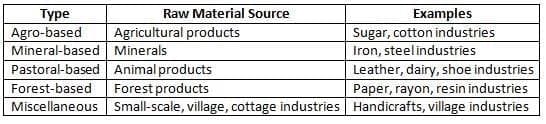
Other Classifications
- Consumer industries: Produce goods based on consumer demand.
- Basic industries: Fulfill fundamental needs (iron, steel, power generation).
- Capital-intensive industries: Require heavy investment (iron & steel, cement, aluminum).
- Labor-intensive industries: Require a large workforce.
Industrial Clusters and Distribution
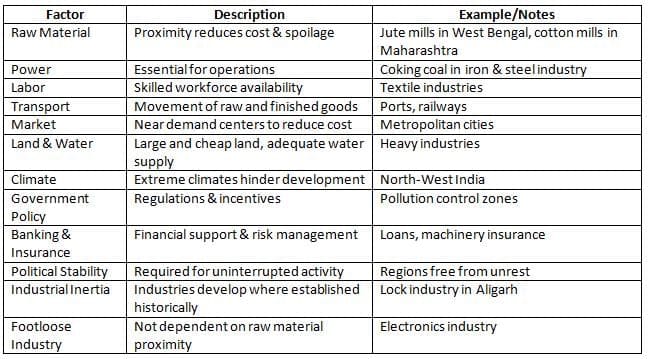
- Industries are unevenly distributed due to factors like raw material, labor, power, transport, market, climate, and government policies.
- Industrial clusters: Areas with high concentration of industries.
- Transporting raw materials over long distances increases cost and risk, especially for perishable goods.
Indicators of Major vs Minor Industrial Regions

Major Industrial Regions in India
- Mumbai-Pune: Cotton textiles ("Cottonopolis"), chemicals, automobiles, garments, films.
- Hugli Industrial Region (West Bengal): Jute, chemical, cotton textiles; Kolkata as historical investment hub; Haldia port development.
- Other regions: Bengaluru, Tamil Nadu, Gujarat, Chota Nagpur, Vishakhapatnam, Guntur, Gurgaon-Delhi-Merut.
- Focus on spread, type of industries, advantages, and disadvantages of each region.
Factors Affecting Industrial Location
Key Industries in India
Sugar Industry
- Second largest agro-based industry.
- Raw material: sugarcane (perishable).
- Localized near cultivation areas to prevent sucrose loss.
- Maharashtra: 20% of sugar mills, longer crushing season (162 days).
- Uttar Pradesh: More mills but smaller and lower production.
- Peninsular India advantages: tropical climate, higher yield, better machinery management.
- Problems: low yield, short crushing season, low recovery (<10%), small mill size.
Cotton Textile Industry
- Largest agro-based industry in India.
- India is the third largest producer worldwide.
- First mill: 1818 near Kolkata; first successful mill: Mumbai, 1854.
- Partition of India reduced cotton-growing areas (only 27% remained in India).
- Location factors: labor, transport, proximity to raw cotton, hydroelectricity, large market.
- Production sectors: mills (dominant), power looms, handlooms (15% combined output).
- Maharashtra: "Cottonopolis" (Mumbai, Akola, Nagpur, Wardha).
- Gujarat: Ahmedabad, major producer.
- UP: Kanpur, "Manchester of UP"; Tamil Nadu: "Manchester of South India".
Readymade Garments
- Labor-intensive, significant employment.
- Footloose industry, not tied to raw materials.
- Popular due to attractive design, patterns, color combinations.
- Supported by NIFT for fashion education and innovation.
Iron and Steel Industry
- Key industry providing machinery and tools to other industries.
- Historical evidence: iron pillars of Qutub Minar.
- TISCO established in Jamshedpur in 1907.
- Location factors: proximity to iron ore, coal, limestone, manganese; transport; labor; water supply.
- Mini steel plants: use scrap steel or sponge iron, electric arc/induction furnaces, produce mild, alloy, stainless steel.
Aluminum Smelting
- Second important metallurgical industry.
Conclusion
- Industries transform raw materials into finished goods, crucial for economic development.
- British colonization severely damaged Indian industries; post-independence growth was slow until 1991 reforms.
- Industry classification includes scale, raw material basis, ownership, capital/labor intensity, and footloose industries.
- Industrial location depends on raw materials, power, labor, transport, land, water, climate, government policies, banking, and political stability.
- Major vs minor industrial regions distinguished by workforce size, number of units, and output.
- Strategic study of factual chapters involves focusing on major points, locations, and concepts rather than memorizing every detail.
FAQs on Chapter Notes: Industries & Tourism Industry
| 1. What are the different types of industries and how are they categorized? |  |
| 2. How did British colonization impact industrial development in various regions? | |
| 3. What are industrial clusters, and why do they matter in economic development? | |
| 4. What factors influence the location of industries? | |
| 5. How do major and minor industrial regions differ in terms of characteristics and economic impact? | |

