ANOVA
- Prof. R. A. Fisher first used the term variance and developed a detailed theory of ANOVA.
- He explained how ANOVA is useful for practical research applications.
- ANOVA is a procedure to test whether different groups of data are homogeneous.
- It partitions the total variation in a data set into two parts: variation due to chance and variation due to specific causes.
- ANOVA splits variance into components for analytical purposes.
- It analyses the variance of a response by assigning components to different sources of variation.
- Using ANOVA, one can study any number of factors believed to affect the dependent variable.
Types of ANOVA
These are as follows:
One-Way ANOVA
- One-way ANOVA tests differences among two or more independent groups.
- It is typically applied when comparing three or more groups, because two-group cases can be handled by Student's t-test.
- When only two means are compared, the t-test and the F-test are equivalent with F = t².
- For example, a researcher might compare students' attitude towards school across school types: SSC, CBSE and ICSE.
- Here the dependent variable is attitude towards the school and the groups are SSC, CBSE and ICSE schools.
- One-way ANOVA tests whether students' attitudes differ among these three groups.
- One-way repeated measures ANOVA is used when the same subjects receive repeated measurements.
- That is, the same subjects are measured under each treatment.
- This design can be affected by carry-over effects.
- It is commonly used in experiments comparing three or more related measurements, for example pre-test and post-test scores.
Two-Way ANOVA
- Two-way ANOVA studies the effects of two independent or treatment variables.
- It is also called factorial ANOVA.
- The most common factorial design is 2 × 2, meaning two independent variables each with two levels.
- Two-way ANOVA can have higher levels such as 3 × 3 or higher-order designs like 2 × 2 × 2.
- Manual calculations for many factors are lengthy, so higher-order analyses became common after data analysis software emerged.
- For example, a researcher might compare students' attitude by school type (SSC, CBSE, ICSE) and gender.
- Here the dependent variable is attitude towards the school and the independent variables are school type (three levels) and gender (two levels).
- This would be a 3 × 2 two-way ANOVA, testing attitude differences by school type and gender.
MANOVA
- When samples receive repeated measures, such as pre-test and post-test, a factorial mixed design can be used: Multivariate Analysis of Variance (MANOVA).
- In MANOVA one factor may be a between-subjects variable and the other a within-subjects variable.
- This is a type of mixed-effects model.
- MANOVA is used when there is more than one dependent variable.
ANCOVA
- When comparing two groups on a dependent variable, initial differences on another variable (for example SES or pre-test scores) should be removed.
Assumptions of Using ANOVA
- Independence of cases.
- Normality of the distribution in each group.
- Equality or homogeneity of variances (homoscedasticity); group variances should be similar.
- Levene's test is commonly used to check homogeneity of variances.
- The Kolmogorov-Smirnov or Shapiro-Wilk tests may be used to test normality.
- Lindman argues that the F-test is unreliable when distributions deviate from normality.
- Ferguson and Takane claim the F-test is robust to such deviations.
- The Kruskal-Wallis test is a non-parametric alternative that does not assume normality.
Chi-Square (Equal Probability and Normal Probability Hypothesis)
- A chi-square test (also chi-squared or χ2 test) is any statistical test whose test statistic follows a chi-square distribution when the null hypothesis holds.
- More generally, the test statistic's distribution can be made to approximate a chi-square distribution as sample size increases.
- Chi-square tests are commonly used to compare observed data with expected frequencies under a specified hypothesis.
- For example, if a researcher expects parents' attitudes towards sex education to follow a particular distribution, the chi-square test checks whether observed counts fit those expectations.
- The null hypothesis states there is no significant difference between observed and expected results.
- If expected frequencies are assumed equal across cells, the test is the equal distribution hypothesis.
- If expected frequencies follow a normal distribution, it is the normal distribution hypothesis.
- The chi-square (χ2) test measures agreement between two sets of frequency counts.
- These must be categorical counts, not percentages or ratios.
Thus,
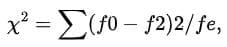
- fo denotes observed frequency and fe denotes expected frequency.
- Expected values may need scaling to match observed totals.
- Total counts for observed and expected values should be equal.
- In a contingency table, expected frequency can be estimated as fe = (row total × column total) / N.
- Here N is the grand total of all cells.
- The calculated chi-square is compared with table values to assess significance.
In a table, the degrees of freedom are computed as follows:
- df = (R - 1) × (C - 1)
- Where R = number of rows and C = number of columns.
- Chi-square indicates whether a significant association exists between variables but does not measure the strength or importance of that association.
- χ2 is the most used non-parametric test for comparing sample distributions with theoretical or established distributions.
- It is useful when the population distribution cannot be assumed to be normal.
- Advantages of chi-square tests include being distribution-free, easy to compute, and applicable when parametric tests are not suitable.
- The χ2 test was first used by Karl Pearson in 1890.
- Chi-square can also compare two or more actual samples.
Steps in the Calculation of χ
2
- First compute expected frequencies (E) using the formula shown in the image below.
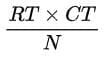
- RT = row total for the row containing the cell.
- CT = column total for the column containing the cell.
- Compute O - E for each cell.
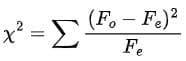
- Divide (O - E)² by E for each cell and then sum across all cells.
- χ2 ranges from zero to infinity; zero indicates perfect agreement between observed and expected counts.
- Larger discrepancies between O and E produce larger χ2 values.
Basic Computational Equation
(Observed frequency - Expected frequency)²

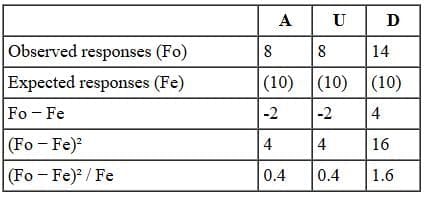
- Therefore, accept the null hypothesis.
- When there is one degree of freedom, Yates' correction for continuity should be applied.
- This correction subtracts 0.5 from the absolute value of each cell's numerator contribution before squaring.
- The adjusted chi-square formula with Yates' correction is shown in the image below.

- In χ2, the sum of (O - E) over all cells equals zero: ∑(O - E) = N - N = 0.
- This provides a check on chi-square computations.
- χ2 depends only on observed and expected frequencies and the degrees of freedom.
- The χ2 distribution approximates the multinomial distribution and applies to discrete frequency counts.
Level of Significance
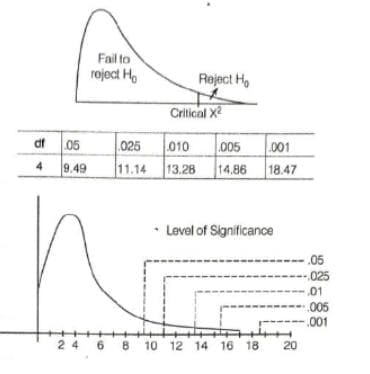
- The calculated χ2 is compared with the table value for a given degree of freedom at a chosen significance level.
- Usually a 5% level of significance is selected.
- If χ2 > table value, the difference between theory and observation is considered significant.
- χ2 is a random variable that varies by sample and is always non-negative.
- χ2 is a statistic derived from data, not a population parameter.
Above table represents a graph for degrees of freedom equal to 4 at different significance levels.
Uses of χ
2
Test
- χ2 test as a test of independence: it checks whether two or more attributes are associated.
- To test association, the null hypothesis assumes no relationship between the attributes.
- If χ2 is less than the table value at the chosen significance level, we do not reject the null hypothesis; the attributes appear unrelated.
- If χ2 > table value, we reject the null hypothesis and infer the attributes are related.
- χ2 test as a goodness-of-fit test: it shows how well a theoretical distribution fits observed data.
- It compares an ideal frequency curve with observed facts to assess fit.
- χ2 test as a test of homogeneity: it determines whether two or more independent samples come from the same population.
Example: If a fair coin is flipped 20 times, we expect 10 heads and 10 tails, though sampling error can produce variations such as 12 heads and 8 tails.
If the experiment yielded 12 heads and 8 tails, we enter expected (10, 10) and observed (12, 8) frequencies into a table.
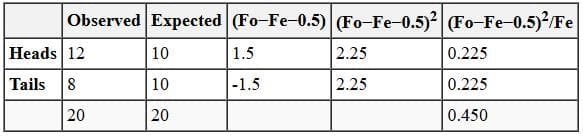
- With Yates' correction, subtract 0.5 from the absolute difference between observed and expected in each category before squaring.
- Divide the squared result by the expected frequency and sum across categories to compute χ2.
- How does a calculated χ2 of 0.450 inform us about the coin flip result 12 vs 8?
- The chi-square sampling distribution shape depends on degrees of freedom.
- For a one-way χ2 test, degrees of freedom equal r - 1, where r is the number of levels.
- Here r = 2, so df = 1.
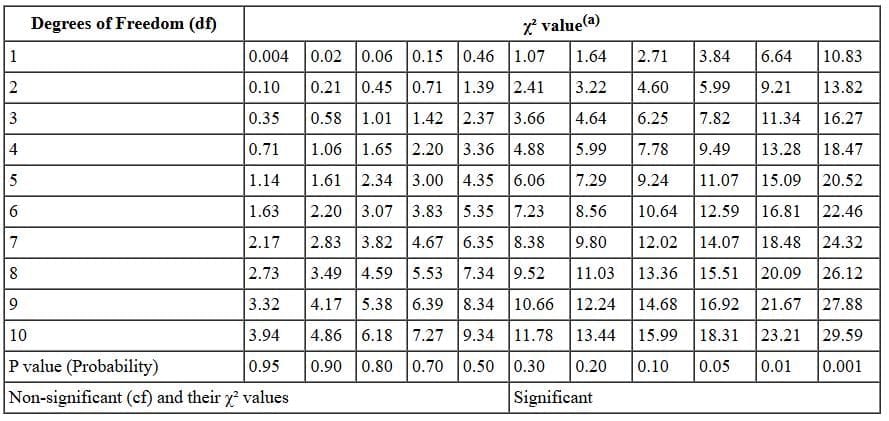
- From tables, χ2 ≥ 3.84 is needed for significance at the 0.05 level with 1 df.
- Our χ2 = 0.450 is less than 3.84, so the deviation could be due to sampling error and is not significant at the 0.05 level.
Different Levels of Significance
Correlation
- Correlation is a statistical measure of the relationship between two variables.
- It quantifies both the strength and direction of that relationship.
- Each subject must have two measures to compute correlation.
- If two quantities change together, they are said to be correlated.
- The degree of correlation indicates how strongly the two variables are related.
- This degree is summarised by the correlation coefficient.
- Two independent variables are not correlated because they lack a meaningful relationship to interpret.
- The correlation coefficient ranges from -1 to +1; -1 is perfect negative, +1 is perfect positive, and 0 means no correlation.
- Correlation analysis can determine whether a relationship exists, its direction (positive or negative), and whether it is statistically significant.
- Correlation analysis may also be used in attempts to establish cause-and-effect, though correlation alone does not prove causation.
Types of Correlation
There are different types of correlation, as follows:
Positive and Negative Correlation- Positive correlation occurs when both variables move in the same direction; for example, higher intelligence associated with higher adjustability.
- This is denoted by a plus (+) sign.
- Negative correlation occurs when the variables move in opposite directions; one increases while the other decreases.
- This is denoted by a minus (-) sign.
- A zero coefficient indicates no relationship between the variables.
Simple, Partial and Multiple Correlation
- These distinctions depend on the number of variables studied.
- Simple correlation involves two variables.
- Partial correlation considers more than two variables but examines the relationship between two variables while holding others constant.
- Multiple correlation studies the relationship among three or more variables simultaneously.
Linear and Non-Linear Correlation
- Linear correlation means the variables vary in a constant ratio and the relationship remains at a constant rate.
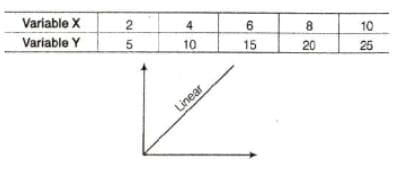
- If percentage changes in X and Y are not constant and fluctuate, the relationship is non-linear or curvilinear.
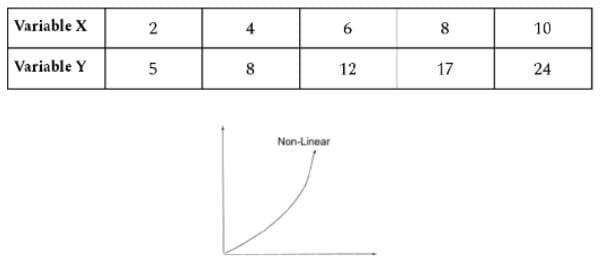
Methods of Studying Correlation
These are:
- Scatter diagram
- Correlation graph
- Product-moment coefficient of correlation
- Rank-difference correlation method
- Coefficient of concurrent deviation
- Method of least squares
Uses of Correlation
- To evaluate reliability and validity of psychological tests and inventories.
- In factor analysis techniques.
- To make predictions.
- In path analysis techniques.
Two Methods of Correlation
Product-Moment Method of Coefficient
- Pearson's coefficient is commonly denoted by r.
- It is used when the relationship between two variables is linear.
- It applies when data for X and Y are at interval or ratio level and the distribution is linear.
- The term product-moment refers to the mean of the product of mean-adjusted random variables.
- It measures the strength and direction of the linear relationship and equals the sample covariance divided by the product of the standard deviations.
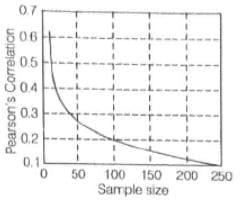
A graph shows the minimum Pearson correlation that is significantly different from zero at the 0.05 level for given sample sizes.
- There are two calculation methods for Pearson's coefficient:
- Long method (actual mean method)
- Short method (assumed mean method)
For the actual mean method:
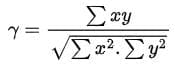
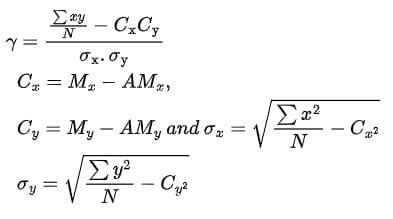
- Care points:
- If ∑xy is large relative to ∑x² and ∑y², the correlation will be high, and vice versa.
- If ∑xy is negative, the correlation coefficient will be negative.
- The degree of y indicates the degree of variation between the two series.
Rank-Order Coefficient of Correlation
- Used when data are ranks rather than scores.
- It applies when the relationship is not linear and product-moment methods are inappropriate.
- In such cases, the rank-order method uses Spearman's rho (ρ) to measure association.
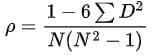
- Where D = difference in ranks for a pair and N = number of pairs.
- ρ = coefficient of correlation by rank-order method.
Significance of Correlation Coefficient
- From 0.00 to 0.20 denotes negligible relationship.
- From 0.20 to 0.40 denotes slight correlation.
- From 0.40 to 0.70 denotes substantial or marked relationship.
- From 0.70 to 1.00 denotes high to very high relationship.
Z-Test
- A Z-test is a type of hypothesis test that helps assess whether test results are likely to be true or repeatable.
- A hypothesis test determines whether findings are probably true or probably not true.
- A Z-test is used when data are approximately normally distributed.
When to Use a Z-Test
- Use a Z-test when your sample size is greater than 30; otherwise use a t-test.
- Data points should be independent of each other.
- Data should be normally distributed, though large samples reduce this concern.
- Samples should be randomly drawn so each item has equal selection chance.
- Prefer equal sample sizes where possible.
One-Sample Z-Test Example
- An investor tests whether a stock's average daily return exceeds 1%.
- A random sample of 50 returns has a mean of 2% and an assumed population standard deviation of 2.50%.
- The null hypothesis states the mean equals 1% and the alternative states the mean is greater than 1%.
- Assume α = 0.05 with a two-tailed test, so critical z values are ±1.96.
- Z is computed as (observed mean - test mean) divided by (standard deviation / √n).
- Here z = (0.02 - 0.01) / (0.025 / √50) ≈ 2.83.
- Since 2.83 > 1.96, the investor rejects the null hypothesis and concludes the mean return is greater than 1%.
Qualitative Data Analysis
- Qualitative data are verbal or symbolic materials describing behaviours, people, situations and events.
- Analyzing qualitative data means studying organised material to discover underlying facts.
- Researchers examine the data from many angles to explore new facts or reinterpret known ones.
The types of qualitative data analysis are:
Data Reduction
- Data reduction involves selecting, focusing, simplifying, abstracting and transforming data from field notes or transcriptions.
- Raw data must be organised and meaningfully condensed to become manageable.
- Reduction transforms data to make them intelligible for the research questions.
- Researchers use the principle of selectivity to choose which data to describe.
- Data reduction typically combines deductive and inductive analysis.
- Coding is done by discussion topics, observation checklists or semi-structured interview guides.
Classification
- Classification groups items by shared attributes to create categories or typologies.
- Historically, science emphasised classification systems; examples include botanical classifications and the periodic table.
- Analysts look for recurring patterns in categorized data and form classification systems accordingly.
- Categories are judged by internal homogeneity and external heterogeneity.
- A large number of unassignable or overlapping items suggests faults in the category system.
- Analysts iteratively refine categories by checking data placement and category meaningfulness.
- Priorities among classification schemes are set by salience, credibility, uniqueness, feasibility and materiality.
- Completeness is tested by internal and external checks to ensure categories are consistent and form a coherent whole.
- Category building involves both technical and creative work; no infallible procedure exists.
- In summary: identify and develop categories, judge them for homogeneity and heterogeneity, assign data, recheck and prioritise categories, test for completeness, and label categories clearly.
Analytical Induction
- Analytical induction builds explanations by creating and testing causal links within cases and extending these to other cases.
- It is a research logic used to collect data, develop analysis and structure research findings.
- Its goal is causal explanation and it originated from symbolic interaction theory.
- It searches for broad categories and then develops sub-categories; definitions are refined as analysis progresses.
- If similarities are not found, data or definitions are re-evaluated or categories narrowed.
- Definitions are treated as hypotheses to be tested and revised using inductive reasoning.
- Katz defined analytic induction as a logic to collect data, develop analysis and present findings.
- AI calls for progressive redefinition of the phenomenon and explanatory factors to maintain a universal relationship.
- Initial cases suggest provisional explanations which are revised as contradictory cases appear.
- Cressey outlined analytical induction steps as:
- Define the phenomenon tentatively.
- Develop a hypothesis about it.
- Examine a single instance to test the hypothesis.
- If the hypothesis fails, redefine the phenomenon or revise the hypothesis to include the instance examined.
- Examine additional cases; if the hypothesis continues to hold, confidence increases.
- Each negative case requires reformulation until no exceptions remain.
Constant Comparison
- Constant comparison analyses qualitative data to develop theory and is central to grounded theory methods.
- It involves comparing newly coded passages with previously coded passages to ensure consistent coding.
- This helps to identify passages that may be better coded differently or that reveal new dimensions.
- Comparisons can extend across cases or even to external examples to refine codes.
- New data are constantly compared with existing data to refine theoretical categories and guide the research.
Strauss and Corbin (1990) recommend these components for constant comparison:
- Word repetitions - look for frequently used words and repeats that indicate emotions.
- Indigenous categories - use terms respondents use with special meaning (in vivo codes).
- Key words in context - examine the range of a term's uses in phrases and sentences.
- Compare and contrast - ask what a passage is about and how it differs from adjacent statements.
- Social science queries - introduce explanations to account for conditions, actions and consequences.
- Searching for missing information - look for expected but absent phenomena.
- Metaphors and analogies - metaphors may reveal central beliefs and feelings.
- Transitions - note discursive elements like turn-taking and narrative structures.
- Paging - mark and scan text using highlights and marginal lines to identify patterns.
- Cutting and sorting - collect all similarly coded transcript excerpts together to review and analyse them as a set.
Triangulation
- Triangulation uses more than one method to collect data on the same topic.
- It validates data by cross-verification from multiple sources.
- Triangulation tests consistency across instruments and helps assess multiple causes influencing results.
- It deepens and broadens understanding rather than only providing validation.
- Triangulation is used in both qualitative and quantitative research.
The term originated in surveying and navigation and was adopted in social science as a metaphor for multiple operationalisation.
- Campbell and Fiske first applied the term triangulation to research to describe multiple data collection strategies measuring a single concept (data triangulation).
- The purpose of triangulation is to relate different kinds of data to enhance validity and understanding.
Types of Triangulation
They include:
- Data triangulation (time, space and person)
- Method triangulation (design and data collection)
- Investigator triangulation
- Theory triangulation
- Multiple triangulation, which combines two or more triangulation techniques
- Denzin (1989) described three types of data triangulation:
- Time triangulation - collecting data about a phenomenon at different times; note this differs from longitudinal studies meant to document change.
- Space triangulation - collecting data at more than one site to distinguish time- or space-specific characteristics.
- Person triangulation - collecting data from multiple levels of persons (individuals, groups or collectives); Denzin describes aggregate, interactive and collective levels.
Smith lists seven levels of person triangulation:
- (i) Individual level
- (ii) Group analysis - interaction patterns among individuals and groups
- (iii) Organisational units of analysis - units that have qualities beyond the individuals
- (iv) Institutional analysis - relationships across legal, political, economic and familial institutions
- (v) Ecological analysis - spatial explanations
- (vi) Cultural analysis - norms, values, practices and ideologies of a culture
- (vii) Societal analysis - broad factors like urbanisation, industrialisation, education and wealth
- Methods triangulation can occur at the design level or the data collection level.
- Design-level triangulation (between-method) combines quantitative and qualitative methods in the study design, either simultaneously or sequentially.
- Data-collection triangulation (within-method) uses two different techniques within the same research tradition to gain a fuller understanding of the phenomenon.
- Method triangulation can be time-consuming and expensive but often yields richer insights.
- Investigator triangulation involves multiple researchers with diverse backgrounds collaborating on the same study.
- Each investigator should have a distinct, complementary role.
- Theory triangulation uses different theoretical perspectives to interpret the same data.
- This strategy enhances research quality and helps reveal multiple theoretical explanations.
- Researchers cycle between data generation and analysis to test emerging theories until conclusions are reached.
- Denzin recommends combining multiple methods, data sources and investigators to identify and validate issues.
- Multiple methods reveal different aspects of reality and together increase trustworthiness and comprehensiveness.
- Guba argues triangulation enhances credibility, dependability and confirmability in qualitative research.