Humanities/Arts Exam > Humanities/Arts Notes > History Class 11 > Unit Test Solutions: Nomadic Empires
Unit Test Solutions: Nomadic Empires

Time: 1 hour
M.M. 35
Attempt all questions.
- Question numbers 1 to 5 carry 1 mark each .
- Question numbers 6 to 8 carry 2 marks each.
- Question numbers 9 to 10 carry 4 marks each.
- Question numbers 11 and 12 carry 5 marks each
- Question numbers 13 carry 6 marks
Q.1 The term 'barbarian' is derived from a Greek word meaning: (1 mark)
(a) Nomad
(b) One who cannot speak Greek
(c) Horse rider
(d) City dweller
Ans: (b) One who cannot speak Greek
The Greeks used 'barbaros' for anyone whose language sounded like meaningless noise.
The Greeks used 'barbaros' for anyone whose language sounded like meaningless noise.
Q.2 Who united the Mongol tribes into a political confederation in 1206 CE? (1 mark)
(a) Kublai Khan
(b) Ogodei
(c) Genghis Khan
(d) Batu
Ans: (c) Genghis Khan
He was proclaimed the 'Great Khan' at the quriltai in 1206 CE.
He was proclaimed the 'Great Khan' at the quriltai in 1206 CE.
Q.3 Name the river that marked the northern boundary of the Mongol homeland. (1 mark)
Ans: Onon River.
Q.4 What was the basic unit of Mongol military organisation? (1 mark)
Ans: The arban (unit of 10 soldiers).
Q.5 Which of the following was NOT a feature of nomadic societies? (1 mark)
Q.5 Which of the following was NOT a feature of nomadic societies? (1 mark)
(a) Mobile pastoralism
(b) Large urban centres
(c) Clan-based structure
(d) Horse-based warfare
Ans: (b) Large urban centres
Nomads avoided permanent settlements, relying on mobility.
Nomads avoided permanent settlements, relying on mobility.
Q.6 Give two reasons why Genghis Khan's campaigns were successful despite smaller numbers. (2 marks)
Ans: Genghis Khan's military success stemmed from superior tactics and organisation, even when outnumbered.
- Advanced cavalry and archery: Mongol horse archers used composite bows with a range of 300 metres, allowing hit-and-run attacks while maintaining distance from enemy infantry.
- Psychological warfare and intelligence: Spies infiltrated enemy cities; false retreats lured opponents into ambushes. The Mongols also used terror - massacring resistant populations - to force quick surrenders.
Q.7 State any two social features common to Mongol and Turkic tribes. (2 marks)
Ans: Both Mongol and Turkic nomadic societies shared core social structures shaped by the harsh steppe environment.
- Patrilineal clans and tribal loyalty: Descent was traced through the male line; clans formed the basis of political and military alliances, with leaders chosen from noble lineages.
- Active role of women: Women managed camps, herded livestock, and participated in hunting and even warfare. High-status women like Genghis Khan's mother Hoelun wielded significant influence in tribal councils.
Q.8 Explain the term yasa in one sentence. Give one example. (2 marks)
Ans: The yasa was the comprehensive legal and administrative code introduced by Genghis Khan to unify diverse tribes under a single imperial framework.
Example: It strictly prohibited theft among Mongols and regulated hunting seasons to preserve game, ensuring both internal discipline and ecological sustainability across the vast empire.
Example: It strictly prohibited theft among Mongols and regulated hunting seasons to preserve game, ensuring both internal discipline and ecological sustainability across the vast empire.
Q.9 Describe the Mongol military structure. Give three levels with their sizes and roles. (4 marks)
Ans: The Mongols created a decimal-based, highly disciplined army that broke tribal loyalties and ensured loyalty to the Khan. This system enabled rapid mobilisation and coordination across vast distances.
Q.10 Study the data on Mongol conquests:
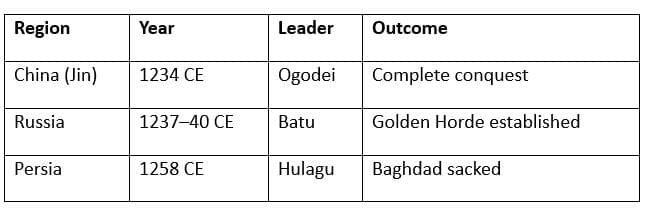
Analyse three reasons why the Mongols could conquer such diverse regions. (4 marks)
- Arban (10 soldiers): Smallest unit; handled daily patrols, coordination, and rapid communication on the battlefield. Each soldier knew every other, fostering tight cohesion.
- Jaghun (100 soldiers): Led by a noyon; conducted raids, scouting missions, and maintained discipline within larger formations. It acted as a link between small and large units.
- Mingghan (1,000 soldiers): Major tactical unit; executed large-scale maneuvers and coordinated attacks across wide fronts. Commanders were chosen for merit, not birth.
- Tumen (10,000 soldiers): Largest field formation; used in major battles and sieges, capable of independent operations across regions.
Q.10 Study the data on Mongol conquests:
Analyse three reasons why the Mongols could conquer such diverse regions. (4 marks)
Ans: The Mongols built the largest contiguous land empire due to military innovation, strategic adaptability, and psychological dominance. Their success was not just brute force but a blend of steppe tactics and borrowed technologies.
- Mobility and speed: Horse archers covered 100 km daily; Russia was overrun in 3 years despite vast size. This allowed surprise attacks and rapid reinforcement.
- Psychological terror: Sacking Baghdad (1258) broke resistance; cities surrendered to avoid destruction. Fear became a weapon more effective than armies.
- Adaptation and integration: In China, they used Chinese engineers for siege weapons; in Persia, local administrators were retained to collect taxes. This pragmatic approach sustained long-term control.
Q.11 You are a Chinese scholar in 1270 CE. Draft a short report (in 5 points) to the Song Emperor advising how to resist Mongol invasion, based on their known tactics. (5 marks)
Ans: The Mongol threat grows daily. Their speed, archery, and terror tactics demand a defensive strategy that denies them their strengths. Below is a five-point plan based on observed patterns from Jin and Xi Xia campaigns.
Q.12 Examine the role of the quriltai and yasa in Genghis Khan's empire. Cover their functions and impact in three points each. (5 marks)
- Fortify river crossings: Mongols avoid water; use the Yangtze as a natural barrier. Build floating bridges that can be destroyed quickly.
- Burn grasslands: Deny pasture to their horses; force them into prolonged sieges where their mobility is useless.
- Use crossbows in formation: Outrange their composite bows with massed volleys from city walls. Train 50,000 archers in rotating shifts.
- Spread false information: Their spies are everywhere; leak fake troop movements to mislead commanders like Subutai.
- Offer surrender terms: They spare cities that submit early; buy time to regroup and rebuild southern defences.
Q.12 Examine the role of the quriltai and yasa in Genghis Khan's empire. Cover their functions and impact in three points each. (5 marks)
Ans: Genghis Khan transformed loose tribes into a centralized empire using political and legal innovations. The quriltai and yasa were twin pillars of this transformation, replacing tribal anarchy with imperial order.
Quriltai (Assembly):
Quriltai (Assembly):
- Elected the Great Khan (1206 CE); gave legitimacy beyond birthright and prevented succession wars.
- Decided war and succession; prevented civil wars among sons by formalising inheritance (e.g., Ogodei chosen in 1229).
- Included women (e.g., Toregene as regent); broader participation than sedentary courts, ensuring diverse tribal input.
- Unified diverse tribes under one law; banned blood feuds and standardised punishments across regions.
- Regulated trade, marriage, and military duty; created predictability for merchants and soldiers alike.
- Enforced by jarquchi officials; ensured compliance across vast territories from China to Hungary.
Q.13 "The Mongol Empire was a paradox - nomadic in origin, imperial in structure." Discuss with reference to social background, military system, and administration (two points each). (6 marks)
Ans: The Mongols built history's largest land empire by blending pastoral roots with sophisticated statecraft. This paradox - nomadic mobility enabling conquest, imperial institutions sustaining rule - defined their success and eventual fragmentation.
Social Background:
Social Background:
- Nomadic clans (e.g., Kereyit, Naiman) lived by herding and raiding; no cities or farms. Survival depended on seasonal migration and horse-based mobility.
- Women managed camps and trade; high status unlike Chinese or Persian norms. Genghis Khan's mother Hoelun led the family after abandonment.
- Decimal units (arban to tumen) broke tribal ties; loyalty shifted to Khan. Soldiers were rotated across clans to prevent rebellion.
- Horse archers with stirrups and signals enabled coordinated attacks over 100 km fronts. A single tumen could outflank entire sedentary armies.
- Yasa applied uniformly from China to Russia; local laws retained for taxes. This flexibility allowed rapid integration of conquered peoples.
- Used Uighur script, Persian bureaucrats, Chinese engineers; adopted best practices. Kublai Khan's Yuan dynasty in China was a Mongol-Chinese hybrid.
The document Unit Test Solutions: Nomadic Empires is a part of the Humanities/Arts Course History Class 11.
All you need of Humanities/Arts at this link: Humanities/Arts
FAQs on Unit Test Solutions: Nomadic Empires
| 1. What are the defining characteristics of nomadic empires? |  |
Ans.Nomadic empires are characterized by their reliance on pastoralism, mobile lifestyles, and trade. They often formed vast territories by moving across regions, establishing control over trade routes, and integrating diverse cultures. Their social structures typically included clan-based governance, with leaders known for their military prowess, which allowed them to expand and maintain their empires.
| 2. How did nomadic empires influence settled societies? | |
Ans.Nomadic empires influenced settled societies through trade, cultural exchange, and sometimes military conquest. They facilitated the spread of goods, technologies, and ideas, leading to advancements in agriculture and crafts in settled areas. The interactions often resulted in the blending of cultures, as nomadic groups introduced new practices and perspectives that enriched the civilizations they encountered.
| 3. What role did trade play in the expansion of nomadic empires? | |
Ans.Trade was crucial for the expansion of nomadic empires as it provided economic resources and fostered alliances. Nomadic groups often controlled key trade routes, enabling them to engage in commerce with settled societies. This economic power not only funded military campaigns but also established diplomatic relationships, allowing nomadic empires to exert influence far beyond their territorial borders.
| 4. Can you name some prominent nomadic empires in history? | |
Ans.Some prominent nomadic empires include the Mongol Empire, which became the largest contiguous empire in history; the Huns, known for their invasions of Europe; and the Scythians, who were influential in the ancient world. Each of these empires played significant roles in shaping the political and cultural landscapes of their respective eras through conquests and interactions with agrarian societies.
| 5. What were the primary methods of governance in nomadic empires? | |
Ans.Nomadic empires typically employed a tribal or clan-based system of governance. Leadership was often based on merit and military capability, with chieftains or khans leading their groups. Decision-making was usually communal, with councils of elders or warriors playing significant roles. This structure allowed for flexibility and adaptability, essential traits for survival in the challenging environments nomadic peoples often inhabited.
About this Document

4.61/5 Rating

Apr 20, 2026 Last updated
Related Exams
Document Description: Unit Test Solutions: Nomadic Empires for Humanities/Arts 2026 is part of History Class 11 preparation. The notes and questions for Unit Test Solutions: Nomadic Empires have been prepared according to the Humanities/Arts exam syllabus. Information about Unit Test Solutions: Nomadic Empires covers topics like and Unit Test Solutions: Nomadic Empires Example, for Humanities/Arts 2026 Exam. Find important definitions, questions, notes, meanings, examples, exercises and tests below for Unit Test Solutions: Nomadic Empires.
Introduction of Unit Test Solutions: Nomadic Empires in English is available as part of our History Class 11 for Humanities/Arts & Unit Test Solutions: Nomadic Empires in Hindi for History Class 11 course. Download more important topics related with notes, lectures and mock test series for Humanities/Arts Exam by signing up for free. Humanities/Arts: Unit Test Solutions: Nomadic Empires
Description
Unit Test Solutions: Nomadic Empires of History Class 11 - variety of important questions with solutions, helping you prepare for exam. Download free PDF from EduRev.
Information about Unit Test Solutions: Nomadic Empires
In this doc you can find the meaning of Unit Test Solutions: Nomadic Empires defined & explained in the simplest way possible. Besides explaining types of Unit Test Solutions: Nomadic Empires theory, EduRev gives you an ample number of questions to practice Unit Test Solutions: Nomadic Empires tests, examples and also practice Humanities/Arts tests



Related Searches
Sample Paper, Objective type Questions, Semester Notes, Viva Questions, pdf , Exam, shortcuts and tricks, Free, mock tests for examination, Unit Test Solutions: Nomadic Empires, study material, Important questions, MCQs, practice quizzes, Unit Test Solutions: Nomadic Empires, Unit Test Solutions: Nomadic Empires, video lectures, ppt, Previous Year Questions with Solutions, Summary, Extra Questions, past year papers;