Chapter Notes: Indian Constitution


Introduction
The Preamble of the Indian Constitution serves as its soul, spirit, and guiding light. It expresses the ideals, values, and objectives upon which the entire Constitution is built. Often described as the "political horoscope of the Constitution"-a term coined by K.M. Munshi (not K.C. Munshi)-the Preamble reveals the vision of the Constitution's framers and outlines its purpose.
It begins with the powerful words "We, the People of India," signifying that ultimate sovereignty rests with the people. The Preamble defines India as a Sovereign, Socialist, Secular, Democratic, and Republic nation and aims to secure Justice, Liberty, Equality, and Fraternity for all citizens. It acts as an introduction to the Constitution, embodying the essence of India's political philosophy and democratic values.
Meaning and Importance of the Preamble
- The Preamble is seen as one of the most valuable parts of the Constitution because it shows the goals and principles of those who created it.
- It acts as a brief overview of the entire Constitution, highlighting the values of justice, liberty, equality, and fraternity that the country aims to achieve.
- Often called the "key to the Constitution", it reveals the thoughts of the framers and the aims they wanted to fulfill.
- Initially, the Preamble did not mention the terms "Socialist", "Secular", and "Integrity". These words were added later through the 42nd Amendment Act of 1976.
- The Preamble stresses that the people of India are the true source of power, reflecting the democratic character of the Constitution.
Nature of the Indian State and Its Core Features
According to the Preamble, the Indian State possesses the following characteristics:
- Sovereign: India is completely independent in its internal and external affairs. It makes its own laws and decisions without external interference.
- Socialist: The Constitution promotes social and economic equality. It seeks to reduce the gap between the rich and the poor, ensuring fair distribution of wealth and opportunities.
- Secular: India has no official religion. The State treats all religions equally and guarantees freedom of conscience and worship.
- Democratic: India has a government of the people, by the people, and for the people. Citizens elect their representatives through free and fair elections, and the government is accountable to them.
- Republic: The head of the State (the President) is elected, not hereditary. This reflects the sovereignty of the people and the democratic nature of governance.
Thus, the Preamble highlights the close relationship between democracy and republicanism, where citizens hold ultimate power through their right to vote.
(Note: The Protection of Human Rights Act, 1993 is not part of the Preamble; it can be mentioned separately as a supporting example, not as a constitutional component.)
Four Basic Objectives of the Indian State
The Preamble sets out four essential objectives that form the foundation of the Indian State:
Justice: Justice in India is ensured in three dimensions-social, economic, and political.
- Social justice eliminates discrimination based on caste, gender, or religion.
- Economic justice reduces inequality in wealth and opportunities.
- Political justice ensures equal participation in the political process.
The aim is to create a fair society free from privilege and oppression.
Liberty: Liberty refers to freedom of thought, expression, belief, faith, and worship. These freedoms are not absolute and are subject to reasonable restrictions to maintain harmony and security.
Equality: Equality ensures that all citizens have equal status before the law and equal access to opportunities, regardless of caste, religion, gender, or background. It prohibits discrimination and promotes equal rights for all, especially the marginalized.
Fraternity: Fraternity means a sense of brotherhood among citizens, promoting unity and integrity while ensuring the dignity of every individual. The abolition of untouchability and promotion of social harmony reflect this objective.
Historical Adoption of the Constitution and the Constituent Assembly
- The Constitution of India was officially adopted on 26 November 1949 and became effective on 26 January 1950. This day is celebrated as Constitution Day.
- The Constituent Assembly, which included representatives from various parts of Indian society, was responsible for drafting the Constitution. It was based on the Objective Resolution, introduced by Jawaharlal Nehru on 22 January 1947, which set the essential principles for the Constitution.
- The drafting process of the Constitution took a total of 2 years, 11 months, and 18 days (not 17 days) of discussions and debates before it was finalized.
- The Constitution was signed by Dr. Rajendra Prasad, the President of the Constituent Assembly, which represented the collective will of the people.
Major Features of the Indian Constitution
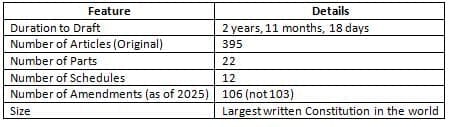
Comparison with the U.S. Constitution:
The U.S. Constitution has only 7 Articles and 27 Amendments, whereas India's Constitution has far more detailed provisions to accommodate its social, cultural, and political diversity.
Federal Structure with Unitary Features
India's Constitution is quasi-federal-it combines federal and unitary features.
Federal Features:
- Division of powers between the Centre and the States
- Supremacy of the Constitution
- Independent Judiciary
Unitary Features:
- Strong Centre with power to override States during emergencies
- Single Constitution and single citizenship
- Common Election Commission and All-India Services
This blend ensures both unity and flexibility. The Constitution has undergone over 100 amendments to adapt to changing needs.
Special Method of Amendment (Article 368)
Article 368 provides the procedure for amending the Constitution.
Most provisions can be amended by the Parliament with:
- A majority of the total membership, and
- A two-thirds majority of members present and voting.
Certain provisions also require ratification by at least half of the State Legislatures, such as:
- Election of the President
- Distribution of powers between Union and States
- Judiciary's powers and jurisdiction
- Representation of States in Parliament
- The amendment procedure itself
This ensures a balance between rigidity and flexibility.
Fundamental Rights (Part III of the Constitution)
Fundamental Rights, guaranteed under Articles 12 to 35, safeguard liberty, equality, and justice.
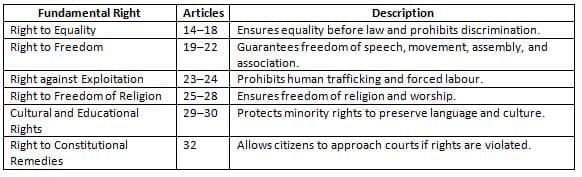
Key Insights and Conclusions
- The Preamble reflects the spirit and ideals of the Constitution.
- India is defined as a Sovereign, Socialist, Secular, Democratic, and Republic nation.
- The Constitution was adopted on 26 November 1949 and enforced on 26 January 1950.
- It is the largest written Constitution in the world, combining federal and unitary features.
- The amendment process ensures stability with flexibility.
- Fundamental Rights form the foundation of Indian democracy.
FAQs on Chapter Notes: Indian Constitution
| 1. What is the significance of the Preamble in the Indian Constitution? |  |
| 2. What are the four basic objectives of the Indian State as outlined in the Constitution? | |
| 3. How does the Indian Constitution reflect a federal structure with unitary features? | |
| 4. What is the special method of amending the Constitution as described in Article 368? | |
| 5. What are the Fundamental Rights enshrined in Part III of the Indian Constitution? | |