UGC NET Exam > UGC NET Notes > Crash Course Political Science > Conservatism
Conservatism

Introduction
- Conservatism is a political ideology that aims to preserve existing institutions and the established political system.
- Francois-Rene de Chateaubriand first used the term in 1818 during the Bourbon Restoration to oppose the momentum of the French Revolution.

Origin Of Conservatism
- In the nineteenth century, conservatism developed in Europe as a reaction against changes brought by modern ideologies like liberalism and socialism.
- Conservatives opposed the French revolutionary slogan of liberty, equality, and fraternity and defended an authoritative, traditional social and political order.
Core Themes
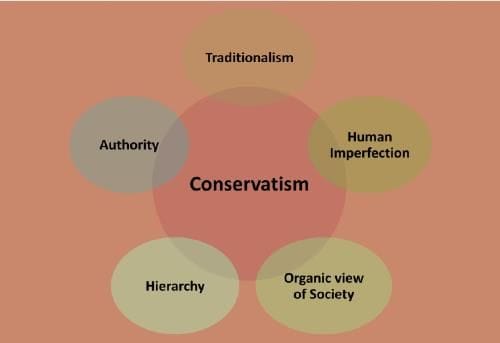
Edmund Burke argued that institutions and practices tested by time should be preserved for the benefit of the living and future generations. Conservative thinkers consider tradition to reflect the accumulated wisdom of the past.
O'Sullivan described conservatism as a "philosophy of human imperfection". The Hobbesian idea of human imperfection provided a basis for conservatism to resist radical reform and revolution. Conservatives have limited trust in human rationality and prefer institutions that are time-tested.
Conservatives view humans as dependent, security-seeking beings who cannot exist outside society. They see the individual as part of social groups such as family, friends, colleagues, local community, and the nation. They warn that a society in which people know only their rights and ignore duties would become rootless and atomistic. Conservatives argue that bonds of duty and obligation hold society together and protect liberty.
Conservatives believe that society is naturally hierarchical and that natural inequalities exist among people. They stress leadership and discipline as necessary to maintain authority. Conservatism holds that individuals have an obligation to respect social hierarchy for society to function. For example, conservatives argue that young people should follow teachers' or elders' guidance as a matter of duty.
- Conservatives argue that property provides security because owners have a vested interest in maintaining law and order.
- Property ownership therefore supports conservative values such as respect for law, authority, and social order.
Authoritarian Conservatism
- Authoritarianism is the belief in or practice of government "from above," where authority is exercised over the population with or without its consent.
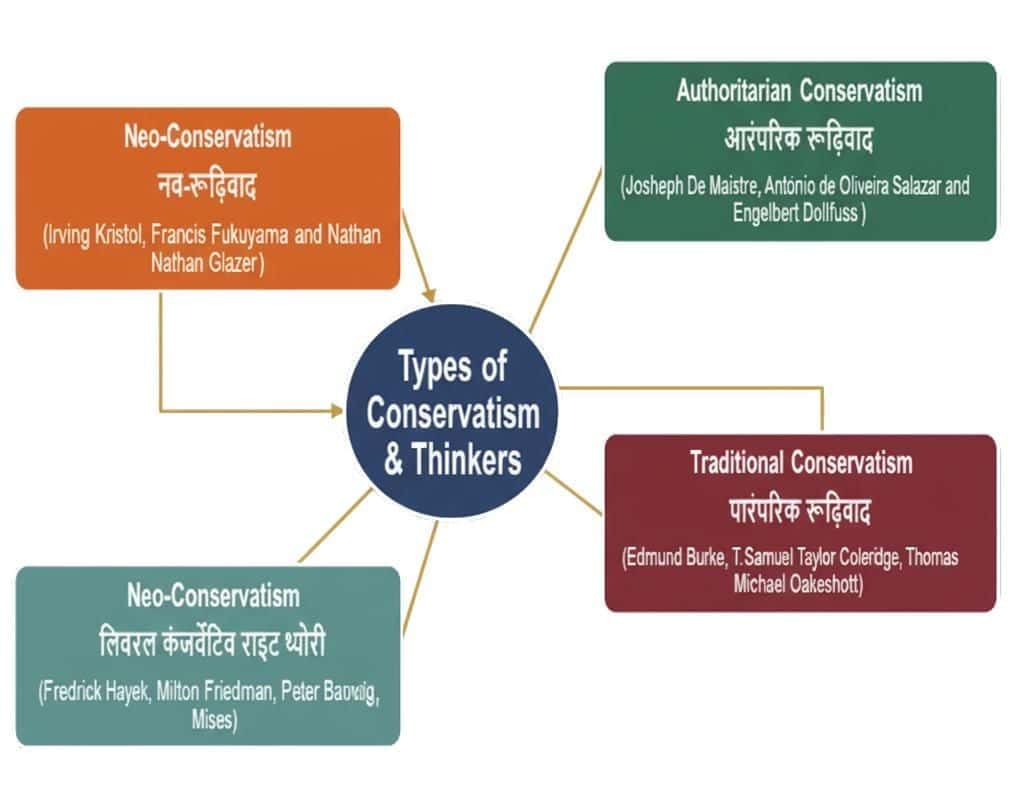
- Authoritarian conservatism aimed to restore absolute power to hereditary monarchy.
- There are a few historical examples associated with authoritarian conservatism.
Tsar Nicholas ruled Russia in the nineteenth century and promoted the principles of "orthodoxy, autocracy and nationality." These principles contrasted with the values that inspired the French Revolution: liberty, equality, and fraternity.
- Traditional conservatism is also called classical conservatism.
- It stresses the importance of transcendent moral principles, customs, conventions, and traditions.
- Traditionalists defend classical Western civilization.
- They are committed to hierarchical and paternalistic values.
- Key proponents include Edmund Burke, T. S. Eliot, Samuel Taylor Coleridge, Thomas Carlyle, and Michael Oakeshott.
Liberal Conservatism & New Right Theory
- Liberal conservatism does not simply become liberalism; it holds that liberal economics can coexist with a traditional conservative social philosophy based on authority and duty.
- A strong state is seen as necessary to maintain public order and to ensure respect for authority.
- Libertarian conservatives favour free-market theories because they believe markets help secure social order.
- The New Right combines classical liberal economics with traditional conservative defence of order, authority, and discipline.
- The New Right emerged in the 1980s and emphasises two main elements: economic neoliberalism and neoconservatism.
- Neoliberalism within the New Right supports minimal government intervention and argues that state management cannot achieve market efficiency.
- New Right governments favour deregulation, competition, and individualism to promote prosperity.
- Neoconservatism seeks to restore moral order and authority in what it sees as an increasingly permissive society.
- The New Right promotes the traditional nuclear family as a source of hierarchy, discipline, and structure, which reduces the need for state intervention in value transmission.
- The main difference between the New Right and classical conservatism is that the New Right is more doctrinal.
- Classical conservatives preferred pragmatic preservation of the status quo and believed that "the wise conservative travels light".
- The New Right, by contrast, holds firm commitments to ideals such as faith in the free market and belief in a minimal state.
Carl Menger is considered by many to be the founder of the Austrian school. He published "Principles of Economics" in 1871. Ludwig von Mises is another major Austrian thinker. Friedrich Hayek is also associated with the Austrian school of thought. Key concepts include marginal utility, methodological individualism, and subjectivism. They support a free-market economy.
The Chicago School of economics originated in the 1930s and was founded by Frank Hyneman Knight. It is a neoclassical school of economic thought. Milton Friedman is the most prominent thinker of the Chicago School. The Chicago School supports free-market economics. Key concepts include the quantity theory of money and regulatory rupture. They reject Keynesian ideas that government management of aggregate demand is necessary for growth.
- Neo-conservatism emerged in the 1970s in the United States and combines political individualism with traditional conservative ideas.
- Neo-conservatives argue that current social crises stem from the declining influence of culture and religion.
- Neo-conservatism began as a response to communism and Stalinism.
- Notable neo-conservative thinkers include Irving Kristol, Francis Fukuyama, and Nathan Glazer.
Key Figures In Conservatism
Burke is associated with a pragmatic willingness to "change in order to conserve". He is regarded as the father of Anglo-American conservatism and a founder of modern conservatism. Burke strongly opposed the French revolutionary idea of "the universal rights of man" and argued that wisdom largely resides in experience, tradition, and history. Some important books by Burke include: A Vindication of Natural Society (1756) Reflections on the Revolution in France (1790)
Hayek defended individualism and market order. In The Road to Serfdom (1944), he defended laissez-faire and criticised government economic intervention as potentially totalitarian. Hayek observed that recent decades had generally trended toward socialism and that conservatives and liberals had mainly tried to slow that movement. His other works include The Constitution of Liberty (1960) and Low, Legislation and Liberty (1979).
Oakeshott described conservative disposition as a preference for the familiar over the unknown, the tried over the untried, and fact over mystery. His best-known works include Rationalism in Politics (1962) and On Human Conduct (1975).
- Kristol moved away from liberalism in the 1970s and criticised welfarism and the counterculture.
- He is often called the "Godfather of Neo-Conservatism".
- Some important books by Kristol include:
- Two Cheers for Capitalism (1978)
- Reflections of a Neo-Conservative (1983)
Famous Quotes Related To Conservatism
- Michael Oakeshott: "To be conservative...is to prefer the familiar to the unknown, to prefer the tried to the untried, fact to mystery, the actual to the possible, the limited to the unbounded, the near to the distant".
- O'Sullivan described conservatism as a "philosophy of human imperfection".
- Burke said, "liberty connected with order; that exists not only along with order and virtue, but which cannot exist at all without them".
- Tsar Nicholas of Russia promoted the phrase "orthodoxy, autocracy and nationality".
- Maistre proclaimed the value of "Throne and altar."
- Hayek said, "Since the development during the last decades has been generally in a socialist direction, it may seem that both conservatives and liberals have been mainly intent on retarding that movement."
- Michael Oakeshott: "Ensure the cure is not worse than the disease."
The document Conservatism is a part of the UGC NET Course Crash Course for UGC NET Political Science.
All you need of UGC NET at this link: UGC NET
FAQs on Conservatism
| 1. What are the key principles of conservatism? |  |
Ans. Conservatism is primarily characterised by a belief in tradition, social stability, and the importance of established institutions. Key principles include a cautious approach to change, an emphasis on moral values, and the idea that society functions best when it is built upon long-standing traditions and social hierarchies. Conservatives often advocate for gradual reform rather than radical change, prioritising continuity and the preservation of cultural norms.
| 2. How does conservatism view human nature? | |
Ans. Conservatism generally holds a rather pessimistic view of human nature, suggesting that individuals are inherently self-interested and prone to irrational behaviour. This perspective leads conservatives to emphasise the need for strong institutions and authority to maintain social order and moral standards. They believe that a structured society can help mitigate the negative aspects of human behaviour by instilling discipline and responsibility.
| 3. What role does tradition play in conservative ideology? | |
Ans. Tradition plays a central role in conservative ideology as it is seen as a repository of wisdom accumulated over generations. Conservatives argue that traditions provide individuals with a sense of identity and belonging, while also serving as a stabilising force in society. By valuing customs and practices that have stood the test of time, conservatives believe they can maintain social cohesion and continuity, which are essential for a healthy society.
| 4. How do conservatives approach economic policies? | |
Ans. Conservatives typically advocate for free-market principles, believing that economic freedom leads to prosperity and individual empowerment. They support limited government intervention in the economy, promoting private enterprise and competition as the best means to create wealth. However, conservatives also recognise the need for a regulatory framework to ensure fairness and protect property rights, often prioritising the interests of businesses and entrepreneurs.
| 5. In what ways has conservatism evolved in recent times? | |
Ans. In recent times, conservatism has evolved to address contemporary social and political challenges, such as globalisation, environmental concerns, and cultural shifts. Some conservatives have embraced a more populist approach, focusing on national sovereignty and the interests of local communities. Additionally, debates within conservative circles regarding social issues, such as immigration and climate change, have led to the emergence of various factions within the broader conservative movement, reflecting a dynamic and adaptable ideology.
About this Document

4.83/5 Rating

Apr 19, 2026 Last updated
Related Exams
Document Description: Conservatism for UGC NET 2026 is part of Crash Course for UGC NET Political Science preparation. The notes and questions for Conservatism have been prepared according to the UGC NET exam syllabus. Information about Conservatism covers topics like and Conservatism Example, for UGC NET 2026 Exam. Find important definitions, questions, notes, meanings, examples, exercises and tests below for Conservatism.
Introduction of Conservatism in English is available as part of our Crash Course for UGC NET Political Science for UGC NET & Conservatism in Hindi for Crash Course for UGC NET Political Science course. Download more important topics related with notes, lectures and mock test series for UGC NET Exam by signing up for free. UGC NET: Conservatism
Description
Conservatism of Crash Course covers all the important topics, helping you prepare for the UGC NET exam on EduRev. Start for free!
Information about Conservatism
In this doc you can find the meaning of Conservatism defined & explained in the simplest way possible. Besides explaining types of Conservatism theory, EduRev gives you an ample number of questions to practice Conservatism tests, examples and also practice UGC NET tests



Related Searches
Objective type Questions, shortcuts and tricks, Exam, pdf , MCQs, past year papers, Conservatism, Viva Questions, mock tests for examination, practice quizzes, Extra Questions, study material, Sample Paper, Semester Notes, Summary, Conservatism, Previous Year Questions with Solutions, Conservatism, Free, video lectures, Important questions, ppt;