NCERT Solutions: Quadrilaterals

Exercise 8.1
Q1. If the diagonals of a parallelogram are equal, then show that it is a rectangle.
Ans: Given: ABCD is a parallelogram in which AC = BD.
To Prove: ABCD is a rectangle.
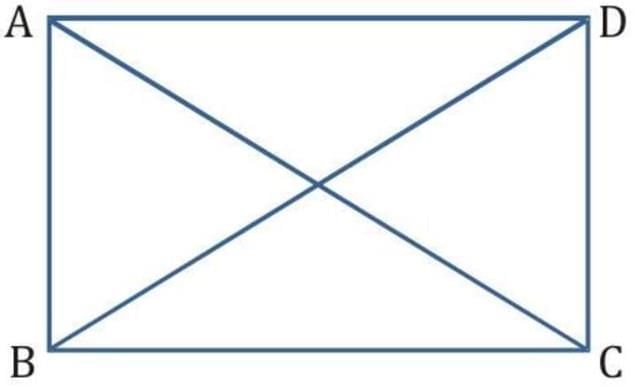
Proof: In ΔABC and ΔABD
AB = AB [Common]
BC = AD [Opposite sides of a parallelogram]
AC = BD [Given]
∴ ΔABC ≅ ΔABD [SSS congruence]
∠ABC = ∠BAD ...(i) [CPCT]
Since, ABCD is a parallelogram, thus,
∠ABC + ∠BAD = 180° ...(ii) [Consecutive interior angles]
∠ABC + ∠ABC = 180°
∴ 2∠ABC = 180°
⇒ ∠ABC = ∠BAD = 90°
This shows that ABCD is a parallelogram one of whose angle is 90°.
Hence, ABCD is a rectangle.
Q2. Show that the diagonals of a square are equal and bisect each other at right angles.
Ans:
Let ABCD is a square
To Prove: AC = BD and AC and BD bisect each other at right angles.
Proof: In ΔABC and ΔABD,
AB = AB (common line)
BC = AD (All sides of square are equal)
∠ABC = ∠BAD = 90° (All angles of square are 90°)
∴ ΔABC ≅ ΔABD (By SAS property)
So, AC = BD (By CPCT)
Hence, diagonals of a square are equal in length.
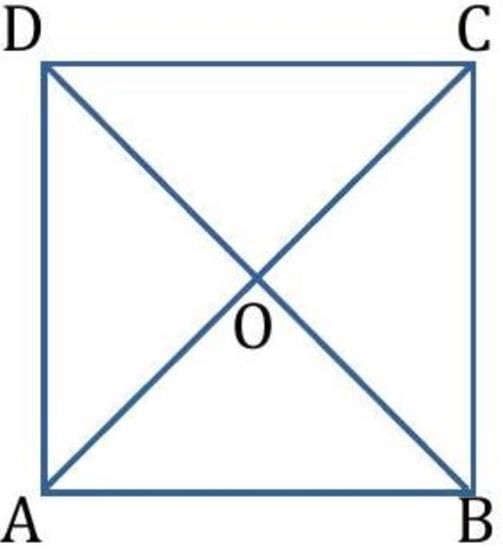
In ΔOAD and ΔOCB,
AD = CB (All sides of square are equal)
∠OAD = ∠OCB (Alternate Angles) {AB || CD and AC is the transversal}
∠ODA = ∠OBC (Alternate Angles) {AD || BC and BD is the transversal}
∴ ΔOAD ≅ ΔOCB (ASA property)
So, OA = OC (By CPCT) ...(i)
Similarly, OB = OD ...(ii)
From (i) and (ii) we can say that AC and BD bisect each other.
Now in ΔAOB and ΔODA,
OB = OD (from (ii))
BA = DA (All sides of square are equal)
OA = OA (common)
∴ ΔAOB ≅ ΔODA [By SSS congruence rule]
∠AOB = ∠AOD ...(iii) (by CPCT)
Now,
∠AOB + ∠AOD = 180° (linear pair)
⇒ 2∠AOB = 180°
⇒ ∠AOB = 90°
∴ AC and BD bisect each other at right angles.
Q3. Diagonal AC of a parallelogram ABCD bisects ∠A (see Fig.). Show that
(i) It is bisecting ∠C also,
(ii) ABCD is a rhombus
Ans: Given: A parallelogram ABCD, in which diagonal AC bisects ∠A, i.e., ∠DAC = ∠BAC.
To Prove:
(i) Diagonal AC bisects ∠C i.e., ∠DCA = ∠BCA
(ii) ABCD is a rhombus.
Proof:
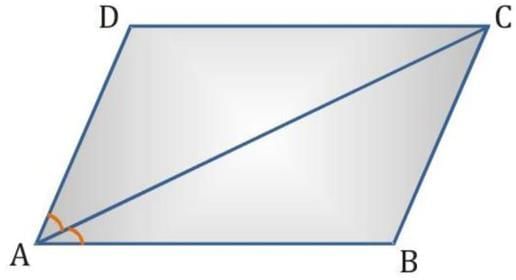
(i) ∠DAC = ∠BCA [Alternate angles]
∠BAC = ∠DCA [Alternate angles]
But, ∠DAC = ∠BAC [Given]
∴ ∠BCA = ∠DCA
Hence, AC bisects ∠DCB Or, AC bisects ∠C. Proved.
(ii) In ΔABC and ΔCDA
AC = AC [Common]
∠BAC = ∠DAC [Given]
And ∠BCA = ∠DAC [Proved above]
∴ ΔABC ≅ ΔADC [ASA congruence]
∴ BC = DC [CPCT]
But AB = DC [Given]
∴ AB = BC = DC = AD
Hence, ABCD is a rhombus. (Proved)
Q4. ABCD is a rectangle in which diagonal AC bisects ∠A as well as ∠C . Show that:
(i) ABCD is a square
(ii) Diagonal BD bisects ∠B as well as ∠D.
Ans:
Given: ABCD is a rectangle, in which diagonal AC bisect ∠A as well as ∠C.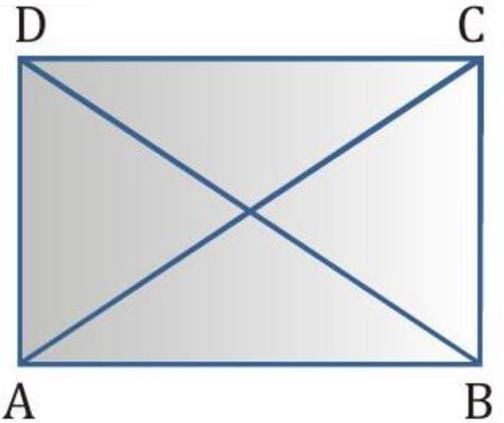
Therefore,
∠DAC = ∠CAB ...(1)
∠DCA = ∠BCA ...(2)
(i) To prove: ABCD is a square
In rectangle ABCD, AD ∥ BC & AC is transversal, therefore
∠DAC = ∠BCA [Alternate angles]
⇒ ∠CAB = ∠BCA ...(3) [∵ ∠DAC = ∠CAB from (1)]
In ΔABC,
∠CAB = ∠BCA ...(4) [from (3)]
BC = AB ...(5) [sides opposite to equal angles]
But BC = AD & AB = DC ...(6) [Opposite sides of rectangle]
Therefore from (5) & (6),
AB = BC = CD = AD
Hence, ABCD is a square.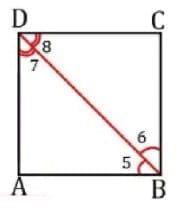 (ii) To prove: Diagonal BD bisects ∠B as well as ∠D
In ABCD, AD ∥ BC & AC is transversal, therefore
∠5 = ∠8 ...(i) [Alternate angles]
In ΔADB,
AB = AD ...(ii) [∵ ABCD is a square (proved above)]
∠7 = ∠5 ...(iii) [Angles opposite to equal sides are equal]
∴ ∠7 = ∠8 ...(iv) [Using (i) and (ii)]
∠7 = ∠6 ...(v) [Alternate angles]
∴ ∠5 = ∠6 ...(vi) [Using (iii) and (v)]
Hence, from (iv) and (v) we can say that diagonal BD bisects angle B as well as D.
Q5. In parallelogram ABCD, two points P and Q are taken on the diagonal BD such that DP = BQ (see the given figure).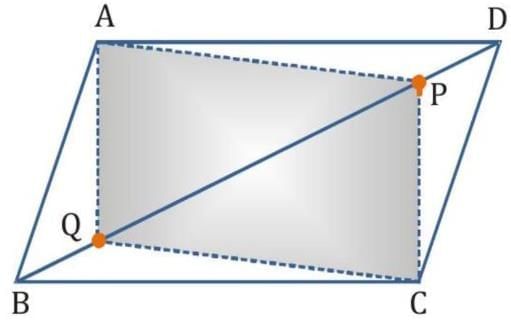 Show that:
(i) ΔAPD ≅ ΔCQB
(ii) AP = CQ
(iii) ΔAQB ≅ ΔCPD
(iv) AQ = CP
(v) APCQ is a Parallelogram
Ans:
Given: ABCD is a parallelogram and P and Q are points on diagonal BD such that
DP = BQ.
To Prove:
(i) ΔAPD ≅ ΔCQB
(ii) AP = CQ
(iii) ΔAQB ≅ ΔCPD
(iv) AQ = CP
(v) APCQ is a parallelogram
Proof:
(i) In ΔAPD and ΔCQB, we have
AD = BC [Opposite sides of a ||gm]
DP = BQ [Given]
∠ADP = ∠CBQ [Alternate angles]
∴ ΔAPD ≅ ΔCQB [SAS congruence]
(ii) ∴ AP = CQ [CPC T]
(iii) In ΔAQB and ΔCPD, we have
AB = CD [Opposite sides of a ||gm]
DP = BQ [Given]
∠ABQ = ∠CDP [Alternate angles]
∴ ΔAQB ≅ ΔCPD [SAS congruence]
(iv) Since ΔAQB ≅ ΔCPD [Proved above]
∴ AQ = CP [CPC T]
(v) Since in APCQ, opposite sides are equal, therefore it is a parallelogram.
Q6. ABCD is a parallelogram and AP and CQ are perpendiculars from vertices A and C on diagonal BD (See the given figure).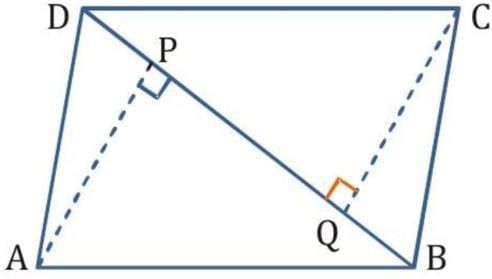 Show that
(i) ΔAPB ≅ ΔCQD
(ii) AP = CQ
Ans:
Given: ABCD is a parallelogram and AP and CQ are perpendiculars from vertices A and C on BD.
To Prove:
(i) ΔAPB ≅ ΔCQD
(ii) AP = CQ
Proof:
(i) In ΔAPB and ΔCQD, we have
∠ABP = ∠CDQ [Alternate angles]
AB = CD [Opposite sides of a parallelogram]
∠APB = ∠CQD [Each = 90°]
∴ ΔAPB ≅ ΔCQD [AAS congruence]
(ii) Since ΔAPB ≅ ΔCQD
So, AP = CQ [CPC T]
Q7. ABCD is a trapezium in which AB || CD and AD = BC (see the given figure).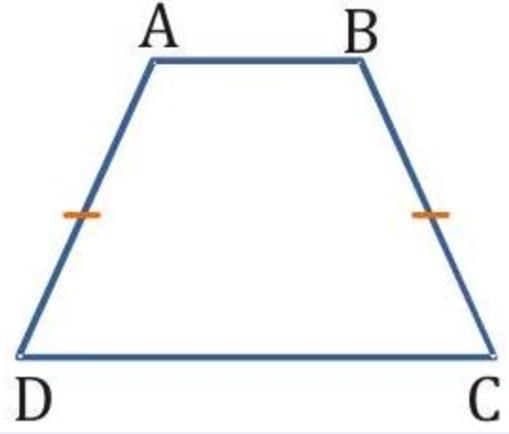 Show that
(i) ∠A = ∠B
(ii) ∠C = ∠D
(iii) ΔABC ≅ ΔBAD
(iv) diagonal AC = diagonal BD
(Hint: Extend AB and draw a line through C parallel to DA intersecting AB produced at E.)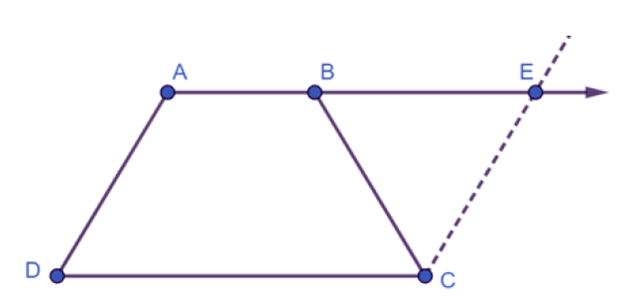 Ans:
Ans:
Given: In trapezium ABCD, AB ∥ CD and AD = BC.
To Prove:
(i) ∠A = ∠B
(ii) ∠C = ∠D
(iii) ΔABC ≅ ΔBAD
(iv) diagonal AC = diagonal BD
Constructions: Join AC and BD. Extend AB and draw a line through C parallel to D meeting AB produced at E.
Proof:
(i) Since AB ∥ DC
⇒ AE ∥ DC ...(i)
and AD ∥ CE ...(ii) [Construction]
∴ ADCE is a parallelogram [Opposite pairs of sides are parallel]
∠A + ∠E = 180° ...(iii) [Consecutive interior angles]
∠B + ∠CBE = 180° ...(iv) [Linear pair]
AD = CE ...(v) [Opposite sides of a ||gm]
AD = BC ...(vi) [Given]
⇒ BC = CE [From (v) and (vi)]
⇒ ∠E = ∠CBE ...(vii) [Angles opposite to equal sides]
∴ ∠B + ∠E = 180° ...(viii)
[From (iv) and (vii)]
Now from (iii) and (viii) we have
∠A + ∠E = ∠B + ∠E
⇒ ∠A = ∠B (Proved)
(ii) ∠A + ∠D = 180°, ∠B + ∠C = 180° [Consecutive interior angles]
⇒ ∠A + ∠D = ∠B + ∠C
[∵ ∠A = ∠B]
⇒ ∠D = ∠C or ∠C = ∠D (Proved)
(iii) In ΔABC and ΔBAD, we have
AD = BC [Given]
∠A = ∠B [Proved]
AB = AB [Common]
∴ ΔABC ≅ ΔBAD [ISAS congruence]
(iv) diagonal AC = diagonal BD [CPCT] Proved.
Exercise 8.2
Q1. ABCD is a quadrilateral in which P, Q, R and S are mid-points of the sides AB, BC, CD and DA (see the given figure). AC is diagonal. Show that:
(i) SR || AC and SR = (1/2) AC
(ii) PQ = SR
(iii) PQRS is a parallelogram.
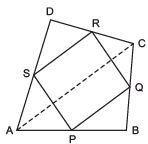
Ans: Given: ABCD is a quadrilateral
To prove: (i) SR || AC and SR = 1/2 AC
(ii) PQ = SR
(iii) PQRS is a parallelogram.
(i) In ΔADC, S and R are the mid-points of sides AD and CD respectively.
In a triangle, the line segment connecting the midpoints of any two sides is parallel to and half of the third side.
∴ SR || AC and SR = 1/2 AC ... (1)
(ii) In ΔABC, P and Q are mid-points of sides AB and BC respectively. Therefore, by using midpoint theorem,
PQ || AC and PQ = 1/2 AC ... (2)
Using Equations (1) and (2), we obtain
PQ || SR and PQ = SR ... (3)
(iii) From Equation (3), we obtained
PQ || SR and PQ = SR
Clearly, one pair of quadrilateral PQRS opposing sides is parallel and equal. PQRS is thus a parallelogram.
Q2. ABCD is a rhombus and P, Q, R and S are the mid-points of the sides AB, BC, CD and DA respectively. Show that the quadrilateral PQRS is a rectangle.
Ans: 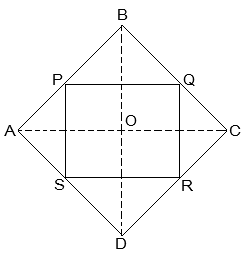
Given: ABCD is a rhombus and P, Q, R and S are the mid-points of the sides AB, BC, CD and DA, respectively.
To Prove: PQRS is a rectangle.
Construction:
Join AC and BD.
Proof:
In ΔDRS and ΔBPQ,
DS = BQ (Halves of the opposite sides of the rhombus)
∠SDR = ∠QBP (Opposite angles of the rhombus)
DR = BP (Halves of the opposite sides of the rhombus)
ΔDRS ≅ ΔBPQ [SAS congruency]
RS = PQ [CPCT]-------- (i)
In ΔQCR and ΔSAP,
RC = PA (Halves of the opposite sides of the rhombus)
∠RCQ = ∠PAS (Opposite angles of the rhombus)
CQ = AS (Halves of the opposite sides of the rhombus)
ΔQCR ≅ ΔSAP [SAS congruency]
RQ = SP [CPCT]-------- (ii)
Now,
In ΔCDB,
R and Q are the mid points of CD and BC, respectively.
⇒ QR || BD
also,
P and S are the mid points of AD and AB, respectively.
⇒ PS || BD
⇒ QR || PS
PQRS is a parallelogram.
also, ∠PQR = 90°
Now,
In PQRS,
RS = PQ and RQ = SP from (i) and (ii)
∠Q = 90°
PQRS is a rectangle.
Q3. ABCD is a rectangle and P, Q, R and S are mid-points of the sides AB, BC, CD and DA respectively. Show that the quadrilateral PQRS is a rhombus.
Ans: 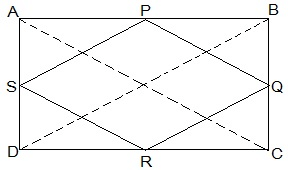 Given: ABCD is a rectangle and P, Q, R and S are mid-points of the sides AB, BC, CD and DA respectively.
To prove: The quadrilateral PQRS is a rhombus.
Proof: Let us join AC and BD.
In ΔABC, P and Q are the mid-points of AB and BC respectively.
∴ PQ || AC and PQ = 1/2 AC (Mid-point theorem) ... (1)
Similarly, in ΔADC , SR || AR, SR = 1/2 AC (Mid-point theorem) ... (2)
Clearly, PQ || SR and PQ = SR
It is a parallelogram because one pair of opposing sides of quadrilateral PQRS is equal and parallel to each other.
∴ PS || QR , PS = QR (Opposite sides of parallelogram) ... (3)
In ΔBCD, Q and R are the mid-points of side BC and CD respectively.
∴ QR || BD, QR = 1/2 BD (Mid-point theorem) ... (4)
Also, the diagonals of a rectangle are equal.
∴ AC = BD ... (5)
By using Equations (1), (2), (3), (4), and (5), we obtain
PQ = QR = SR = PS
So, PQRS is a rhombus
Q4. ABCD is a trapezium in which AB || DC , BD is a diagonal and E is the mid - point of AD. A line is drawn through E parallel to AB intersecting BC at F (see the given figure). Show that F is the mid-point of BC.
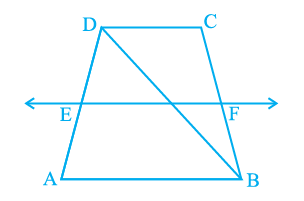
Ans: Given: ABCD is a trapezium in which AB || DC , BD is a diagonal and E is the mid - point of AD. A line is drawn through E parallel to AB intersecting BC at F.
To prove: F is the mid-point of BC.
Proof: Let EF intersect DB at G.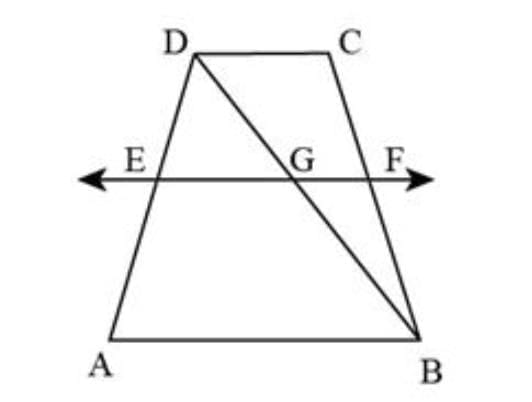 We know that a line traced through the mid-point of any side of a triangle and parallel to another side bisects the third side by the reverse of the mid-point theorem.
In ΔABD, EF || AB and E is the mid-point of AD.
Hence, G will be the mid-point of DB.
As EF || AB, AB || CD,
∴ EF || CD (Two lines parallel to the same line are parallel)
In ΔBCD, GF || CD and G is the mid-point of line BD.
So, by using the converse of mid-point theorem, F is the mid-point of BC.
Q5. In a parallelogram ABCD, E and F are the mid-points of sides AB and CD respectively (see the given figure). Show that the line segments AF and EC trisect the diagonal BD.
Ans: Given: In a parallelogram ABCD, E and F are the mid-points of sides AB and CD respectively to prove: The line segments AF and EC trisect the diagonal BD.
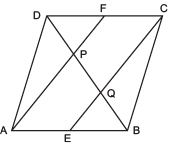
To Prove: The line segments AF and EC trisect the diagonal BD.
Proof: ABCD is a parallelogram.
AB || CD
And hence, AE || FC
Again, AB = CD (Opposite sides of parallelogram ABCD)
1/2 AB = 1/2 CD
AE = FC (E and F are mid-points of side AB and CD)
In quadrilateral AECF, one pair of opposite sides (AE and CF) is parallel and the same as each other. So, AECF is a parallelogram.
∴ AF || EC (Opposite sides of a parallelogram)
In ΔDQC, F is the mid-point of side DC and FP || CQ (since AF || EC, and AF intersects BD at P ).
So, by using the converse of mid-point theorem, it can be said that P is the mid-point of DQ.
∴ DP= PQ ... (1)
Similarly, in ΔAPB , E is the mid-point of side AB and EQ || AP (since AF || EC, and EC intersects BD at Q ).
As a result, the reverse of the mid-point theorem may be used to say that Q is the mid-point of PB.
∴ PQ = QB ... (2)
From Equations (1) and (2),
DP = PQ= BQ
Hence, the line segments AF and EC trisect the diagonal BD.
Q6. ABC is a triangle right angled at C. A line through the mid-point M of hypotenuse AB and parallel to BC intersects AC at D. Show that
(i) D is the mid-point of AC
(ii) MD ⊥ AC
(iii) CM = MA = 1/2 AB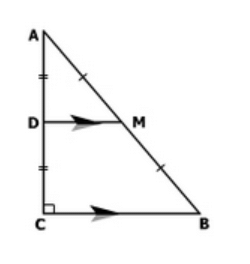 Ans: Given: ABC is a triangle right angled at C. A line through the mid-point M of hypotenuse AB and parallel to BC intersects AC at D.
(i) In ΔABC,
It is given that M is the mid-point of AB and MD || BC.
Therefore, D is the mid-point of AC. (Converse of the mid-point theorem)
(ii) As DM || CB and AC is a transversal line for them, therefore,(Co-interior angles)
(iii) Join MC.
In ΔAMD and ΔCMD,
AD = CD (D is the mid-point of side AC)
∠ADM = ∠CDM (Each)
DM = DM (Common)
∴ ΔAMD ≅ ΔCMD (By SAS congruence rule)
Therefore,
AM = CM (By CPCT)
However,
AM = 1/2 AB (M is mid-point of AB)
Therefore, it is said that CM = AM = 1/2 AB.
FAQs on NCERT Solutions: Quadrilaterals
| 1. What's the difference between a parallelogram and a trapezium in quadrilaterals? |  |
| 2. How do I identify if a quadrilateral is a rhombus or a square? | |
| 3. Why do the diagonals of a rectangle bisect each other but aren't equal in a parallelogram? | |
| 4. What's the angle sum property of quadrilaterals and how do I use it to find missing angles? | |
| 5. How can I prove a quadrilateral is a parallelogram using properties of sides and diagonals? | |