GMAT Exam > GMAT Notes > Quantitative Reasoning > Mind Map: Functions
Mind Map: Functions

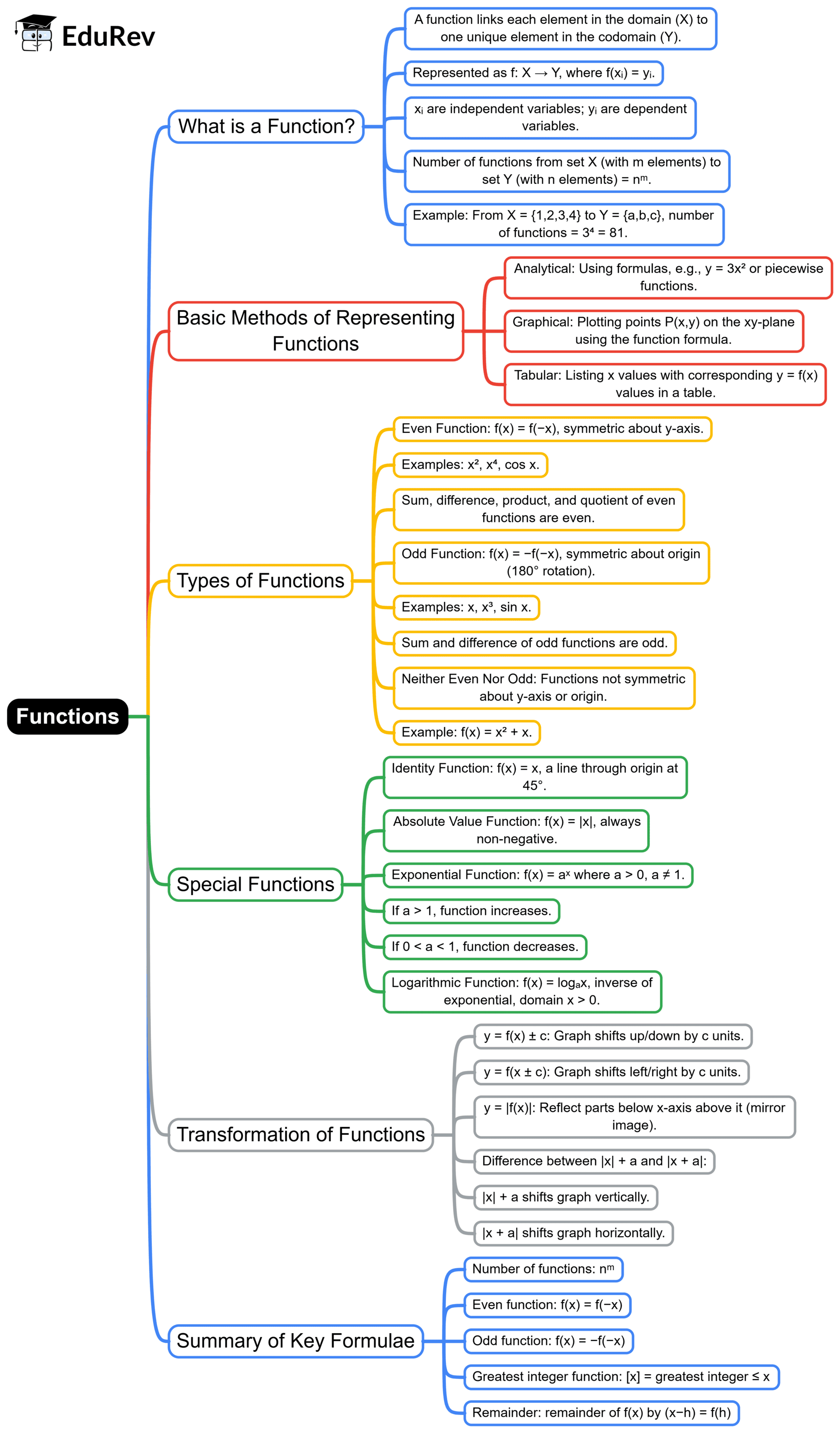
The document Mind Map: Functions is a part of the GMAT Course Quantitative Reasoning for GMAT.
All you need of GMAT at this link: GMAT
FAQs on Mind Map: Functions
| 1. What are the main functions of enzymes in biological systems? |  |
Ans. Enzymes are biological catalysts that speed up chemical reactions in living organisms by lowering the activation energy required for reactions to occur. They are crucial for metabolic processes, including digestion, energy production, and DNA replication. Enzymes are specific to substrates, meaning each enzyme catalyses a particular reaction or type of reaction.
| 2. How do environmental factors affect enzyme activity? | |
Ans. Environmental factors such as temperature, pH, and substrate concentration significantly influence enzyme activity. Each enzyme has an optimal temperature and pH at which it functions best. Deviations from these optimal conditions can lead to decreased activity or denaturation of the enzyme, which alters its structure and function.
| 3. What role do coenzymes play in enzyme function? | |
Ans. Coenzymes are organic non-protein molecules that assist enzymes in catalysing reactions. They often act as carriers for chemical groups or electrons during enzymatic reactions. Coenzymes, such as vitamins, are essential for the proper functioning of many enzymes, enhancing their ability to facilitate biochemical processes.
| 4. Can enzymes be reused after a reaction? | |
Ans. Yes, enzymes can be reused after catalysing a reaction. Once the reaction is complete, enzymes return to their original state and are free to catalyse additional reactions. This characteristic makes enzymes highly efficient, as a single enzyme molecule can act on multiple substrate molecules over time.
| 5. What is the significance of enzyme specificity? | |
Ans. Enzyme specificity refers to the ability of an enzyme to select and catalyse a specific substrate among many potential candidates. This is crucial for maintaining the integrity of metabolic pathways, as it ensures that the correct biochemical reactions occur in a controlled and efficient manner, preventing unwanted side reactions.
About this Document

4.84/5 Rating

Apr 18, 2026 Last updated
Related Exams
Document Description: Mind Map: Functions for GMAT 2026 is part of Quantitative Reasoning for GMAT preparation. The notes and questions for Mind Map: Functions have been prepared according to the GMAT exam syllabus. Information about Mind Map: Functions covers topics like and Mind Map: Functions Example, for GMAT 2026 Exam. Find important definitions, questions, notes, meanings, examples, exercises and tests below for Mind Map: Functions.
Introduction of Mind Map: Functions in English is available as part of our Quantitative Reasoning for GMAT for GMAT & Mind Map: Functions in Hindi for Quantitative Reasoning for GMAT course. Download more important topics related with notes, lectures and mock test series for GMAT Exam by signing up for free. GMAT: Mind Map: Functions
Description
Mind Map: Functions of Quant Reasoning provides you one-page visual summary of the chapter covering all the important topics. Download the PDF from EduRev.
Information about Mind Map: Functions
In this doc you can find the meaning of Mind Map: Functions defined & explained in the simplest way possible. Besides explaining types of Mind Map: Functions theory, EduRev gives you an ample number of questions to practice Mind Map: Functions tests, examples and also practice GMAT tests
Top Courses for GMAT
Related Searches
Mind Map: Functions, Important questions, shortcuts and tricks, study material, Viva Questions, Previous Year Questions with Solutions, ppt, Objective type Questions, past year papers, MCQs, Free, Extra Questions, pdf , Exam, Semester Notes, mock tests for examination, video lectures, Summary, Mind Map: Functions, Sample Paper, Mind Map: Functions, practice quizzes;