Humanities/Arts Exam > Humanities/Arts Notes > History Class 11 > Cheat Sheet: Displacing Indigenous Peoples
Cheat Sheet: Displacing Indigenous Peoples


Overview
Explores European colonization of Americas & Australia (16th-19th centuries), displacement of indigenous peoples, and the ideology of settler colonialism.
- Core Idea: Europeans claimed land was "empty" (terra nullius) → justified takeover.
- Two Regions: North America (USA/Canada) & Australia.
- Impact: Genocide, disease, land loss, cultural erasure of native peoples.
- Legacy: Ongoing struggles for rights, land, identity.
Key Concepts
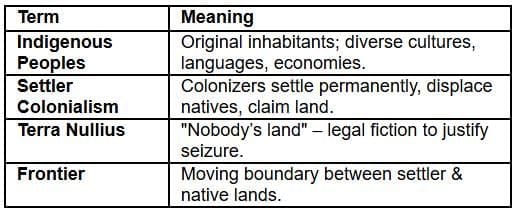
- Europeans saw natives as "uncivilized" → "civilizing mission".
- Used disease, violence, treaties, reservations to displace.
North America: Indigenous Peoples
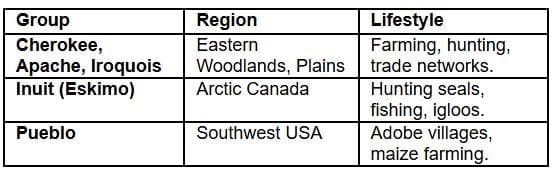
- Population pre-1492: ~10-12 million in North America.
- Complex societies: Cahokia (mound city), Iroquois Confederacy.
- Trade: Turquoise, shells, corn across continents.
European Arrival & Impact
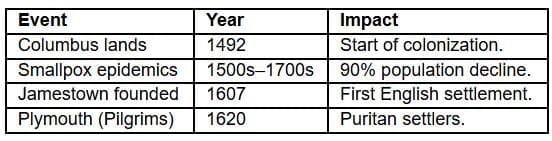
- Disease: Smallpox, measles → no immunity → mass death.
- Land Grab: Natives seen as obstacles to "progress".
- Slavery: Some natives enslaved; later replaced by Africans.
USA: Westward Expansion
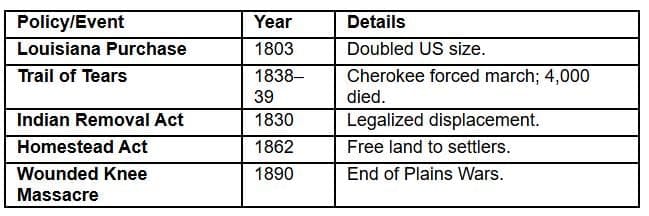
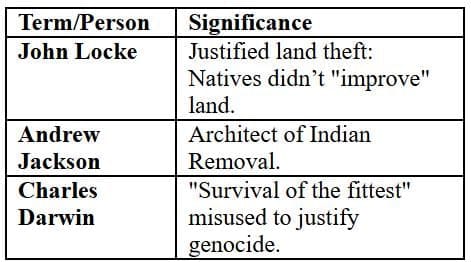
- Manifest Destiny: God-given right to expand coast to coast.
- Reservations: Natives confined to small, poor lands.
- Buffalo Slaughter: US Army killed herds → starved Plains tribes.
Canada: Indigenous Experience
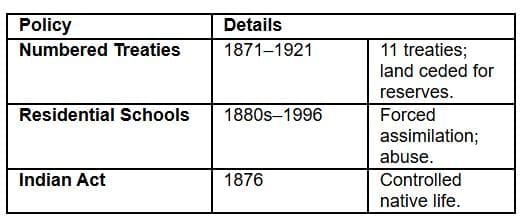
- Métis: Mixed French-Indigenous; Louis Riel rebellion (1885).
- Potlatch Ban: Outlawed native ceremonies.
- Truth & Reconciliation Commission (2015): Called it "cultural genocide".
Australia: Aboriginal Peoples
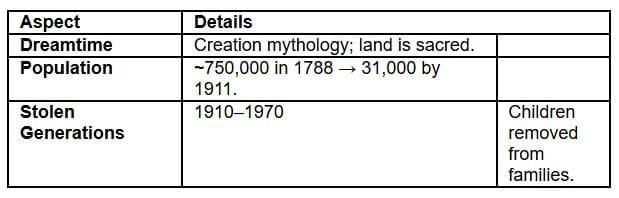
- Terra Nullius: Declared Australia "empty" despite 250+ nations.
- Frontier Wars: Violent clashes 1788-1930s.
- Mabo Case (1992): Overturned terra nullius; native title recognized.
Resistance & Survival
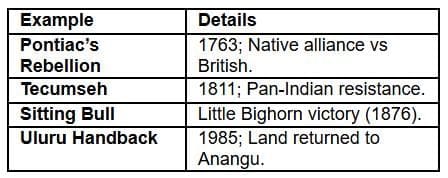
- Legal Wins: US - Indian Citizenship Act (1924); Australia - 1967 Referendum.
- Cultural Revival: Language programs, land claims, art.
- UNDRIP (2007): UN Declaration on Rights of Indigenous Peoples.
Key Terms & Thinkers
Timeline Highlights
- 1492: Columbus → "Discovery".
- 1607: Jamestown.
- 1830: Indian Removal Act.
- 1862: Homestead Act.
- 1887: Dawes Act (broke up reservations).
- 1890: Wounded Knee.
- 1992: Mabo Decision (Australia).
- 2008: Australian Government apology.
The document Cheat Sheet: Displacing Indigenous Peoples is a part of the Humanities/Arts Course History Class 11.
All you need of Humanities/Arts at this link: Humanities/Arts
FAQs on Cheat Sheet: Displacing Indigenous Peoples
| 1. What were the effects of European arrival on Indigenous peoples in North America? |  |
Ans. The arrival of Europeans in North America had profound effects on Indigenous peoples, including the introduction of new diseases that decimated populations, the disruption of traditional ways of life due to land dispossession, and the imposition of foreign governance and economic systems. These changes led to significant cultural, social, and demographic shifts within Indigenous communities.
| 2. How did westward expansion impact Indigenous peoples in the USA? | |
Ans. Westward expansion in the USA resulted in the forced removal of Indigenous peoples from their ancestral lands, often through treaties that were not honoured. This expansion facilitated the settlement of European Americans and led to violent conflicts, loss of traditional hunting grounds, and the destruction of Indigenous cultures and societies.
| 3. What is the significance of Aboriginal peoples in Australia? | |
Ans. Aboriginal peoples are the original inhabitants of Australia, with a rich cultural heritage that includes unique languages, spiritual beliefs, and connections to the land. Their significance lies in their deep understanding of the environment and their ongoing struggle for recognition, rights, and preservation of their cultures amidst colonisation and contemporary challenges.
| 4. What forms of resistance have Indigenous peoples shown against displacement? | |
Ans. Indigenous peoples have shown resistance to displacement through various means, including armed conflict, legal challenges, and peaceful protests. They have also engaged in cultural revitalisation efforts, asserting their rights to land, sovereignty, and self-determination, and raising awareness about their histories and contemporary issues.
| 5. How have recent changes affected the Indigenous experience in Canada? | |
Ans. Recent changes in Canada have included a greater recognition of Indigenous rights and efforts towards reconciliation, such as the implementation of the Truth and Reconciliation Commission's recommendations. However, challenges remain, including ongoing socio-economic disparities, access to resources, and the need for genuine partnerships between Indigenous peoples and the Canadian government.
About this Document

4.86/5 Rating

Apr 20, 2026 Last updated
Related Exams
Document Description: Cheat Sheet: Displacing Indigenous Peoples for Humanities/Arts 2026 is part of History Class 11 preparation. The notes and questions for Cheat Sheet: Displacing Indigenous Peoples have been prepared according to the Humanities/Arts exam syllabus. Information about Cheat Sheet: Displacing Indigenous Peoples covers topics like and Cheat Sheet: Displacing Indigenous Peoples Example, for Humanities/Arts 2026 Exam. Find important definitions, questions, notes, meanings, examples, exercises and tests below for Cheat Sheet: Displacing Indigenous Peoples.
Introduction of Cheat Sheet: Displacing Indigenous Peoples in English is available as part of our History Class 11 for Humanities/Arts & Cheat Sheet: Displacing Indigenous Peoples in Hindi for History Class 11 course. Download more important topics related with notes, lectures and mock test series for Humanities/Arts Exam by signing up for free. Humanities/Arts: Cheat Sheet: Displacing Indigenous Peoples
Description
Cheat Sheet: Displacing Indigenous Peoples of History Class 11 to help you remember important concepts with short tricks. Start learning for Humanities/Arts exam & improve retention with EduRev.
Information about Cheat Sheet: Displacing Indigenous Peoples
In this doc you can find the meaning of Cheat Sheet: Displacing Indigenous Peoples defined & explained in the simplest way possible. Besides explaining types of Cheat Sheet: Displacing Indigenous Peoples theory, EduRev gives you an ample number of questions to practice Cheat Sheet: Displacing Indigenous Peoples tests, examples and also practice Humanities/Arts tests



Related Searches
ppt, Extra Questions, Free, Important questions, practice quizzes, Exam, video lectures, Summary, past year papers, mock tests for examination, Cheat Sheet: Displacing Indigenous Peoples, Viva Questions, Sample Paper, Semester Notes, Previous Year Questions with Solutions, Objective type Questions, Cheat Sheet: Displacing Indigenous Peoples, Cheat Sheet: Displacing Indigenous Peoples, shortcuts and tricks, study material, MCQs, pdf ;