Humanities/Arts Exam  >  Humanities/Arts Notes  >  History Class 11  >  Unit Test: Nomadic Empires

Unit Test: Nomadic Empires

Time: 1 hour

M.M. 35

Attempt all questions.

  • Question numbers 1 to 5 carry 1 mark each .
  • Question numbers 6 to 8 carry 2 marks each.
  • Question numbers 9 to 10 carry 4 marks each.
  • Question numbers 11 and 12 carry 5 marks each
  • Question numbers 13 carry 6 marks

Q.1 The term 'barbarian' is derived from a Greek word meaning: (1 mark)
(a)
Nomad
(b) One who cannot speak Greek
(c) Horse rider
(d) City dweller

Q.2 Who united the Mongol tribes into a political confederation in 1206 CE? (1 mark)
(a) 
Kublai Khan
(b) Ogodei
(c) Genghis Khan
(d) Batu

Q.3 Name the river that marked the northern boundary of the Mongol homeland. (1 mark)

Q.4 What was the basic unit of Mongol military organisation? (1 mark)

Q.5 Which of the following was NOT a feature of nomadic societies? (1 mark)
(a) 
Mobile pastoralism
(b) Large urban centres
(c) Clan-based structure
(d) Horse-based warfare

Q.6 Give two reasons why Genghis Khan's campaigns were successful despite smaller numbers. (2 marks)

Q.7 State any two social features common to Mongol and Turkic tribes. (2 marks)

Q.8 Explain the term yasa in one sentence. Give one example. (2 marks)

Q.9 Describe the Mongol military structure. Give three levels with their sizes and roles. (4 marks)

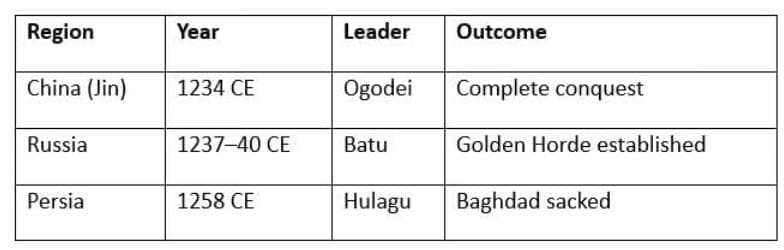
Q.10 Study the data on Mongol conquests:
Unit Test: Nomadic Empires

Analyse three reasons why the Mongols could conquer such diverse regions. (4 marks)

Q.11 You are a Chinese scholar in 1270 CE. Draft a short report (in 5 points) to the Song Emperor advising how to resist Mongol invasion, based on their known tactics. (5 marks)

Q.12 Examine the role of the quriltai and yasa in Genghis Khan's empire. Cover their functions and impact in three points each. (5 marks)

Q.13 "The Mongol Empire was a paradox - nomadic in origin, imperial in structure." Discuss with reference to social background, military system, and administration (two points each). (6 marks)

You can find the solutions of this Unit Test here: Unit Test Solutions: Nomadic Empires

The document Unit Test: Nomadic Empires is a part of the Humanities/Arts Course History Class 11.
All you need of Humanities/Arts at this link: Humanities/Arts

FAQs on Unit Test: Nomadic Empires

1. What are Nomadic Empires?
Ans. Nomadic Empires refer to large political entities formed by groups of people who primarily rely on herding and pastoralism. These empires often expanded through migration and conquest, driven by the need for grazing land and resources, and are characterised by their mobility and adaptability to different environments.
2. How did trade influence the development of Nomadic Empires?
Ans. Trade played a crucial role in the development of Nomadic Empires by facilitating the exchange of goods, ideas, and culture between nomadic groups and settled societies. This interaction often led to economic prosperity and the establishment of trade routes, which not only enriched the nomadic communities but also allowed them to exert influence over more sedentary populations.
3. What are some key characteristics of the social structure in Nomadic Empires?
Ans. The social structure in Nomadic Empires is typically hierarchical, often centred around tribal or clan affiliations. Leaders, usually referred to as chieftains or khans, hold significant authority, while a warrior class may emerge to protect the community and expand its territory. Gender roles can vary, with some societies allowing women to partake in decision-making and economic activities.
4. What role did warfare play in the expansion of Nomadic Empires?
Ans. Warfare was a fundamental aspect of the expansion of Nomadic Empires, as it enabled these groups to acquire new territories and resources. Skilled horsemen and archers gave nomadic armies a tactical advantage, allowing them to conduct swift raids and conquests. Conflicts often arose over grazing land, trade routes, and political dominance, shaping the geopolitical landscape of the regions they inhabited.
5. How did the cultural exchanges shape the legacy of Nomadic Empires?
Ans. Cultural exchanges significantly shaped the legacy of Nomadic Empires by blending traditions, languages, and practices with those of sedentary societies. These interactions led to advancements in art, technology, and governance, contributing to a rich cultural heritage. Many modern nations still reflect the influences of these nomadic groups, highlighting their enduring impact on world history.
Explore Courses for Humanities/Arts exam
Get EduRev Notes directly in your Google search
Related Searches
Important questions, Unit Test: Nomadic Empires, Viva Questions, past year papers, Unit Test: Nomadic Empires, Semester Notes, Objective type Questions, Exam, study material, ppt, pdf , video lectures, mock tests for examination, Free, MCQs, practice quizzes, Summary, Sample Paper, shortcuts and tricks, Unit Test: Nomadic Empires, Previous Year Questions with Solutions, Extra Questions;